2VisitUs is a mobile application combining a business directory with marketing tools, aimed at the South African tourism sector. The deck outlines a specific partnership proposal for SAHRA (South African Heritage Resources Agency), leveraging the BNI Global Network for expansion. The business model relies on a high-touch sales approach, with a 'minimum goal' of 3 sales per agent per day across major South African hubs like Johannesburg and Cape Town. While the deck provides an unusually granular breakdown of Year 2 expenses—down to the cost of individual Mac laptops and monthly car hire—it la…
Key takeaways
- The platform positions itself as the only mobile business directory with a fully integrated marketing tool (Slide 4).
- The expansion strategy is built on a specific agent-to-sale ratio, targeting 3 sales per agent per day across seven South African regions (Slide 5).
- Financial modeling for Year 2 projects a total profit of R8,192,476, with income reaching R1,980,000 per month by Month 5 (Slide 6).
- The investment request is structured as a monthly cash flow requirement, peaking at R3,000,000 in February (Slide 7).
- Capital expenditure is highly specific, detailing the purchase of 6 computers at R25,000 each and 15 tablets at R9,000 each (Slide 8).
- Operational logistics include a detailed travel budget of R121,800 per year, covering flights, car hire, and hotels in Durban and Cape Town (Slide 9).
- The deck highlights a strategic advantage through access to the BNI Global Network team for rapid project launching (Slide 2).
- A 'free first 12 month social media visibility' offer is used as a primary user acquisition incentive (Slide 4).
Executive Summary and Strategic Positioning
The 2VisitUs pitch deck, titled 'SAHRA Investment Proposal,' is a targeted document designed to secure funding and partnership within the South African tourism and heritage sector. The company identifies as a 'Business Directory, Marketing and Tourism App,' aiming to bridge the gap between local businesses and visiting tourists. A notable branding element on the cover slide is the 'Proud BNI Member' logo, suggesting the company relies heavily on the Business Network International framework for its professional credibility and networking reach.
Slide 1: Title and Branding
The cover slide introduces 2VisitUs as a 'Business Directory, Marketing and Tourism App.' It explicitly states this is a 'SAHRA Investment Proposal,' indicating the deck was likely customized for the South African Heritage Resources Agency. The visual design features mobile OS icons (Android and Apple) and the BNI membership seal, establishing the platform's cross-platform availability and its roots in professional networking circles.
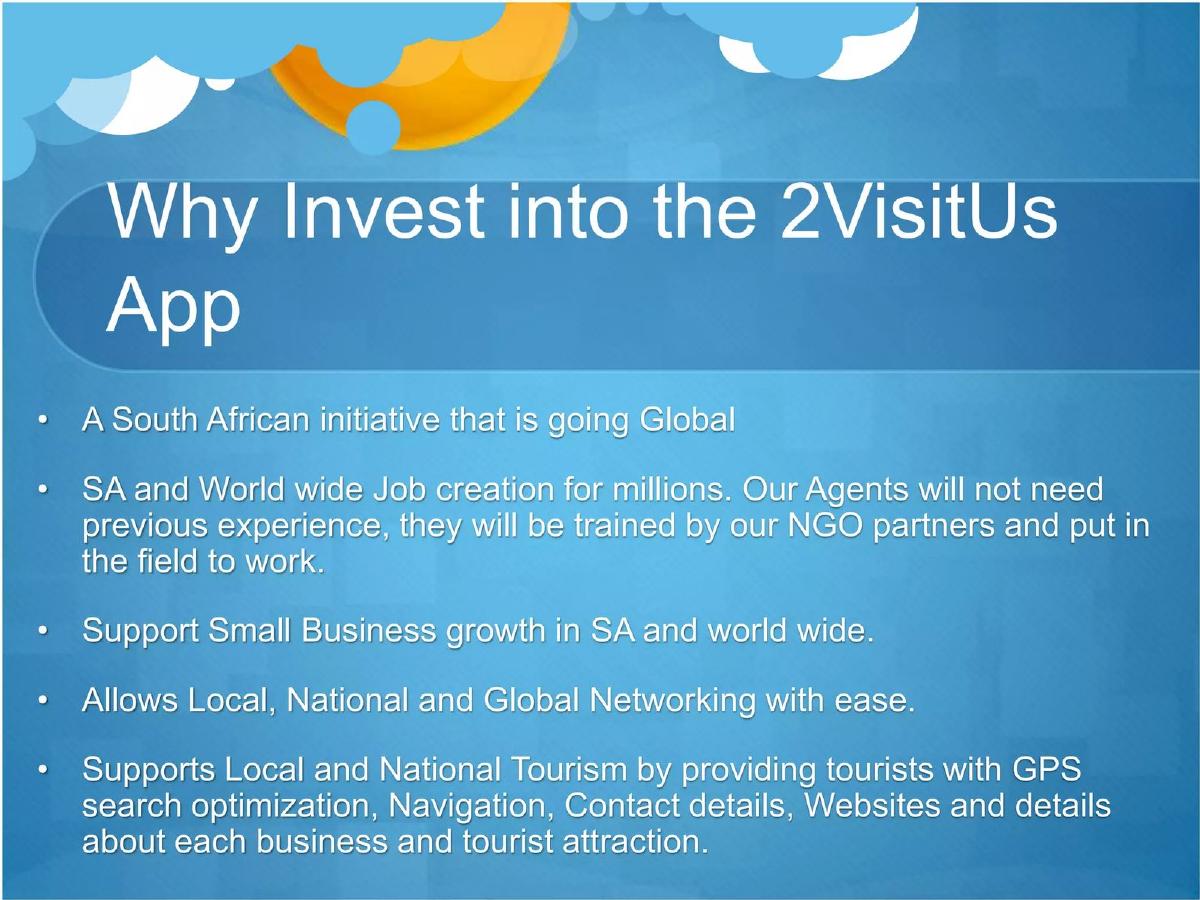
Slide 2: Specific Advantages for SAHRA
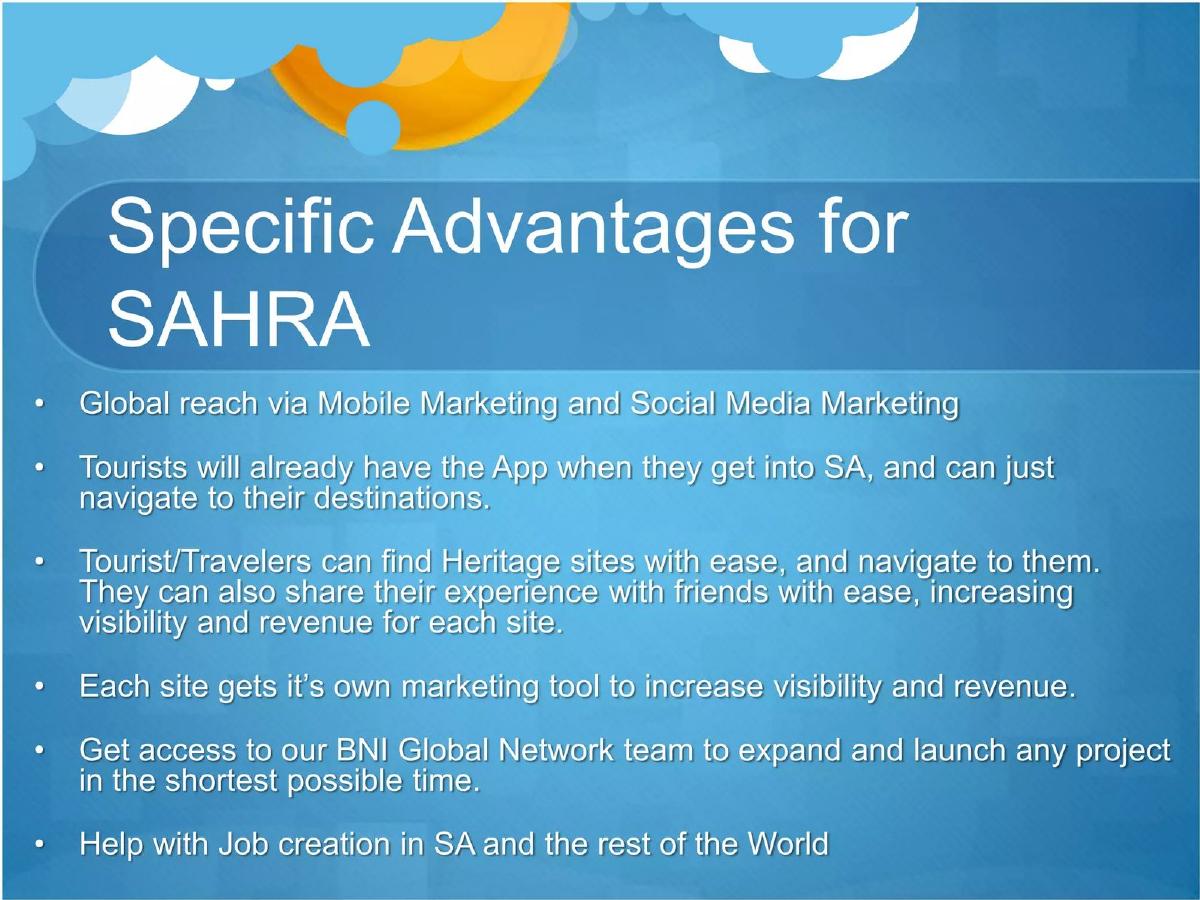
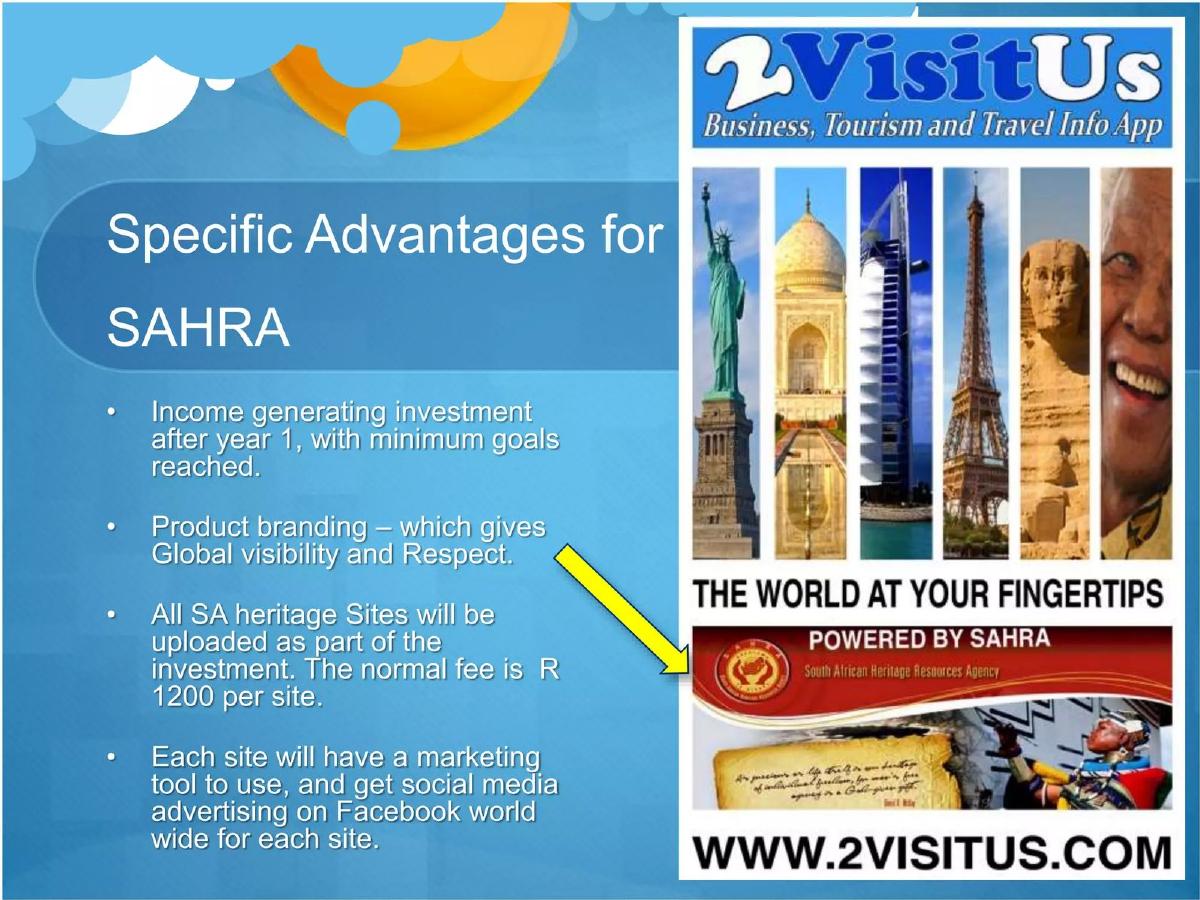
This slide outlines the value proposition for a heritage-focused partner. Key points include global reach via mobile and social media marketing, and the ability for tourists to navigate to destinations directly through the app. It claims that 'Tourists will already have the App when they get into SA,' though it does not provide data to support this pre-arrival adoption rate. Crucially, it mentions access to the 'BNI Global Network team' to accelerate project launches and emphasizes job creation within South Africa.
Slide 3: Business Directory Scope
Slide 3 is a minimalist transition or high-level summary slide. It focuses on 'Increased Visibility' across three tiers: Locally, Nationally, and Globally. This suggests a tiered marketing strategy where businesses listed on the directory can scale their reach depending on their subscription or engagement level within the app.
Slide 4: Unique Features
The company lists five core features that distinguish it from competitors. It claims to be the 'only Mobile Business Directory with full integrated marketing tool.' To incentivize sign-ups, it offers 'Free first 12 month social media visibility.' Technical features include an 'Own Admin panel' for businesses to manage their own specials and events, an 'all-in-one' app concept, and a standardized interface featuring '8 information and contact buttons' for every listing.
Slide 5: 12-Month Sales Goals
This slide provides a tactical look at the company's go-to-market strategy in South Africa. The growth is predicated on a '3 sales per agent per day' metric. The regional breakdown is specific: Pretoria (1,584 sales, 2 agents), Johannesburg (3,168 sales, 4 agents), Cape Town (3,168 sales, 4 agents), Durban (1,584 sales, 2 agents), and single agents for Bloemfontein, Nelspruit, and Travel Agents. This indicates a high-touch, human-centric sales model rather than a purely digital acquisition strategy.
Slide 6: Detailed Income and Expenses (Year 2)
This is the most data-dense slide in the deck, providing a month-by-month breakdown for the second year of operation. Total Income is projected at R19,932,000, with Total Expenses at R11,739,524. The table includes specific line items such as 'Management' (R100,000/month), 'Sales agents' (peaking at R751,449/month), and 'Advertising' (R100,000/month). The slide also calculates 'Income per 1% share' at R81,924.76, providing a direct valuation hint for potential investors.
Slide 7: Monthly Investment Requirements
Rather than asking for a lump sum, slide 7 breaks down the required investment by month: December (R630,000), January (R2,000,000), February (R3,000,000), and March (R1,595,800). This suggests a phased rollout or a specific ramp-up period where capital needs fluctuate significantly before the business reaches the steady-state projected in the Year 2 financials.
Slide 8: Capital Expenditure Detail - Office Equipment
The deck provides an unusual level of detail regarding equipment purchases. It specifies a need for R294,000 to cover 6 computers (R25,000 each) and 15 tablets (R9,000 each). A note at the bottom states, 'This will all be Mac Laptops to make sure all work is 100% the same,' indicating a focus on hardware standardization for the creative or sales team.
Slide 9: Operational Expenditure Detail - Travel
Continuing the theme of granular budgeting, slide 9 breaks down annual travel expenses of R121,800. This includes flights to Durban and Cape Town (R48,000), car hire (R31,200), hotels (R6,600), and general travel for the Pretoria/Johannesburg/Bloemfontein corridor (R36,000). This level of detail is intended to show fiscal responsibility and a clear understanding of the costs associated with a national rollout.
Slide 10: Contact Information
The final slide lists Aldo Cilliers as the Managing Director. It provides a mobile number, email, and links to the company's digital presence. The inclusion of a YouTube channel suggests a focus on video marketing or tutorials for the app's features.
What 2VisitUs Does Well
The 2VisitUs deck excels at operational transparency. By providing a line-by-line breakdown of Year 2 expenses and specific capital requirements (Slide 6, 8, and 9), the founders demonstrate that they have thought through the logistical realities of running a multi-city sales operation in South Africa. The focus on a '3 sales per agent per day' goal (Slide 5) gives investors a clear KPI to track the success of the sales team. Furthermore, the strategic alignment with SAHRA and the BNI network provides a built-in ecosystem for growth, which is often more valuable than capital alone in the early stages of a directory-based business.
Omissions and Weaknesses
Despite the financial granularity, the deck has several significant omissions. There is no 'Problem' slide defining why current tourism directories are failing or what specific pain point 2VisitUs solves for the traveler. There is also a lack of a 'Team' slide; while the Managing Director is named, the backgrounds of the developers, marketing leads, or the 'BNI Global Network team' are not detailed. The deck also fails to address the competitive landscape—established players like TripAdvisor or local South African tourism boards are not mentioned. Finally, the 'Ask' is presented as a series of monthly requirements (Slide 7) without specifying what total percentage of equity is being offered in exchange for the capital, or what the long-term exit strategy looks like for an investor.
Founder's Playbook: Lessons from 2VisitUs
Founders can learn from the way 2VisitUs handles regional scaling. Instead of a vague 'national rollout' plan, they assigned specific agent counts to specific cities based on projected sales volumes (Slide 5). This makes the business plan feel grounded and actionable. Additionally, the use of a 'Detail about Investment Required' slide (Slide 8 and 9) is a strong tactic for seed-stage companies. It removes the mystery of where the money goes, showing that the funds are allocated to tangible assets like hardware and travel rather than just 'general operations.' However, founders should ensure they balance this bottom-up budgeting with a top-down vision that clearly articulates the market opportunity and the competitive advantage of the technology itself.
Frequently asked questions
- What is the primary value proposition of 2VisitUs?
- 2VisitUs positions itself as a 'Business Directory, Marketing and Tourism App.' Its unique selling point, according to slide 4, is being the only mobile business directory with a fully integrated marketing tool. It offers businesses an admin panel to upload specials and events, alongside 12 months of free social media visibility to drive initial adoption.
- How does the company plan to scale its sales in South Africa?
- The company utilizes a regional agent model. Slide 5 details a 'Minimum Goal' of 3 sales per agent per day. The plan allocates specific agent counts to regions: 4 agents each for Johannesburg and Cape Town, 2 each for Pretoria and Durban, and 1 each for Bloemfontein, Nelspruit, and travel agencies.
- What are the projected financials for the second year of operation?
- According to the Year 2 income/expense table on slide 6, 2VisitUs expects to generate R19,932,000 in total income against R11,739,524 in total expenses. This results in a projected annual profit of R8,192,476. The model assumes income will stabilize at R1,980,000 per month starting in Month 5.
- What specific assets is the investment funding intended to cover?
- The deck provides a granular breakdown of capital needs. Slide 8 specifies R294,000 for office equipment, including 6 Mac laptops (R150,000) and 15 tablets (R144,000). Slide 9 outlines travel costs totaling R121,800 annually, covering flights, car rentals, and hotel stays for regional operations.
- Who is the primary contact for this investment proposal?
- The proposal is led by Managing Director Aldo Cilliers. Slide 10 provides his direct contact information, including a mobile number, a company email address (@2visitus.co.za), and links to the company's website, Facebook, and YouTube channels.