Market Validation Slide: 6 Real Pitch Deck Examples
What belongs on a market validation slide: proof that people already want what you sell, not market-size statistics.
Market Validation Slide: Proof of Demand, Not Market Size
Many decks have a slide titled "Market Validation", but they use the title for very different evidence: the company's own customers, behaviour on existing services, rival products, acquisitions, or general statistics. The six real slides below show which kinds actually tell an investor that demand exists for this product.
TL;DR
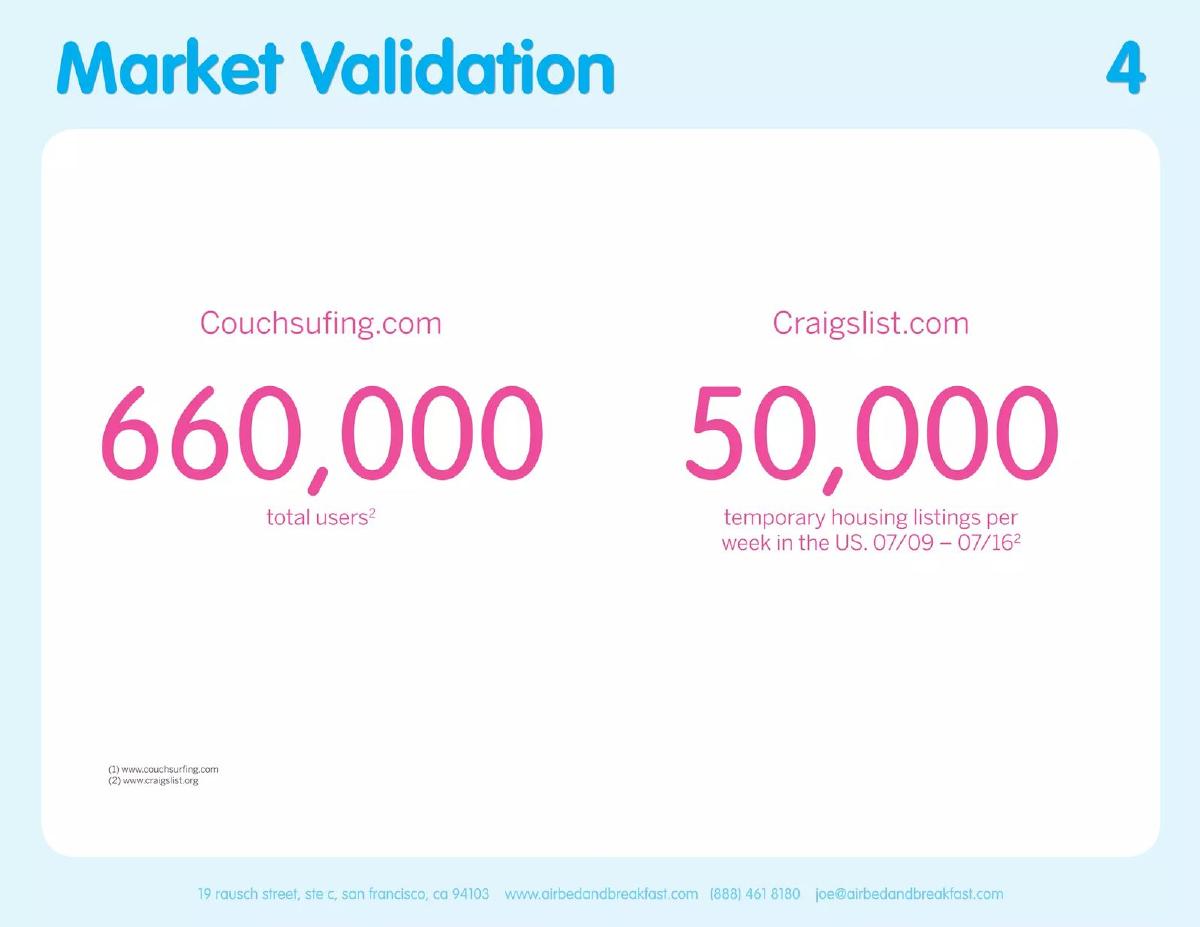
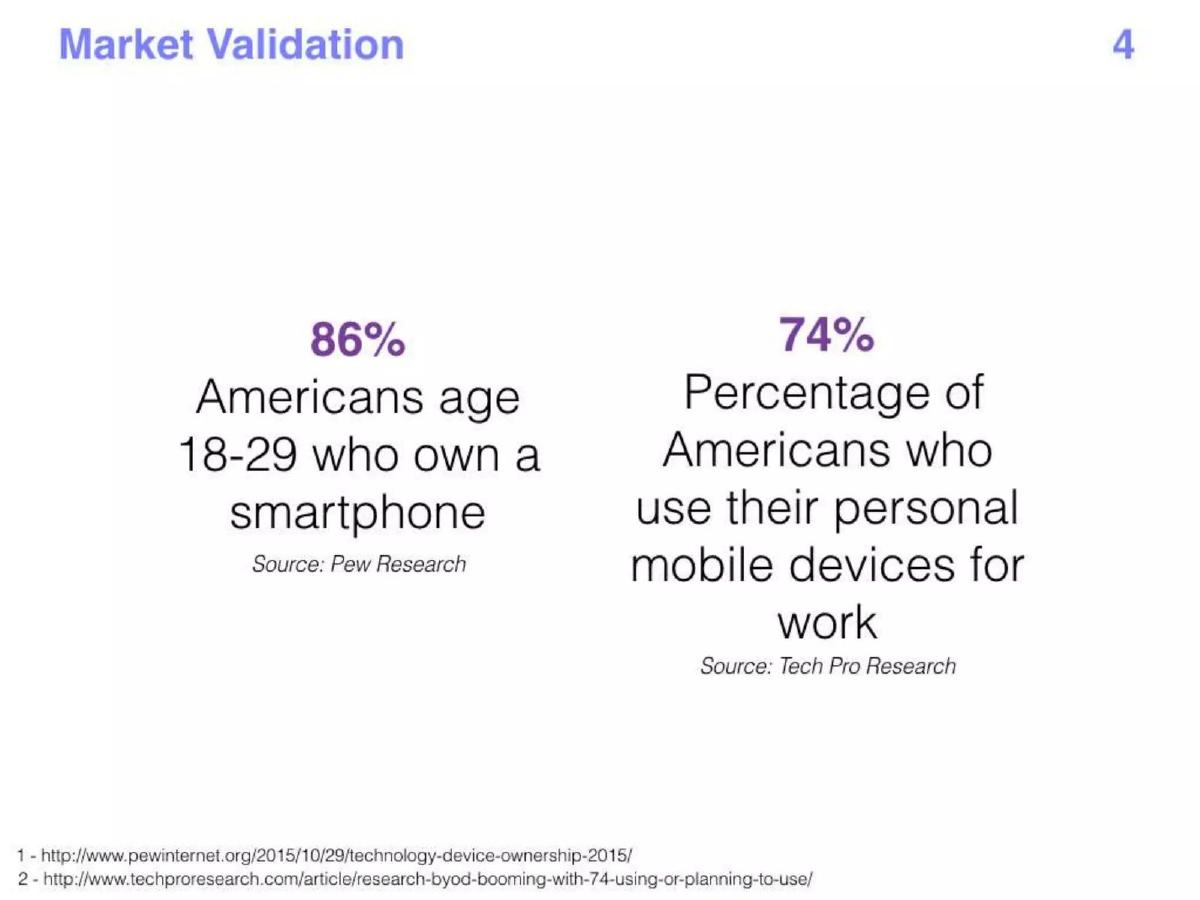
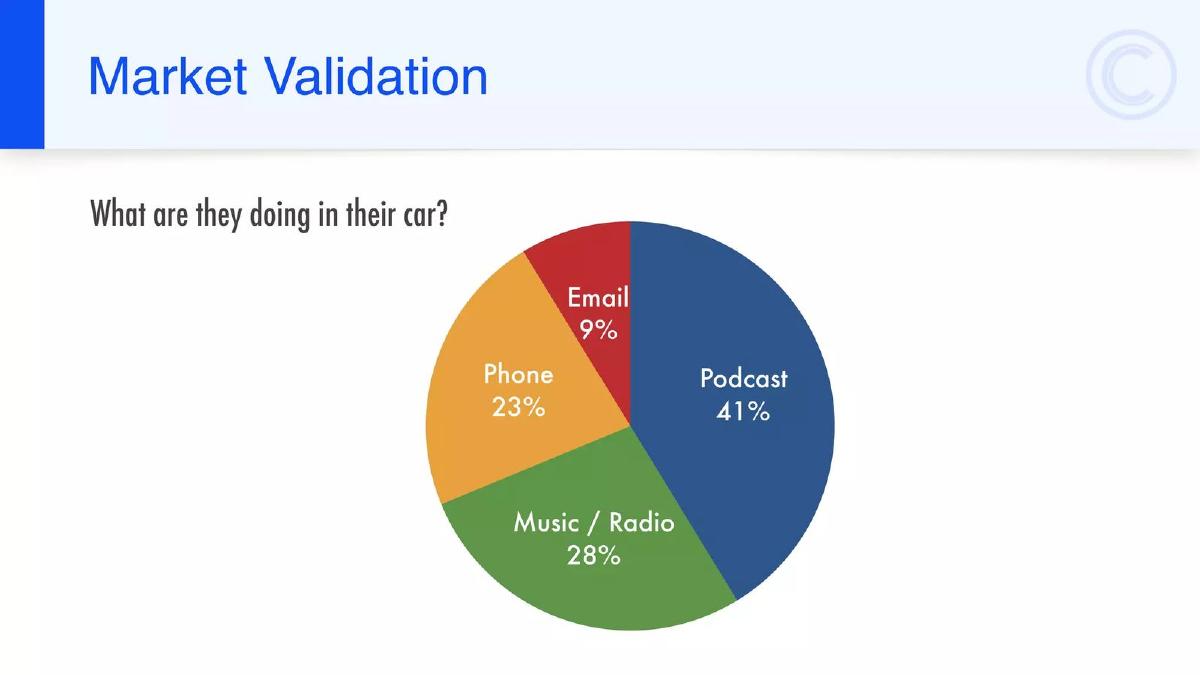
A market validation slide should show that people already spend time or money on the job your product does, ideally with your own customers. JVSP lists named organisations and how many of their people use its training. Airbnb's early deck counts 660,000 Couchsurfing users and 50,000 weekly Craigslist housing listings: behaviour that the product would serve better. FTF points to two proven products (eToro, Wealthfront) that it combines, and GameOnBiz cites acquisitions in its category; both show that the category is real but not that customers want this company. Grapevine uses sourced smartphone statistics, which are context rather than validation. Commute Call shows an unsourced pie chart. Lead with your own evidence, then behaviour on substitutes, and label everything else as market context.
Market validation slides from real pitch decks
Each example shows the exact stored slide above its analysis and links to the full teardown. Figures are as shown on the slides; we have not verified them. Stage and year are given only where the slide or deck states them.
JVSP market slide — slide 6
Corporate learning platform, apparently based in Spain. Stage and year are not stated on the slide.
JVSP deck, slide 6. Exact stored slide matched to this analysis.
Our analysis: This is the company's own evidence: named organisations, a user count and the use case for each.
Evidence and limitation: User counts are not revenue, and the range (30 to 10,000) mixes pilots with large deployments. Say which are paid and which have renewed.
What a founder can adapt: List named customers with a number and what they use you for.
Supporting analysis
What the deck claims: "Market Validation" with ten customer logos and a line each, for example: P&G "Beginning with 700 users in Europe, Digital transformation learning program"; Acciona "10,000 users, Sustainability training"; Veolia "2,000 users. LATAM onboarding for new employees"; Cecabank "More than 5,000 users. Compliance MiFID II"; Nestlé "30 users. Sales academy". A footer notes selection for Google for Entrepreneurs.
Presentation choice: This is the company's own evidence: named organisations, a user count and the use case for each.
When it does not fit: User counts are not revenue, and the range (30 to 10,000) mixes pilots with large deployments. Say which are paid and which have renewed.
Airbnb deck, slide 4. Exact stored slide matched to this analysis.
Our analysis: Before it had traction of its own, Airbnb showed that large numbers of people were already doing the thing its product makes easier, on sites that did it badly.
Evidence and limitation: It proves demand for cheap stays with strangers, not that those users will pay Airbnb. Once you have your own bookings, they replace this slide.
What a founder can adapt: Count people already using a substitute for your job, with the source and date.
Supporting analysis
What the deck claims: "Market Validation": "Couchsufing.com 660,000 total users" and "Craigslist.com 50,000 temporary housing listings per week in the US. 07/09 – 07/16". Footnotes give both websites as sources.
Presentation choice: Before it had traction of its own, Airbnb showed that large numbers of people were already doing the thing its product makes easier, on sites that did it badly.
When it does not fit: It proves demand for cheap stays with strangers, not that those users will pay Airbnb. Once you have your own bookings, they replace this slide.
Social trading and wealth management product. Stage and year are not stated on the slide.
FTF deck, slide 5. Exact stored slide matched to this analysis.
Our analysis: It turns two companies' results into the two behaviours its product depends on, which is a clear way to structure the argument.
Evidence and limitation: The figures carry no source or date, and proving each half separately does not show demand for the combination. Add any evidence from your own users.
What a founder can adapt: Name the one or two behaviours your product needs, and show a company that already proved each.
Supporting analysis
What the deck claims: "Market Validation — We combine two successful products into one great product." eToro: "Peer to Peer Trading 3 million users, 128 million copied trades, $400 billion in nominal value traded." Wealthfront: "Online Wealth Management $1 billion under management, 60% growth in last quarter." Two questions, each answered "YES": "Individuals trust the stock trading ideas of their peers?" and "Individuals make investments into funds using online portals?"
Presentation choice: It turns two companies' results into the two behaviours its product depends on, which is a clear way to structure the argument.
When it does not fit: The figures carry no source or date, and proving each half separately does not show demand for the combination. Add any evidence from your own users.
Workplace gamification software. Stage and year are not stated on the slide.
GameOnBiz deck, slide 5. Exact stored slide matched to this analysis.
Our analysis: Named acquisitions show that large software companies pay for this category.
Evidence and limitation: Acquisitions, a quote and an analyst prediction are all about the category. None shows a customer wanting GameOnBiz, and SuccessFactors was an HR suite rather than a gamification company.
What a founder can adapt: If you cite acquisitions, say how the acquired company is like yours.
Supporting analysis
What the deck claims: "Market validation": "SAP acquired SuccessFactors for $3.4 billion. Salesforce bought Rypple.com for $65M." A quote, "Every Startup CEO Should Understand Gamification" – Bing Gordon, and "Gartner Group predicts gamification will be a key trend that every CIO, IT planner and enterprise architect must be aware of as it relates to business."
Presentation choice: Named acquisitions show that large software companies pay for this category.
When it does not fit: Acquisitions, a quote and an analyst prediction are all about the category. None shows a customer wanting GameOnBiz, and SuccessFactors was an HR suite rather than a gamification company.
Workplace communication app, with restaurants as the first use case. Stage and year are not stated on the slide.
Grapevine deck, slide 4. Exact stored slide matched to this analysis.
Our analysis: Each figure has a named source and a link, so an investor can check it.
Evidence and limitation: Smartphone ownership shows the app is possible, not wanted. The deck's next slide, on restaurants, is closer to validation; lead with evidence from restaurant staff or managers.
What a founder can adapt: Treat this as a slide to improve on. Keep the sources; move the figures to a market context slide.
Supporting analysis
What the deck claims: "Market Validation": "86% Americans age 18-29 who own a smartphone" (Source: Pew Research) and "74% Percentage of Americans who use their personal mobile devices for work" (Source: Tech Pro Research). Footnotes give both URLs, including a 2015 Pew article.
Presentation choice: Each figure has a named source and a link, so an investor can check it.
When it does not fit: Smartphone ownership shows the app is possible, not wanted. The deck's next slide, on restaurants, is closer to validation; lead with evidence from restaurant staff or managers.
Product for people commuting by car. Stage and year are not stated on the slide.
Commute Call deck, slide 5. Exact stored slide matched to this analysis.
Our analysis: Asking what the target customer does today in the moment your product serves is the right question.
Evidence and limitation: There is no source, sample size or date, so an investor can't tell whether this is a survey of 20 people or national data. Add who was asked, how many and when.
What a founder can adapt: Treat this as a slide to improve on. Keep the question.
Supporting analysis
What the deck claims: "Market Validation — What are they doing in their car?" A pie chart: Podcast 41%, Music / Radio 28%, Phone 23%, Email 9%.
Presentation choice: Asking what the target customer does today in the moment your product serves is the right question.
When it does not fit: There is no source, sample size or date, so an investor can't tell whether this is a survey of 20 people or national data. Add who was asked, how many and when.
Evidence higher on this list tells an investor more about demand for your product.
Example
Evidence type
About this company?
Source shown
JVSP
Own named customers
Yes
Not needed
Airbnb
Behaviour on substitutes
No (the need)
Yes
FTF
Comparable products
No (the behaviours)
No
GameOnBiz
Acquisitions, analyst view
No (the category)
Partly
Grapevine
General statistics
No
Yes, links
Commute Call
Behaviour chart
Unclear
No
Key Takeaways
Own customers beat everything. JVSP names organisations and user counts.
Behaviour on substitutes is the next best thing. Airbnb counts people already using Couchsurfing and Craigslist for the same need.
Comparable products and acquisitions show the category is real, not that you will win it.
General statistics are market context. Label them that way, with sources, as Grapevine does.
Every number needs a source and a date. Commute Call's pie chart has neither.
Build your market validation slide
Use the strongest evidence you have and label the rest.
Own evidence. Which named customers, pilots or paying users do you have, and how many?
Substitutes. Where do people already spend time or money on this job today? How many, per which source?
Behaviours. Which behaviours does your product depend on, and who has already proved each?
Context. Which general statistics remain? Label them as market context with source and year.
Copyable framework: Demand exists: [N] [users/customers] of ours, including [named customer, use]. People already [behaviour] on [substitute]: [figure] ([source, date]). Context: [statistic] ([source, year]).
Illustrative example 1 — written by us
Before: Market Validation: 86% of young adults own a smartphone.
After: Market Validation: 12 restaurants use us weekly (3 paying); managers were previously running shifts over group texts with 40+ staff. Context: 86% of 18–29s own a smartphone (Pew, 2015).
What improved: Our illustrative rewrite, not any company's text; the figures are invented for the example. It leads with own customers and the behaviour replaced, and labels the statistic as context.
Validation versus market size
The market size slide answers "how big could this be?" A validation slide answers "is there evidence people want this?" Several decks in our library title a market size slide "Market Validation"; those slides are analysed in the market size guides, not here.
The evidence below is ordered from strongest to weakest: your own customers, behaviour on existing substitutes, comparable products, acquisitions in the category, and general statistics.
Common mistakes
Market size titled as validation. Totals show size, not demand for you.
Category proof only. Acquisitions and rivals show the category exists, not that you will win.
Unsourced charts. State who, how many and when.
Ignoring your own evidence. Even small pilots beat general statistics.
Diagnostic checklist
The slide leads with your own customers or users, if you have any.
Behaviour on substitutes is counted with a source and date.
Comparable products are linked to the specific behaviour they prove.
General statistics are labelled as context.
Every figure has a source and date.
Frequently asked questions
How we chose these examples
Corpus: published pitch deck teardowns on StartupFundraising.com. Founder-uploaded private decks are excluded.
Selection (2026-09-28): we grouped the opening words of extracted slide text for slides 2–25 and found about 32 decks whose slide begins "Market Validation". We excluded slides that are market size calculations (these belong in the market size guides, and some already appear there: Bicara Berita, the kids' bike deck, the time-tracking SaaS deck and a travel deck), a template placeholder (Makers Row) and slides used in other guides. Six remain.
Overlap check: the customer research guide covers surveys and interviews; the pre-revenue traction guide covers pilots, waitlists and letters of intent; the market size guides cover TAM, SAM and SOM. Airbnb's slide 5 is used in the travel market guide; this guide uses slide 4. Grapevine's slide 6 is used in the food market guide; this guide uses slide 4.
Review: all six stored slide images were inspected on 2026-09-28 and matched to company, deck and slide number (editorial model review). No person has yet completed an editorial review of this page.
Figures are as shown on the slides; we have not verified them. We make no claim that any slide caused a fundraising outcome.