When a customer logo slide persuades investors and when it is just decoration. Seven real customer slides compared: logo walls, outcomes.
Customer Logo Slide: Real Pitch Deck Examples
Seven customer slides, shown in full, compare how companies turn a list of customers into evidence, and what an investor cannot tell from logos alone.
TL;DR
A customer slide persuades when it says what those customers do with you: how many there are, what they pay or gain, and whether each logo is a paying customer, a pilot or a one-off order. A logo wall on its own shows who has touched the product, not how much they use it. The strongest examples below pair logos with a count (Fictiv, Printivo), a measured result (Arkestro) or named quotes (Hadean). Group logos by segment when you sell to several markets (Loeb's Crunch), and keep investor logos on a separate slide.
Customer slides from real pitch decks
Each example shows the exact stored slide above its analysis and links to the full teardown. Logos and figures are the companies' own claims and have not been verified. Stage and year are given only where the slide states them.
Fictiv customer slide — slide 6
On-demand manufacturing platform. The slide carries the page number 5, while our archive stores it as slide 6. Stage and year are not stated.
Fictiv deck, slide 6. Exact stored slide matched to this analysis.
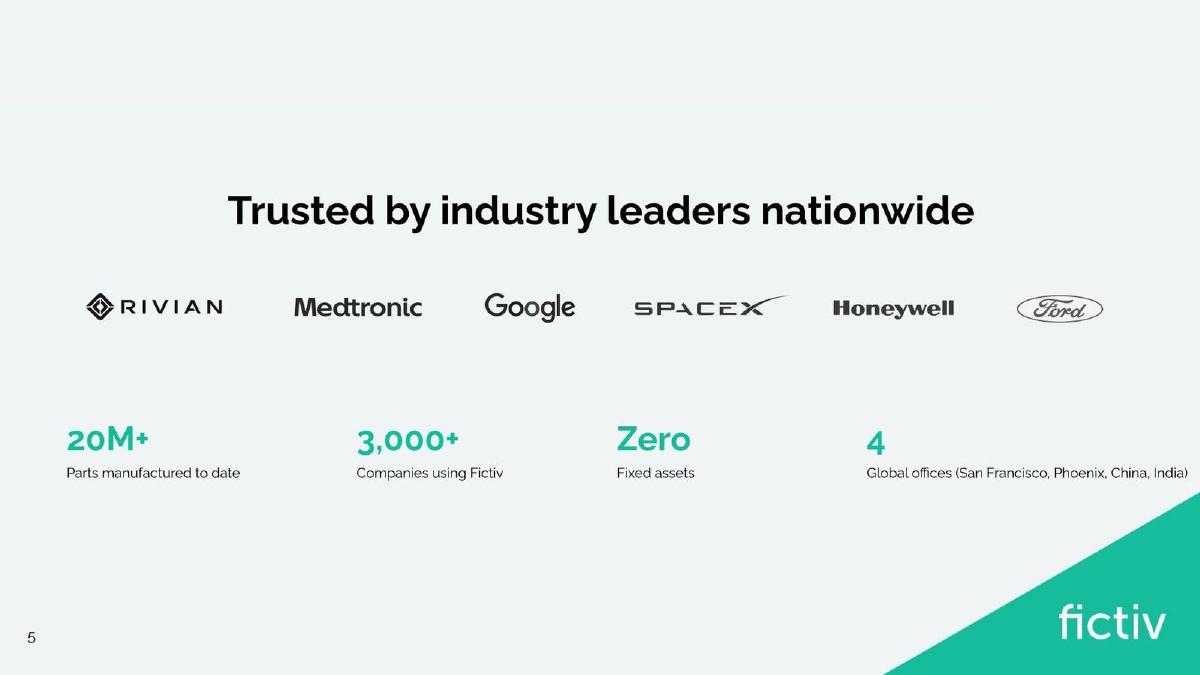
Our analysis: The logos are selective and the figures underneath show breadth. "Zero fixed assets" quietly makes a business-model point: Fictiv is a network, not a factory.
Evidence and limitation: The slide does not say how much any of these logos spend, or whether they are company-wide accounts or single engineering teams. "Nationwide" sits oddly next to offices in China and India.
What a founder can adapt: Choose five or six logos that fit your target market, then add your total customer count and one usage figure.
Supporting analysis
What the deck claims: "Trusted by industry leaders nationwide" over six logos (Rivian, Medtronic, Google, SpaceX, Honeywell, Ford), then four figures: "20M+ parts manufactured to date", "3,000+ companies using Fictiv", "Zero fixed assets" and "4 global offices (San Francisco, Phoenix, China, India)".
Presentation choice: The logos are selective and the figures underneath show breadth. "Zero fixed assets" quietly makes a business-model point: Fictiv is a network, not a factory.
When it does not fit: The slide does not say how much any of these logos spend, or whether they are company-wide accounts or single engineering teams. "Nationwide" sits oddly next to offices in China and India.
Procurement software. Stage and year are not stated on the slide.
Arkestro deck, slide 4. Exact stored slide matched to this analysis.
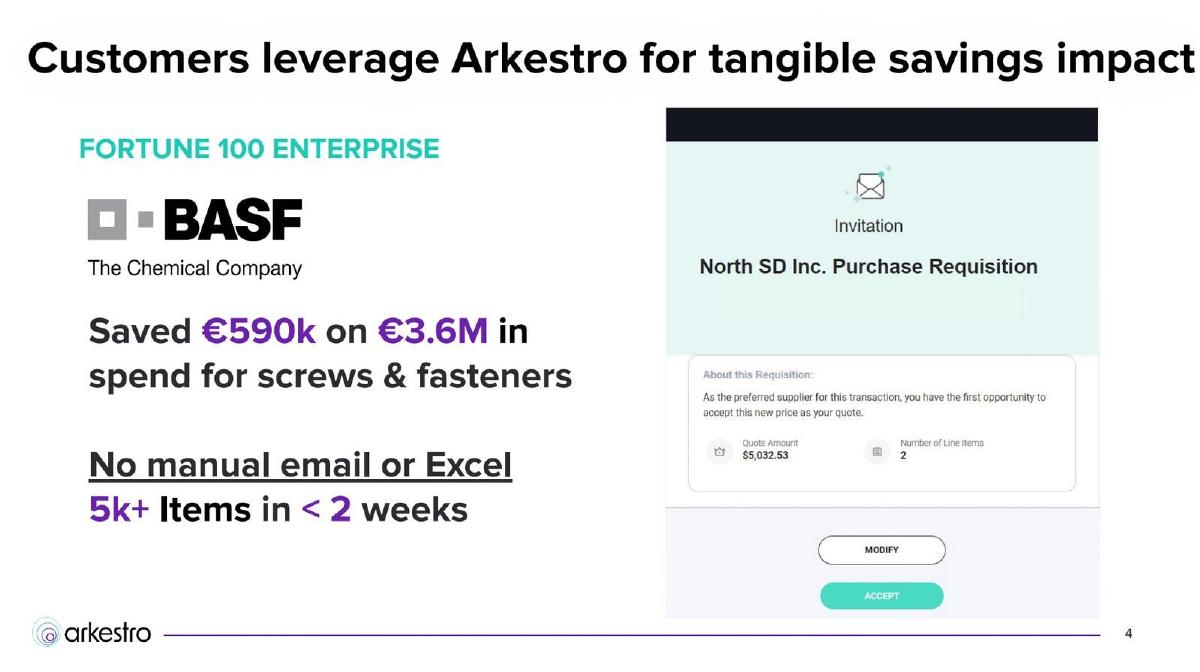
Our analysis: A measured saving at a named customer is the clearest customer evidence there is. The spend category and timeframe make it concrete, and the screenshot shows what the supplier actually sees.
Evidence and limitation: One case can be an outlier; say how many customers have similar results. The "Fortune 100 enterprise" label doesn't say which Fortune list it refers to. We have not verified the savings figure.
What a founder can adapt: If you have one customer with a measured result, give it a whole slide: customer, problem area, result in money or time, and how long it took.
Supporting analysis
What the deck claims: "Customers leverage Arkestro for tangible savings impact." One case, labelled "Fortune 100 enterprise": the BASF logo, "Saved €590k on €3.6M in spend for screws & fasteners" and "No manual email or Excel, 5k+ items in < 2 weeks", beside a screenshot of a supplier purchase-requisition invitation.
Presentation choice: A measured saving at a named customer is the clearest customer evidence there is. The spend category and timeframe make it concrete, and the screenshot shows what the supplier actually sees.
When it does not fit: One case can be an outlier; say how many customers have similar results. The "Fortune 100 enterprise" label doesn't say which Fortune list it refers to. We have not verified the savings figure.
Simulation and computing platform for defence and training. Stage and year are not stated on the slide.
Hadean deck, slide 5. Exact stored slide matched to this analysis.
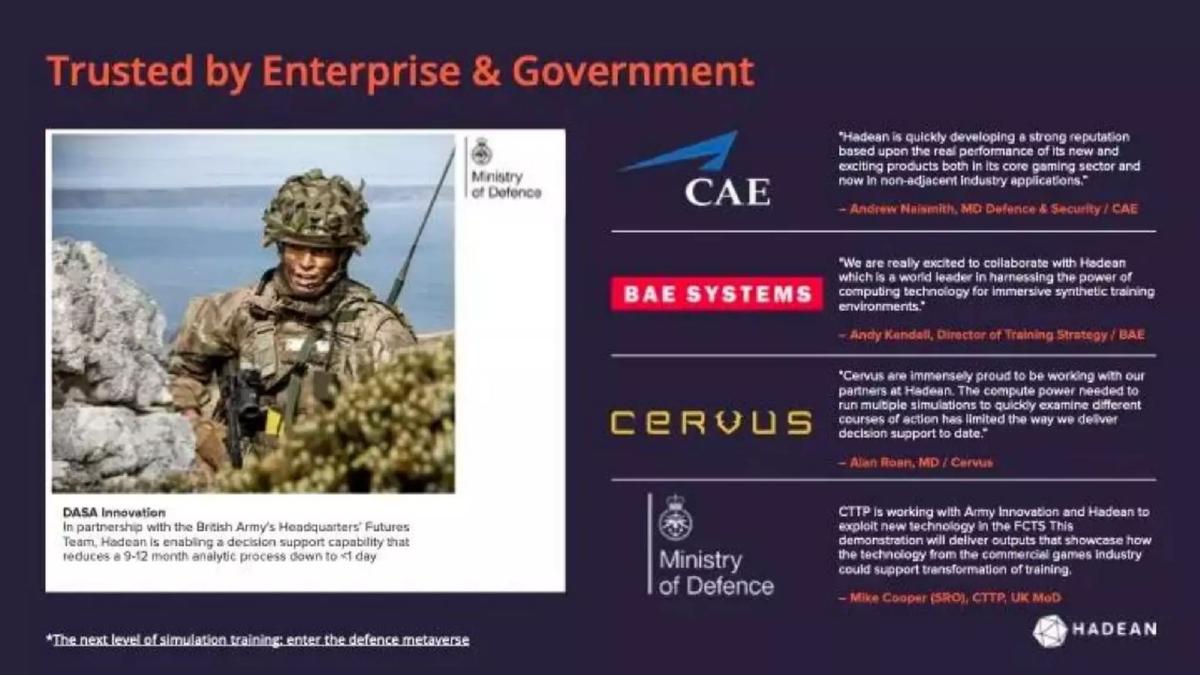
Our analysis: In defence, buyers and partners are hard to name. Named, titled quotes from established contractors do the work that logos do elsewhere, and the 9–12 months to under one day figure gives one outcome.
Evidence and limitation: The quotes express enthusiasm ("really excited to collaborate") rather than commercial terms. The slide doesn't say which of these are paying customers, partners or trial programmes.
What a founder can adapt: In long-sales-cycle markets, a few attributed quotes from buyers or partners can stand in for revenue you cannot yet show.
Supporting analysis
What the deck claims: "Trusted by Enterprise & Government": a DASA Innovation panel says Hadean, with the British Army's Headquarters Futures Team, enables a decision-support capability that "reduces a 9–12 month analytic process down to <1 day". Four quotes follow, attributed by name and title to people at CAE, BAE Systems, Cervus and the UK Ministry of Defence.
Presentation choice: In defence, buyers and partners are hard to name. Named, titled quotes from established contractors do the work that logos do elsewhere, and the 9–12 months to under one day figure gives one outcome.
When it does not fit: The quotes express enthusiasm ("really excited to collaborate") rather than commercial terms. The slide doesn't say which of these are paying customers, partners or trial programmes.
Online printing service in Nigeria. Stage and year are not stated on the slide.
Printivo deck, slide 6. Exact stored slide matched to this analysis.
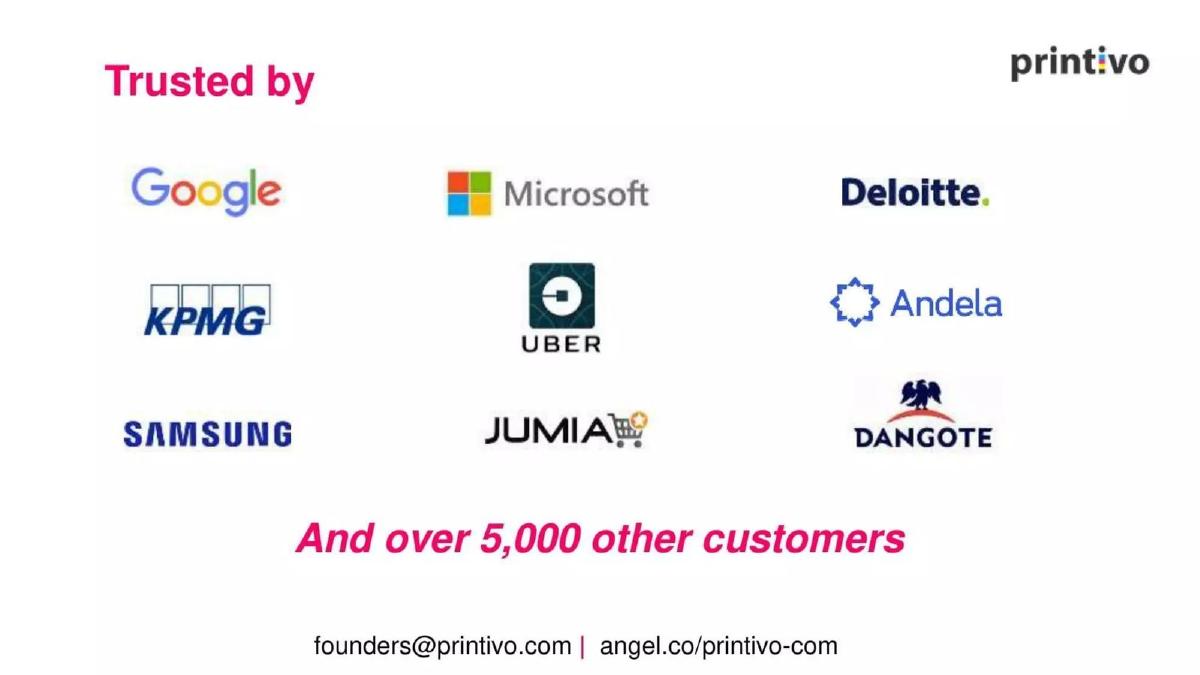
Our analysis: Mixing global brands with major Nigerian companies (Jumia, Dangote, Andela) signals local enterprise adoption, and the 5,000 figure shows the logos sit on top of a wider base.
Evidence and limitation: Printing orders from a global company's local office are very different from a group-wide contract. Say whether these are repeat accounts, and what share of revenue the top customers make up.
What a founder can adapt: Include recognisable local customers alongside global ones if you sell in one country; they are often more relevant to local investors.
Supporting analysis
What the deck claims: "Trusted by" over nine logos (Google, Microsoft, Deloitte, KPMG, Uber, Andela, Samsung, Jumia, Dangote) and "And over 5,000 other customers", with founder contact details.
Presentation choice: Mixing global brands with major Nigerian companies (Jumia, Dangote, Andela) signals local enterprise adoption, and the 5,000 figure shows the logos sit on top of a wider base.
When it does not fit: Printing orders from a global company's local office are very different from a group-wide contract. Say whether these are repeat accounts, and what share of revenue the top customers make up.
Snack food sold through food service and convenience channels. Stage and year are not stated on the slide.
Loeb's Crunch deck, slide 5. Exact stored slide matched to this analysis.
Our analysis: Grouping by channel shows where the product sells and which channel is deepest, which matters more to a consumer-goods investor than any single logo.
Evidence and limitation: Store counts can mean a few locations of a large chain. Say how many locations per chain carry the product and whether reorders are recurring. Sports-team logos may have usage restrictions worth checking.
What a founder can adapt: If you sell into several segments, group logos by segment and put the count in the headline.
Supporting analysis
What the deck claims: "Customers: over 2000 food service and convenience stores", with logos in columns: convenience (Meijer, 7-Eleven, QuikTrip and others), restaurants, healthcare (Stanford School of Medicine), amusement parks, universities and stadiums (several NFL and NBA teams).
Presentation choice: Grouping by channel shows where the product sells and which channel is deepest, which matters more to a consumer-goods investor than any single logo.
When it does not fit: Store counts can mean a few locations of a large chain. Say how many locations per chain carry the product and whether reorders are recurring. Sports-team logos may have usage restrictions worth checking.
Product-recommendation software for online retailers. Stage and year are not stated on the slide.
Depict.ai deck, slide 4. Exact stored slide matched to this analysis.
Our analysis: For an early company, mid-sized retailers that match the target customer are more honest evidence than one famous name, and the "+10" gives a rough total.
Evidence and limitation: With no figures, investors cannot tell whether these are paying, piloting or free. Add revenue, retention, or a result for one customer.
What a founder can adapt: Show the customers who look like your ideal buyer, even if the names are unfamiliar, and give the total.
Supporting analysis
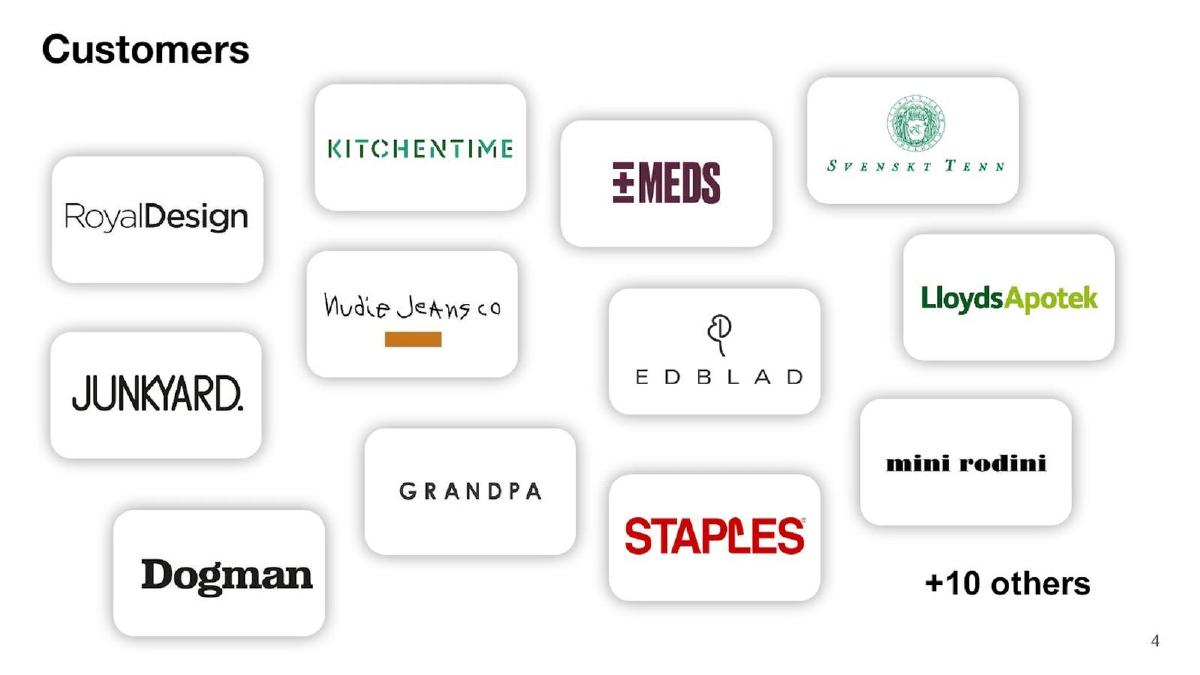
What the deck claims: "Customers" and twelve logos of mostly Nordic retailers (Royal Design, Kitchentime, MEDS, Svenskt Tenn, Nudie Jeans, Lloyds Apotek, Staples and others), with "+10 others". By our count that is about 22 customers.
Presentation choice: For an early company, mid-sized retailers that match the target customer are more honest evidence than one famous name, and the "+10" gives a rough total.
When it does not fit: With no figures, investors cannot tell whether these are paying, piloting or free. Add revenue, retention, or a result for one customer.
Apparel manufacturing marketplace. The slide says Fashinza raised a $100M Series B; the year is not stated.
Fashinza deck, slide 3. Exact stored slide matched to this analysis.
Our analysis: Recognisable brand buyers for a manufacturing marketplace signal that the platform can meet large retailers' requirements.
Evidence and limitation: Customer and investor logos prove different things, and mixing them makes both harder to read. The slide gives no order volume or repeat rate for any brand.
What a founder can adapt: Keep the brand row, but move investors to their own slide or the ask slide.
Supporting analysis
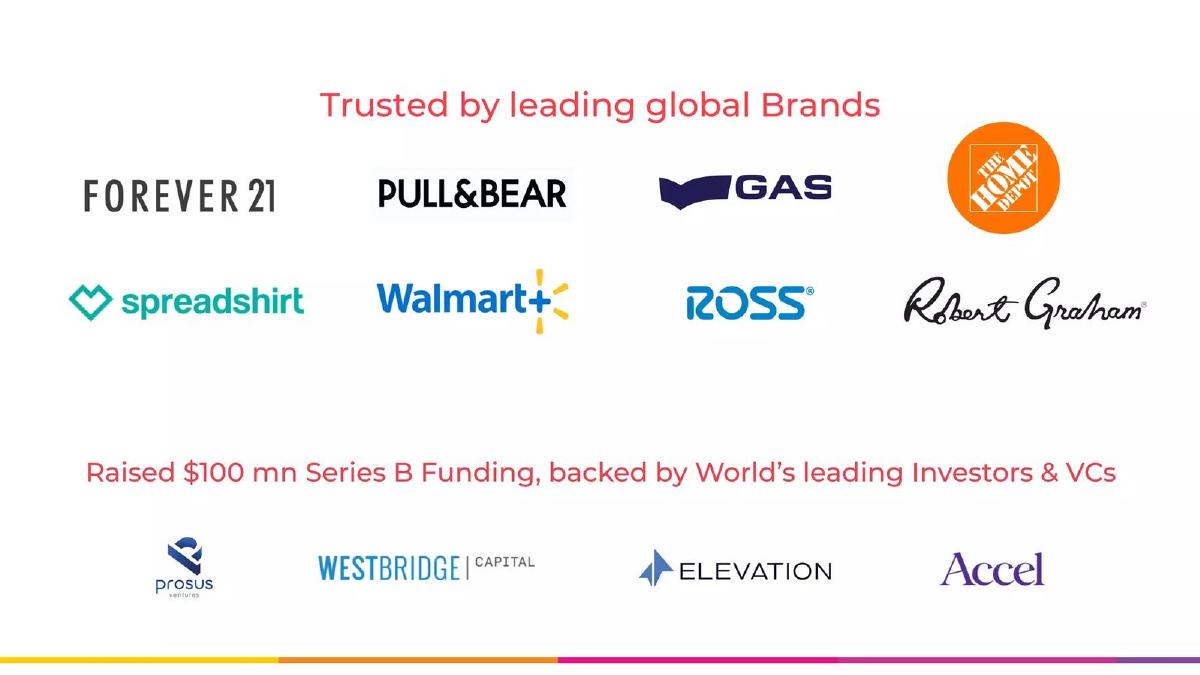
What the deck claims: "Trusted by leading global Brands" with eight logos (Forever 21, Pull&Bear, GAS, The Home Depot, Spreadshirt, Walmart+, Ross, Robert Graham), then "Raised $100 mn Series B Funding, backed by World's leading Investors & VCs" with four investor logos (Prosus, WestBridge Capital, Elevation, Accel).
Presentation choice: Recognisable brand buyers for a manufacturing marketplace signal that the platform can meet large retailers' requirements.
When it does not fit: Customer and investor logos prove different things, and mixing them makes both harder to read. The slide gives no order volume or repeat rate for any brand.
Choose by what you can prove, not by how many logos you have.
Format
Example
Proves
Fits when
Add
Logos plus scale figures
Fictiv
Selective names and a broad base
You have many customers and a few strong names
Spend or contract type
Single measured case
Arkestro
A concrete result
One customer has a measurable outcome
How many others see similar results
Named quotes
Hadean
Buyers vouch for you
Long sales cycles; names are hard to publish
Which are paying customers
Logo wall plus long tail
Printivo
Big names and a wider base
Enterprise logos sit on top of many small accounts
Repeat rate, revenue concentration
Logos grouped by segment
Loeb's Crunch
Where demand comes from
You sell into several channels
Locations per account, reorders
Ideal-customer logos
Depict.ai
Fit with the target buyer
Early stage, lesser-known customers
Any revenue or result
Key Takeaways
Add a count beside the logos. Fictiv shows six logos with "3,000+ companies using Fictiv" and "20M+ parts manufactured"; Printivo adds "over 5,000 other customers". The count shows the logos are not the whole business.
One measured customer result can beat a dozen logos. Arkestro gives a single case, BASF saving €590k on €3.6M of spend, which by our arithmetic is about 16%.
Named quotes answer "do they actually use it?". Hadean attributes each quote to a named executive at CAE, BAE Systems, Cervus and the UK Ministry of Defence.
Group logos to show where demand comes from. Loeb's Crunch sorts logos into convenience, restaurants, healthcare, amusement parks, universities and stadiums, under a headline of over 2,000 stores.
Don't blur customers and investors. Fashinza puts customer logos and its Series B investors on one slide; they prove different things and deserve separate slides.
Build your customer slide
Answer each prompt. If you can't answer the status question, don't show the logo.
Status. For each logo: paying, pilot, or free? Remove or label anything that isn't paying.
Count. How many customers in total, as of what date?
Result. What measured result has at least one customer seen, in money or time?
Voice. Which customer would let you quote them by name and title?
Copyable framework: [Headline: N paying customers as of month/year] · [5–8 logos that match your target buyer, labelled if pilots] · [One result: customer saved X in Y weeks] · [Optional: one named quote]
Illustrative example 1 — written by us
Before: Trusted by: [twelve logos, some pilots, some free trials]
After: [N] paying customers as of [month/year]. [Customer] cut [process] from [x] weeks to [y] days. Logos: [five paying accounts]; pilots labelled separately.
What improved: Our illustrative rewrite, not any company's text. It adds a dated count, a measured result and customer status; bracketed values are placeholders.
What a customer slide has to prove
Investors read logos as a claim that recognisable buyers chose you. The follow-up questions are predictable: are they paying, how much, for how long, and is this one team at a large company or a company-wide contract? A slide that answers even one of those is stronger than a larger logo wall.
The customer slide is different from the traction slide. Traction shows growth over time; the customer slide shows who buys and why that matters. Many decks combine them, but if your logos are strong and your numbers are early, a separate slide lets each do its job.
Common mistakes
Unlabelled pilots. Label logos that are pilots or free trials.
Logos with no count. Give the total so investors know the logos aren't the whole business.
Customer and investor logos together. Put investors on their own slide.
Famous but irrelevant names. A one-off order from a big brand matters less than repeat customers who match your target buyer.
Quotes without names. An unattributed quote carries almost no weight.
Diagnostic checklist
Every logo is a paying customer, or is labelled as a pilot.
The slide gives a total customer count and a date.
At least one customer result or named quote is included.
Logos are grouped by segment if you sell to more than one.
Investor logos are on a different slide.
You have permission, or a clear basis, to show each customer's name.
Frequently asked questions
How we chose these examples
Corpus: published pitch deck teardowns on StartupFundraising.com. Founder-uploaded private decks are excluded.
Selection (2026-09-24): we searched extracted text of slides 2–6 for slides titled customers, clients, trusted by or similar, where a stored slide image exists, and inspected eight candidates. Seven were selected. iugu slide 5 was excluded because it is a template placeholder ("BIG CASE #1"–"#9" with an instruction note), not a real customer slide.
Review: all seven stored slide images were inspected on 2026-09-24 and matched to company, deck and slide number (editorial model review). No person has yet completed an editorial review of this page.
Logos, counts, quotes and savings are the companies' own claims and have not been independently verified. The Arkestro percentage and the Depict.ai customer count are our arithmetic from the slides. We make no claim that any slide caused a fundraising outcome.