Target Customer Slide Examples: Personas and Ideal Customer
How pitch decks define their ideal customer: personas, qualifying criteria, ranked segments and the mix of current users.
Target Customer Slide Examples: Personas and Ideal Customer Profiles
Six target customer slides from real pitch decks, shown in full, compare how narrowly each one defines who buys first, whether it gives any evidence for that choice, and how it separates current users from the chosen target.
TL;DR
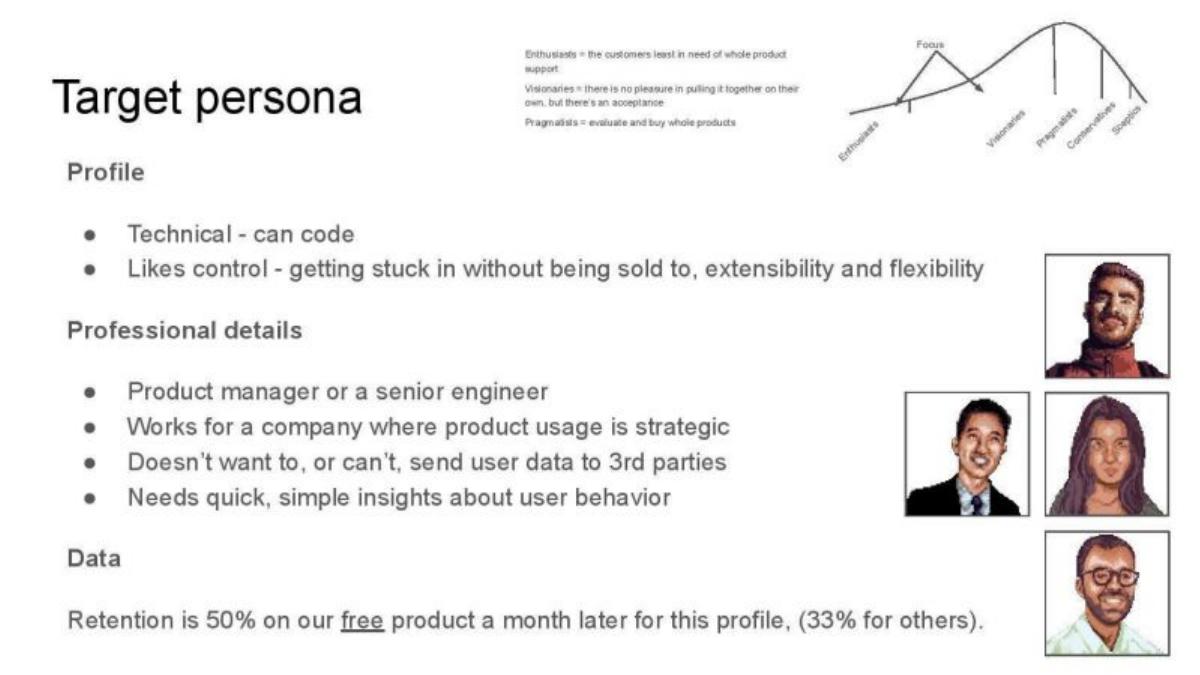
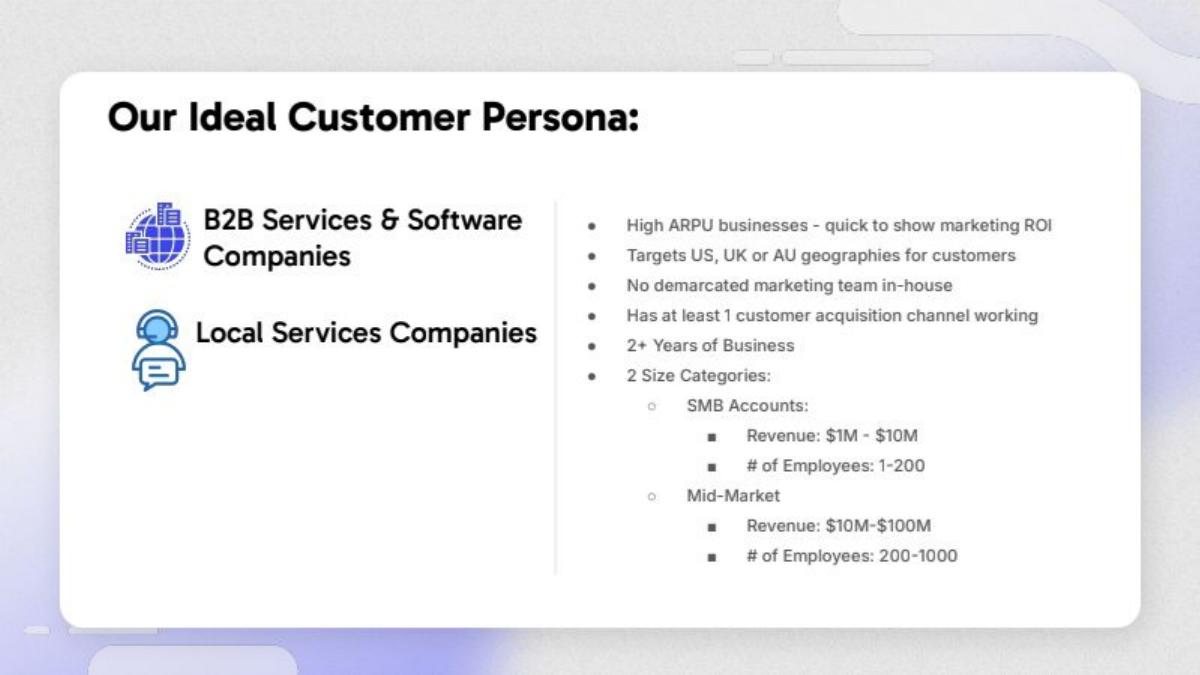
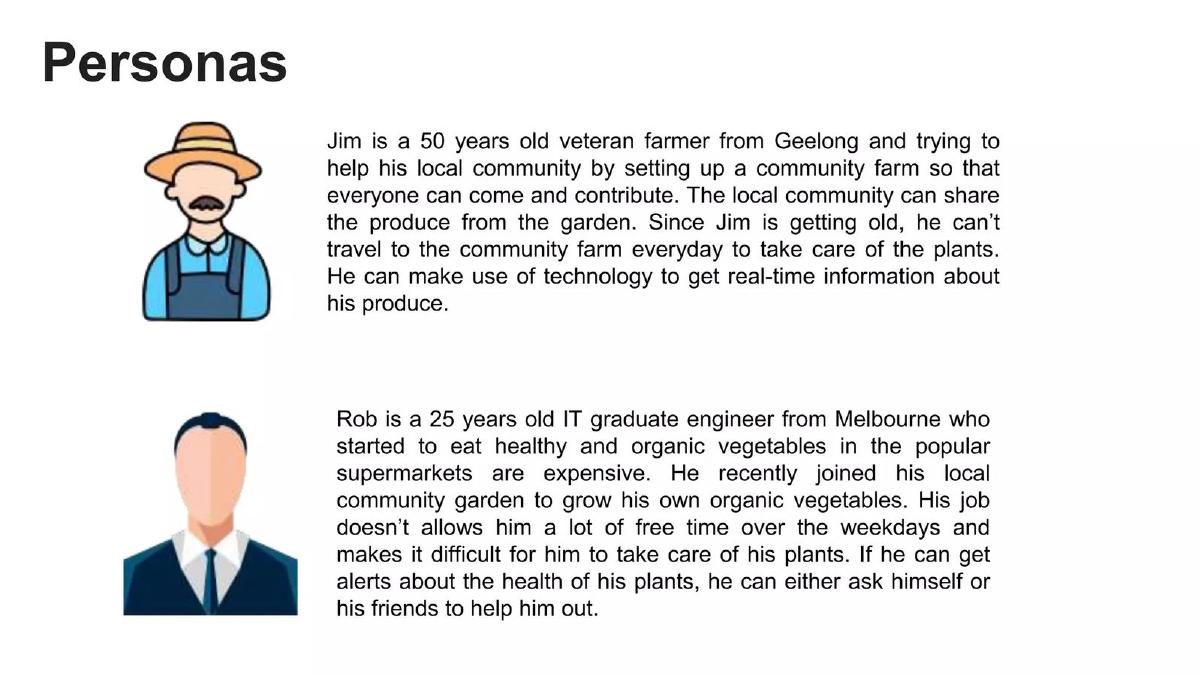
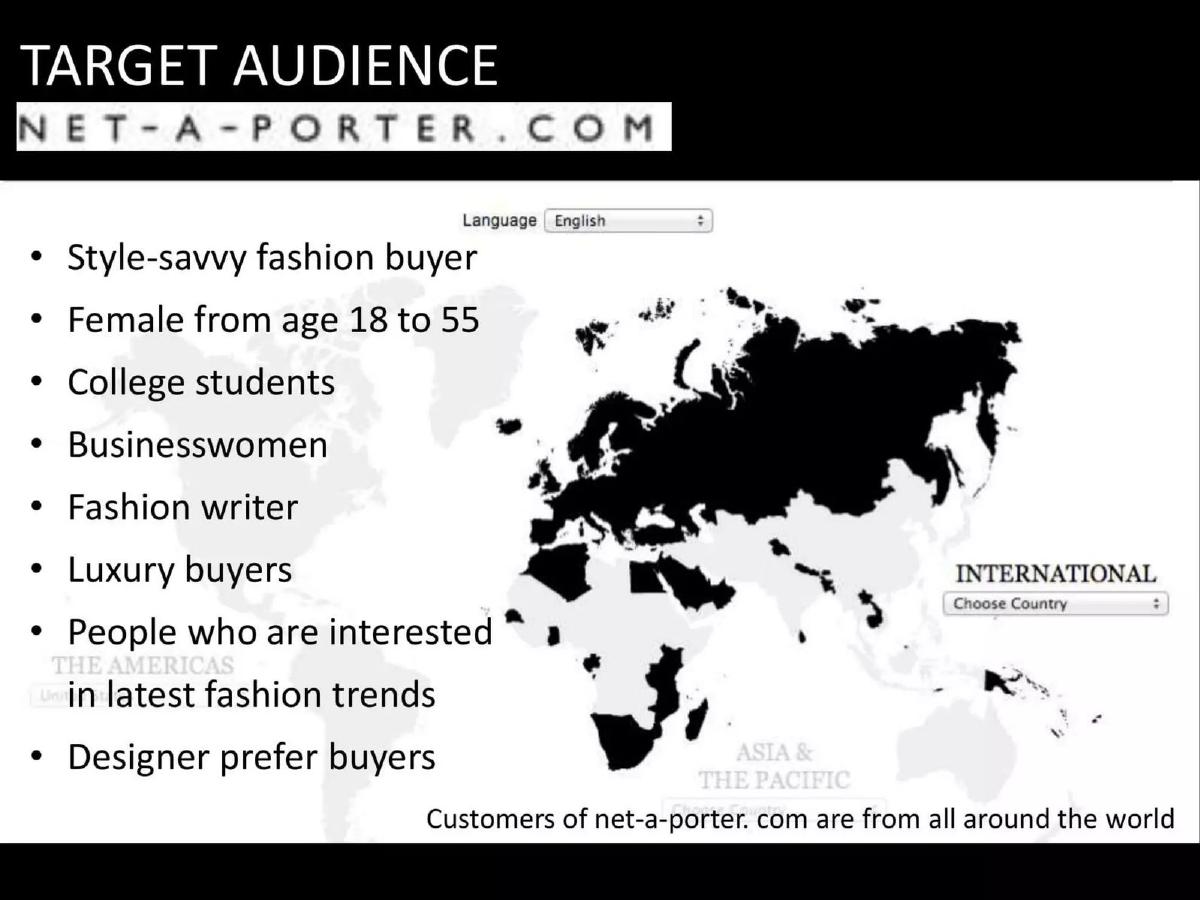
A target customer slide works when it names a customer narrow enough to find and gives a reason that group comes first. PostHog does both: its "Target persona" is a technical product manager or senior engineer, and a data line says retention on its free product is 50% a month later for this profile against 33% for others. Gushwork lists qualifying criteria for its ideal customer, such as no in-house marketing team and at least two years in business, with revenue and headcount bands. Rubix Health ranks two physician segments and says why hospitals come first. Agrination tells two story personas with no numbers. Net-a-Porter lists broad audiences, from college students to luxury buyers, which describes almost anyone. SEOmoz (Moz) shows something different: the job titles of the people already using it, with each group's approximate share of current members.
Target customer slides from real pitch decks
Each example shows the exact stored slide above its analysis and links to the full teardown. Figures are as stated on the slide; we have not checked them independently. Stage and year are given only where the deck states them.
PostHog customer slide — slide 3
Open-source product analytics. Stage and year not stated on the slide.
PostHog deck, slide 3. Exact stored slide matched to this analysis.
Our analysis: The persona is specific (role, skill, a data-privacy constraint), and the data line shows the company picked this group because it already behaves better in the product. That turns a description into evidence.
Evidence and limitation: The slide doesn't say how many such people or companies exist or how the retention figure was measured (sample size, period). One line on each would make the choice easier to trust.
What a founder can adapt: Add one line of your own data showing that your chosen customer converts, retains or pays better than others.
Supporting analysis
What the deck claims: "Target persona". Profile: "Technical - can code"; "Likes control - getting stuck in without being sold to, extensibility and flexibility". Professional details: "Product manager or a senior engineer"; "Works for a company where product usage is strategic"; "Doesn't want to, or can't, send user data to 3rd parties"; "Needs quick, simple insights about user behavior". Data: "Retention is 50% on our free product a month later for this profile, (33% for others)." A small adoption curve marks the focus on enthusiasts and visionaries.
Presentation choice: The persona is specific (role, skill, a data-privacy constraint), and the data line shows the company picked this group because it already behaves better in the product. That turns a description into evidence.
When it does not fit: The slide doesn't say how many such people or companies exist or how the retention figure was measured (sample size, period). One line on each would make the choice easier to trust.
Marketing services for businesses. Stage and year not stated on the slide.
Gushwork deck, slide 6. Exact stored slide matched to this analysis.
Our analysis: Each criterion is something a sales team could check before a call. "No demarcated marketing team" explains why these customers need the service, and the high-ARPU point explains why they are worth serving.
Evidence and limitation: Two customer types and two size bands give four combinations with no order. Say which one the company sells to first and how many customers it has in each.
What a founder can adapt: Write your ideal customer as a short checklist a salesperson could use to qualify a lead.
Supporting analysis
What the deck claims: "Our Ideal Customer Persona": "B2B Services & Software Companies" and "Local Services Companies". Criteria: "High ARPU businesses - quick to show marketing ROI"; "Targets US, UK or AU geographies for customers"; "No demarcated marketing team in-house"; "Has at least 1 customer acquisition channel working"; "2+ Years of Business". Two size categories: SMB accounts (revenue $1M–$10M, 1–200 employees) and mid-market (revenue $10M–$100M, 200–1000 employees).
Presentation choice: Each criterion is something a sales team could check before a call. "No demarcated marketing team" explains why these customers need the service, and the high-ARPU point explains why they are worth serving.
When it does not fit: Two customer types and two size bands give four combinations with no order. Say which one the company sells to first and how many customers it has in each.
Medical coding software for physicians. Stage and year not stated on the slide.
Rubix Health deck, slide 3. Exact stored slide matched to this analysis.
Our analysis: Ranking the segments tells investors where the company will start, and the reasons (time spent on coding, cost of billers) connect the choice to the problem.
Evidence and limitation: The hospital logos could be read as customers; the slide doesn't say whether they are pilots, customers or examples. The time and cost figures also need a source.
What a founder can adapt: If you have two segments, label which comes first and give the one or two facts that decided it.
Supporting analysis
What the deck claims: "Customer Segments". "Physicians in Hospitals/IT Admins" (shown with Wayne State School of Medicine and NYP logos): many patients; hospitals spent "30-50 million dollars in EMR systems (~4-5 years ago)"; physicians spend "around 30mins-1 hr a day on coding even though they have billers"; they pay billers "5-12% of the total payment"; "Most Important". "Private Practice Physicians": fewer patients, more willing to use new EMR systems with coding built in, still about half an hour a day on coding; "Less Important".
Presentation choice: Ranking the segments tells investors where the company will start, and the reasons (time spent on coding, cost of billers) connect the choice to the problem.
When it does not fit: The hospital logos could be read as customers; the slide doesn't say whether they are pilots, customers or examples. The time and cost figures also need a source.
Plant-monitoring technology for community gardens and farms in Australia. Stage and year not stated.
Agrination deck, slide 5. Exact stored slide matched to this analysis.
Our analysis: Story personas make the need concrete: both describe a person who cares about plants but can't be there to check them, which is the product's job.
Evidence and limitation: The personas are illustrative, with no count, no sign they are real customers, and no indication who pays. Two different people with no ranking also leave the first customer open.
What a founder can adapt: If you use story personas, end each one with a fact about how many people like them exist or how many you have spoken to.
Supporting analysis
What the deck claims: "Personas". Jim, "a 50 years old veteran farmer from Geelong", is setting up a community farm, can't travel there every day, and "can make use of technology to get real-time information about his produce." Rob, "a 25 years old IT graduate engineer from Melbourne", joined a community garden to grow organic vegetables, has little weekday time, and could use alerts about his plants' health.
Presentation choice: Story personas make the need concrete: both describe a person who cares about plants but can't be there to check them, which is the product's job.
When it does not fit: The personas are illustrative, with no count, no sign they are real customers, and no indication who pays. Two different people with no ranking also leave the first customer open.
Online luxury fashion retail. The deck's date and author are not stated on the slide.
Net-a-Porter deck, slide 3. Exact stored slide matched to this analysis.
Our analysis: It is easy to read, and "luxury buyers" does point at the company's actual market.
Evidence and limitation: Eight overlapping audiences spanning a 37-year age range and "all around the world" describe almost anyone. College students and luxury buyers are very different customers; the slide doesn't say which one matters.
What a founder can adapt: Pick the one group from a list like this that buys first and most, and describe them in detail instead.
Supporting analysis
What the deck claims: "Target Audience": "Style-savvy fashion buyer"; "Female from age 18 to 55"; "College students"; "Businesswomen"; "Fashion writer"; "Luxury buyers"; "People who are interested in latest fashion trends"; "Designer prefer buyers". A world map carries the line "Customers of net-a-porter.com are from all around the world".
Presentation choice: It is easy to read, and "luxury buyers" does point at the company's actual market.
When it does not fit: Eight overlapping audiences spanning a 37-year age range and "all around the world" describe almost anyone. College students and luxury buyers are very different customers; the slide doesn't say which one matters.
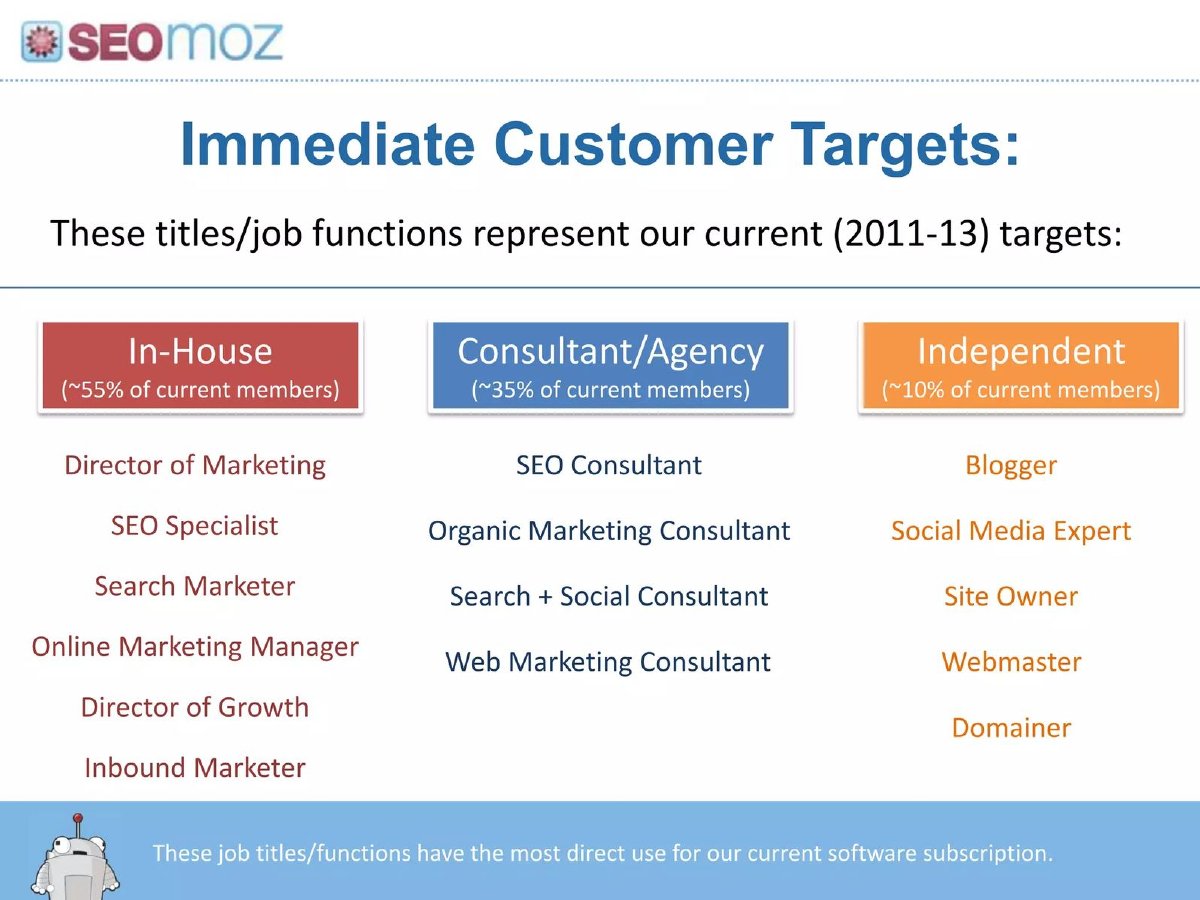
SEO software sold by subscription. The slide refers to "2011-13"; the round is not stated on the slide.
SEOmoz deck, slide 18. Exact stored slide matched to this analysis.
Our analysis: Job titles are criteria a salesperson can check, and the shares tell investors where the existing member base sits. It is grounded in who actually uses the product rather than who might.
Evidence and limitation: The shares are of "current members"; the slide doesn't say whether all members pay, what each group is worth in revenue, or how the shares were counted. All three groups are called targets with no stated first choice, so the current mix and the target are not separated. Name the group you will prioritise and the reason.
What a founder can adapt: If you have users, show your current mix by a checkable trait such as job title, with the share of each and the date it was measured.
Supporting analysis
What the deck claims: "Immediate Customer Targets:" "These titles/job functions represent our current (2011-13) targets:". Three groups with a share of current members: "In-House (~55% of current members)" — Director of Marketing, SEO Specialist, Search Marketer, Online Marketing Manager, Director of Growth, Inbound Marketer; "Consultant/Agency (~35% of current members)" — SEO Consultant, Organic Marketing Consultant, Search + Social Consultant, Web Marketing Consultant; "Independent (~10% of current members)" — Blogger, Social Media Expert, Site Owner, Webmaster, Domainer. Footer: "These job titles/functions have the most direct use for our current software subscription."
Presentation choice: Job titles are criteria a salesperson can check, and the shares tell investors where the existing member base sits. It is grounded in who actually uses the product rather than who might.
When it does not fit: The shares are of "current members"; the slide doesn't say whether all members pay, what each group is worth in revenue, or how the shares were counted. All three groups are called targets with no stated first choice, so the current mix and the target are not separated. Name the group you will prioritise and the reason.
Specific criteria plus a reason for the choice make a target customer believable.
Example
Format
Checkable criteria
First segment chosen
Evidence for choice
PostHog
Single persona
Yes (role, skill, data constraint)
Yes
Yes (retention 50% vs 33%)
Gushwork
Ideal customer profile
Yes (size, geography, no marketing team)
No (two types, two sizes)
No
Rubix Health
Two ranked segments
Partly (time on coding, biller cost)
Yes ("Most Important")
Partly (unsourced figures)
Agrination
Two story personas
No
No
No
Net-a-Porter
Audience list
No
No
No
SEOmoz (Moz)
Current members by job title
Yes (job titles)
No (three groups, all called targets)
Partly (share of current members; basis not stated)
Key Takeaways
Name one first customer narrow enough that you could list where to find them.
Use criteria an investor could check: company size, role, geography, a behaviour or a pain you can measure.
If you have more than one segment, rank them and say why the first one comes first.
Back the choice with evidence where you have it. PostHog's retention comparison is the strongest line in this set.
A long list of audiences reads as no choice at all.
Who uses you now and who you target first are different claims. Label each, and say whether a share is of users, paying customers or revenue.
Define your target customer
Answer each line before designing the slide.
Who. What role, company type or person buys or uses first?
Criteria. Which three or four facts would let a salesperson qualify them (size, geography, a missing capability, a behaviour)?
Pain. What do they lose today without you, in time or money?
Why first. Why this group before others? Faster sales, higher retention, bigger budget?
Evidence. What data from your product, pilots or interviews supports that choice?
Copyable framework: We sell first to [role] at [company type, size, geography] who [pain]. They [behave better: retain / convert / pay] at [X] vs [Y] for others, based on [source, period].
Illustrative example 1 — written by us
Before: Target audience: female from age 18 to 55, college students, businesswomen, luxury buyers.
After: We sell first to [specific group] in [market] who [pain]. They [metric] at [X] vs [Y] for other buyers, based on [source].
What improved: Our illustrative rewrite, not Net-a-Porter's text. Bracketed parts are placeholders, not company facts. It replaces a list of audiences with one first customer and a reason.
What this guide adds to the other customer guides
The customer logo slide guide covers showing who already buys, and the customer survey guide covers research results. The go-to-market guides mention target customers only as the start of a sales plan. This guide is about the slide that defines the ideal customer itself: a persona, an ideal customer profile or a ranked list of segments, and how specific it needs to be.
Current users are not the same as a chosen target
Most target customer slides describe who the company wants. A few describe who already uses the product, which is evidence of a different kind. SEOmoz's slide (below) splits its current members into three groups by job title, In-House ("~55% of current members"), Consultant/Agency ("~35%") and Independent ("~10%"), under the heading "Immediate Customer Targets".
A split like this shows where usage is concentrated today. It does not, by itself, show which group to sell to first: a group can be large because it was easiest to reach, not because it pays most or stays longest. The slide does not say whether "members" are all paying subscribers, how the shares were measured, or what each group is worth in revenue. It lists all three groups as targets rather than choosing one.
If you show your current user mix, say what the percentage is a share of (users, paying customers or revenue), give the date and the total it is based on, and then state separately which group you are targeting first and why.
Common mistakes
Everyone is a customer. A long audience list reads as no choice.
No ranking. Say which segment comes first.
Uncheckable traits. Use criteria a salesperson could verify.
Personas without numbers. Say how many such customers exist or you have met.
No evidence. Show one data point that supports the choice.
Diagnostic checklist
One first customer is named.
Criteria are specific and checkable.
Other segments are ranked behind it.
The pain is stated in time or money.
At least one data point supports the choice.
Any share of current users says what it is a share of, and when it was measured.
Frequently asked questions
How we chose these examples
Corpus: published pitch deck teardowns on StartupFundraising.com. Founder-uploaded private decks are excluded.
Selection (2026-09-28): we searched extracted slide text for slides whose opening words include "persona", "ideal customer", "target customer", "target audience", "customer segments" or "early adopters" and that have a stored slide image. Excluded: slides mainly about marketing channels (for example Revolut's early-adopter marketing slide), audience lines inside market-size or problem slides, and decks already used for the same point by other guides.
Overlap check: the customer logo guide covers existing customers and the customer survey guide covers research; go-to-market guides mention target customers only as part of a sales plan. None of these five slides is used by another guide.
Addition (2026-09-29): SEOmoz slide 18 was found in a sample of slides our coverage map had not tagged. The stored original (36 pages, file hash beginning 174517723d03) was checked as a founder pitch deck and the slide image was inspected against the quoted text. The shares are quoted as stated and refer to current members; we do not treat them as paying customers or as proof of which segment to target first.
Review: the first five stored slide images were inspected on 2026-09-28 and matched to company, deck and slide number (editorial model review). No person has yet completed an editorial review of this page.
Figures are quoted as stated on the slides and were not verified independently. We make no claim that any slide caused a fundraising outcome.