The SEO Moz Series B deck is a masterclass in demonstrating the transition from a service-based 'Mom + Son consultancy' to a high-margin SaaS leader. Raising $18M in 2011-2012, the company leveraged its massive organic reach—1.25 million monthly visits and 300,000 email subscribers—to prove that it could acquire customers without paid advertising. The deck is notably transparent, detailing specific unit economics like a 57% trial-to-paid conversion rate and a 25% churn rate in the first two months. It also takes a rare, direct approach to founder liquidity, earmarking $6-7 million of the rais…
Key takeaways
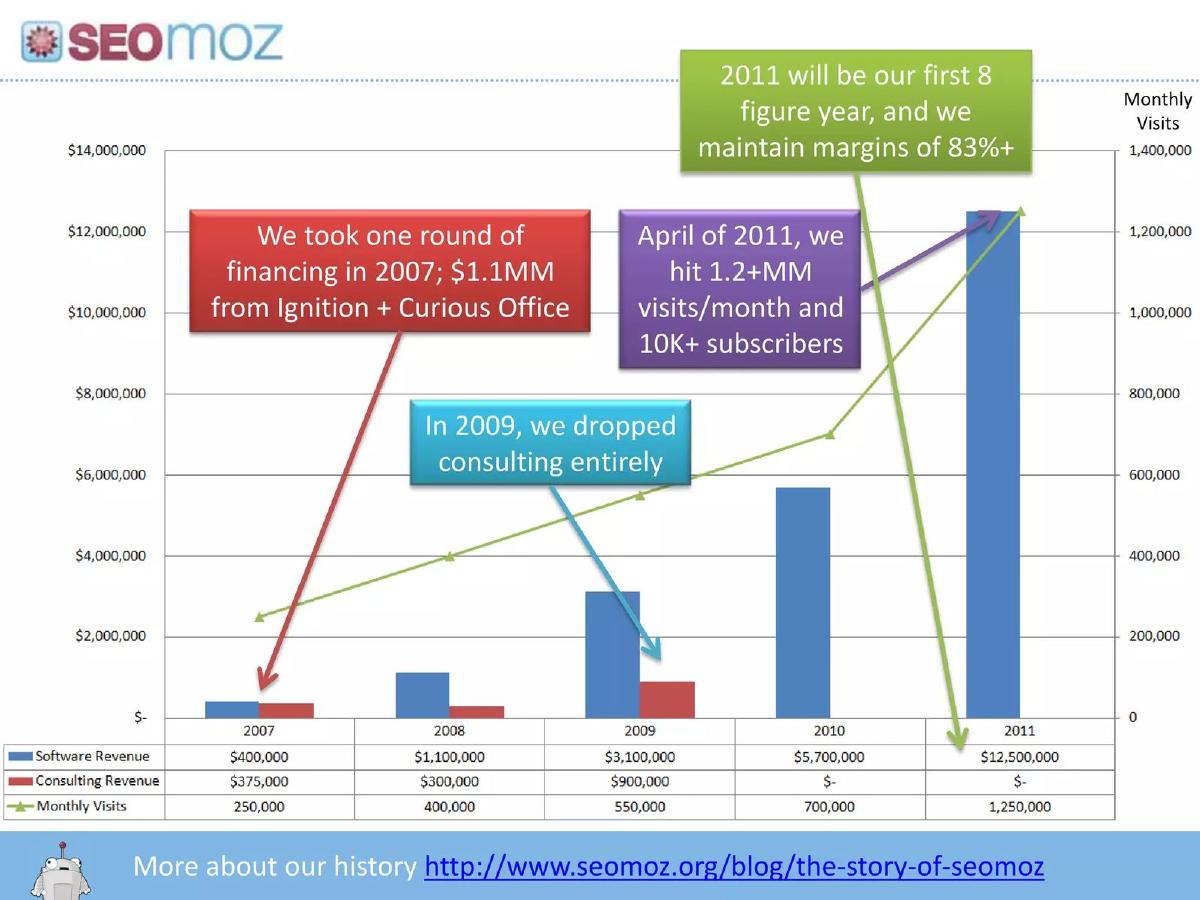
- The company successfully pivoted from consulting to software, dropping consulting entirely in 2009 to reach $12.5M in software revenue by 2011 (Slide 2).
- Moz maintained exceptionally high gross margins of 82% to 83% while scaling (Slides 2 and 11).
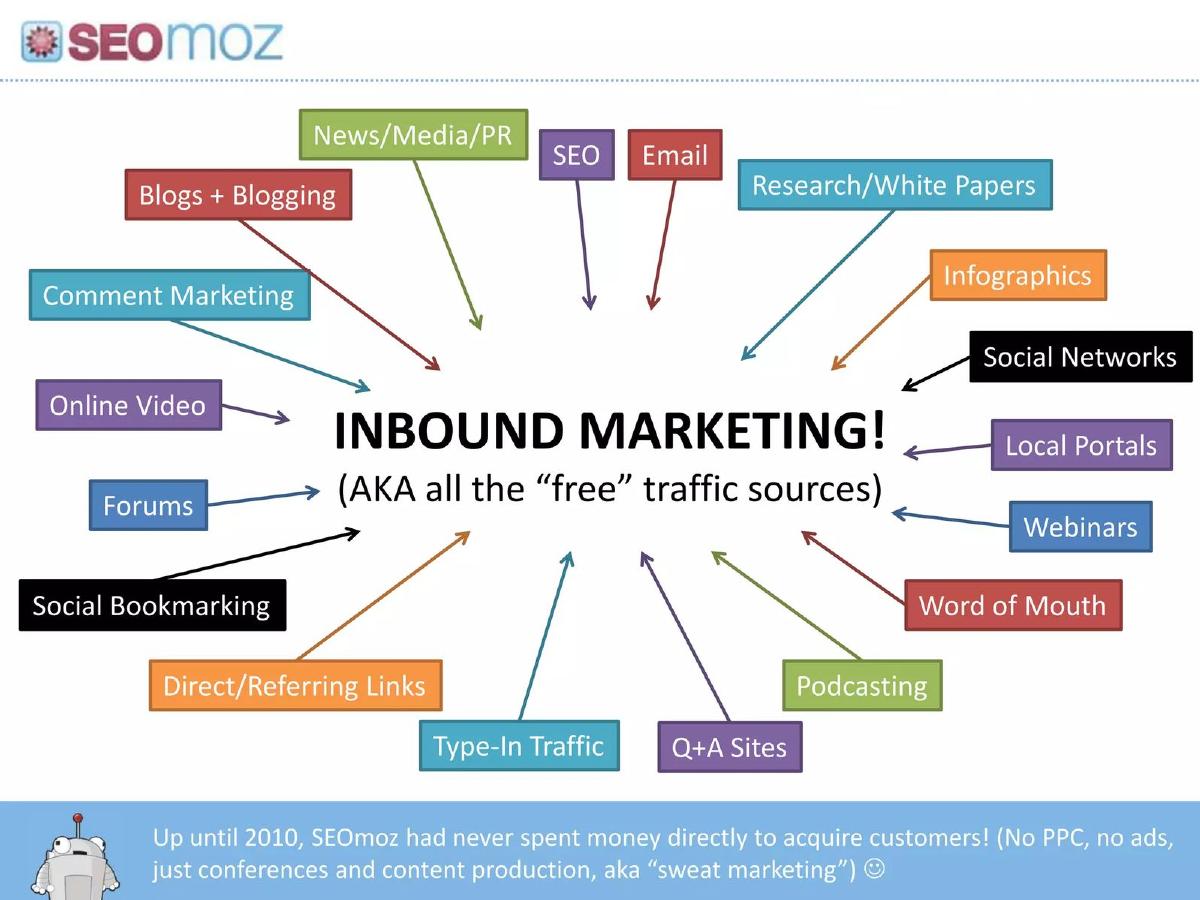
- The 'sweat marketing' strategy allowed the company to avoid all paid customer acquisition (PPC/ads) until 2010 (Slide 3).
- Organic search is positioned as a massive opportunity, driving 90%+ of web traffic but receiving only ~$5 billion in investment compared to $31+ billion for paid media (Slide 5).
- The deck identifies a 'Weekly Analytics Challenge' where marketers must log into 10+ different tools to collect KPIs (Slide 7).
- Transparency in unit economics is high, disclosing a ~57% free trial to paid conversion rate and ~25% churn in the first two months (Slide 11).
- The $20-$25M target raise included a specific $6-$7M allocation for founder equity secondary sales (Slide 12).
- The growth plan involved scaling the team from 40 to 100 'Mozzers' across six core departments (Slide 16).
Introduction: From Consultancy to SaaS Powerhouse
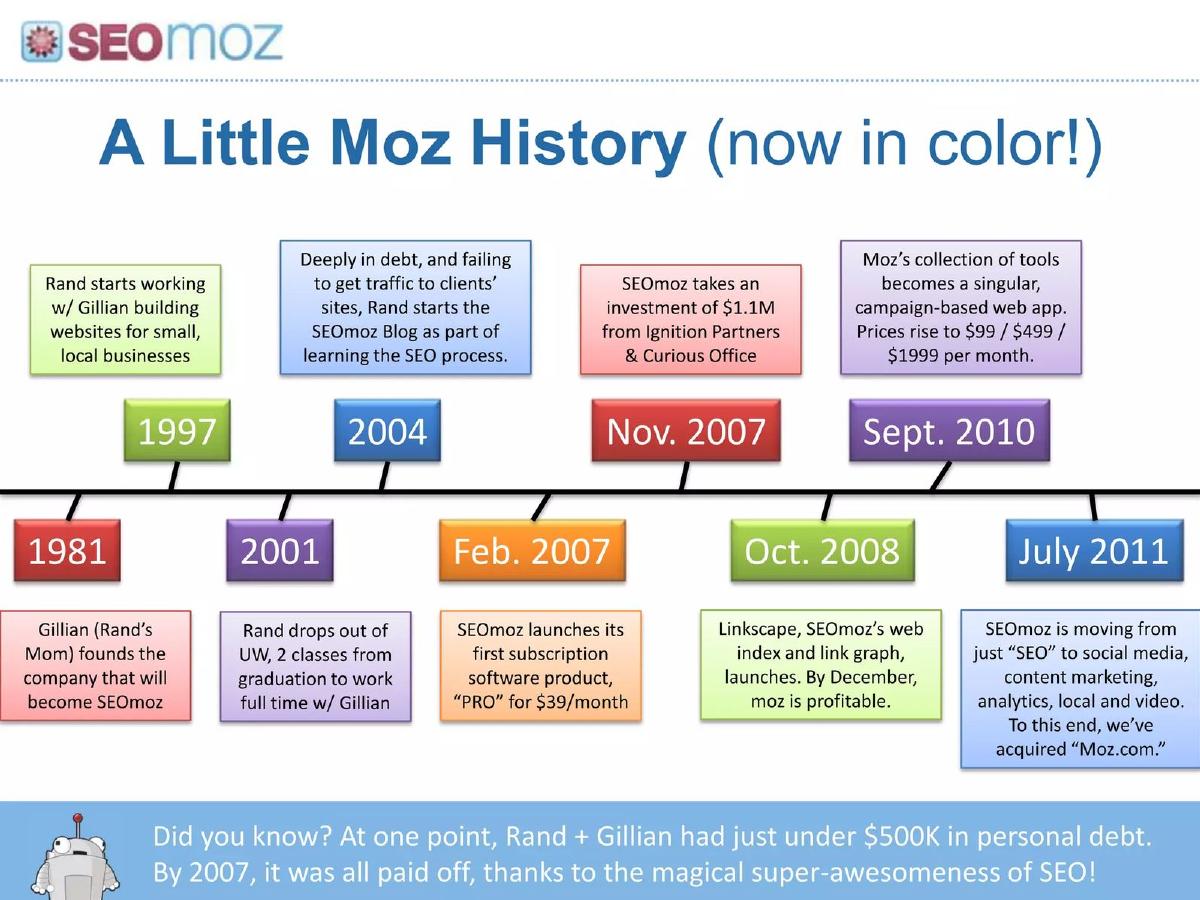
The SEO Moz Series B pitch deck from 2011-2012 is a foundational document in the history of SaaS fundraising. It details the journey of a "tiny Mom + Son consultancy" into a world leader in SEO software. According to the catalogue facts, this deck was used to raise $18M in 2012, led by Ignition Partners. At the time of the deck's creation in July 2011, the company was positioning itself to become "Seattle’s next $1 Billion company."
The Growth Story and Pivot
Slide 1: Title Slide The deck opens with a clear mission statement. It highlights the transition from a consultancy to a software leader and sets an ambitious goal of a $1 billion valuation. The presentation is dated July 2011 and credited to Rand Fishkin, CEO & Co-founder.
Slide 2: Revenue and Traffic Growth This slide provides a high-density look at the company's financial history from 2007 to 2011. It shows a critical strategic pivot: in 2009, the company "dropped consulting entirely." The results were significant. Software revenue grew from $400,000 in 2007 to a projected $12,500,000 in 2011. Simultaneously, monthly visits grew from 250,000 to 1,250,000. A key highlight on this slide is the mention of 83%+ margins and reaching 10K+ subscribers by April 2011.
The Inbound Marketing Moat
Slide 3: Inbound Marketing! Moz defines its competitive advantage through its acquisition strategy. The slide lists 18 different "free" traffic sources, including blogging, SEO, webinars, and word of mouth. The footer contains a powerful claim: "Up until 2010, SEOmoz had never spent money directly to acquire customers!" They refer to this as "sweat marketing."
Slide 4: Macroeconomic Trends This is a transition slide introducing the broader market forces that favor the Moz business model.
Slide 5: Organic Marketing is Under-Invested Moz presents a compelling market gap. According to the slide, organic search drives 90%+ of web traffic but only received ~$5 billion in investment in 2011. Conversely, paid advertising drove Slide 6: Problem(s) We’re Here to Solve A transition slide leading into the specific pain points of the target customer.
Slide 7: The Web Marketer’s Weekly Analytics Challenge This slide visualizes the fragmentation of the marketing toolset. It notes that marketers must log into 10+ services to collect KPIs. It categorizes these tools by usage: "Many (75%+)" use Google Analytics and Facebook Insights; "Most (~50%)" use Bing Webmaster Tools and Bit.ly; and "Some (~10%)" use SEOmoz and Yelp. The value proposition is simple: Moz can put all this data in one place.
Slide 8: Our Target Market A transition slide for market segmentation.
Slide 9: We Help Marketers Who Focus on Organic Using a 2x2 grid (Focus on Organic Web Practices vs. Level of Experience), Moz identifies its current target market as those with moderate-to-expert experience and a moderate-to-exclusive focus on organic SEO. The slide claims they have captured ~5% of this market as paying customers and ~15% as registered members.
Current Performance and Unit Economics
Slide 10: Where are We Today? A transition slide for the company's current metrics.
Slide 11: Key Metrics This is perhaps the most transparent slide in the deck. It lists eight critical data points:
% of Free Trials Converting to Paid: ~57% · Churn Rate in 1st 2 Paid Months: ~25% · Monthly Visits to Moz + OSE: ~1.25 million · Email Subscribers: ~300K · Gross Margins: ~82% · Estimated Net Profit in 2011: ~$1 million · Staffing Costs: ~$650K / Month · Crawling, Serving, Hosting + Processing: ~$180K / Month
The Ask and Risks
Slide 12: The Raise Moz was seeking $20-$25 million. Unusually for a pitch deck, it breaks down where the money goes: $6-$7 million for "Founder Equity" (secondary) and $13-$19 million "Onto Balance Sheet." It also outlines the proposed board structure: 2 Investors, 2 Insiders, and 1 Independent director.
Slide 13: Risk - Google Integration The deck acknowledges the threat of Google integrating SEO and social analytics. It uses a Calvin and Hobbes graphic to illustrate the scale of the threat but frames it as a short-term challenge.
Slide 14: Risk - Failure to Adapt Using a Google Trends chart comparing Digg and Reddit, Moz illustrates the risk of failing to keep up with organic marketing shifts. The chart shows Digg's decline relative to Reddit's growth, serving as a cautionary tale for their own platform's relevance.
Future Roadmap and Conclusion
Slide 15: Use of Funds / Growth Opportunities A transition slide for the 2011-2012 plan.
Slide 16: 2 Year Team Roadmap The plan was to scale from 40 to 100 employees. The slide breaks down hiring needs across Product, Engineering, Marketing, Operations, Customer Success, and Retention. Specific roles like "Broad Web Crawl" engineers and "Quant + Cohort Analysis" specialists are mentioned.
Slide 17: Potential Acquisitions Moz identifies several companies for potential M&A to accelerate growth. Logos shown include GinzaMetrics, Followerwonk, Crowdbooster, GetListed.org, and Distilled. (Note: Moz did eventually acquire Followerwonk and GetListed.org).
Slide 18: Summary The deck concludes with four pillars of the business: 1. Passionate community of 300K+ marketers. 2. A technology lead that is "very hard to catch." 3. A proven record of 2X+ growth for 4 years. 4. A unique, "world-changing" culture.
What Works in This Deck
The SEO Moz deck is exceptionally strong in its transparency and data density . Slide 11, which lists conversion rates, churn, and specific monthly costs, provides the kind of granular detail that Series B investors require but founders often try to obscure. By showing the high trial-to-paid conversion rate (57%), Moz proved that their product had significant pull in the market.
The market gap argument on Slide 5 is also a highlight. By contrasting the massive amount of traffic driven by organic search (90%) against the relatively small investment it receives ($5B), Moz creates a sense of inevitability. They aren't just selling a tool; they are selling a correction to a market inefficiency.
Finally, the strategic pivot narrative on Slide 2 is very effective. Investors love to see a company that has the discipline to kill a lower-margin business (consulting) to focus entirely on a high-margin, scalable software model. Showing the revenue growth accelerating after the consulting arm was dropped in 2009 provides clear evidence of product-market fit.
What is Missing
While the deck is comprehensive, there are a few notable omissions in the 18 slides provided. First, there is no dedicated Team slide in this selection. While the title slide mentions Rand Fishkin, a Series B deck usually highlights the executive leadership team's pedigree, especially when planning to grow from 40 to 100 people. Second, while potential acquisitions are listed, there is no detailed competitive landscape beyond the general threat of Google. Other SEO tools existing at the time (like Raven Tools or SEMRush) are not mentioned or compared. Lastly, the Unit Economics lack LTV/CAC ratios . While they provide churn and conversion rates, a formal calculation of Lifetime Value versus Customer Acquisition Cost would have strengthened the financial argument for the $18M raise.
What a Founder Should Copy
Be Honest About Secondary: If you are raising a Series B or C and intend to provide liquidity for founders, follow the example on Slide 12. Being upfront about "Founder Equity" sales prevents surprises during due diligence and frames the conversation around long-term alignment rather than "cashing out."
The "Problem" as a Workflow Issue: Slide 7 is a perfect way to visualize a problem. Instead of abstract pain points, it shows a concrete workflow struggle (logging into 10+ sites). Founders should try to map out their customers' daily or weekly "challenge" in a similar grid format.
Own Your Risks: Most decks hide risks in an appendix or wait for investors to bring them up. Moz put the "Google Threat" and the "Failure to Adapt" risk (Slides 13 and 14) right in the middle of the deck. This builds immense credibility with investors, as it shows the founders are thinking critically about the longevity of the business.
Community as a Moat: If your business has a non-traditional acquisition channel (like Moz's "sweat marketing"), dedicate a slide to it. Proving you can grow without a massive paid marketing budget is one of the most attractive signals you can send to a VC.
Frequently asked questions
- How did SEO Moz justify its valuation during the Series B?
- Moz justified its valuation by demonstrating a 'proven record of 2X+ growth for 4 years' and reaching an eight-figure revenue run rate ($12.5M) by 2011. They also highlighted their massive organic moat, including 1.25 million monthly visits and 300,000 email subscribers, which allowed for a very low cost of customer acquisition compared to competitors relying on paid ads.
- What was the specific 'Problem' Moz aimed to solve for marketers?
- The deck identifies the 'Web Marketer’s Weekly Analytics Challenge.' It argues that marketers are forced to log into over 10 different services—ranging from Google Analytics and Facebook Insights to Yelp and Bit.ly—to collect basic KPIs. Moz positioned itself as the single platform to consolidate these fragmented data points into one place.
- Why did the deck include a slide about founder equity?
- Slide 12 explicitly mentions $6-$7 million for 'Founder Equity' out of a $20-$25 million raise. This is a secondary sale, allowing founders to take some 'money off the table.' In a Series B, this is often used to align founder and investor incentives for a longer-term hold toward a larger exit, reducing the founders' personal financial pressure.
- How did Moz view the competitive threat of Google?
- Moz addressed the 'Google Threat' directly in its risk section (Slide 13), using a Calvin and Hobbes illustration to depict Google as a giant. They acknowledged that Google might integrate more SEO and social analytics functionality in the short term, which served as a justification for why Moz needed to raise capital to stay ahead technologically.
- What was the 'sweat marketing' strategy mentioned in the deck?
- As shown on Slide 3, 'sweat marketing' referred to Moz's reliance on free traffic sources like blogging, SEO, social media, and community engagement. The company stated it had never spent money on direct customer acquisition (PPC or ads) until 2010, relying instead on content production and conferences to build a community of 300,000+ marketers.