Free Trials on a Pitch Deck: Length, Terms, Conversion
A free trial is a pricing decision investors will question. Four real decks show how to state the trial's terms, report trial-to-paid conversion.
Free Trials on a Pitch Deck: State the Terms, Report Conversion, Show What Happens After
Many subscription companies let new customers try the product free for a week, a month or longer before they pay. On a pitch deck the trial is easy to mention and easy to get wrong. Investors want to know its terms (how long, which plan, whether a card is needed), how many trials turn into paying customers, and how many of those customers stay once the first bill arrives. They also want trial users kept apart from paying ones when the company counts accounts. This guide looks at four real decks: one that reports trial conversion and early churn side by side, one that shares what six months of trials taught the founders, one that ties a short trial to an annual price, and one that lists a trial as a plan feature with no result.
TL;DR
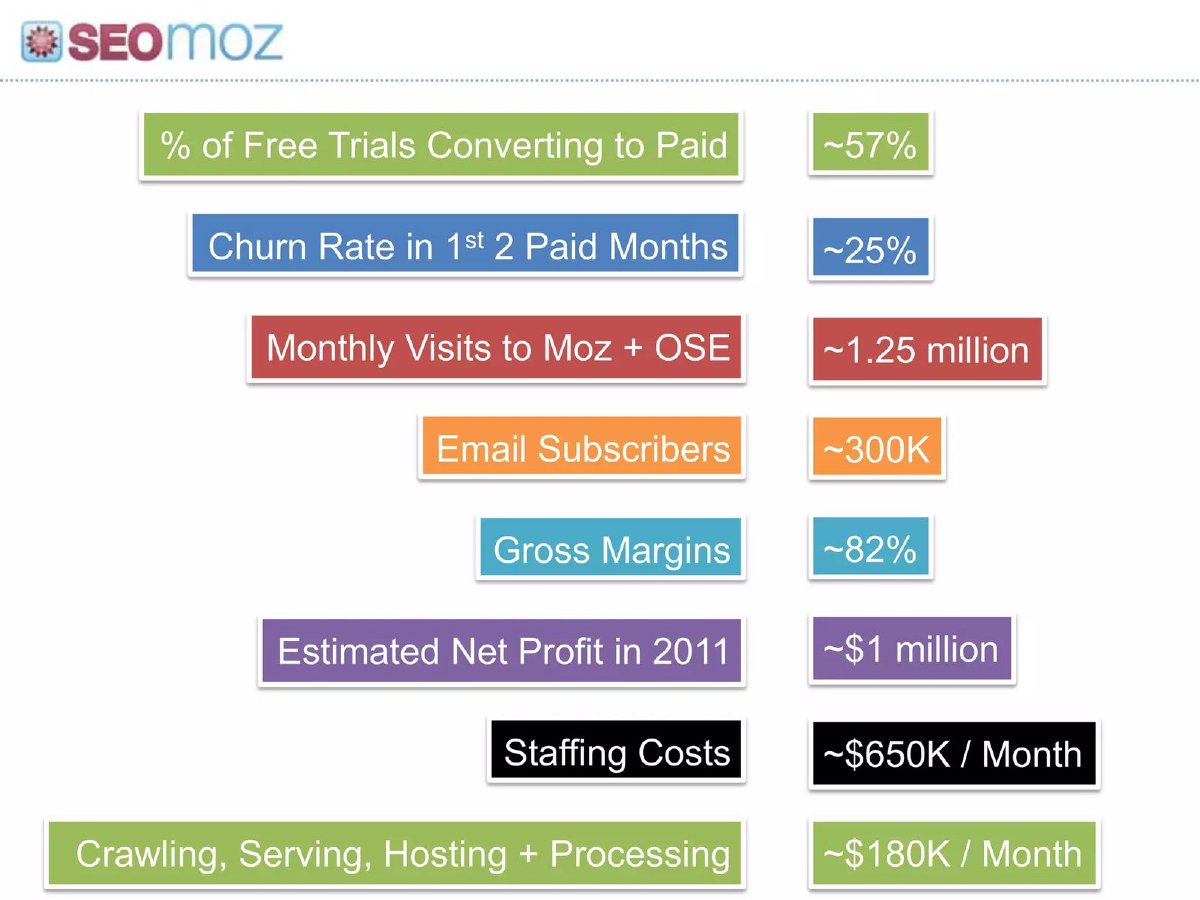
State the trial's terms (length, which plan, card required or not), report the share of trials that convert to paid with its period, show churn in the first paid months, and count trial users separately from paying customers. SEOmoz does the most in one slide: '% of Free Trials Converting to Paid ~57%' beside 'Churn Rate in 1st 2 Paid Months ~25%'; if both apply to the same customers, roughly 43 of every 100 trials are still paying after two months (our calculation). Mattermark's 'Lessons learned from 6 months of SaaS sales' says 'Trial accounts w/out credit card info up front rarely close' and '30 day trial != 30 days to close', which explains its trial policy but gives no rates; its accounts chart elsewhere in the deck shows free-trial accounts as their own colour, separate from paying subscribers. Curio states 'Price: $59.99 p.a. (with 7 day free trial) or $7.99/month', which tells the reader the trial is attached to the annual plan but not how many trials convert. Hoorah lists '1 month free trial' as a feature of its 'USD 10/MTH per user' business plan, with no result.
Four slides that present a free trial
Each slide is read at full size. Quotes are exact.
SEOmoz deck, slide 21. Exact stored slide matched to this analysis.
Our analysis: Answers how many trials become lasting customers.
Evidence and limitation: Conversion and early churn stated; terms and period not given. About 43 of 100 trials still paying after two months (our calculation).
What a founder can adapt: Add trial length, card policy and the measurement period.
Supporting analysis
What the deck claims: "% of Free Trials Converting to Paid ~57%"; "Churn Rate in 1st 2 Paid Months ~25%"; "Gross Margins ~82%".
Presentation choice: The only example with both conversion and early churn.
When it does not fit: Conversion without the trial terms beside it.
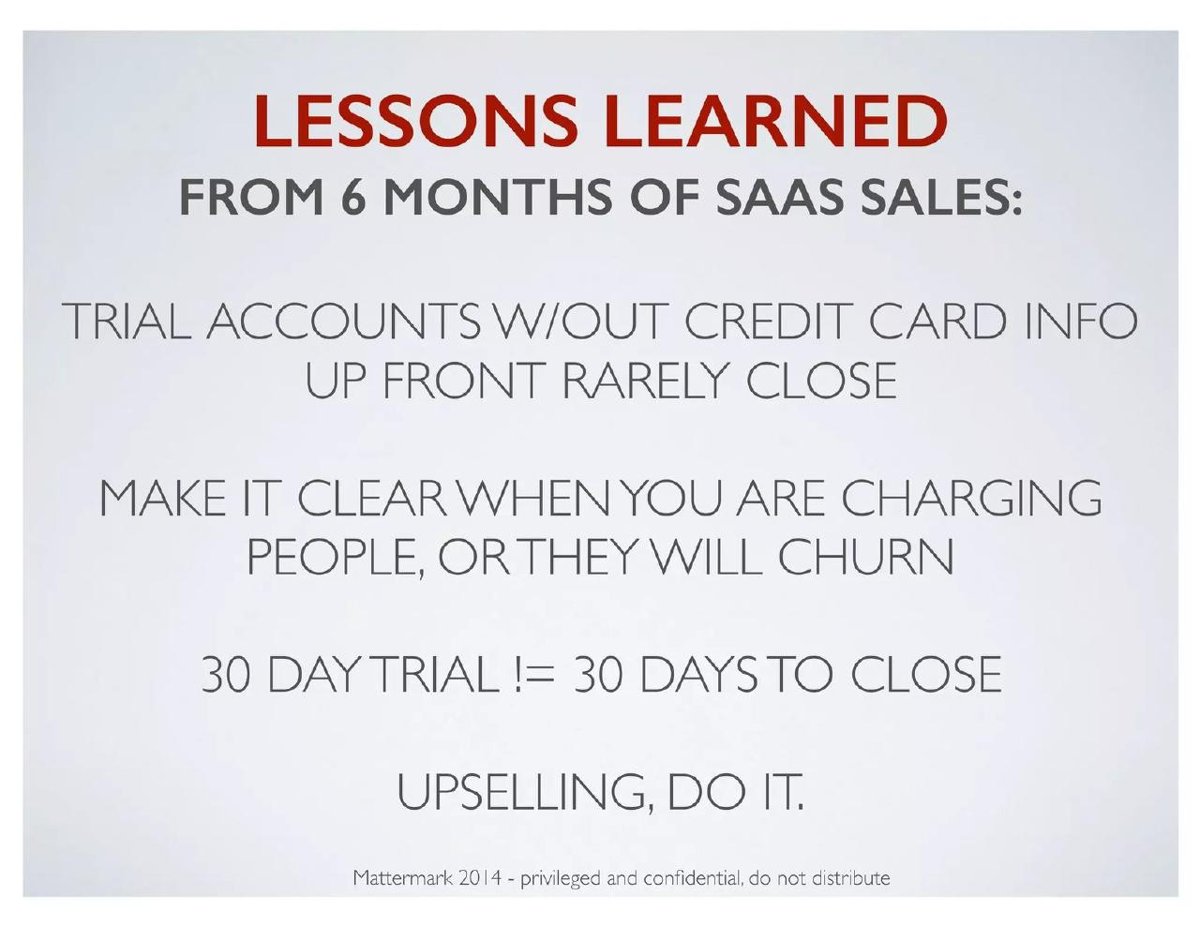
Mattermark deck, slide 25. Exact stored slide matched to this analysis.
Our analysis: Shows the founders tested and learned from their trial policy.
Evidence and limitation: Qualitative lessons; no rates. Trial accounts charted separately elsewhere in the deck.
What a founder can adapt: Add conversion with and without a card, and the change you made.
Supporting analysis
What the deck claims: "Trial accounts w/out credit card info up front rarely close"; "Make it clear when you are charging people, or they will churn"; "30 day trial != 30 days to close".
Presentation choice: Shows how to present what a trial taught you.
When it does not fit: 'Rarely' where a number is available.
State length, plan and whether a card is required.
Report trial-to-paid conversion with its period.
Show churn in the first paid months, not just conversion.
Count trial users apart from paying customers.
Say what the trial taught you and what you changed.
Don't compare trial conversion with freemium conversion.
Prepare your free trial
Answer these before writing the slide.
Terms. How long, which plan, card or no card, what happens at the end?
Conversion. What share of trials converted, over which period?
Early churn. What share of converters cancel in the first paid months?
Counts. Are trial users kept out of your customer totals?
Copyable framework: "[n]-day trial, card [required/not]; [a]% convert ([period]); [b]% of converters cancel within [n] paid months."
Illustrative example 1 — written by us
Before: "% of Free Trials Converting to Paid ~57%" and "Churn Rate in 1st 2 Paid Months ~25%"
After: "[n]-day trial, card [required]; ~57% convert ([period]); ~25% of those cancel in two months, so ~43% of trials still pay."
What improved: Our illustrative rewrite of SEOmoz's lines. Bracketed details are not stated on the slide; the 43% is our calculation.
The question this guide answers
This guide answers one founder question: if my product has a free trial, what should my deck say about it so that investors can judge whether it works?
Our freemium conversion guide covers free plans that never expire and warns that trial conversion should not be compared with free-to-paid rates, but it doesn't explain how to present a trial. Our pricing guide covers tiers and price levels, and our conversion funnel guide covers the stages from visit to purchase. Our churn and retention guide covers churn across the customer base. None takes the free trial as its subject: which terms to state, which conversion figure to report, how to show what happens in the first paid months, and how to keep trial users out of customer counts.
How we chose and read the examples
We searched extracted text across the library for 'free trial' and 'day trial'. Most of the 44 matches were a single line on a product or go-to-market slide ('free trials/demos', 'free trial, no hassle'). We kept four private-company slides that show a trial in different ways: a metrics slide with trial conversion and early churn, a lessons slide about trial policy, a price line linking a trial to an annual plan, and a pricing card listing a trial. Rattle's slide reporting 'xx% of users move from free trials to paid plans' was set aside because the figure is redacted. Mattermark's accounts chart (page 10) is described in the text but not shown as a separate example, because it comes from the same deck.
Each slide was rendered from the source deck and read at full size. Combined figures, such as the share of SEOmoz trials still paying after two months and Curio's annual discount, are our calculations from the slides' own numbers. All four companies were private when these decks were made. We did not check any figure against outside sources.
Why investors probe the trial
It shapes the funnel. A trial moves the paying decision from the first visit to the end of the trial. Conversion at that point drives how many customers each marketing dollar buys, so it sits behind CAC and payback.
It can inflate counts. Trial users are active, often in large numbers, and they are not customers. A chart of 'users' or 'accounts' that mixes them in overstates the paying base.
Conversion is only half the answer. A trial that converts well but loses a quarter of its customers in the first two paid months is less valuable than the conversion figure suggests. Investors look for early churn alongside it.
The terms change the meaning. A 7-day trial on an annual plan and a 30-day trial with no card are different offers. A 57% conversion rate from card-required trials is not comparable with 5% from no-card trials, so the terms belong beside the rate.
Conversion and early churn side by side: SEOmoz
SEOmoz, the search-marketing software company later renamed Moz, has a metrics slide in its 2011 deck with eight coloured labels and values. The first two are '% of Free Trials Converting to Paid ~57%' and 'Churn Rate in 1st 2 Paid Months ~25%'. The rest are 'Monthly Visits to Moz + OSE ~1.25 million', 'Email Subscribers ~300K', 'Gross Margins ~82%', 'Estimated Net Profit in 2011 ~$1 million', 'Staffing Costs ~$650K / Month' and 'Crawling, Serving, Hosting + Processing ~$180K / Month'.
Placing trial conversion directly above early churn is the lesson. Together they answer the real question, how many trials become lasting customers, instead of stopping at the end of the trial. If the 25% applies to the customers who converted, 57% × 75% means about 43 of every 100 trials are still paying after two paid months (our calculation). That single figure is more useful to an investor than either number alone, and the slide gives the reader enough to work it out.
What the slide leaves out are the terms and the period. It doesn't say how long the trial is, whether a card is required, or over what months the 57% was measured. A 57% rate is high for trials without a card and more ordinary for trials with one, so the missing term matters. One added line would fix it: '30-day trial, card required; ~57% convert (Jan–Jun 2011); ~25% of converters cancel in their first two paid months.'
What trials taught the founders: Mattermark
Mattermark, a startup data company, has a slide headed 'Lessons learned from 6 months of SaaS sales' with four lines: 'Trial accounts w/out credit card info up front rarely close', 'Make it clear when you are charging people, or they will churn', '30 day trial != 30 days to close', and 'Upselling, do it.' Earlier in the same deck, a stacked 'Accounts' chart from June to December 2013 splits accounts into 'Paying Subscribers', 'Enterprise Seats', 'Free Trial' and 'Founders', with the note 'Paid subscribers growing 31% MoM, Enterprise seats growing 71% MoM, Total accounts growing 40% MoM'.
The lessons slide shows that the founders tested their trial policy and learned from it, which is what investors want from an early company. Two of the four lines are about trials: no-card trials rarely convert, and the trial length is not the sales cycle. The third, about making charges clear, links the trial to early churn. Read with the accounts chart, which shows free-trial accounts as a large separate band, the reader can see why the policy matters: in our reading of the chart, trial accounts make up a large share of total accounts in every month shown.
The gap is that the lessons have no numbers. 'Rarely close' could mean 2% or 20%, and the slide doesn't say whether the company moved to card-required trials or what happened when it did. The '40% MoM' total also includes the trial band, so the paying growth figures are the ones to read. A stronger version: 'No-card trials converted [a]%; card-required [b]% since [month]. Typical close [n] days after trial start.'
A trial attached to an annual price: Curio
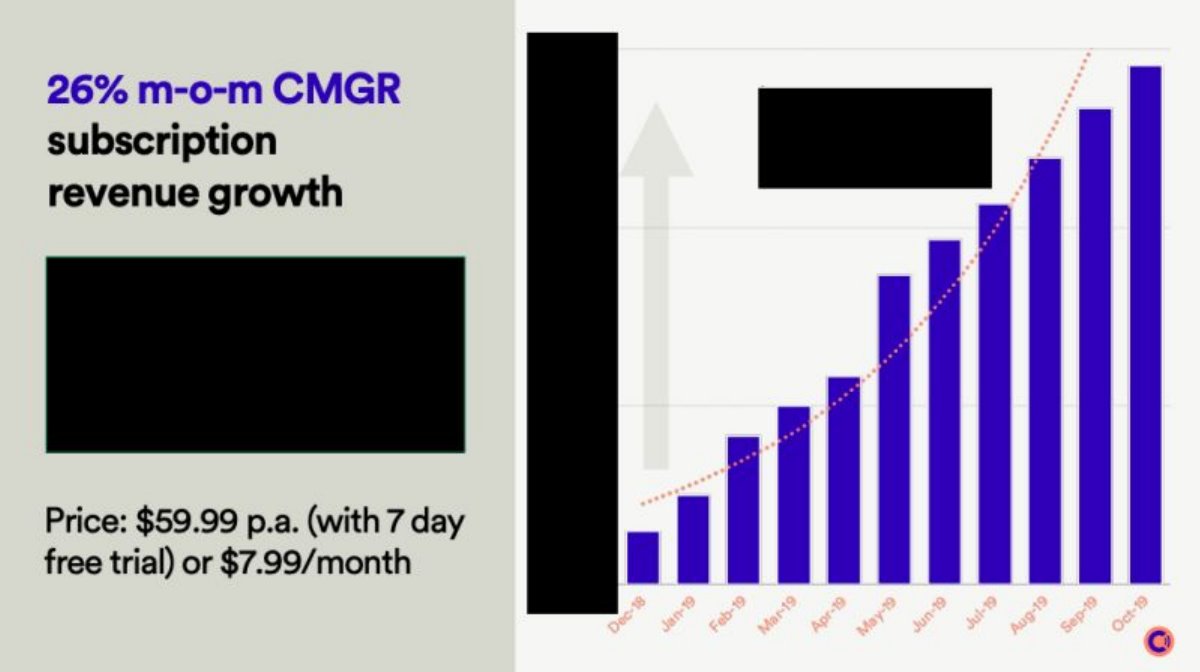
Curio, an audio journalism app, has a slide headed '26% m-o-m CMGR subscription revenue growth' with a monthly bar chart from Dec-18 to Oct-19 and several blacked-out boxes in our copy. Below the headline: 'Price: $59.99 p.a. (with 7 day free trial) or $7.99/month'.
The price line does more than it seems. It says the trial is attached to the annual plan, which is a common way to steer customers toward paying a year upfront. Twelve months at $7.99 is $95.88, so the annual plan is about 37% cheaper (our calculation). An investor reading the line understands the offer: a short trial, then a discounted year.
What it can't show is whether the trial works. There is no conversion rate, no split between annual and monthly subscribers, and no figure for how many annual subscribers renew. The redactions may have hidden some of this. If they did not, a short addition would help: '[x]% of trials convert; [y]% of subscribers choose annual.'
A trial as a feature: Hoorah
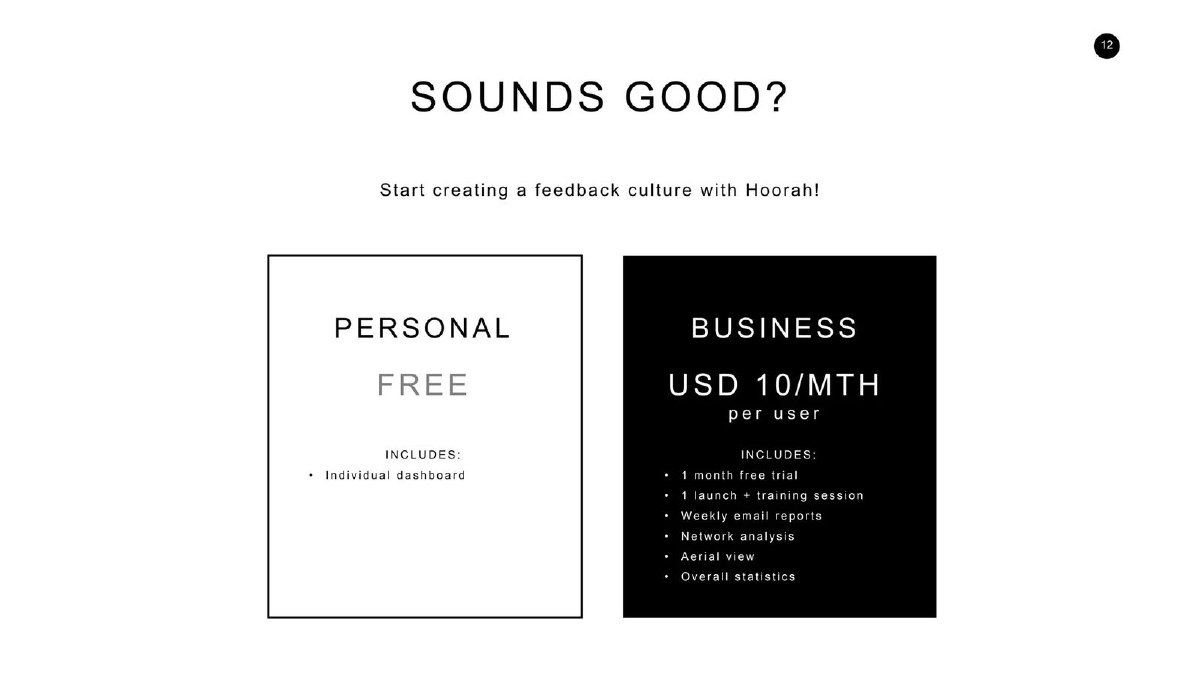
Hoorah, a workplace feedback app, ends its deck with a pricing slide headed 'Sounds good?' and 'Start creating a feedback culture with Hoorah!'. Two cards: 'Personal FREE', including 'Individual dashboard', and 'Business USD 10/MTH per user', including '1 month free trial', '1 launch + training session', 'Weekly email reports', 'Network analysis', 'Aerial view' and 'Overall statistics'.
The card states the trial's length and which plan it applies to, which is more than many decks do. It also pairs a free personal plan with a paid business plan that has its own trial, a structure worth explaining because the two free offers do different jobs: one brings in individuals, the other lets a company test the paid product.
As evidence it is empty. The trial appears as a feature in a list, with no number of trials started, converted or retained. For an early company that may be honest, but the slide could say so: 'Trials started: [n] since [month]; first conversions expected [month].' Without that, an investor can't tell whether the trial has been offered to anyone.
What to put on the slide
The terms. Length, which plan, whether a card is needed, and what happens at the end (automatic charge or a prompt). Hoorah and Curio show length and plan; neither says whether a card is needed.
The conversion rate. The share of trials that become paying customers, with the period measured and the trial terms beside it. SEOmoz's line is the model, with a date added.
The early churn. The share of converted customers who cancel in the first one to three paid months. SEOmoz is the only one of the four to show it.
The separation. Count trial users apart from paying customers in every chart and total. Mattermark's accounts chart gives trials their own colour.
The lesson. If you have changed your trial, say what you changed and what happened. Mattermark's lessons slide is the model; add the numbers.
Where the trial goes in the deck
On the business model or pricing slide for the terms. On the traction or funnel slide for conversion and early churn. In the unit economics, where trial conversion feeds CAC and payback.
Keep it consistent. If the funnel shows 57% trial conversion and the CAC model assumes 15% visit-to-paid, the reader should be able to see how the two fit.
Templates
Terms: '[n]-day free trial on [plan]; card [required/not required]; auto-converts to $[x]/[period].'
Conversion: '[a]% of trials convert to paid ([period], [n] trials).'
Early churn: '[b]% of new subscribers cancel in their first [n] paid months.'
Change: 'Moved to card-required trials in [month]: conversion [c]% → [d]%.'
What these examples can and cannot show
These four slides show how founders have presented free trials. They can't show whether the trials were profitable, how conversion changed over time, or how these rates compare with other companies. Our combined SEOmoz figure assumes the churn rate applies to the same converted customers. Curio's discount is our arithmetic from its two prices. Our reading of Mattermark's chart is visual; the chart gives no labels for each band.
Treat them as patterns. SEOmoz reports conversion and early churn together but not the terms. Mattermark shares trial lessons and separates trial accounts but gives no rates. Curio ties a short trial to an annual price. Hoorah lists a trial and nothing more.
Common mistakes
No terms. A conversion rate with no trial length or card policy.
No early churn. Conversion reported, but not who cancels after the first bill.
Trials as customers. Trial users counted in user or account totals.
Wrong comparison. Trial conversion compared with freemium conversion.
Feature, not result. A trial listed with no number of trials or conversions.
Diagnostic checklist
Trial length, plan and card policy stated.
Trial-to-paid conversion with period.
Churn in the first paid months.
Trial users counted separately.
Changes to the trial and their effect.
Frequently asked questions
Should my trial require a credit card?
That is a product decision. Whatever you choose, say it beside your conversion rate, because card-required and no-card trials convert at very different rates.
I have just launched my trial. What can I show?
The terms, the number of trials started, and when the first cohort ends. Label it as early.
How we chose these examples
Corpus: published pitch deck teardowns on StartupFundraising.com. Founder-uploaded private decks are excluded.
Selection (2026-10-01): we searched extracted text for 'free trial' and 'day trial', set aside one-line mentions and a slide with a redacted conversion rate, and kept four private-company slides each presenting a trial differently.
Review: the four slides, and Mattermark's accounts chart for context, were rendered from the source decks on 2026-10-01 and read in full at full size against company, deck and slide number (editorial model review, with AI assistance in drafting; not human-reviewed). Combined figures were calculated from the slides' stated numbers. No figure was checked against outside sources.