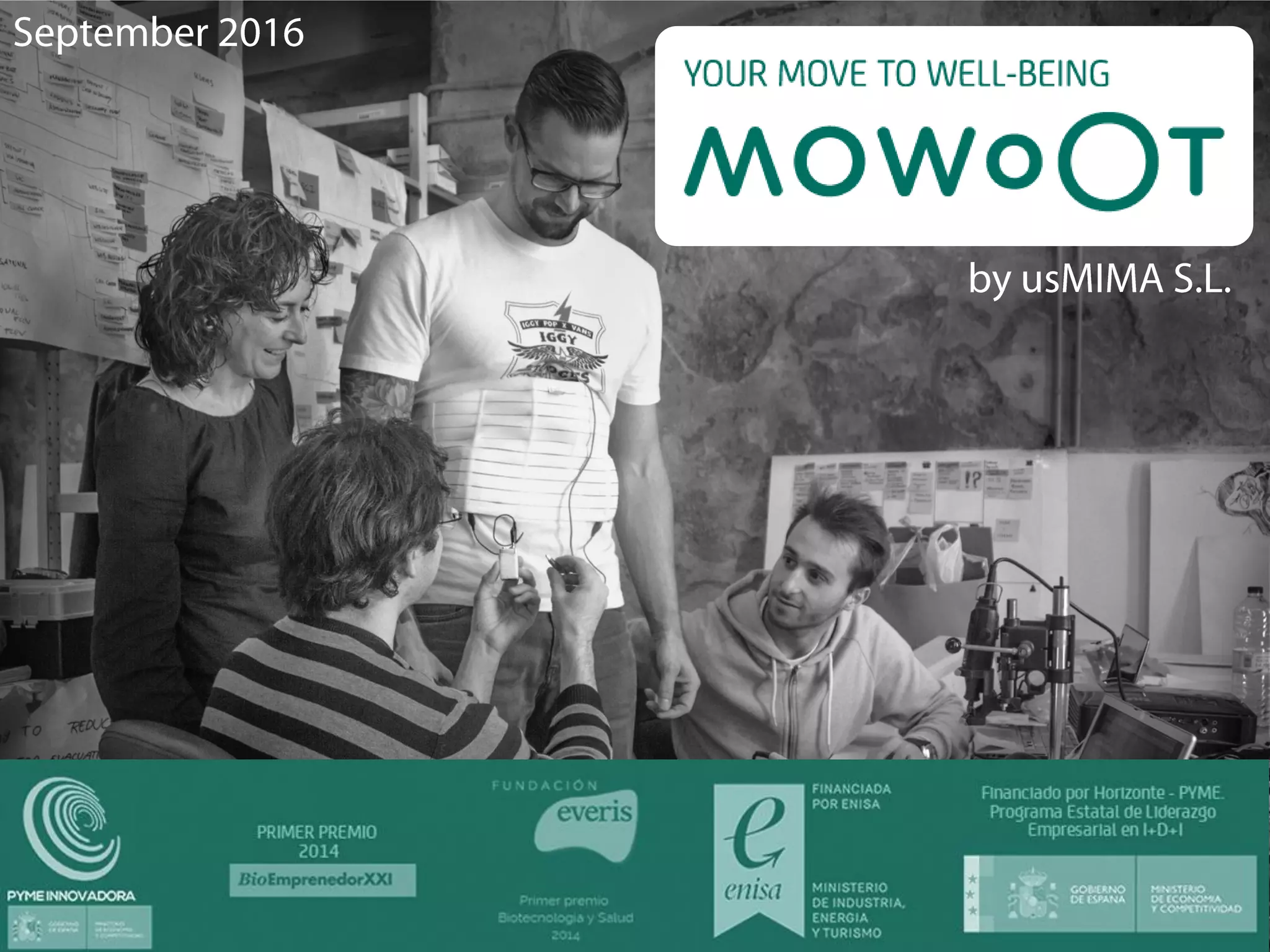
Mowoot’s 2016 pitch deck introduces a non-invasive, non-pharmacological medical device designed to treat chronic constipation through automated abdominal massage. The company positions itself as a disruptive alternative to expensive and invasive treatments, such as Medtronic pacemakers costing over 35,000€ and annual enema costs of 2,300€. By targeting the 80% of neurogenic disease patients and 15% of the general population suffering from constipation, Mowoot aims to fill a massive 'opportunity gap' with a device priced under 500€. The deck relies heavily on prototype testing data showing an…
Key takeaways
- The product addresses a high-prevalence medical issue affecting 80% of neurogenic disease patients and 15% of the general population (Slide 3).
- Mowoot identifies a price-to-side-effect gap, positioning its device at under 500€ compared to 700€/year for laxatives and 35,000€ for pacemakers (Slide 6).
- The technology utilizes an 'Actuator Matrix' to deliver automated abdominal massage via a wearable belt and control unit (Slide 7).
- Prototype testing results claim to increase bowel movement frequency from 2-3 times per week to daily (Slide 8).
- The company holds a PCT patent (PCT/IB2015/001576) for the 'Method and Apparatus for Automated Abdominal Massage' (Slide 11).
- The founding team is highly academic, featuring three PhDs in Biomedical Sciences, Telecom Engineering, and Microbiology (Slide 19).
- Mowoot has secured early validation through awards like the 2014 BioEmprendedorXXI and funding from ENISA and the Spanish Ministry of Industry (Slide 1).
- The deck lacks essential financial projections, a detailed business model, and a specific funding request in the provided slides.
Introduction and Visual Identity
The Mowoot pitch deck, dated September 2016, opens with a cover slide that emphasizes the company's origins and early validation. The company is registered as usMIMA S.L. The visual identity is clean, using a teal and white color palette that suggests a medical or wellness focus. A significant portion of the first slide is dedicated to institutional logos, including the Spanish Ministry of Industry, Energy and Tourism, ENISA, and the European Patent Office. These logos serve as immediate social proof, indicating that the company has already navigated some level of government or institutional vetting.
Slide 1: Title and Validation
The cover slide features a black-and-white photograph of the team working on a prototype. This humanizes the technical nature of the product. The tagline 'YOUR MOVE TO WELL-BEING' is positioned above the Mowoot logo. The bottom of the slide lists several accolades, including 'Primer Premio 2014 BioEmprendedorXXI' and 'Fundación Everis Primer Premio 2014.' This establishes that the company has been active for at least two years prior to this deck and has a history of winning startup competitions in the biotech and health sectors.
Slide 3: The Problem and Market Size
Slide 3 uses a simple, high-contrast visual to define the target market. It splits the audience into two categories: '80% of Neurogenic Disease Patients' and '15% of General Population.' By using these figures, Mowoot identifies a massive total addressable market (TAM). The choice of imagery—an elderly person in a wheelchair versus a crowded public space—clearly delineates the two primary user personas: the chronically ill and the general consumer suffering from lifestyle-related constipation. This slide effectively communicates that the problem is both severe for a specific niche and prevalent in the broader population.
Slide 6: Competitive Landscape and Opportunity Gap
This is a critical strategic slide. Mowoot uses a 2x2-style grid, though it is formatted as an 'Opportunity Gap' chart. The Y-axis represents 'Price' and the X-axis represents 'Side Effects.' Mowoot places itself in the bottom-left corner: 'Less than 500€' with 'non-pharma, non-invasive, no-side-effects.' They contrast this against:
Laxatives: ~700€/year with high side effects (Pfizer, J&J, Bayer, Roche). · Enemas: ~2,300€/year with moderate side effects (Coloplast, Peristeen). · Pacemakers: >35,000€ with high price and invasive nature (Medtronic).
By framing the competition this way, Mowoot makes a compelling case for the economic and clinical superiority of their device. They aren't just competing on price; they are competing on the quality of life (fewer side effects).
Slide 7: Product and Technology
Slide 7 provides a 'Schematic' of the 'Actuator Matrix.' It shows a transparent overlay of the human digestive system with four teal ovals representing the actuators placed over the large intestine. Below the torso is a photo of the physical control unit, which features a digital display (showing '15'), a timer, pressure settings, and play/pause/stop buttons. This slide is essential for moving the conversation from a conceptual 'solution' to a tangible 'product.' It shows that the hardware is designed to mimic the physical motion of manual massage, which is a recognized clinical technique for bowel stimulation.
Slide 8: Efficacy and Prototype Results
To answer the inevitable question, 'Does it work?', Slide 8 presents a bar chart titled 'Results of Prototype Testing.' The metric is 'Bowel Movements.' The 'Pre-Use' bar shows a frequency of 2-3 per week, while the 'Post-Use' bar shows a frequency of 'DAILY.' While the data is presented simply, it provides the necessary 'proof of concept' that investors look for in medical device startups. However, the slide is missing details on the number of participants (n=?) and the duration of the study, which would be required for a deeper due diligence process.
Slide 11: Intellectual Property
Slide 11 focuses on 'Protected Intellectual Property.' It lists the PCT application number PCT/IB2015/001576 and the title: 'METHOD AND APPARATUS FOR AUTOMATED ABDOMINAL MASSAGE TO RELIEVE CONSTIPATION.' The inclusion of the European Patent Office logo and the name of the patent firm (ZBM Patents) reinforces the company's defensibility. For a hardware-based medical device, IP is often the most valuable asset, and Mowoot clearly prioritizes this in their narrative.
Slide 19: The Team
The team slide, titled 'Multidisciplinary Experts,' showcases a group of four founders. The academic credentials are the highlight here:
Markus (CEO): PhD in Microbiology. · Immaculada (CSO): PhD in Biomedical Sciences. · Angel (CTO): PhD in Telecom Engineering. · Marc (CCO): MSc in Product Design.
Having three PhDs on a four-person founding team provides immense technical credibility. It suggests that the device is rooted in scientific research rather than just consumer gadgetry. The photo shows the team holding the device, further proving that the product exists in a functional form.
Slide 24: Conclusion and Additional Information
The final slide provided is a transition slide titled 'ADDITIONAL INFORMATION.' It contains no data but serves as a placeholder for appendices. In a full deck, this would typically be followed by financial tables, regulatory pathways (CE mark/FDA), or detailed clinical data.
What Works in the Mowoot Deck
Clear Value Proposition: The deck does an excellent job of explaining why the product needs to exist. By comparing the cost of the device (under 500€) to the annual cost of laxatives and enemas, they make a 'no-brainer' economic argument for both patients and healthcare providers.
Technical Credibility: The combination of a PCT patent and a team heavily weighted with PhDs gives the impression of a high-barrier-to-entry product. This is vital in MedTech, where 'copycat' products are a constant concern.
Visual Simplicity: The slides are not cluttered. They use large text, clear charts, and professional photography. The 'Opportunity Gap' slide (Slide 6) is particularly effective at summarizing the entire business case in one image.
What is Missing from the Mowoot Deck
The Ask: The provided slides do not include a funding request. We don't know how much they are raising or what the 'use of proceeds' will be (e.g., manufacturing scale-up, clinical trials, or marketing).
Go-to-Market (GTM) Strategy: While the market size is established, the deck doesn't explain how they will sell the device. Will it be sold D2C (Direct-to-Consumer), through pharmacies, or via prescription through hospitals and specialists?
Regulatory Roadmap: For a medical device in 2016, the path to CE marking in Europe or FDA approval in the US is a major milestone. The deck mentions the patent but doesn't detail where they stand in the regulatory process.
Financial Projections: There are no slides showing revenue targets, unit economics (COGS vs. MSRP), or break-even analysis. Investors need to see how a The Opportunity Gap Chart: Founders should emulate Slide 6. Instead of a standard 2x2 matrix where the startup is just in the 'top right,' Mowoot uses specific price points and side-effect profiles to show exactly where the market is underserved. This is much more persuasive than generic 'feature' comparisons.
Credentialing: If your team has advanced degrees, list them clearly at the bottom of the team slide as Mowoot does. It immediately signals that the founders have the 'right to win' in a technical space.
Social Proof Placement: Putting award logos and government funding stamps on the very first slide (Slide 1) is a smart move. It sets a tone of legitimacy before the investor even reads the problem statement.
Hardware Visualization: The 'Actuator Matrix' (Slide 7) is a great way to explain complex hardware. It shows the 'how' without getting bogged down in engineering blueprints, making it accessible to non-technical investors.
Frequently asked questions
- What specific problem is Mowoot solving?
- Mowoot is addressing chronic constipation, which the deck notes affects 80% of patients with neurogenic diseases and 15% of the general population. Current solutions are either invasive (pacemakers), chemical-based with side effects (laxatives), or recurringly expensive (enemas). Mowoot offers a non-invasive, non-pharma alternative.
- How does the Mowoot device work technically?
- According to Slide 7, the device uses an 'Actuator Matrix Schematic.' It consists of a wearable belt containing four primary pneumatic or mechanical actuators placed over the abdomen. These are connected to a control unit that allows the user to adjust pressure and time to simulate manual abdominal massage.
- What is the competitive pricing strategy?
- Mowoot positions itself as the low-cost leader in the specialized treatment space. Slide 6 shows the device priced at 'Less than 500€.' This is significantly cheaper than the annual cost of enemas (~2,300€/year) or the one-time cost of surgical pacemakers (>35,000€), while claiming fewer side effects than 700€/year laxative regimens.
- What evidence of efficacy does the company provide?
- Slide 8 presents 'Results of Prototype Testing' regarding bowel movements. The data shows that before using the device, subjects averaged 2-3 bowel movements per week. After using the Mowoot device, the frequency increased to 'Daily.' However, the slide does not specify the sample size or clinical trial parameters.
- Is the technology proprietary?
- Yes, Slide 11 highlights 'Protected Intellectual Property' under PCT/IB2015/001576. The patent covers both the method and the apparatus for automated abdominal massage. The slide also mentions the European Patent Office and ZBM Patents, indicating a formal legal strategy to protect their hardware and method.