Multus, a London-based biotech startup, raised $9.5M in 2022 to address the most significant cost driver in the cultivated meat industry: growth media. Their Series A deck positions the company as a critical infrastructure provider rather than a consumer brand. By focusing on animal-free nutrients, Multus aims to lower production costs and eliminate ethical concerns associated with traditional serum. The deck highlights their origins at Imperial College London and their participation in IndieBio, signaling technical credibility. While much of the specific market data and performance metrics a…
Key takeaways
- The deck identifies growth media as the 'key' to affordable and scalable meat production on Slide 4.
- Multus positions itself as a B2B supplier targeting three distinct market segments: scale-up, pilot-stage, and research-stage companies as shown on Slide 6.
- The founding team leverages institutional credibility from Imperial College London and IndieBio on Slide 2.
- The company emphasizes its intellectual property position with 'Patent Pending' badges on Slide 5.
- Market dynamics on Slide 3 focus on three pillars: Ethics (No Animals Killed), Health (0mg Antibiotics), and Sustainability (GHG Reduction).
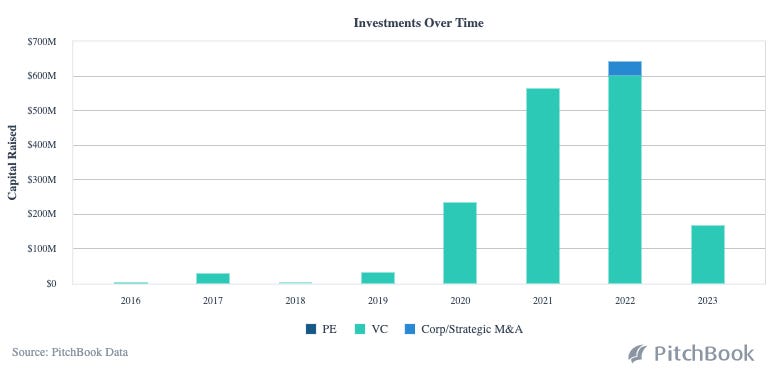
- The deck uses a macro-to-micro approach, starting with a PitchBook chart of industry investment trends on Slide 1.
- The mission statement on Slide 2 explicitly targets making cultivated meat 'affordable' for everyone, addressing the industry's biggest hurdle.
- The product line, including Proliferum M, is presented as a serum substitute designed for high performance and low cost on Slide 5.
The Macro Context: Industry Momentum
Slide 1: Investment Trends
Multus opens their deck not with their own logo, but with a PitchBook data chart titled 'Investments Over Time.' This slide serves to validate the entire sector before the company even introduces itself. The chart shows a dramatic increase in capital raised for cultivated meat, peaking in 2022 at over $600M. By starting here, Multus is telling investors: 'The smart money is already moving into this space; we are the infrastructure that will make those investments pay off.'
The Team and Mission
Slide 2: The Founders and Origins
Slide 2 introduces the core team: Reka Tron (COO), Cai Linton (CEO), and Kevin Pan (CTO). The slide is heavy on institutional credibility, featuring logos for Imperial College London and IndieBio. It notes the company was incorporated in March 2020. This slide sets the stage for a 'science-first' narrative. The mission statement at the bottom is clear: 'Make cultivated meat the sustainable and affordable choice, for everyone.' The use of the word 'affordable' is critical, as it acknowledges the primary barrier to mass adoption in the industry.
The Market Opportunity
Slide 3: Step-Change in Production
This slide outlines the 'Cultivated Meat Market Dynamics.' It frames the technology as a solution to three major global issues: Ethics (No Animals Killed), Health (0mg Antibiotics), and Sustainability (GHG Reduction). While the specific percentage for GHG reduction is redacted, the intent is clear: cultivated meat is a moral and environmental imperative. The slide also references consumer surveys regarding the willingness to pay a premium for cultured meat, though the specific percentages and regions are redacted.
The Technical Solution
Slide 4: The Growth Media Bottleneck
Slide 4 is perhaps the most important slide for a technical investor. It presents a simple equation: Stem Cells + Nutrients + Bioreactor = Cultivated Meat. By highlighting 'Nutrients' (growth media) and noting it accounts for a significant percentage of costs (redacted, but typically cited as 55-95% in industry literature), Multus identifies itself as the 'key' to profitability. They aren't trying to build the whole cow; they are selling the 'fuel' that makes the cow grow.
Slide 5: Product and Intellectual Property
This slide introduces the 'Proliferum' product line. It categorizes the value proposition into three buckets: Performance, Cost, and Scalability. Crucially, the slide features two 'Patent Pending' stamps. In biotech, IP is the primary driver of valuation, and Multus is signaling that their formulations are proprietary and protected. The visual of the laboratory bottles (Proliferum M, Serum P, etc.) makes the abstract concept of 'nutrients' feel like a tangible, shippable product.
Go-To-Market Strategy
Slide 6: Market Segmentation
Multus demonstrates a sophisticated understanding of their customer base on Slide 6. They segment the market into Scale-up, Pilot-stage, and Research-stage companies. This suggests a tiered pricing and product strategy. By catering to research-stage companies, they get 'designed in' to the production process early, creating high switching costs as those companies move toward pilot and full-scale production.
Slide 7: Closing and Contact
The final slide is a standard contact page with the Multus logo, website, and social media handles. It maintains the clean, clinical aesthetic established throughout the deck.
What Works in the Multus Deck
1. Clear Value Proposition: The deck does an excellent job of identifying a single, massive problem (the cost of growth media) and positioning the company as the primary solution. By focusing on one part of the value chain, they avoid the 'boil the ocean' trap that many early-stage startups fall into.
2. Credibility Markers: The inclusion of Imperial College London and IndieBio logos immediately signals to investors that the team has been vetted by top-tier academic and accelerator programs. This is vital for a Series A biotech raise where the technical risk is high.
3. Logical Flow: The narrative moves seamlessly from the macro industry growth (Slide 1) to the specific technical hurdle (Slide 4) to the proprietary solution (Slide 5). It follows a classic 'Problem-Solution-Product' arc that is easy for investors to digest.
What is Missing from the Multus Deck
1. Detailed Unit Economics: While the deck mentions that nutrients are the key to affordability, the public version lacks specific data on how much Multus reduces the cost per liter of media compared to traditional fetal bovine serum. Investors in this space need to see a clear path to price parity with conventional meat.
2. Competitive Landscape: The deck does not explicitly mention other growth media startups or how Multus differentiates itself from incumbents like Thermo Fisher or Merck, who are also eyeing this space. A competitive matrix or 'Why Us' slide would strengthen the case for their specific technical approach.
3. The 'Ask' and Use of Funds: There is no slide in this version detailing how much they are raising (though we know it was $9.5M) or how that capital will be allocated. Typically, a Series A deck should outline milestones such as 'Build out manufacturing facility' or 'Achieve regulatory approval in X region.'
Founder Takeaways
Focus on the Bottleneck: If you are in a crowded or expensive industry, don't try to compete with the giants on the final product. Instead, identify the single most expensive component of the process and become the best supplier of that component. Multus isn't making burgers; they are making the stuff that makes burgers possible.
Lead with Industry Validation: If your sector is seeing a massive influx of capital, use that to your advantage. Starting with a third-party chart (like the PitchBook data on Slide 1) creates a sense of urgency and 'FOMO' (fear of missing out) before you even pitch your specific company.
Segment Your Customers: Don't treat all potential clients as a monolith. By showing that you have different offerings for research vs. scale-up companies, you demonstrate a clear understanding of the B2B sales cycle and how to grow alongside your customers.
Frequently asked questions
- What problem is Multus specifically solving?
- Multus is solving the cost and ethical bottlenecks of growth media in cultivated meat. Traditional growth media often relies on fetal bovine serum, which is expensive and contradicts the 'animal-free' premise of lab-grown meat. Multus develops animal-free nutrients that aim to make the final product price-competitive with traditional meat.
- How does Multus segment its target market?
- According to Slide 6, Multus targets three tiers of companies: Scale-up stage companies (large-scale production), Pilot-stage companies (testing and validation), and Research-stage companies (early-stage R&D). This allows them to capture value across the entire lifecycle of a biotech firm.
- What is the significance of the Imperial College London mention?
- Slide 2 highlights that the company was founded at Imperial College London. For a biotech startup, this provides essential academic and technical validation, suggesting that the underlying science is rigorous and born out of a top-tier research institution.
- Does the deck mention any specific products?
- Yes, Slide 5 showcases their product line, specifically naming 'Proliferum M,' an animal-free serum substitute. The slide indicates that these products are designed to address performance, cost, and scalability, with multiple patents pending to protect their formulations.
- What macro trends does Multus use to justify its business?
- The deck begins with a PitchBook chart on Slide 1 showing a massive spike in capital raised for cultivated meat between 2020 and 2022. It also cites consumer willingness to pay a premium and the environmental necessity of changing food systems on Slides 2 and 3.