Mural’s pitch deck is a concise 10-slide presentation that effectively leverages traction and team experience to build an investment case. Founded in 2011, the company presents a compelling narrative of transitioning physical 'project rooms' into digital environments. The deck highlights significant financial milestones, specifically $1.6M in ARR with 95% year-over-year growth as of Q1 2016. It leans heavily on enterprise validation, featuring a direct quote from the Head of IBM Design and logos from Disney, PayPal, and Autodesk. The team slide emphasizes a history of successful exits, includ…
Key takeaways
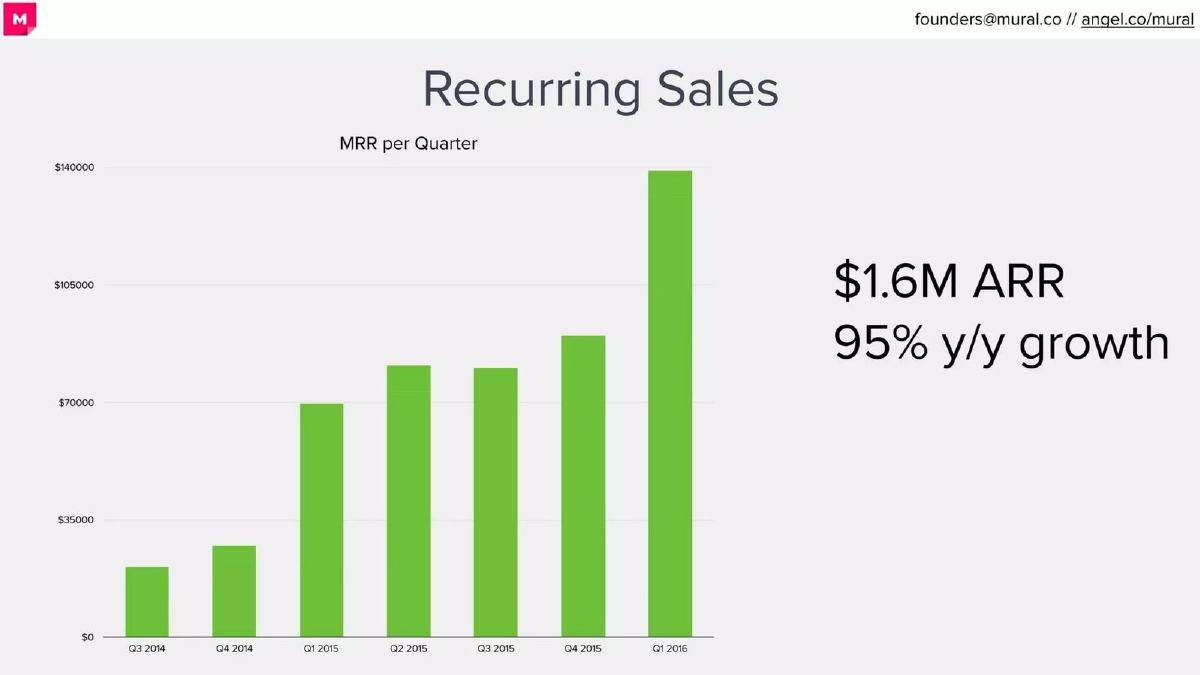
- The deck reports $1.6M in ARR with 95% year-over-year growth as of Q1 2016 (Slide 2).
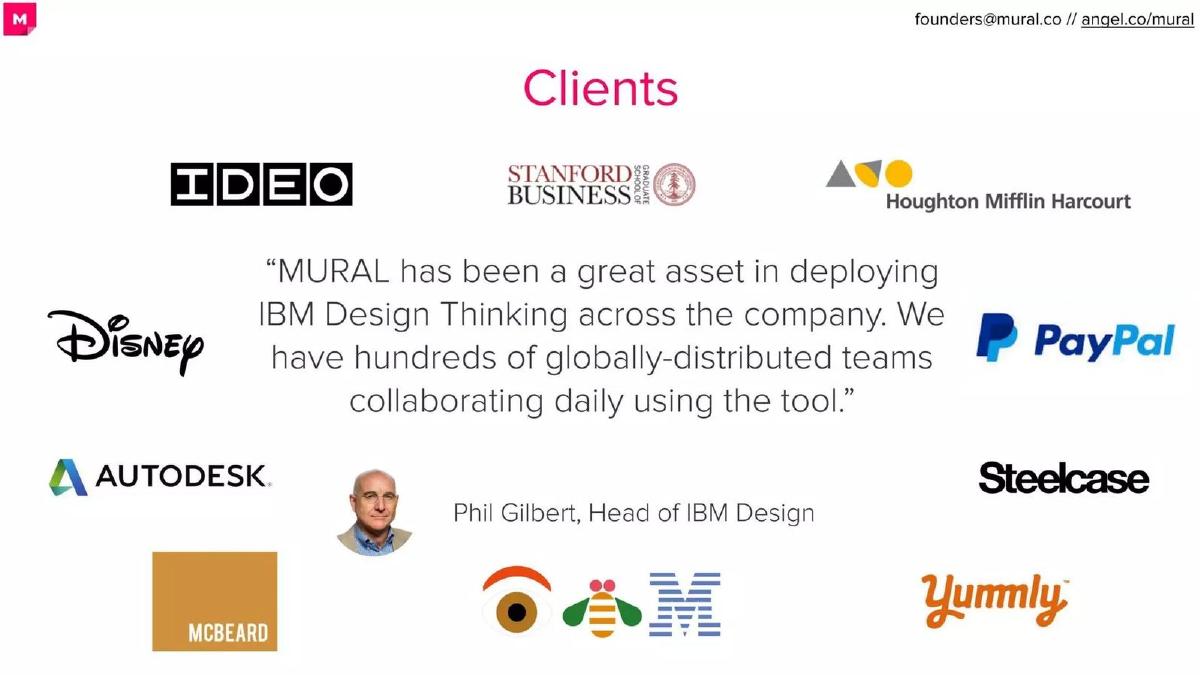
- Enterprise validation is a core pillar, featuring logos from IBM, Disney, PayPal, and Autodesk (Slide 3).
- Phil Gilbert, Head of IBM Design, provides a testimonial stating that hundreds of globally-distributed teams use the tool daily (Slide 3).
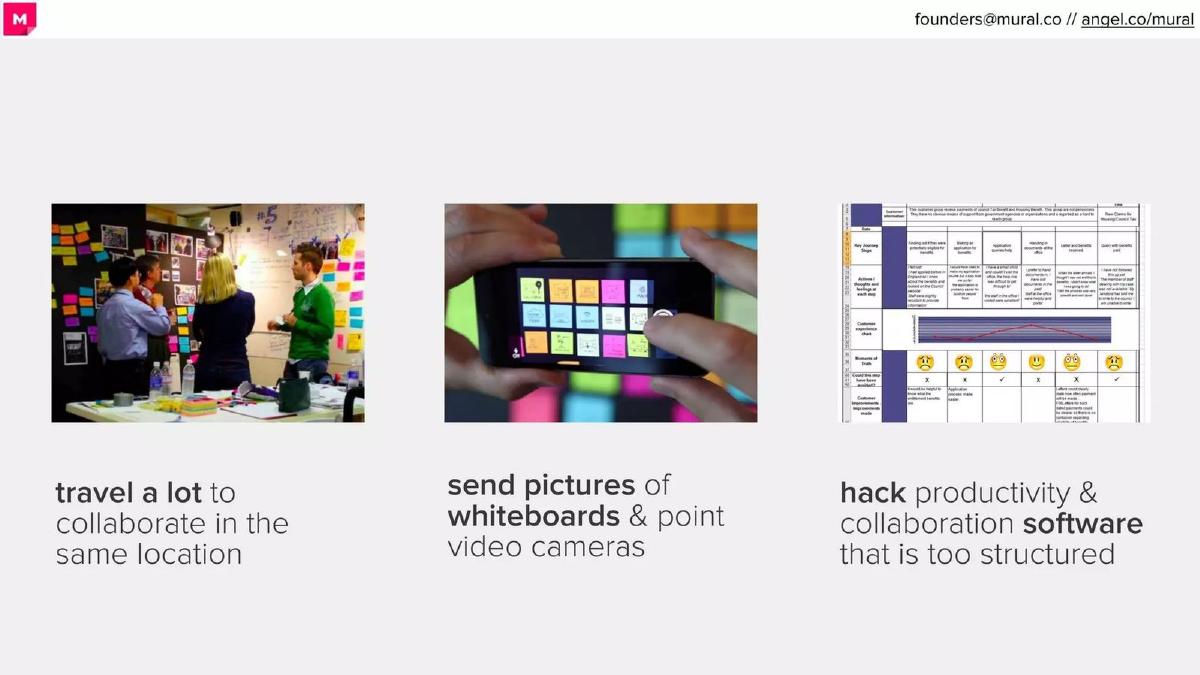
- The problem is framed through the inefficiency of physical travel and 'hacking' structured software for creative work (Slide 6).
- The solution is presented as 'Flexible Structure Digital Whiteboards' designed for continuous collaboration (Slide 7).
- The founding team has significant exit experience, specifically selling a previous venture to Playdom/Disney (Slide 8).
- Mural participated in the IDEO Startup in Residence program, adding design-industry prestige (Slide 8).
- The company had already secured $2M in seed funding from investors including Intel Capital and 500 Startups (Slide 9).
Introduction: The Lean Enterprise Pitch
Mural’s 10-slide deck is a study in brevity and high-signal information. Founded in 2011, the company identifies as a collaborative intelligence firm. At the time of this deck's creation, Mural was positioning itself as the digital successor to the physical 'war room' or 'project room' used by design and product teams. The deck does not waste time on abstract problem statements; instead, it immediately validates the business through revenue growth and enterprise adoption. This teardown examines how Mural used a minimalist structure to communicate a massive market opportunity in the early days of the remote work revolution.
Slide 1: Title and Tagline
The cover slide is functional and visual. It features the Mural logo over a grayscale image of a physical whiteboard covered in sticky notes, which serves as a visual metaphor for the problem they are solving. The tagline, "Collaborate Visually from Anywhere," is a direct value proposition. Notably, the slide includes contact information and a link to their AngelList profile, signaling that this deck was intended for active circulation among investors.
Slide 2: Recurring Sales and Growth
Mural makes a bold move by placing their traction slide second. This immediately answers the most important question for a Series-stage investor: 'Is there a product-market fit?' The slide displays a bar chart of MRR per Quarter from Q3 2014 to Q1 2016. The visual shows consistent growth, culminating in a callout of "$1.6M ARR" and "95% y/y growth." By leading with these figures, Mural earns the right to spend the rest of the deck explaining the 'how' and 'why' because the 'what' (a growing SaaS business) is already established.
Slide 3: Enterprise Client Validation
Slide 3 focuses on social proof. It features a high-density collection of logos including IDEO, Disney, PayPal, Autodesk, Steelcase, and Stanford Business. The centerpiece is a quote from Phil Gilbert, Head of IBM Design , stating that Mural is a "great asset in deploying IBM Design Thinking across the company" with "hundreds of globally-distributed teams collaborating daily." This slide is crucial because it demonstrates that Mural is not just a tool for small startups, but a scalable solution for the world's largest and most complex organizations.
Slide 4: The Physical Precedent
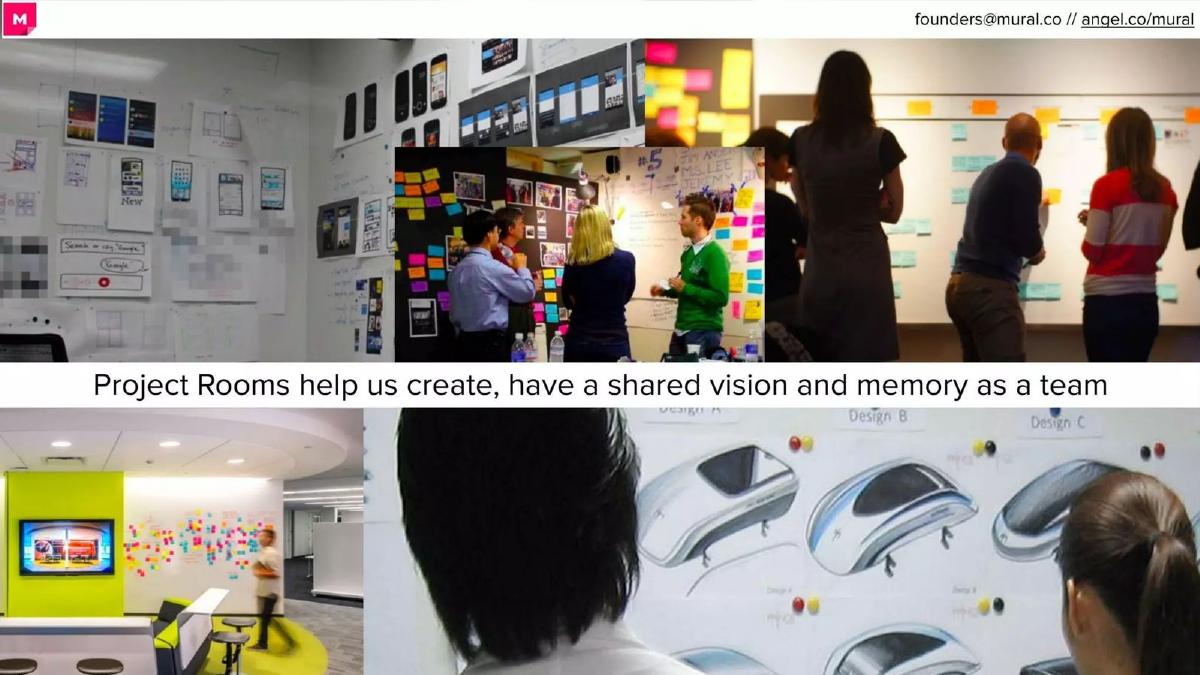
This slide uses a collage of photos showing physical 'Project Rooms.' The text states, "Project Rooms help us create, have a shared vision and memory as a team." This establishes the baseline behavior Mural intends to digitize. It appeals to the investor's understanding of how creative work happened traditionally—sticky notes, sketches, and physical proximity—setting the stage for the 'digital transformation' narrative.
Slide 5: The Geographic Problem
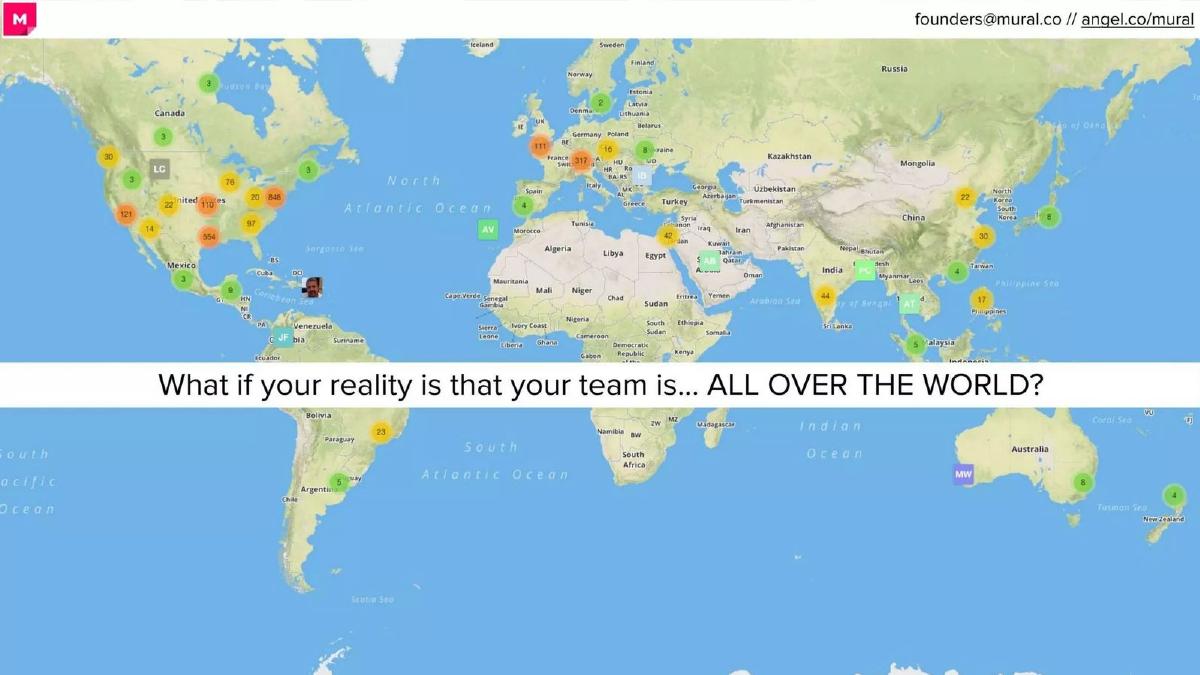
Slide 5 introduces the friction point. Over a world map populated with user clusters, the text asks, "What if your reality is that your team is... ALL OVER THE WORLD?" The map shows significant activity in North America and Europe, with emerging clusters in South America, Asia, and Australia. This slide effectively transitions the narrative from 'how teams work' to 'why the current way of working is broken' due to globalization and distributed workforces.
Slide 6: Current Inefficient Workarounds
Mural identifies three 'pain points' or current behaviors that they aim to replace:
Travel a lot to collaborate in the same location. · Send pictures of whiteboards and point video cameras. · Hack productivity & collaboration software that is too structured.
This is a classic 'status quo' slide. It highlights the cost (travel), the friction (photos of boards), and the tool-gap (structured software like Jira or Excel being used for unstructured creative work).
Slide 7: The Solution
The solution slide is split between a high-quality photo of a team using a large touchscreen and two product diagrams. It labels the product as "Flexible Structure Digital Whiteboards" and "Continuous Collaboration." The imagery emphasizes that the software works across devices (desktop, tablet, and large-format screens) and connects users globally. This is the first time the deck explicitly shows the interface, focusing on the 'sticky note' aesthetic that users of physical boards would find familiar.
Slide 8: The Team
The team slide emphasizes experience and successful exits. Mariano Suarez-Battan (CEO) is highlighted as a "2x entrepreneur" who sold a video games publisher to Playdom/Disney. Patricio Jutard (Head of Product) is credited with scaling a game to 1M DAUs. The slide also lists Jim Kalbach, Celeste Olivieri, and Johnny Halife , citing their decades of experience at Citrix, Microsoft, and as O'Reilly authors. The inclusion of the "IDEO Startup in Residence" badge adds significant industry prestige, suggesting that the product was forged within the world's leading design firm.
Slide 9: Summary and Market Drivers
The summary slide lists their existing $2M seed funding and logos of investors like Intel Capital, Alta Ventures, Collaborative Fund, Nxtp.Labs, IDEO, and 500 Startups. It also lists three macro trends driving their growth:
Visual Collaboration growing due to Design Thinking & Experience Design. · Remote work growing due to distributed teams & digital nomads. · Large Touchscreens coming to every project room.
This slide serves to convince the investor that Mural is riding a wave of inevitable market shifts.
Slide 10: Product in Action
The final slide is a full-bleed photo of a founder (presumably Mariano) interacting with a large-scale Mural board on a touchscreen. It shows a complex "Visual System Simplified" with dozens of digital sticky notes and diagrams. This serves as a 'vision' slide, showing the product's capability to handle high-density professional work, ending the deck on a high-fidelity visual note.
What Works in the Mural Deck
1. Immediate Traction: By putting the $1.6M ARR and 95% growth on Slide 2, Mural eliminates the skepticism that often plagues 'creative tools.' They prove that companies are willing to pay for this solution before they even explain how the software works.
2. High-Quality Social Proof: The IBM testimonial is incredibly strong. Having the Head of Design at one of the world's largest tech companies vouch for 'daily use' by 'hundreds of teams' is a level of validation that most startups never achieve.
3. Clear Market Tailwinds: Slide 9 does an excellent job of connecting the product to broader economic and technological shifts (Design Thinking and Remote Work). It makes the investment feel like a bet on a macro trend rather than just a single piece of software.
4. Founder Pedigree: The 'sold to Disney' narrative on the team slide provides investors with confidence in the founders' ability to execute an exit. It reduces the perceived risk of the leadership team.
What is Missing from the Mural Deck
1. The Ask: There is no slide stating how much money Mural is currently raising, the valuation, or the milestones they intend to hit with the new capital. This is a significant omission for a fundraising deck.
2. Competition: The deck does not mention competitors like Miro (then RealtimeBoard) or InVision. Investors would naturally want to know how Mural differentiates itself in a crowded visual collaboration market.
3. Unit Economics: While ARR is shown, there is no mention of Customer Acquisition Cost (CAC), Lifetime Value (LTV), or churn rates. For a SaaS business, these metrics are vital for evaluating the efficiency of the growth shown on Slide 2.
4. Product Roadmap: The deck explains what the product does now, but it doesn't offer a vision for how it evolves. The mention of 'large touchscreens' is a hardware trend, but it doesn't detail the software's future capabilities (e.g., integrations, AI, or advanced facilitation features).
What a Founder Should Copy
1. The 'Traction First' Approach: If you have impressive revenue or user growth, don't bury it. Putting it at the front of the deck changes the tone of the entire meeting from 'pitching a dream' to 'discussing a business.'
2. The Use of Visual Metaphors: Mural uses photos of physical whiteboards to explain their digital product. This makes an abstract software concept immediately relatable to anyone who has ever worked in an office.
3. Leveraging Logos: Don't just list logos; provide context. Mural’s use of the IBM quote alongside the logo is much more powerful than a simple grid of icons. It tells a story of deep integration rather than just a trial user.
4. Lean Design: With only 10 slides, this deck is easy to digest. It avoids 'wall of text' slides and relies on clear headers and high-impact imagery. Founders should aim for this level of clarity and brevity.
Frequently asked questions
- What is Mural's primary value proposition according to the deck?
- Mural positions itself as a 'Flexible Structure Digital Whiteboard' that enables continuous collaboration for distributed teams. The deck argues that traditional productivity software is too structured for creative work, and physical collaboration requires expensive travel. Mural bridges this gap by providing a shared digital vision and memory for teams regardless of their physical location.
- How does Mural demonstrate market traction?
- Traction is demonstrated through both financial metrics and high-tier client logos. Slide 2 shows a clear upward trajectory in MRR from Q3 2014 to Q1 2016, ending at $1.6M ARR. Slide 3 reinforces this with logos from global enterprises like IDEO, Stanford Business, and Steelcase, alongside a testimonial from IBM describing large-scale internal deployment.
- What is the background of the founding team?
- The team is described as 'second-time entrepreneurs.' CEO Mariano Suarez-Battan previously sold a video game publisher to Playdom (later acquired by Disney). The team also includes veterans from Citrix, Microsoft, and Razorfish, and they are alumni of the IDEO Startup in Residence program, which aligns with their focus on design-led collaboration.
- What market trends does Mural aim to capitalize on?
- Slide 9 identifies three specific tailwinds: the growth of Visual Collaboration driven by Design Thinking and Experience Design, the increase in remote work due to distributed teams and digital nomads, and the hardware trend of large touchscreens being installed in physical project rooms.
- What critical information is missing from this pitch deck?
- The deck lacks a specific 'Ask' slide detailing how much capital is being raised and the intended use of funds. It also omits a detailed competitor analysis, unit economics (such as CAC or LTV), and a clear roadmap for future product development beyond the general mention of large touchscreens.