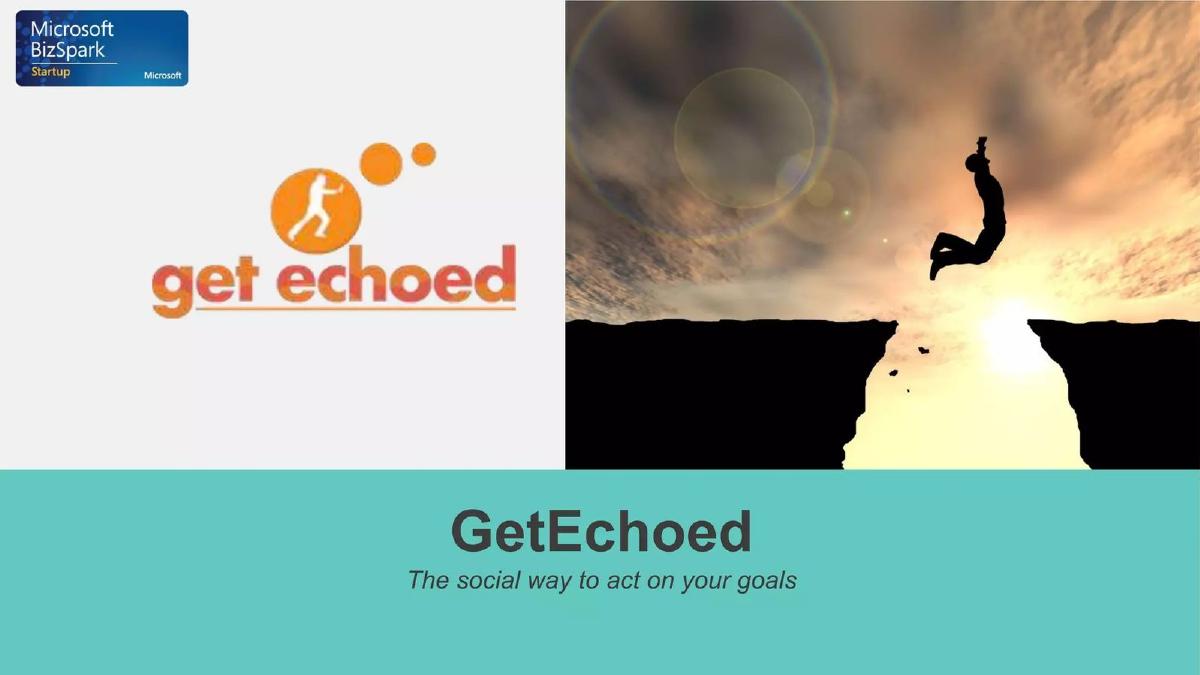
GetEchoed is a social productivity platform aimed at helping users transition from goal-setting to achievement through community reinforcement. The 17-slide deck identifies three core problems: lack of structure, lack of support, and a tendency to give up early. While the deck effectively highlights a blue-chip founding team with experience at LinkedIn, Cisco, and eBay, it suffers from significant omissions typical of early-stage social concepts. There is no specific financial ask, no detailed budget allocation, and no clear roadmap for user acquisition beyond generic market statistics. The r…
Key takeaways
- The platform identifies its core value proposition as the 'social way to act on your goals' (Slide 1).
- The problem is defined across three pillars: Structure, Support, and Inspiration (Slide 8).
- The product utilizes a four-stage loop: Goal Setting, Collaborate, Track, and Achieve & Inspire (Slide 10).
- Market data focuses heavily on Indian internet users, noting that 25% of their time is spent on web groups (Slide 14).
- The revenue strategy is tripartite, consisting of Corporate Partnerships, Brand Impressions, and Sponsored Challenges (Slide 15).
- The founding team brings significant corporate pedigree, citing experience at LinkedIn, Cisco, eBay, and Aon (Slide 16).
- The deck completely omits a financial 'Ask' slide, leaving investors unaware of the funding target or valuation (Slide 17).
- There is a lack of specific unit economics or user growth projections, relying instead on high-level social network trends (Slide 14).
The Vision and Opportunity
Slides 1-4: Setting the Scene
The GetEchoed deck opens with a high-level vision: "empower people to live their goals – super fueled by their communities" (Slide 2). The introductory slides use a collage of lifestyle imagery—skydiving, running, cooking, and dancing—to represent human aspirations. Slide 4 explicitly states the opportunity: these goals "make us better at whatever we do." This is a classic emotional hook, attempting to align the product with the universal human desire for self-improvement. However, the branding on Slide 1 includes a Microsoft BizSpark logo, indicating the startup was part of Microsoft's early-stage support program at the time of the deck's creation.
Slides 5-7: The 'Limbo' Problem
The deck transitions into the problem statement by contrasting the vibrant imagery of the first slides with a desaturated, grey version of the same collage. Slide 6 introduces the concept of "limbo," suggesting that most people fail to move from aspiration to action. Slide 7 is the most substantive of the problem section, breaking down the friction into three categories: Structure (organizing thoughts), Support (connecting with others), and Inspiration (overcoming the tendency to quit). This framing is effective because it identifies specific psychological and social barriers that a software solution could theoretically address.
The Solution and Product Mechanics
Slides 8-10: The GetEchoed Platform
Slide 9 presents the solution: a toolset and community support system to act on personal goals. The tagline "Its about the journey; not about the destination" suggests a focus on process and tracking rather than just end-results. Slide 10 provides a process flow for "cracking the demon" of inaction. The loop consists of Goal Setting (Commitment), Collaborate (Motivation), Track (Getting Back), and Achieve & Inspire (Prestige). This circular model implies a gamified or social feedback loop designed to keep users engaged over the long term.
Slides 11-12: User Experience and Interface
Slide 11 highlights four key pillars of the user experience: Quantified (measuring impact), Personalized (personal relevance), Rewarding (leaving a legacy), and Social (community fueling). Slide 12 provides the first look at the actual interface. It shows a goal selection screen with categories like Health, Technology, and Adventure. It also displays a progress tracker (e.g., "70%" completion for a 'Bokeh' photography goal) and a social feed where users can give "Kudos" to one another. The inclusion of social sharing buttons for Google+, LinkedIn, and Twitter dates the deck but confirms the platform's intent to leverage external social graphs for growth.
Market Context and Competition
Slides 13-14: Competitive Landscape and Numbers
Slide 13 categorizes competitors into "Direct" and "Indirect." Direct competitors listed include Everest , Bucketlistly , and Lift . Indirect competitors include WikiHow , SkillKindle , Quora , Wishberg , and Facebook Groups . By acknowledging these players, the founders demonstrate an awareness of the crowded productivity and social space. Slide 14, titled "Some numbers...", provides market data rather than company traction. It notes that "80% social network users [are] active on user groups" and "25% time on web groups by Indians." This suggests a primary focus on the Indian market, though the deck does not explicitly state its geographic target elsewhere.
Business Model and Team
Slides 15-16: Monetization and Pedigree
The revenue model on Slide 15 is speculative. It lists three sources: Corporate Partnerships (employee engagement), Brand Impressions (advertising), and Sponsored Challenges . The slide admits these will be driven "once community behaviors are established," which is a common hurdle for social platforms that require critical mass before monetization becomes viable. Slide 16, "Why Us?", is the strongest part of the deck. It showcases a team with "12+ years of experience" and logos from Cisco, eBay, LinkedIn, Aon, and Juniper Networks . The presence of advisors from Harvard and McKinsey adds further institutional credibility to the founding team.
Slide 17: Contact Information
The deck concludes with a contact slide featuring a WordPress blog, email, and various social media handles. Notably, there is no mention of a funding round, a specific dollar amount requested, or a breakdown of how investment capital would be used. The absence of a clear "Ask" is a significant omission for a pitch deck intended for investors.
What Works and What is Missing
What Works
Clear Problem Segmentation: Breaking down the failure to achieve goals into Structure, Support, and Inspiration provides a clear roadmap for product features. · Strong Team Pedigree: The founders have legitimate experience at top-tier tech companies, which mitigates execution risk in the eyes of an investor. · Visual Product Walkthrough: Slide 12 gives a concrete sense of what the platform actually does, moving beyond abstract vision statements.
What is Missing
The Ask: There is no slide detailing the funding requirement, valuation, or use of proceeds. · Traction Data: While the deck mentions market statistics, it provides zero data on GetEchoed's own user growth, retention, or engagement rates. · Go-to-Market Strategy: The deck does not explain how the company plans to acquire its first 100,000 users in a crowded social market. · Financial Projections: There are no charts showing expected revenue growth or the path to profitability.
Founder Takeaways
Founders should look to GetEchoed's Problem slide (Slide 8) as a model for how to categorize pain points. Instead of a single vague problem, they identify three distinct friction points that the product solves. This allows for a much tighter alignment between the problem and the solution slides.
However, founders must avoid the omission of traction and the 'Ask' . A pitch deck without a clear funding goal and evidence of current user interest is a brochure, not a fundraising tool. If you are building a social network, investors will demand to see your 'k-factor' (virality) and retention cohorts, both of which are entirely absent here. Finally, ensure that your market data (Slide 14) is directly relevant to your business case; generic stats about internet usage are less compelling than specific data about your target demographic's willingness to pay or engage with your specific niche.
Frequently asked questions
- What is the primary problem GetEchoed aims to solve?
- According to Slide 8, the company addresses the 'limbo' state of personal goals. It identifies three specific hurdles: the challenge of organizing thoughts (Structure), the lack of options to connect with similar people (Support), and the tendency to give up at the first challenge (Inspiration). The platform aims to bridge the gap between aspiration and action.
- How does the platform plan to generate revenue?
- Slide 15 outlines three potential sources: Corporate Partnerships for employee engagement, Brand Impressions for targeted advertising, and Sponsored Challenges where brands connect with users through group activities. The deck notes that brand and corporate partnerships will be driven by specific verticals once community behaviors are established.
- Who are the founders and what is their background?
- The team, detailed on Slide 16, includes three founders described as the 'Tech Dude' (ex-LinkedIn), 'Product Geek' (ex-Aon), and 'Market Guy' (ex-Cisco). Collectively, they claim over 12 years of experience at major tech firms including eBay, Juniper Networks, and SlideShare, suggesting a strong execution background in product and engineering.
- What stage of development is the product in?
- Slide 9 and Slide 12 show web-based interface mockups and screenshots. The product appears to be in a functional beta or early launch phase, featuring goal categories like Music, Dance, and Technology. However, the deck does not provide current user counts or engagement metrics to verify the scale of its current operations.
- What critical information is missing from this pitch deck?
- The deck is missing several standard investment components. Most notably, there is no 'Ask' slide detailing how much capital is being raised. Furthermore, it lacks a clear roadmap, specific go-to-market strategy, detailed financial projections, and a breakdown of how the raised funds would be utilized to achieve growth.