Geodesic.Life is a construction technology startup focused on prefabricated dome houses built with sustainable materials like hempcrete and Cross Laminated Timber (CLT). Their deck highlights a significant environmental problem, noting that construction accounts for 37% of global CO2 emissions. The company targets the Scandinavian market, specifically the Stockholm area, as a beachhead, citing a 23% gap between housing demand and supply. While the deck provides strong visual evidence of physical prototypes (Gen.1 and Gen.2) and a clear material breakdown (73% upcyclable materials), it lacks c…
Key takeaways
- Construction is identified as a major polluter, contributing 37% of global CO2 emissions (Slide 2).
- The company has progressed through two generations of physical prototypes, starting in 2019 (Slide 5).
- The product uses a specific material mix: 33.9% limestone, 25.6% wood, and 24.6% hemp (Slide 7).
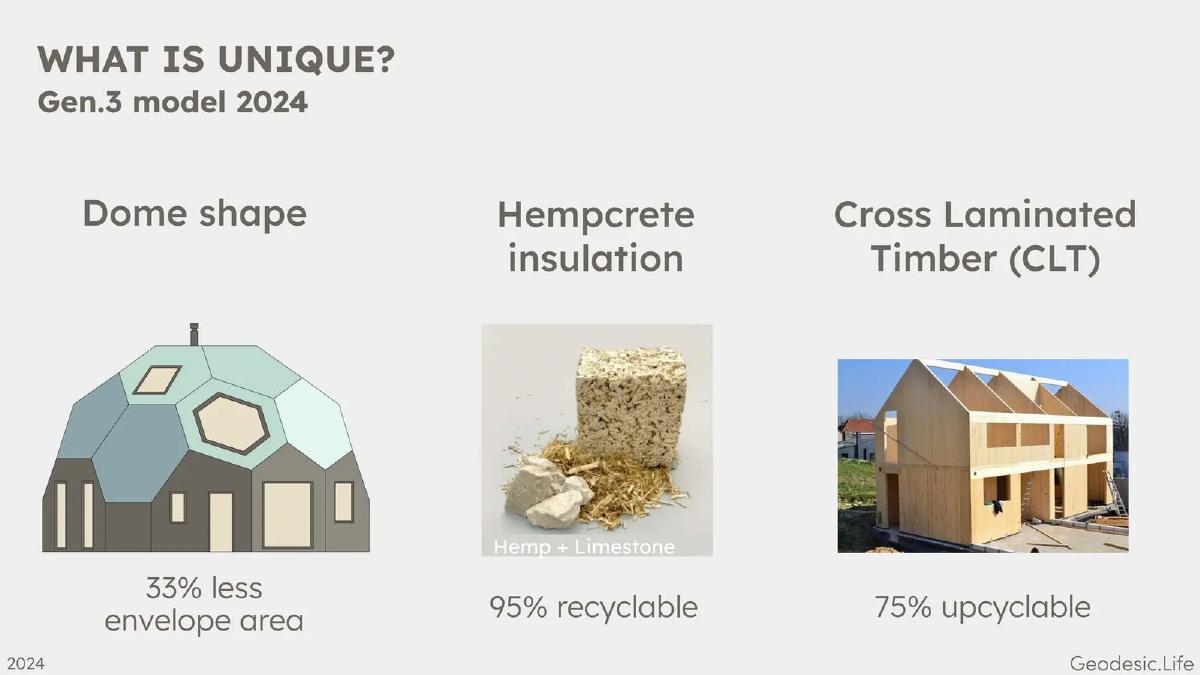
- Geodesic.Life claims their dome shape results in 33% less envelope area compared to traditional structures (Slide 6).
- The Scandinavian market is the primary target, with a total addressable global market estimated at EUR 91.2 billion (Slide 9).
- The business model involves selling design, prefab kits, and consultancy to real estate partners (Slide 8).
- The company identifies as a 'small' (S) or 'extra small' (XS) entity currently in the 'Pilot' stage (Slides 10-11).
- The deck omits a clear financial 'Ask' slide, though the source listing indicates a $500k target.
Executive Summary: The Geodesic Vision
Geodesic.Life is positioning itself at the intersection of the 'Green Building' movement and the 'Rural Renaissance.' The deck, dated 2024, presents a solution to the high carbon footprint of traditional construction and the depopulation of rural areas. By utilizing a geodesic dome shape and sustainable materials like hempcrete, the company aims to provide a high-efficiency housing alternative. While the deck is visually compelling and demonstrates physical progress, it functions more as a product brochure than a complete investment vehicle due to the absence of financial projections and a formal ask.
Slide 1: Title Slide
The deck opens with a clean, minimalist logo featuring a globe containing stylized house shapes. The subtitle, "Sustainable Prefabricated Dome Houses for Rural Development," immediately establishes the niche. It is a clear, no-nonsense introduction that defines the product and the target geography.
Slide 2: The Environmental Problem
This slide uses a stark visual of construction waste to highlight that the industry is responsible for 37% of global CO2 emissions. It notes that after 100 years, 30-60% of traditional building materials end up landfilled. This sets a high-stakes emotional and environmental hook for the investor.
Slide 3: The Societal Problem
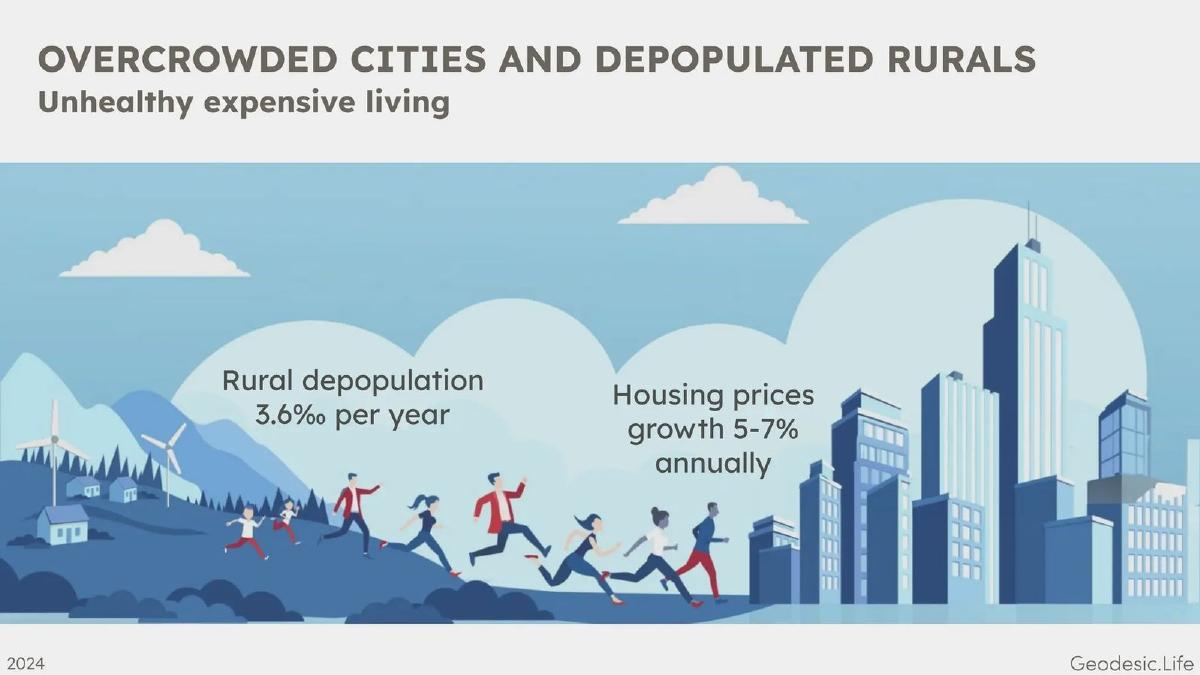
The company pivots from environmental issues to demographic ones. It cites rural depopulation at 3.6% per year and housing price growth of 5-7% annually in cities. The graphic depicts people running away from a crowded city toward a rural landscape, framing Geodesic.Life as the solution to "unhealthy expensive living."
Slide 4: Product Reveal
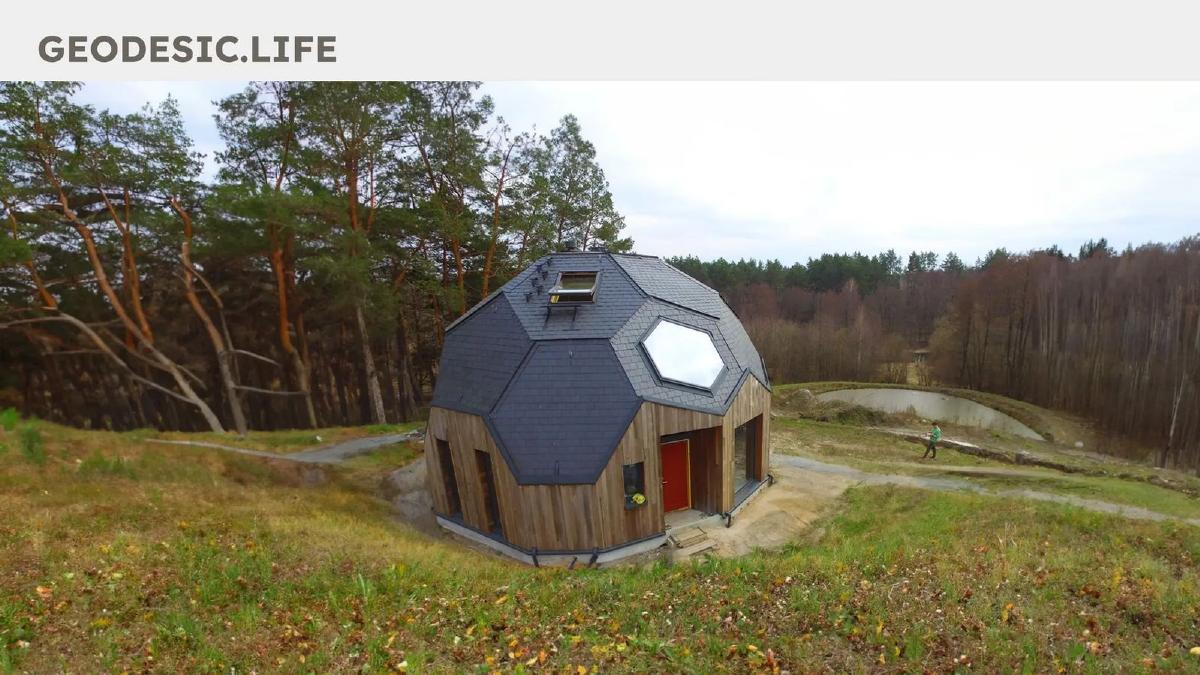
Slide 4 is a full-bleed photograph of a completed dome house in a rural setting. This is a critical slide because it proves the company isn't just selling a concept; they have a physical, aesthetically pleasing prototype. The design is modern, featuring large hexagonal windows and wood cladding.
Slide 5: Iteration and Traction
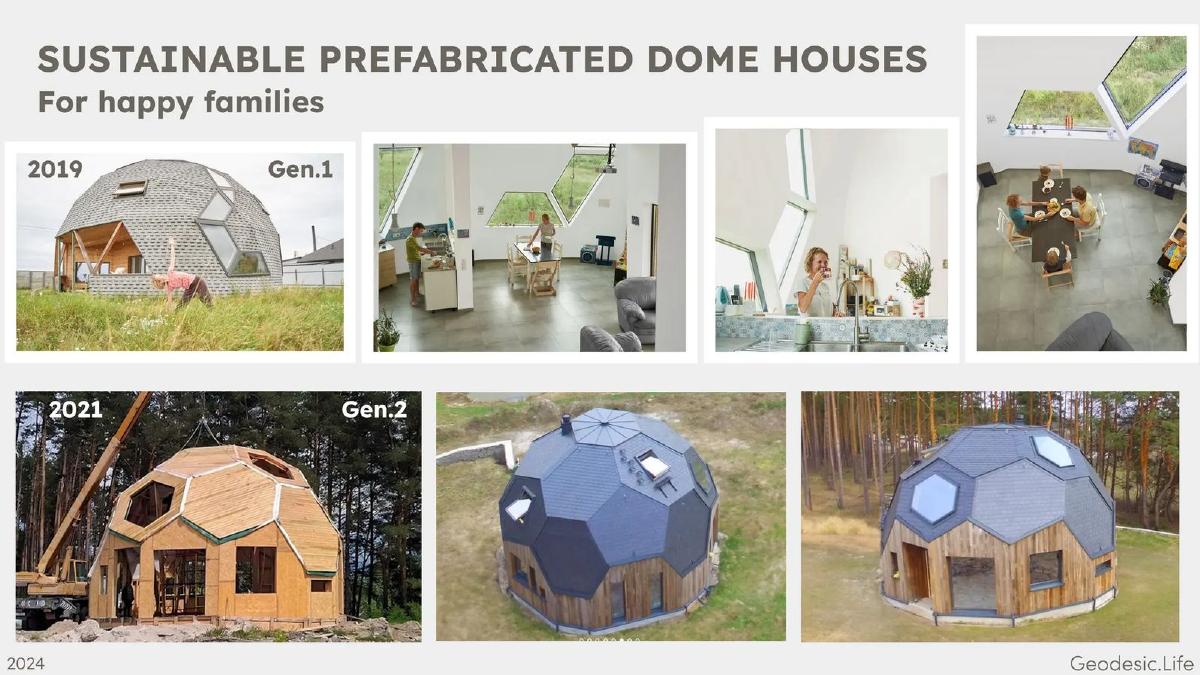
This slide documents the company's history through two generations of prototypes. Gen.1 (2019) shows a shingled dome, while Gen.2 (2021) shows a more sophisticated construction process involving cranes and a refined panel system. Interior shots show a bright, open-plan living space, which helps investors visualize the end-user experience for "happy families."
Slide 6: Technical Differentiation
Here, the company explains why the dome shape matters. It claims 33% less envelope area , which translates to lower material costs and better thermal efficiency. They introduce their material stack for the Gen.3 model (2024) : Hempcrete insulation (95% recyclable) and Cross Laminated Timber (75% upcyclable). This slide provides the technical 'meat' of the presentation.
Slide 7: Material Breakdown
Slide 7 features a cutaway 3D render of the house and a pie chart of materials. The breakdown is specific: Limestone (33.9%), Wood (25.6%), Hemp (24.6%), Concrete (9.4%), Clay (5.9%), Glass (0.2%), and Steel (0.4%). The claim of a -71% CO2 footprint is a powerful metric for impact-focused investors.
Slide 8: The Business Model
Titled "The Deal," this slide uses a flow chart to explain the ecosystem. Geodesic.Life sits at the start, providing house design, prefab kits, and consultancy to Real Estate Partners. These partners pay Geodesic.Life in Euros and then sell turn-key houses to families. It also mentions Rural Municipalities as stakeholders who benefit from "new citizens" and a "creative economy."
Slide 9: Market Opportunity
The company identifies Scandinavia, specifically the Stockholm area , as its beachhead. They value the Stockholm area at EUR 560 million and the turn-key prefab market at EUR 390 million. The global market is cited as EUR 91.2 billion. The rationale for Scandinavia is solid: a 23% supply-demand gap and a high cultural value on sustainability.
Slide 10 & 11: Competitive Landscape
These slides compare Geodesic.Life to four competitors. The company highlights its use of CLT and Hempcrete as a unique combination. They admit to being a "small" or "extra small" company in the "pilot" stage, which is honest but also highlights the early-stage risk. The inclusion of flags (Ukraine, Denmark, USA, Poland) shows the global nature of the competition.
Slide 12: Future Vision
This slide moves beyond single-family homes to "schools & community hubs." The illustration shows a cluster of domes, suggesting a village-scale application. This hints at the scalability of the prefab system for larger infrastructure projects.
Slide 13: Team and Mentors
The final slide introduces the founders: Eugene Kuzmenko (Engineer) and Asya Syvolob (Marketer). They are supported by a BIM Architect, a Designer, and three mentors specializing in architecture, impact business, and finance. The slide also lists logos for New European Bauhaus and EIT Manufacturing , providing essential third-party validation.
What Works in This Deck
Visual Proof of Concept: The inclusion of actual photos from 2019 and 2021 (Slide 5) is the deck's strongest asset. In the hardware and construction space, investors are wary of 'vaporware.' Showing two generations of physical builds significantly de-risks the technical side of the investment.
Material Specificity: Rather than just saying the houses are "green," the deck provides a granular breakdown of materials (Slide 7). This level of detail is excellent for due diligence and appeals to ESG (Environmental, Social, and Governance) investors.
Clear Beachhead Strategy: Many startups fail by trying to target the whole world at once. Geodesic.Life’s focus on the Stockholm area (Slide 9) is logical and backed by specific regional data, such as the 23% housing gap.
What Is Missing
Unit Economics: This is the most glaring omission. There is no mention of what it costs to manufacture a kit, the cost of assembly, or the final price to the consumer. Without these numbers, an investor cannot judge the viability of the business model.
The Ask: While the source listing mentions a $500k pre-seed round, the deck itself does not state how much money is being raised, the terms of the round, or the specific milestones that the funding will enable. An investor should never have to guess what the 'ask' is.
Financial Projections: There are no revenue targets or growth charts. Even for a pre-seed company, a basic 3-year projection is expected to show the founders' ambitions and understanding of their market's scale.
Founder Takeaways
Show, Don't Just Tell: If you are building a physical product, follow Geodesic.Life's lead and include photos of prototypes and construction phases. It builds immediate credibility. · Define Your Materiality: If sustainability is your USP, be specific. The pie chart on Slide 7 is a great template for any 'clean-tech' or 'circular economy' startup. · Don't Forget the Money: A pitch deck is a sales document for your company's shares. You must include the price of your product and the amount of capital you need to reach the next stage. · Leverage Institutional Backing: The logos on the team slide (Slide 13) act as 'trust signals.' If you have been part of an incubator or received a grant, make sure those logos are visible.
Frequently asked questions
- What is the core technology behind Geodesic.Life?
- The company utilizes a combination of Cross Laminated Timber (CLT) for the structure and hempcrete (hemp + limestone) for insulation. According to slide 6, this combination makes the structure 95% recyclable and 75% upcyclable. The dome shape itself is a core efficiency feature, requiring 33% less envelope area than a standard rectangular building.
- How does the company plan to generate revenue?
- Slide 8 outlines a B2B2C model. Geodesic.Life provides house designs, prefabricated kits, and consultancy services to Real Estate Partners. These partners then deliver turn-key houses and services to families. The company also positions itself as a solution for Rural Municipalities seeking to attract new citizens and creative economies.
- What market is Geodesic.Life targeting first?
- The company is focusing on Scandinavia, specifically the Stockholm area in Sweden. Slide 9 identifies this as a EUR 560 million market opportunity. They chose this region due to a 23% gap between housing demand and supply, high demand for prefabs, and the region's top global ranking for sustainability.
- Who are the main competitors mentioned in the deck?
- Slides 10 and 11 compare Geodesic.Life to four main competitors: Compass by VELUX (Denmark), Geoship (USA), EasyDomes (Denmark), and Domir (Poland). They differentiate themselves by being one of the few using a combination of CLT and Hempcrete, whereas others use bio-ceramics or standard timber frames with sheep wool or cellulose.
- What is missing from this pitch deck?
- The deck is notably missing a financial slide. There is no mention of the cost to build a single unit, the retail price, or the projected margins. Furthermore, there is no 'Ask' slide detailing how much capital is being raised or how it will be spent, which is a standard requirement for a fundraising deck.