Genius Group’s January 2023 investor presentation outlines an ambitious attempt to disrupt the $10 trillion global education market through a modular, acquisition-heavy structure. The company positions itself as a lifelong learning provider, covering every age demographic from nursery to age 80. A significant portion of the strategy relies on 'GeniusU,' an EdTech platform intended to serve as a 'Metaversity' with virtual reality campuses. Financial data provided shows a balance sheet that expanded significantly between 2021 and 2022, primarily driven by acquisitions, with total assets growing…
Key takeaways
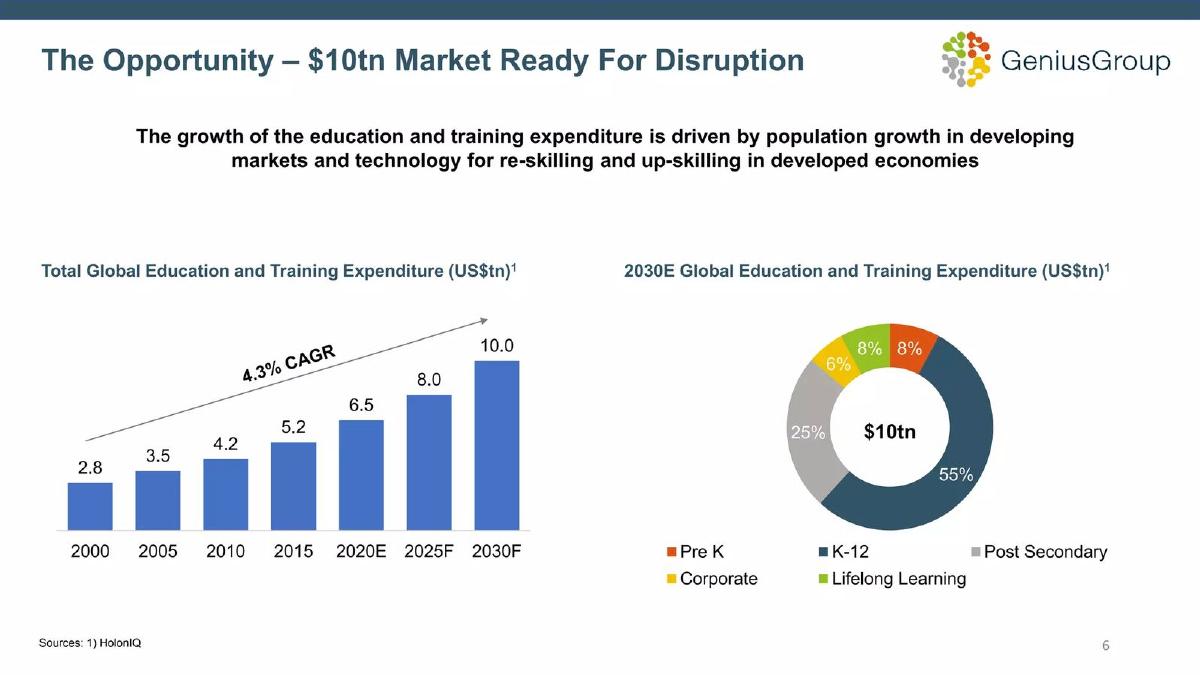
- The company targets a total global education and training expenditure projected to reach $10 trillion by 2030 (Slide 6).
- The senior management team features individuals with backgrounds in scaling high-tech companies across food-tech, blockchain, and 3D printing (Slide 11).
- Market opportunity is tied to the growth of the gig economy, which was projected to reach $455 billion in gross volume by 2023 (Slide 16).
- The 'Lifelong Learning Curriculum' aims to replace traditional linear education with a continuous model serving ages 0 to 80 (Slide 21).
- The business is organized into six distinct divisions, including Genius School, Genius University, and Genius Academy (Slide 26).
- A core growth pillar is the 'Metaversity,' involving the development of six virtual reality campuses on the GeniusU platform (Slide 36).
- Total assets grew from $17,595,000 in December 2021 to an unaudited $83,199,000 by September 2022 (Slide 41).
- The company utilizes a 'modular structure' designed to integrate future acquisitions efficiently into the group (Slide 26).
Genius Group Investor Deck Analysis
The January 2023 investor presentation for Genius Group represents a company in the midst of a rapid roll-up strategy. By acquiring various educational institutions and platforms, the group attempts to create a unified 'lifelong learning' ecosystem. The deck is structured to sell the magnitude of the education market and the company's ability to capture it through a combination of traditional schooling and futuristic 'Metaversity' concepts.
Slide 1: Title Slide
The deck opens with the tagline 'Leading the Education Revolution.' The imagery of a hand holding a lightbulb wearing a graduation cap is a literal representation of the brand's focus on 'genius' and formal education. It establishes the date as January 2023, positioning this as a post-pandemic strategy document.
Slide 6: The $10tn Market Opportunity
This slide focuses on macro-economic tailwinds. It cites HolonIQ data showing global education expenditure growing at a 4.3% CAGR, moving from $2.8 trillion in 2000 to a projected $10 trillion by 2030. The pie chart breaks down the 2030 market, showing that K-12 (55%) and Post-Secondary (25%) remain the dominant sectors. By highlighting these figures, Genius Group is signaling to investors that even a fractional market share represents a multi-billion dollar opportunity.
Slide 11: Senior Management
The management slide features five key executives. Roger Hamilton (CEO) is positioned as the visionary, citing his status as a New York Times bestselling author. The inclusion of Erez Simha (CFO & COO) is notable for his experience in 'food-tech, blockchain, and 3D printing,' suggesting a management team comfortable with diverse, high-growth technology sectors. The slide emphasizes that the team uses the 'Genius Group curriculum' themselves, attempting to validate the product through the leadership's own success.
Slide 16: Market Opportunity and Trends
This slide attempts to connect the company's platform to specific labor market shifts. It uses four charts to show: 1) Growing higher education enrollment (projected 594m by 2040), 2) Increasing online platform penetration (projected 11.4% by 2027), 3) A rise in new U.S. business establishments, and 4) The growth of the gig economy (projected $455bn by 2023). The narrative here is that traditional jobs are disappearing, and Genius Group provides the tools for the new 'entrepreneurial' workforce.
Slide 21: Lifelong Learning Curriculum
This is the core product vision slide. It contrasts the 'traditional' system (where learning stops after university) with the Genius Group model. The graphic shows a continuous arrow from age 0 to 80. It segments the market into Nursery (0-4), K-12 (5-17), University (18-25), and Adult Learning (26-80). The slide claims their curriculum is 'unique' because it provides a 'personalized learning path' specifically for the entrepreneur market across all these age groups.
Slide 26: Scalable Modular Structure
Genius Group explains its corporate architecture here. The company is split into 'Value' (Content) and 'Leverage' (Delivery) divisions. Value Education includes Genius School, Genius University, and Genius Academy. Leverage Experience includes Genius Media, GeniusU (the EdTech platform), and Genius City (physical campuses). This modularity is presented as a way to maximize the value of each 'profit center' while allowing for the 'efficient integration' of future acquisitions.
Slide 31: Growth Strategy (Section Header)
A transition slide featuring a backpack in a classroom. It marks the shift from 'what we do' to 'how we grow.'
Slide 36: Metaversity Launch
This slide introduces the company's pivot into Web3 and Virtual Reality. It details the development of six campuses on GeniusU (Student, Mentor, Investor, Leader, Scale Up, Start Up). The text states they are 'developing over the year into a virtual reality campus in the metaverse.' The accompanying graphic shows a city-builder style map, suggesting a gamified approach to education. This slide targets investors interested in the 'Metaverse' hype that was prevalent in late 2022 and early 2023.
Slide 41: Balance Sheet
The final slide in this set provides hard financial data. It compares audited figures from Dec 31, 2021, to unaudited and pro forma figures from Sept 30, 2022. Total assets rose from $17,595,000 to $83,199,000 (unaudited). Total liabilities also increased from $9,610,000 to $30,372,000. The slide explicitly states the balance sheet has 'significantly grown in size due to the acquisitions.' This confirms that Genius Group is primarily an M&A-driven entity rather than one growing purely through organic student acquisition.
What Works in This Deck
The deck excels at painting a 'Big Picture' vision. By framing education as a $10 trillion market and showing a curriculum that spans a human's entire life, they make the scope of the business feel massive. The modular structure (Slide 26) is also a clever way to explain a complex business with many moving parts; it gives investors a mental framework to categorize different revenue streams. Furthermore, the use of third-party data from HolonIQ and Statista (Slide 16) lends credibility to their claims about the growth of the gig economy and online learning.
What Is Missing from This Deck
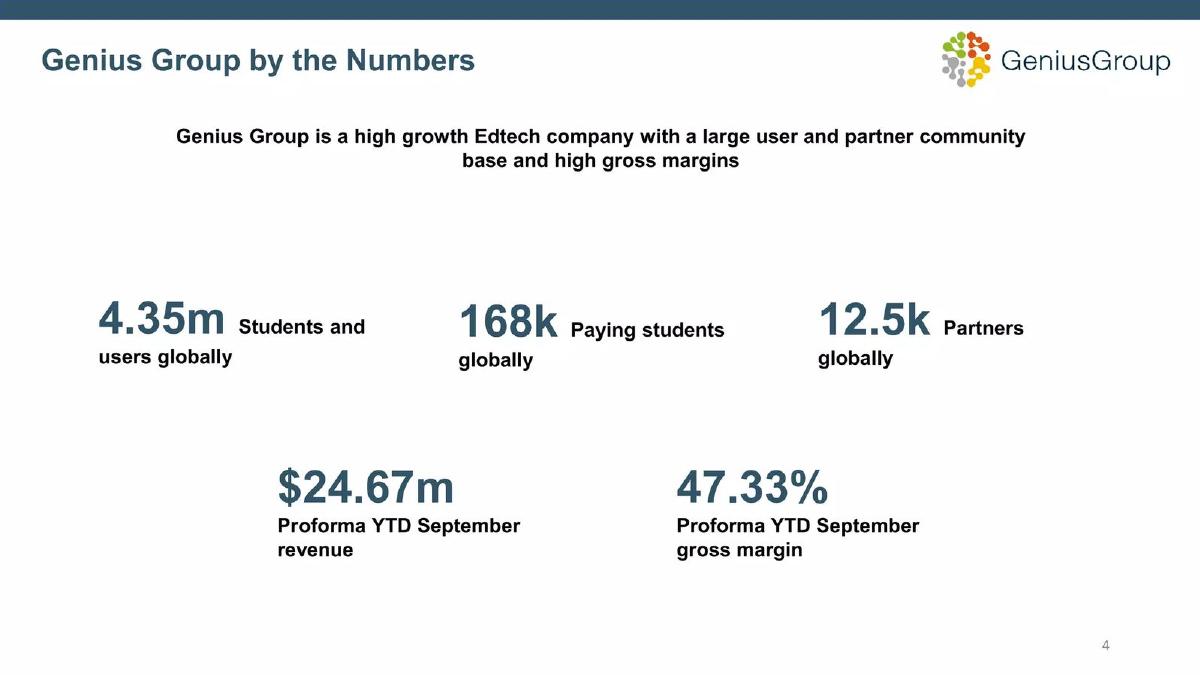
The most glaring omission in these slides is a detailed Profit and Loss (P&L) statement. While the balance sheet (Slide 41) shows asset growth, it does not show revenue, gross margins, or net income. For an acquisition-heavy company, investors need to see if these acquired entities are actually profitable or if they are burning cash. Additionally, there is no 'Ask' slide in this selection—it is unclear how much capital they are seeking or what the specific valuation is. There is also a lack of 'Unit Economics.' We see the number of students globally, but we don't see the Customer Acquisition Cost (CAC) or Lifetime Value (LTV) for a Genius Group student.
What a Founder Should Copy
Founders should look at Slide 21 (Lifelong Learning Curriculum) as a masterclass in 'Category Design.' Instead of saying 'we sell online courses,' they created a visual that makes traditional education look incomplete and their solution look like the only logical way to learn in the modern era. The 'Modular Structure' on Slide 26 is also a great way to present a multi-product company without confusing the audience. If you have multiple brands or services, grouping them into 'Value' and 'Leverage' categories helps maintain a clean narrative.
Frequently asked questions
- What is the primary market Genius Group is targeting?
- Genius Group is targeting the global education and training market, which they value at $10 trillion by 2030. According to slide 6, this market is segmented into K-12 (55%), Post Secondary (25%), Pre-K (8%), Lifelong Learning (8%), and Corporate (6%). They specifically focus on entrepreneurship and the gig economy as primary drivers for their online platform adoption.
- How does Genius Group structure its various business units?
- The company uses what they call a 'Scalable Modular Structure' detailed on slide 26. It is split into two categories: 'Value Education' (Genius School, Genius University, Genius Academy) and 'Leverage Experience' (Genius Media, GeniusU, Genius City). This structure is designed to allow individual subsidiaries to operate as high-growth profit centers while being integrated under a single global EdTech platform.
- What role does the Metaverse play in their growth strategy?
- As shown on slide 36, the company is launching a 'Metaversity.' This involves developing six virtual reality campuses on their GeniusU platform, categorized by user type: Student, Mentor, Investor, Scale Up, Start Up, and Leader. The goal is to transition their community into a fully immersive virtual reality learning environment over the course of a year.
- What do the financial statements reveal about their recent performance?
- Slide 41 shows a massive jump in the balance sheet size. Total assets increased from $17.6 million at the end of 2021 to $83.2 million by September 2022. This growth is explicitly attributed to acquisitions. However, the deck does not provide a detailed Profit and Loss statement or specific unit economics for the individual acquired entities in the provided slides.
- Who are the key leaders mentioned in the deck?
- The leadership team (Slide 11) is led by CEO and Chairman Roger Hamilton, a NYT bestselling author. Other key members include Erez Simha (CFO & COO), who has 20 years of experience in scaling tech companies, and Rav Karwal (CRO), who focuses on go-to-market strategies. The team is presented as having 'proven entrepreneurship success' using the company's own curriculum.