Genicell presents a classic pre-seed biotech pitch focused on solving the '98% failure rate' of novel compounds in the preclinical stage. The deck centers on a novel bioreactor technology designed to reduce the time and cost of drug discovery by providing a testing layer between computer simulations and animal testing. With a lean $500K ask, the team—comprising specialists in tissue and mechanical engineering—aims to secure lab space at QB3 in Berkeley and complete patent filings. While the technical value proposition is clear, the deck lacks detailed competitive analysis and specific unit ec…
Key takeaways
- The company identifies a massive industry pain point: the ~$1 billion cost and 10-12 year timeline to bring a single drug to market (Slide 2, 4).
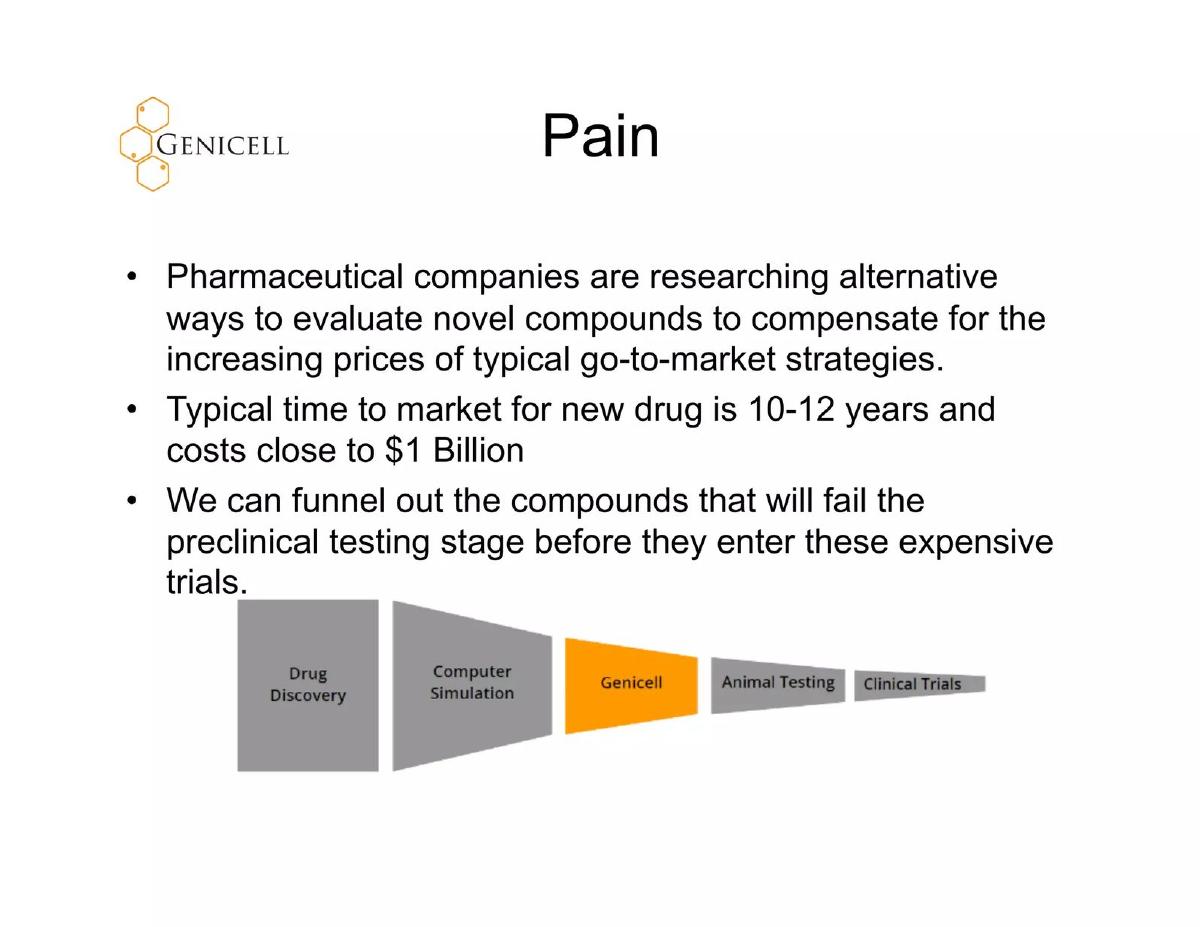
- Genicell positions its technology as a 'funnel' between computer simulation and animal testing to catch failing compounds early (Slide 4).
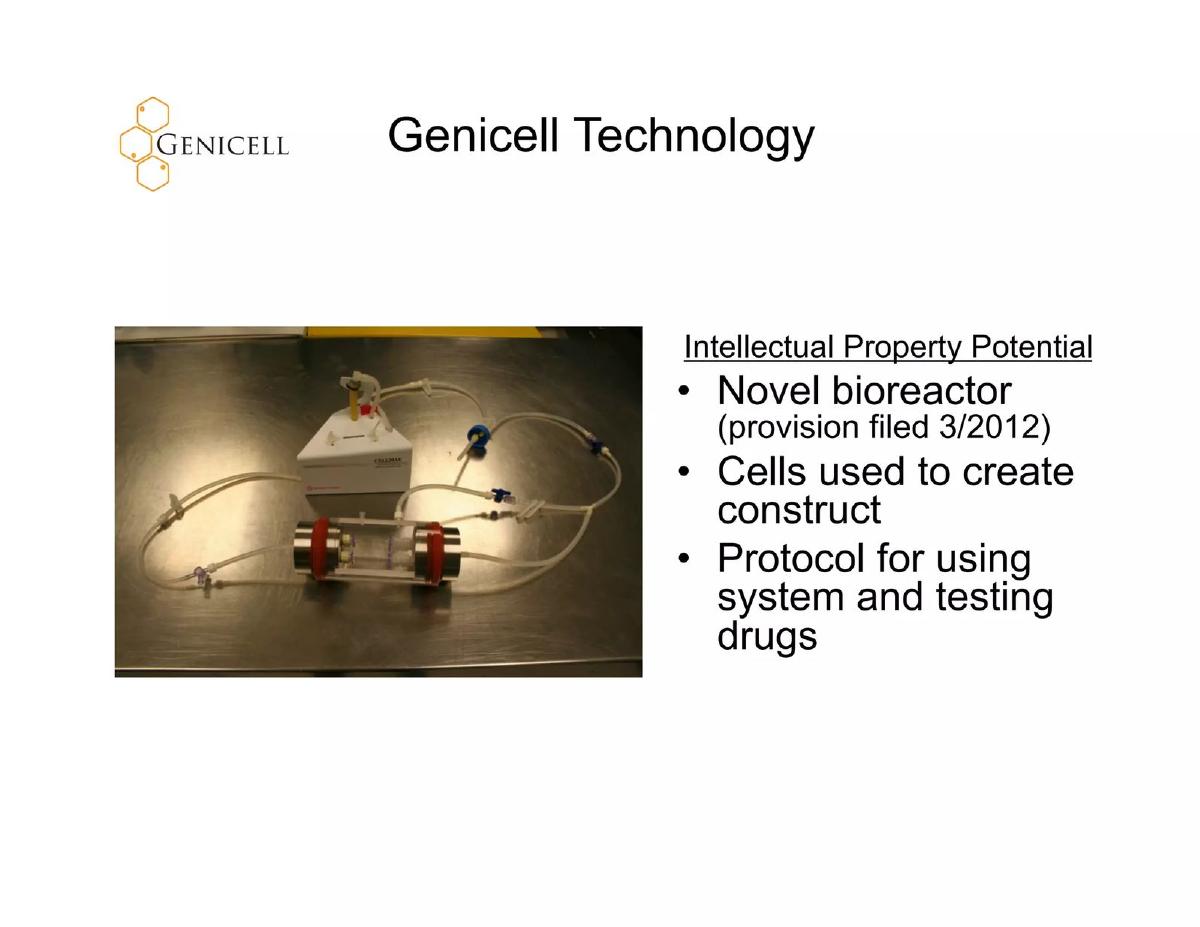
- The core IP involves a novel bioreactor with a provisional patent filed in March 2012 (Slide 5).
- The team is technically heavy, featuring three co-founders with backgrounds in Tissue Engineering and Mechanical Engineering (Slide 3).
- The go-to-market strategy is multi-phased, starting with selling hardware to researchers and moving toward full drug discovery pipeline integration (Slide 7).
- A clear two-stage funding roadmap is presented: $500K for proof of concept and $2M for licensing and animal model comparisons (Slide 8, 9).
- The immediate funding ask is $500K to equip lab space at QB3, file patents, and finish validation studies (Slide 10).
- The deck lacks a competitive landscape slide, failing to mention other organ-on-a-chip or bioreactor competitors.
Genicell Pitch Deck Analysis
Genicell is a biotech startup focused on the preclinical stage of drug development. Their 11-slide deck is a straightforward technical pitch aimed at solving the high failure rate of new drugs. The deck is structured to move from the macro industry problem to a specific hardware solution, followed by a roadmap for validation and commercialization.
Slide 1: Title Slide
The title slide introduces the Genicell logo—a series of orange hexagons suggesting a molecular or cellular structure. The mission statement is clear: "Expediting and lowering the cost of the drug development process." It includes a URL and a link to an AngelList profile, indicating this deck was likely used for early-stage online syndication or outreach.
Slide 2: Summary
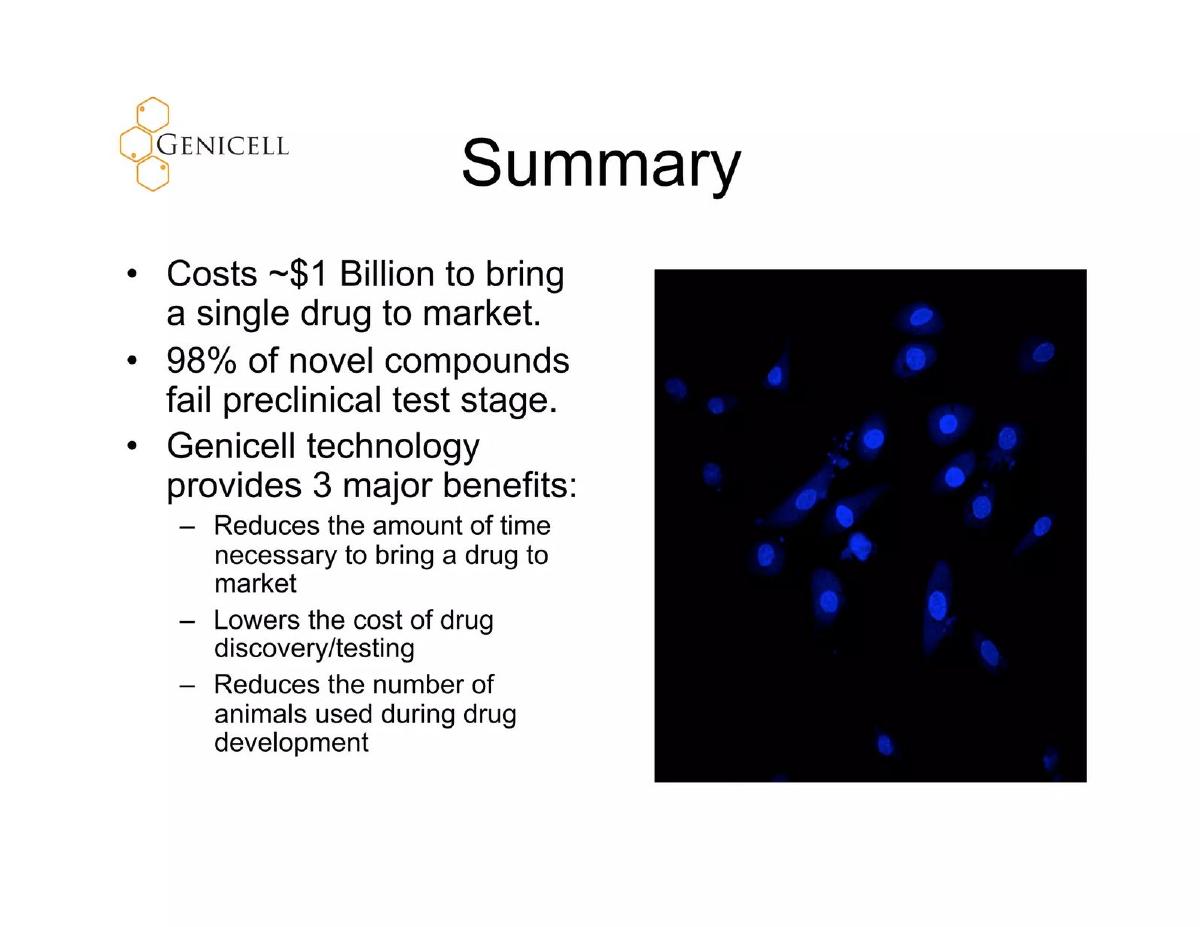
This slide establishes the stakes. It cites the $1 billion cost to bring a drug to market and the 98% failure rate of novel compounds at the preclinical stage. It lists three benefits of Genicell technology: reducing time to market, lowering discovery costs, and reducing animal testing. The inclusion of a microscopic cell image provides a visual cue for the biological nature of the work, though it lacks a caption explaining what specifically is being shown.
Slide 3: Team
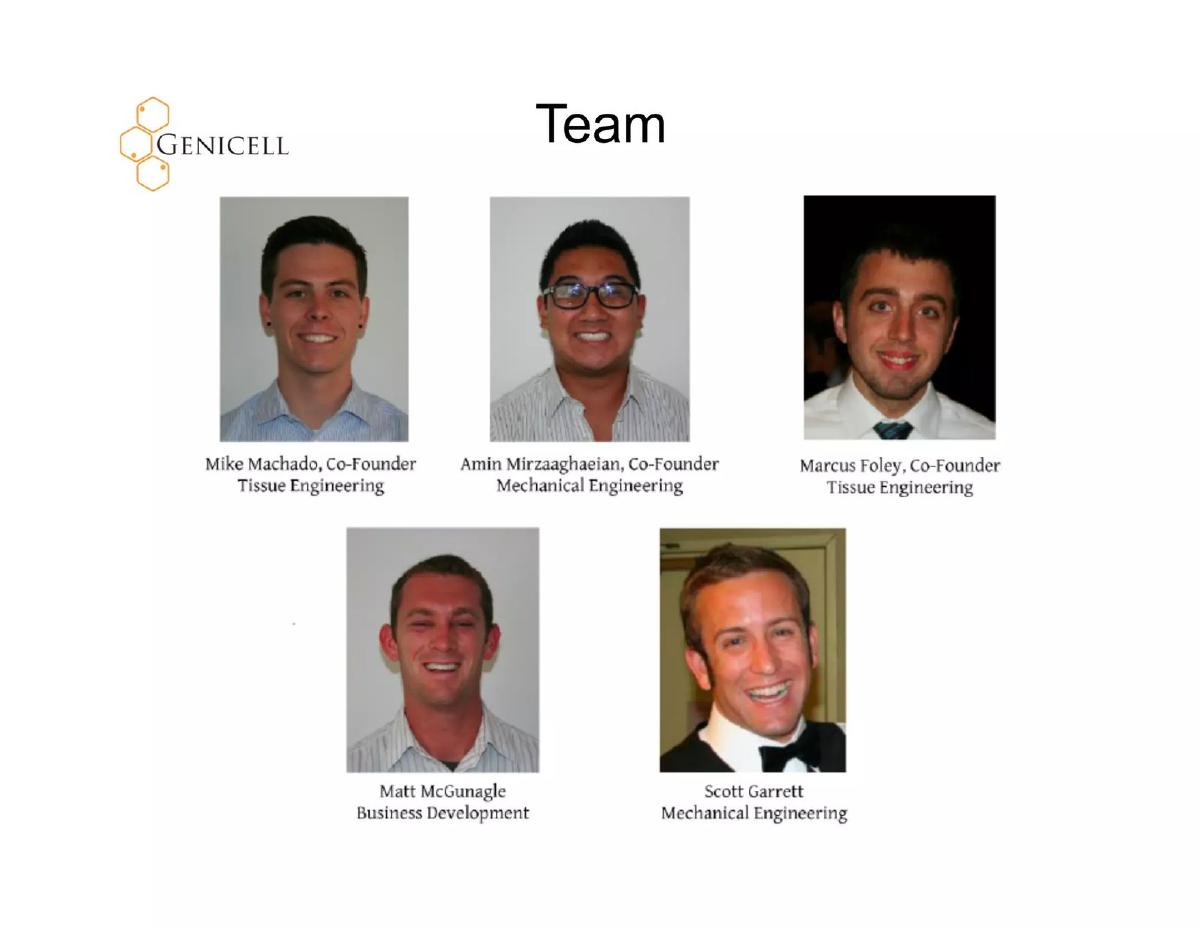
The team slide features five individuals. The core leadership consists of three co-founders: Mike Machado (Tissue Engineering), Amin Mirzaaghaian (Mechanical Engineering), and Marcus Foley (Tissue Engineering). They are supported by Matt McGunagle in Business Development and Scott Garrett in Mechanical Engineering. The team appears to be composed of young technical specialists, likely recent graduates or researchers, given the lack of prior exit history or senior corporate titles listed on the slide.
Slide 4: Pain
Slide 4 elaborates on the industry "Pain." It notes that pharma companies are actively seeking alternative evaluation methods due to the 10-12 year time-to-market. The most effective element of this slide is the funnel graphic. It shows Genicell positioned between "Computer Simulation" and "Animal Testing." This clearly defines their market niche: a filter to catch failures after digital modeling but before expensive live-subject trials.
Slide 5: Genicell Technology
This slide provides a look at the physical product. A photograph shows a benchtop setup with tubes, a pump, and a cylindrical chamber. The text highlights "Intellectual Property Potential," specifically a novel bioreactor with a provisional patent filed in March 2012 . The IP covers the hardware, the cellular construct, and the testing protocols. This is a critical slide for investors to assess the tangibility of the "tech" in biotech.
Slide 6: Market and Customer Segments
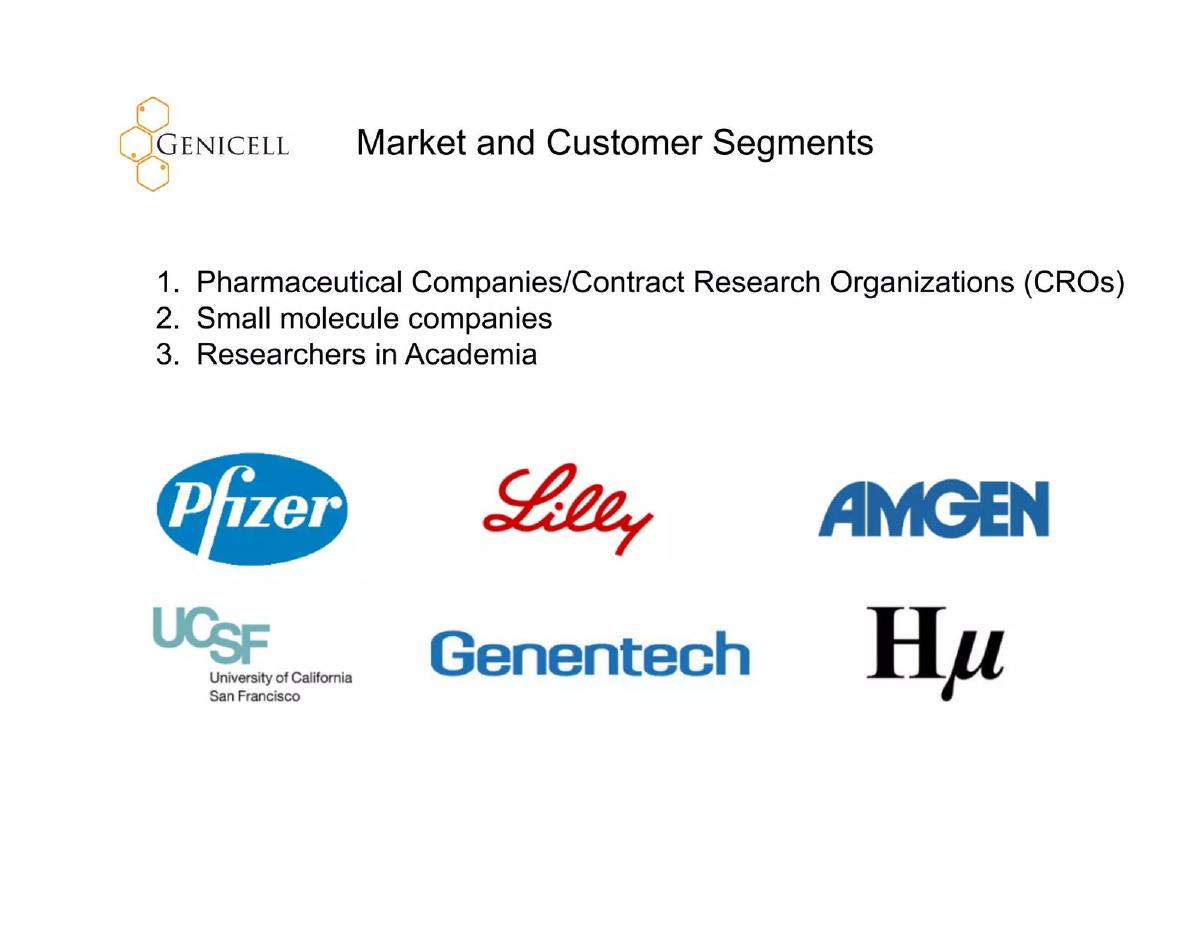
Genicell identifies three tiers of customers: Large Pharma/CROs, Small Molecule companies, and Academic researchers. The slide uses logos from Pfizer, Lilly, Amgen, UCSF, Genentech, and Hu. While these logos represent the target market, the slide does not clarify if Genicell has existing partnerships with these entities or if they are merely examples of the total addressable market.
Slide 7: Go-to-market Strategy
The strategy is a three-step progression. First, they plan to sell the bioreactor hardware to researchers and CROs. Second, they will market "Genicell BBB testing" (likely Blood-Brain Barrier) to small molecule companies. Finally, they aim to use side-by-side data comparisons with animal studies to prove their efficacy and fully integrate into the standard pharma discovery pipeline. This is a logical, risk-mitigated approach to commercialization.
Slide 8 & 9: Product Development Timeline
These two slides break the roadmap into two funding tranches. Slide 8 covers the "Proof of Concept" phase requiring $500K . Milestones include renting lab space at QB3 in Berkeley, finishing patent applications, and completing tissue characterization by Early Summer 2013 . Slide 9 covers the "Licensing" phase requiring $2M , aimed at hiring more researchers and beginning side-by-side animal testing comparisons by January 2014 .
Slide 10: Financing
The financing slide reiterates the immediate need for $500K . It lists four specific uses for the funds: equipping lab space, filing patents, software development, and validation studies. The slide is clean and focused, though it does not specify the type of investment sought (e.g., convertible note, equity) or the valuation cap.
Slide 11: Closing
The deck ends with the company logo. It lacks a "Contact Us" slide with specific email addresses or phone numbers, which is a minor but notable omission for a pitch deck intended for external circulation.
What Genicell Does Well
Clear Positioning: The funnel graphic on Slide 4 is the strongest part of the deck. It tells the investor exactly where the product fits in a complex value chain. · Phased Roadmap: Breaking the funding into $500K and $2M chunks shows that the founders understand the capital requirements of different development stages. · IP Focus: Stating the specific month and year of the provisional patent filing (March 2012) adds credibility to their claims of ownership.
What is Missing from the Deck
Competitive Landscape: The deck completely ignores competitors. In 2012, the organ-on-a-chip and advanced bioreactor space was already growing. Investors need to know why Genicell’s bioreactor is superior to existing solutions. · Unit Economics: There is no mention of the manufacturing cost of the bioreactor or the projected sale price. For a hardware-based GTM, these figures are essential. · Data/Traction: While the deck mentions "Proof of Concept," it does not show any preliminary data or results from their prototype. Even a single chart showing a successful drug test comparison would significantly strengthen the pitch. · Exit Strategy: Biotech investors typically look for an acquisition by a larger life sciences company or an IPO. The deck does not discuss the eventual exit.
Founder Takeaways
Define the Gap: Like Genicell, use a visual aid to show exactly where your product sits in the existing workflow. If you are a "middle-layer" technology, own that position. · Be Specific with Funds: The breakdown of the $500K ask is a good model for pre-seed founders. It lists tangible milestones (renting space, filing patents) rather than vague categories like "operations." · Team Technicality: If your team is all engineers, emphasize the specific disciplines (Tissue vs. Mechanical) to show you have the necessary breadth to build a complex bio-mechanical product. · Include a Comparison: To improve on this deck, a founder should include a slide comparing their technology's performance (speed, accuracy, cost) against the current gold standard (animal testing).
Frequently asked questions
- What is the primary problem Genicell is trying to solve?
- Genicell targets the inefficiency of the drug development lifecycle. According to Slide 2, 98% of novel compounds fail at the preclinical stage, contributing to a total cost of approximately $1 billion per successful drug. By providing a more accurate testing environment early on, Genicell aims to reduce the number of animals used and lower the overall cost of discovery.
- What is the status of Genicell's intellectual property?
- As of the deck's creation, Genicell had filed a provisional patent for their 'novel bioreactor' in March 2012. Slide 5 also notes that their IP potential extends to the specific cells used to create the construct and the protocols for using the system to test drugs.
- Who are the target customers for this technology?
- Slide 6 identifies three primary segments: large pharmaceutical companies and Contract Research Organizations (CROs) like Pfizer and Lilly, small molecule companies, and academic researchers at institutions such as UCSF. Their strategy involves selling the hardware to researchers first before attempting to integrate into the pipelines of major pharma.
- How does the team plan to use the requested $500K?
- The $500K is designated for 'Proof of Concept' milestones. According to Slide 10, this includes equipping lab space at the QB3 incubator in Berkeley, completing and filing patents, continuing software and automation development, and finishing tissue characterization and validation studies.
- What is missing from the Genicell pitch deck?
- The deck is missing a competitive analysis, which is critical in the crowded 'organ-on-a-chip' and bioreactor space. It also lacks detailed financial projections, unit economics (how much the bioreactor costs to make vs. sell), and a specific exit strategy or long-term valuation target.