The Waveborn presentation is not a traditional pitch deck but rather a 'lessons learned' teardown by CEO Mike Malloy. It details the company's journey through a successful crowdfunding campaign that raised $20,705 against a $10,000 goal, as shown on slide 3. The deck is highly tactical, outlining seven types of investors, various investment instruments including convertible notes and warrants, and a specific 3-month preparation timeline for crowdfunding. While it lacks the market sizing and competitive analysis of a standard Series A deck, it offers a granular view of the 'pre-seed' hustle, e…
Key takeaways
- Waveborn successfully raised $20,705 on a $10,000 goal via Indiegogo, achieving 207% of their target (Slide 3).
- The CEO categorizes investors into seven distinct types, ranging from 'Connectors' and 'Domain Experts' to 'Filler' (Slide 6).
- Fundraising is defined as a 5-10 year relationship business where investors bet on the founder rather than just the company (Slide 5).
- A full investment pitch is structured as 10 slides delivered in 20 minutes using a 30+ size font (Slide 8).
- Crowdfunding success requires a 3-month preparation period focused on securing pre-commits for a high-momentum Day One (Slide 14).
- The deck lists specific due diligence documents required for closing, including term sheets, income statements, and cash flow projections (Slide 10).
- Tactical execution relies on tiered contact lists, separating key influencers from general network contacts to drive referrals (Slide 16).
- The presentation highlights SOMA Water's $100k in 10 days as a benchmark for successful crowdfunding (Slide 22).
Introduction: A CEO's Retrospective on Seed Funding
The Waveborn presentation, delivered by CEO Mike Malloy, functions as a tactical manual for early-stage founders. Unlike a standard pitch deck designed to solicit immediate capital, this deck is a 'lessons learned' summary that provides transparency into the mechanics of a $20,000 crowdfunding campaign and subsequent investor relations. It is particularly useful for understanding the transition from 'Friends, Family, and Fools' to more structured angel and venture capital rounds.
Slide 1-3: The Waveborn Story and Crowdfunding Success
The deck opens by establishing Mike Malloy's credentials as a Georgetown alum and CEO of Waveborn Sunglasses. Slide 3 provides the primary evidence of traction: a screenshot of an Indiegogo campaign titled "Waveborn - Shades That Give Sight." The campaign raised $20,705 USD , significantly exceeding its $10,000 goal (207% funded). The campaign ran from April 23 to June 7, 2013, and attracted 334 funders. This slide serves as the 'proof of concept' for the tactical advice that follows.
Slide 4-6: The Hierarchy of Funding and Investor Psychology
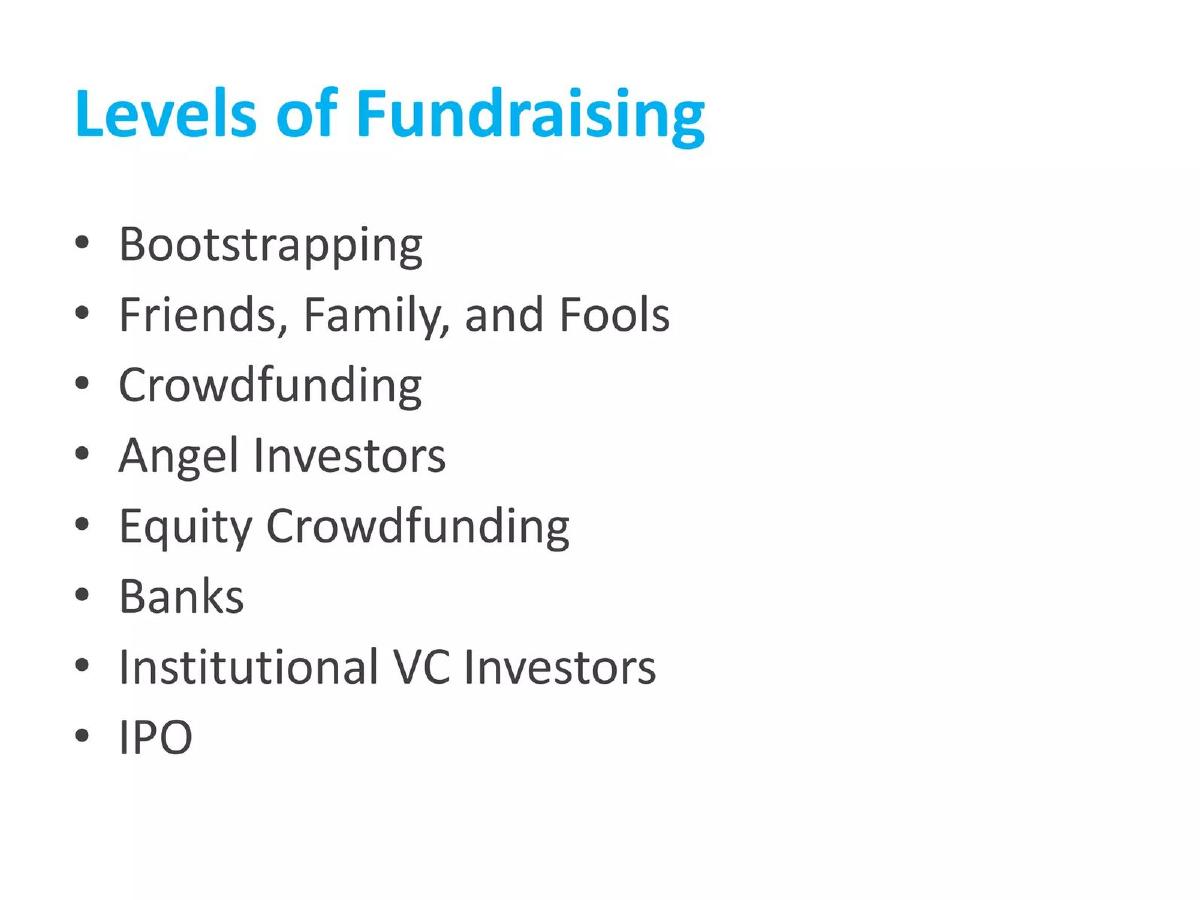
Slide 4 outlines the standard 'Levels of Fundraising,' starting with bootstrapping and moving through crowdfunding, angel investors, equity crowdfunding (citing OneVest), banks, institutional VCs, and finally an IPO. Slide 5 shifts to the philosophy of investor relations, stating that "Raising seed capital is a relationship business for the next 5-10 years." It emphasizes that investors at this stage are betting on the founder, not just the company, and introduces the concept of 'connecting dots to make lines'—a reference to showing progress over multiple touchpoints.
Slide 6 provides a unique taxonomy of investors, identifying seven types: Connectors, Product People, Builders, Smart Business People, Domain Experts, The Brand, and Filler. This classification suggests that founders should target their pitch based on what the specific investor brings to the table beyond just capital.
Slide 7-10: Investment Instruments and Pitch Mechanics
Slide 7 lists the various financial instruments Waveborn considered or used, including Debt, Equity, Convertible Notes, Warrants from Banks, and Series A Preferred Stock. This indicates a sophisticated approach to capital structure even at the early stages. Slide 8 breaks down pitch meetings into three categories: the 30-second elevator pitch, the 5-10 minute conversational pitch, and the 1-hour full investment pitch. Notably, it advocates for the 10/20/30 rule (10 slides, 20 minutes, 30+ size font) for formal presentations.
Slide 9 lists critical questions founders should ask investors to vet them, such as "What is your average check size?" and "Do you do follow on investments?" Slide 10 concludes this section with a checklist of due diligence documents, including the Balance Sheet and Cash Flow Projections , highlighting that even 'social enterprise' startups must maintain rigorous financial records.
Slide 11-16: Crowdfunding 101 and Execution Strategy
The second half of the deck focuses on the mechanics of crowdfunding. Slide 13 offers a specific cadence: a 45-day campaign starting on a Tuesday and ending on a Friday. The strategy is to set a low goal to reach it quickly, thereby creating the 'social proof' needed to attract larger, unaffiliated donors. Slide 14 emphasizes that the work begins three months before launch, focusing on "secure pre-commits prior to launching" to ensure a massive Day One.
Slide 15 and 16 focus on the 'sales' aspect of fundraising. Malloy advocates for "Templates, Templates, Templates," using pre-written emails and Facebook posts to minimize friction for supporters. Slide 16 introduces Tiered Contact Lists , where 'Tier 1' consists of high-net-worth influencers focused on referrals, and 'Tier 3' includes every person the founder has ever met, focused purely on engagement and social sharing.
Slide 17-22: Tools, Press, and Appendix
Slide 17 lists the tech stack used to manage the fundraise: Breevy/TextExpander, Bit.ly, Google Docs, ToutApp, and Contactually. This suggests a highly automated, data-driven approach to outreach. Slide 18 discusses Press Kits, providing links to Waveborn’s own digital assets and FAQs. The deck concludes with contact information (Slide 19) and an appendix (Slides 20-22) that lists other successful campaigns like SOMA Water ($100k in 10 days) and Eone – Watch for the Blind.
What Works in This Deck
Specific Tactical Advice: Unlike many 'thought leadership' decks, this presentation provides actionable numbers. The 45-day campaign window, the Tuesday-to-Friday schedule, and the 3-month prep time (Slides 13-14) are concrete recommendations that founders can implement immediately.
Transparency of Results: By including the actual Indiegogo screenshot (Slide 3), the presenter validates the entire deck. The fact that they raised $20,705 against a $10,000 goal proves that the 'low goal' strategy mentioned later in the deck actually works.
Focus on Process over Product: The deck correctly identifies that fundraising is a sales process. The emphasis on CRM tools like Contactually and the use of templates (Slides 15-17) treats investors as a sales funnel, which is the most efficient way to manage a seed round.
What Is Missing
Unit Economics: While the deck mentions income statements and balance sheets in the due diligence list (Slide 10), it does not actually show Waveborn's margins, customer acquisition cost (CAC), or lifetime value (LTV). For a physical goods company (sunglasses), these are critical metrics for any investor beyond the crowdfunding stage.
Market Sizing: There is no mention of the total addressable market (TAM) for sunglasses or the specific niche of 'social enterprise' eyewear. Investors need to know if the company can scale beyond a $20,000 crowdfunding win.
Competitive Landscape: The deck does not address competitors like Warby Parker, which occupied a similar 'social good' eyewear space during the same era. A standard pitch deck would require a slide showing how Waveborn differentiates itself from established players.
What a Founder Should Copy
The Pre-Commit Strategy: Founders should emulate the advice on Slide 14. Launching a campaign at $0 is a recipe for failure; having 'pre-commits' ensures that when the public sees the page, it already looks successful.
The Tiered Contact List: The segmentation on Slide 16 is a masterclass in network management. By separating 'influencers' from 'general network,' founders can tailor their 'ask'—requesting referrals from the former and simple social shares from the latter.
The 10/20/30 Rule: The adherence to Guy Kawasaki’s 10/20/30 rule (Slide 8) is a best practice that prevents 'death by PowerPoint.' Keeping slides sparse and fonts large forces the founder to focus on the narrative rather than reading off the screen.
Frequently asked questions
- What was Waveborn's primary crowdfunding outcome?
- According to slide 3, Waveborn ran a campaign titled 'Shades That Give Sight' on Indiegogo. The campaign started on April 23 and closed on June 7, 2013. It raised a total of $20,705 USD, which was 207% of its initial $10,000 goal, supported by 334 funders.
- What specific tools does the CEO recommend for managing a fundraise?
- Slide 17 lists several productivity tools for founders, including Breevy (PC) or TextExpander (Mac) for snippet management, Bit.ly for link tracking, Google Docs for collaboration, and ToutApp and Contactually for CRM and email automation. These tools are intended to streamline the high-volume outreach required during a campaign.
- How does Waveborn structure its pitch meetings?
- Slide 8 defines three tiers of meetings: a 30-second elevator pitch designed to provoke a question, a 5-10 minute conversational pitch aimed at securing a second meeting, and a 1-hour full investment pitch. The latter follows the 10/20/30 rule: 10 slides, 20 minutes of speaking, and 30-point font.
- What are the recommended 'best practices' for a crowdfunding campaign?
- Slide 13 outlines a specific strategy: a 45-day campaign duration, starting on a Tuesday and ending on a Friday. It advises setting a low initial goal to reach it quickly and build momentum for stretch goals, while citing the campaign video as the most important feature.
- What due diligence materials does the deck suggest preparing?
- Slide 10 lists six essential documents for the due diligence process: an Executive Summary, the Pitch Deck, a Term Sheet, an Income Statement, a Balance Sheet, and Cash Flow Projections. This indicates the company moved beyond simple crowdfunding into more formal financial reporting.