Connect Wave is positioning itself as a modern alternative to traditional telecommunications, focusing on a mobile-first experience enhanced by Multi-access Edge Computing (MEC) and AI-driven real-time translation. The deck highlights a rapid growth trajectory, claiming a jump from $10K MRR in Month 1 to $456K by Month 6, supported by a 98% retention rate. The business model relies on a tiered subscription strategy, ranging from a $49.99/month basic plan to custom enterprise solutions. While the technology stack—specifically the MEC-AI translator—is a primary differentiator, the deck lacks a…
Key takeaways
- The company claims a rapid revenue scale, reaching $456,000 in monthly recurring revenue (MRR) by its sixth month of operation (Slide 8).
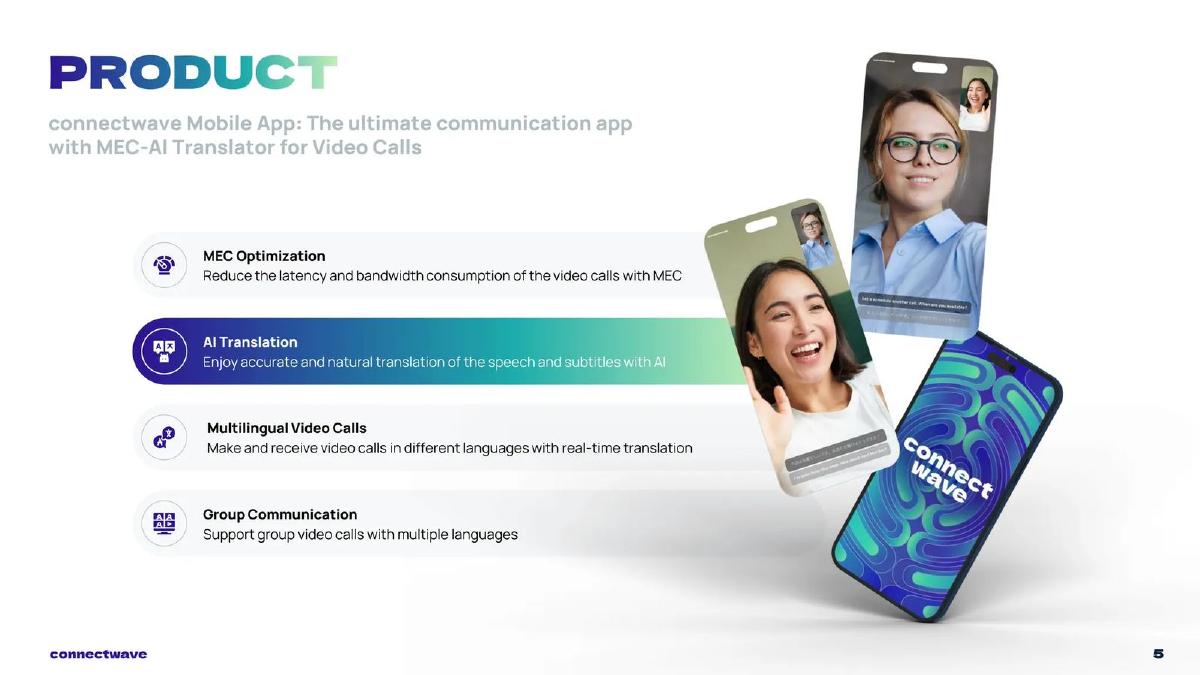
- Connect Wave utilizes Multi-access Edge Computing (MEC) to reduce latency and bandwidth consumption for video calls (Slide 5).
- The product features an AI-driven real-time translator for multilingual video calls and group communication (Slide 5).
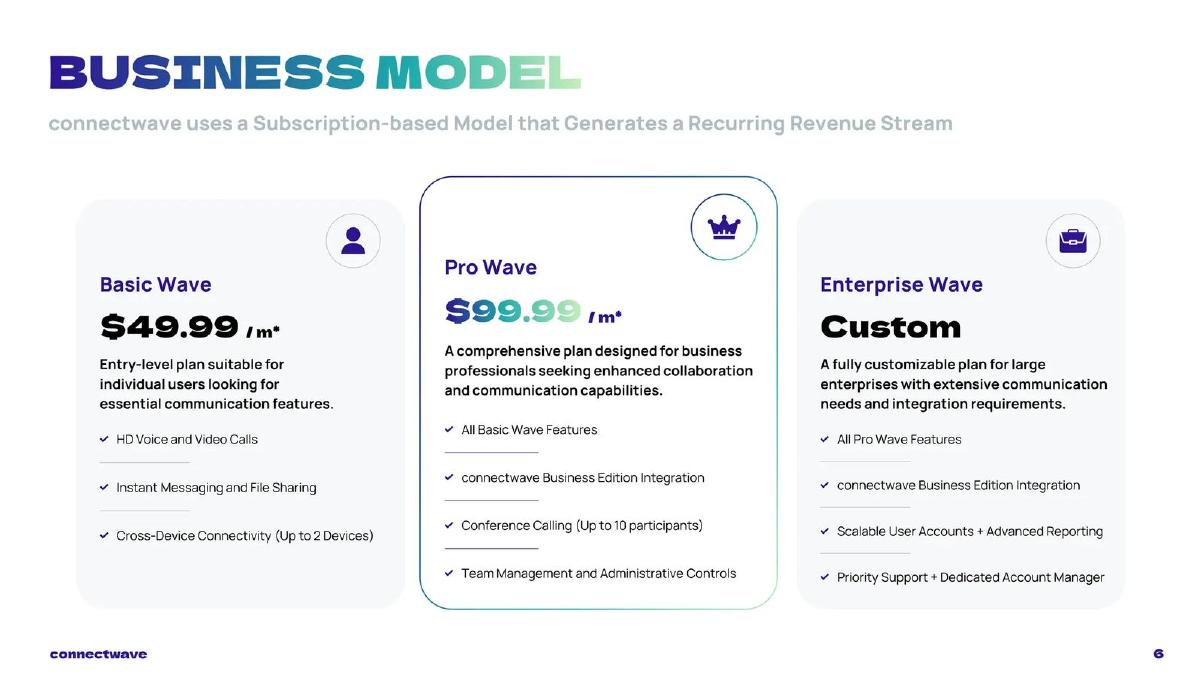
- Pricing is set at a premium compared to many consumer apps, with a basic plan starting at $49.99 per month (Slide 6).
- The total addressable market for internet-based telecommunications is valued at $2.3 billion with a 15% CAGR by 2025 (Slide 10).
- The leadership team includes a CEO who pioneered the FlexiComm project and a CTO who invented the SecureTalk encryption protocol (Slide 12).
- Connect Wave is seeking $10 million in funding, with 40% dedicated to technology development and 30% to marketing (Slide 14).
- The financial projections estimate reaching $5.8 million in annual revenue by Year 5, following a $1.0 million Year 1 (Slide 13).
Connect Wave Pitch Deck Analysis
Connect Wave presents a comprehensive 15-slide pitch deck targeting the telecommunications sector. The company positions itself as a 'Next-Generation Internet Telecommunication' provider, aiming to disrupt a market currently dominated by legacy providers with physical infrastructure limitations. The deck follows a standard narrative arc: identifying the failures of traditional systems, introducing a high-tech solution involving AI and edge computing, and demonstrating rapid early traction to justify a $10 million capital raise.
Slide 1: Title Slide
The opening slide establishes the brand identity with the tagline 'connect the world' and the subtitle 'Next-Generation Internet Telecommunication.' The visual theme uses concentric circles in blue and green gradients, suggesting signal waves or global connectivity. The branding is clean, though the slide lacks a specific mission statement or a high-level value proposition beyond the sector definition.
Slide 2: Problem
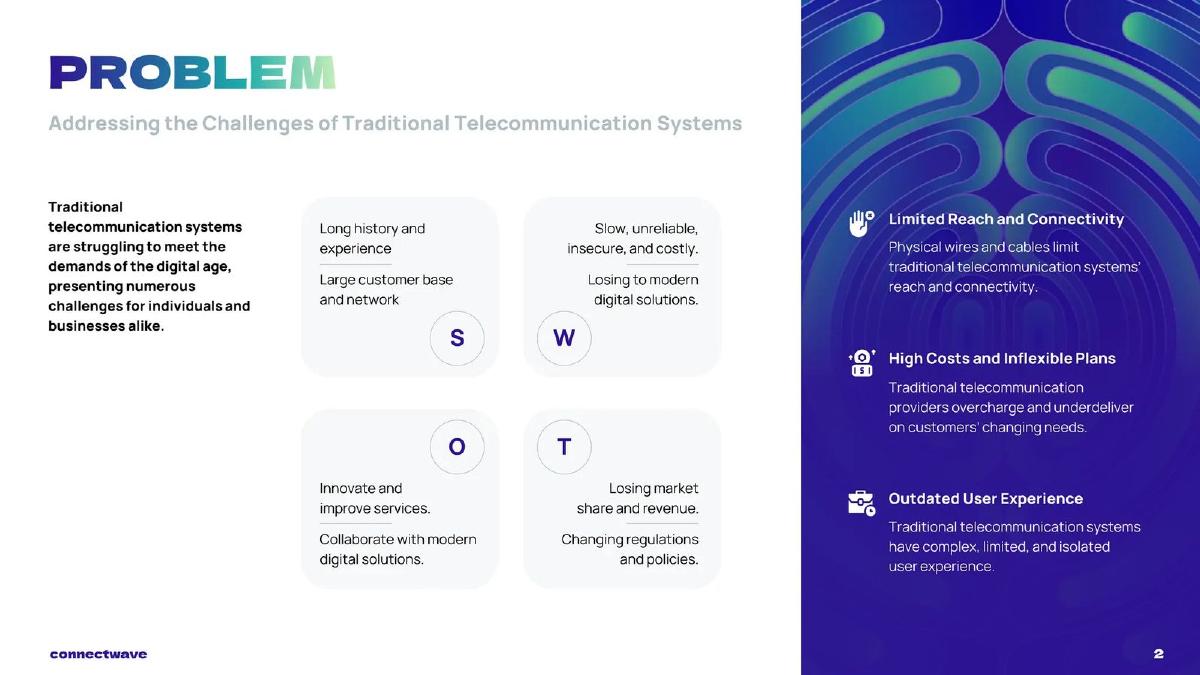
Slide 2 uses a SWOT-style layout to critique 'Traditional Telecommunication Systems.' It identifies weaknesses such as being 'slow, unreliable, insecure, and costly.' The right side of the slide highlights three specific pain points: Limited Reach and Connectivity due to physical wires, High Costs and Inflexible Plans , and an Outdated User Experience characterized by complex and isolated interfaces. This slide effectively sets the stage for a digital-first competitor.
Slide 3: Solution
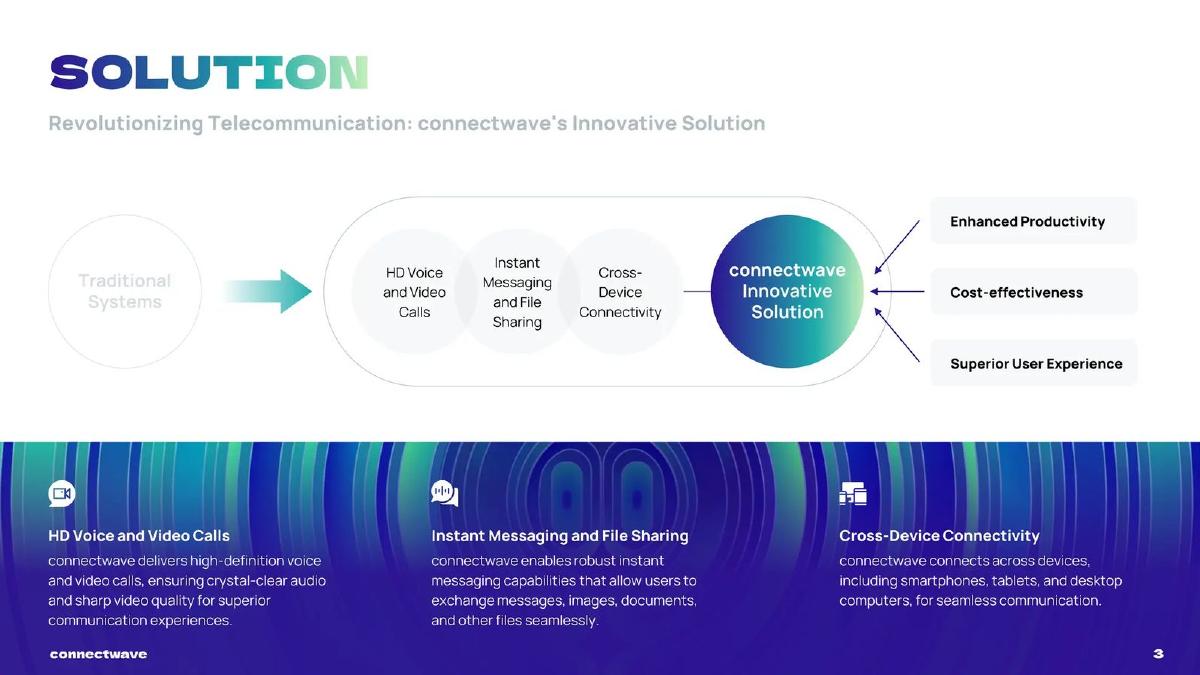
The solution slide uses a process diagram to show the transition from 'Traditional Systems' to the 'connectwave Innovative Solution.' The core offerings listed are HD Voice and Video Calls, Instant Messaging and File Sharing, and Cross-Device Connectivity. The slide claims these lead to 'Enhanced Productivity,' 'Cost-effectiveness,' and 'Superior User Experience.' While these are standard features for modern VOIP services, the deck relies on subsequent slides to explain the underlying technology differentiation.
Slide 4: Product Overview
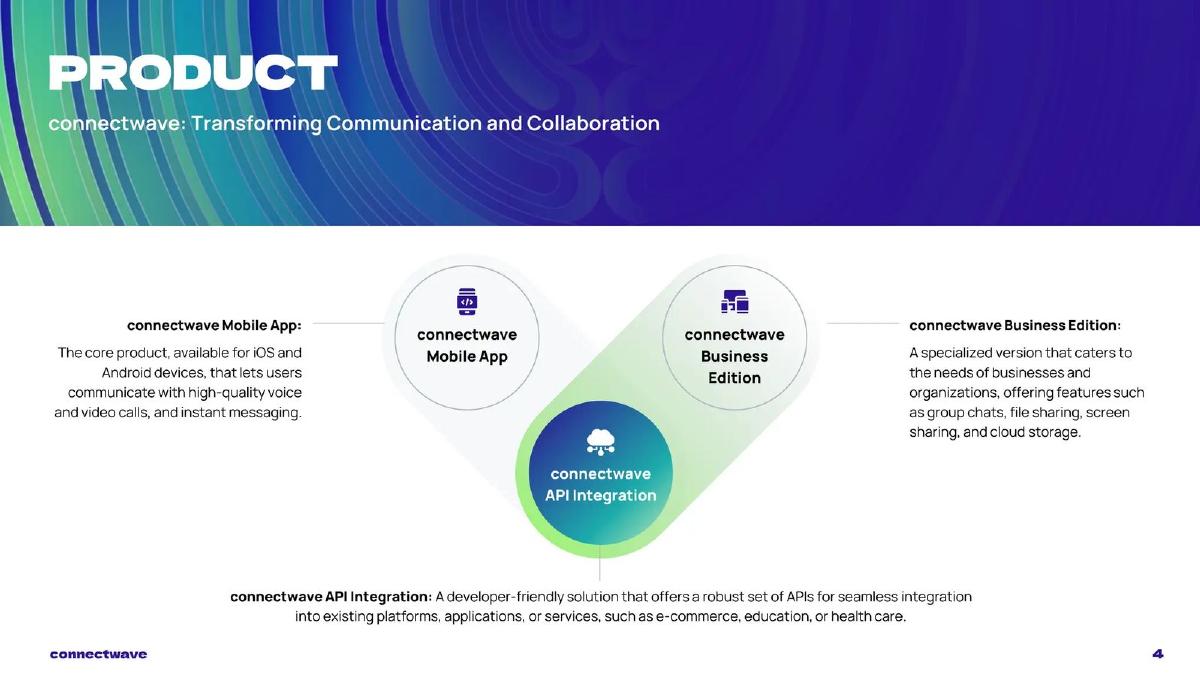
This slide breaks the product into three pillars: the Mobile App (iOS and Android), the Business Edition (group chats, screen sharing, cloud storage), and API Integration . The inclusion of a developer-friendly API suggests a strategy to embed their communication tools into third-party platforms like e-commerce or healthcare, expanding their reach beyond a standalone app.
Slide 5: Product Features (MEC-AI)
Slide 5 introduces the technical 'moat.' It highlights MEC Optimization (Multi-access Edge Computing) to reduce latency and bandwidth—a critical factor for high-quality video calls. It also features an AI Translator for real-time speech and subtitles in multilingual video calls. The visual includes mobile mockups showing a video call interface with translated subtitles, providing a concrete look at the user experience.
Slide 6: Business Model
Connect Wave utilizes a tiered subscription model. Basic Wave is priced at $49.99/month for individuals. Pro Wave is $99.99/month, adding conference calling for up to 10 participants and administrative controls. Enterprise Wave is listed as 'Custom.' The pricing is notably high for a communication app, suggesting the company is targeting high-value professional users rather than competing with free or low-cost consumer messaging apps.
Slide 7: Milestones
The roadmap outlines a progression from mobile app development and closed beta testing to a public launch. Future milestones include expanding product offerings (API and Business Edition), international expansion, and scaling through partnerships. The timeline is not dated, which makes it difficult to assess the speed of execution, but the sequence is logical for a SaaS startup.
Slide 8: Traction
This is the most data-heavy slide in the deck. It shows 'Extended MRR Growth' over six months, starting at $10K in Month 1 and reaching $456K in Month 6. The growth rates are consistently above 113% month-over-month. Additional metrics include a 95% satisfaction rate from 500 users and a 98% retention rate after three months. It also includes two testimonials from an IT Director and an Operations Manager, providing social proof.
Slide 9: Go-To-Market Strategy
The GTM strategy distinguishes between the 'Basic Wave' and 'Enterprise/Pro Wave' segments. Basic users are acquired via Online Self-Service with a $100 CAC and immediate payback. Enterprise users are targeted via Direct Sales with a consultative approach, featuring a CAC of up to $15,000, an ACV of $250,000, and a payback period within the first year. This dual-track approach is common in B2B SaaS but requires a sophisticated sales team.
Slide 10: Market Size
Slide 10 quantifies the opportunity. It values the 'Current Telecommunication Market' at $1.5 B and the 'New internet-based Telecommunication Market' at $2.3 B . It projects a 15% CAGR by 2025. While these figures are specific, the slide does not cite the source of the market data, which is a common omission in early-stage decks.
Slide 11: Competition
The competitive matrix plots functionality against business size. Connect Wave places itself in the top-left quadrant (High Functionality, Small-to-Medium Business Size). It names competitors like BYY , Merizyn , HeyoApp , Cloud , Smartel , 2net , H&G , telew , and WeTELE . The deck argues that traditional providers have legacy infrastructure while internet platforms offer ease of use but lower functionality for larger scales.
Slide 12: Team
Elizabeth Clarke (CEO): Former COO at a tech startup, pioneered the FlexiComm project. · Raj Patel (CTO): Ph.D. in Network Security, inventor of the SecureTalk encryption protocol. · Carlos Gomez (UX Director): Redesigned the interface for ChatSphere, claiming a 150% engagement increase. · Aisha Mohammed (Head of Global Operations): Led the Operation GlobalLink initiative across 80 countries.
The team appears well-balanced between technical expertise, operations, and design.
Slide 13: Financials
The financial slide shows a revenue projection starting at $1.0M in Year 1 and growing to $5.8M by Year 5 . It notes a 30% year-over-year revenue growth and a 65% gross profit margin . The cost structure is dominated by Platform Development (52%) and Marketing (23%) , which aligns with the company's focus on technical differentiation and aggressive acquisition.
Slide 14: Funding Ask
Connect Wave is seeking $10 million in funding. The allocation is clearly defined: 40% for Technology Development, 30% for Marketing Campaigns, 20% for Team Expansion, and 10% for Operational Costs. The slide explicitly states the investment is to 'accelerate growth and enhance our services.'
Slide 15: Contact
The final slide provides contact information, including a phone number (012.3456.987), an email (alisa@connectwave.com), and the website (connectwave.com). The phone number appears to be a placeholder, which is a minor detail but worth noting for a telecommunications company.
What Connect Wave Does Well
The deck excels at identifying a clear technical differentiator in a crowded market. By focusing on MEC (Multi-access Edge Computing) and AI Translation , Connect Wave moves beyond being 'just another Zoom' and addresses specific enterprise needs for low latency and global collaboration. The traction slide (Slide 8) is particularly strong, showing not just revenue growth but also retention and satisfaction metrics that suggest a high degree of product-market fit.
The business model (Slide 6) and GTM strategy (Slide 9) are also well-articulated. The founders clearly understand the difference between self-service acquisition for individuals and consultative sales for enterprises, providing specific CAC and ACV targets for both. This level of granularity gives investors confidence that the team understands their unit economics.
What Is Missing from the Connect Wave Deck
Despite the strong technical focus, the deck is missing a detailed technical roadmap . While it mentions MEC and AI, it doesn't explain how these are deployed or if the company owns the underlying IP or relies on third-party providers like AWS Wavelength or Azure for Operators. For a $10M ask, investors would likely want to see more depth on the infrastructure layer.
Furthermore, the regulatory and compliance aspect is entirely absent. Telecommunications is one of the most heavily regulated industries globally. A company planning 'International Expansion' (Slide 7) and operating in 80 countries (Slide 12) needs to address how it handles data sovereignty, GDPR, and local telecom licensing. Omission of these risks can be a red flag for sophisticated investors in this specific sector.
Founder Takeaways: What to Copy
Specific GTM Metrics: Do not just say you will sell to businesses. Like Slide 9, provide estimated CAC, ACV, and payback periods for different customer segments. · Visualizing the Moat: Slide 5 uses simple icons and a mockup to explain complex tech (MEC and AI). This makes the 'why us' easy to digest in a 30-second skim. · Retention as Traction: Revenue growth is good, but the 98% retention rate on Slide 8 is what proves the product is actually working. Always include a retention or churn metric if you have it. · Balanced Team Profiles: Slide 12 focuses on specific achievements (inventing a protocol, leading an 80-country initiative) rather than just listing previous job titles. This 'proof of work' is more compelling than a list of logos.
Frequently asked questions
- What is Connect Wave's core technological advantage?
- According to slide 5, Connect Wave differentiates itself through MEC (Multi-access Edge Computing) optimization and AI translation. MEC is used to specifically reduce latency and bandwidth consumption during video calls, while the AI component provides real-time speech and subtitle translation for multilingual communication, aiming to solve the 'outdated user experience' of traditional systems mentioned on slide 2.
- How does the company justify its $49.99/month starting price?
- Slide 6 outlines the 'Basic Wave' plan at $49.99/month, which includes HD voice/video, instant messaging, and connectivity for up to two devices. This high entry price suggests a focus on professional or power users rather than a mass-market consumer audience, further supported by the 'Pro Wave' plan at $99.99/month which adds conference calling and administrative controls.
- What does the traction data reveal about their growth?
- Slide 8 shows an aggressive growth curve, starting at $10K MRR and growing at rates between 113% and 120% month-over-month to reach $456K. The slide also claims a 95% satisfaction rate from 500 beta users and over 1,000 business pre-orders, indicating strong initial market validation for their enterprise-focused features.
- Who are the key competitors identified in the deck?
- Slide 11 maps the competitive landscape against 'Functionality' and 'Business Size.' It identifies traditional providers like BYY and Merizyn as having large bases but lower agility. Internet-based platforms like Cloud, HeyoApp, and Smartel are listed as competitors, though Connect Wave places itself at the highest level of functionality for small-to-mid-sized businesses.
- How will the $10 million investment be utilized?
- Slide 14 breaks down the $10 million ask into four categories: 40% for Technology Development (AI algorithms and scalability), 30% for Marketing Campaigns (aggressive user acquisition), 20% for Team Expansion (engineering and design talent), and 10% for Operational Costs (administrative expenses).