Consolefm’s pitch deck is a relic of the early 2010s music streaming wars, emphasizing simplicity over the feature-heavy interfaces of incumbents. The deck relies heavily on visual storytelling, using screenshots of Pandora, Turntable.fm, and iTunes to illustrate user friction before presenting its own minimalist solution. With 40,000 listeners and a 70% active user rate, the startup demonstrated strong early engagement. However, the deck is notably thin on business fundamentals, omitting a team slide, revenue model, and a specific funding ask. It positions itself against a $3.2 billion marke…
Key takeaways
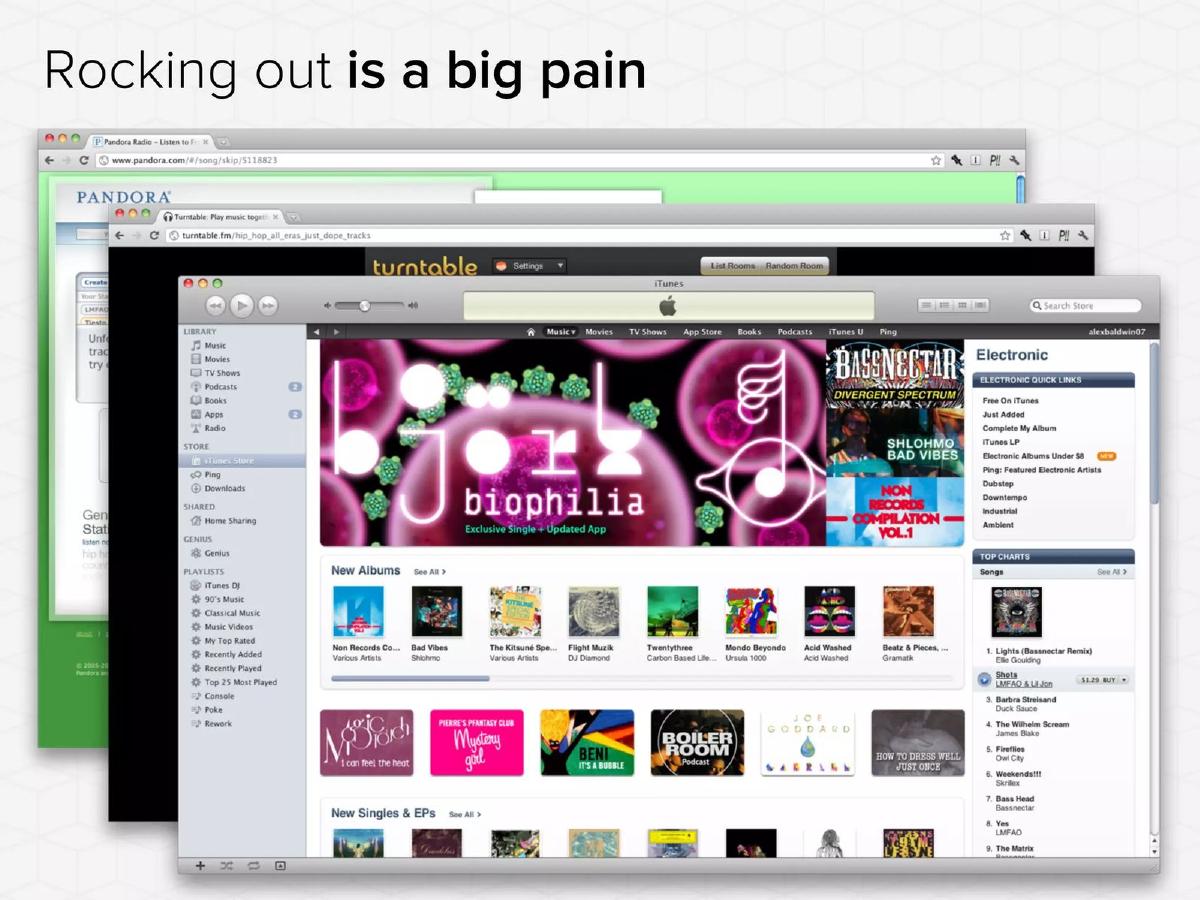
- The deck uses a 'Problem/Solution' visual pair to contrast cluttered legacy interfaces with Consolefm's minimalist design (Slides 2 and 3).
- Traction is presented through three core metrics: 40,000 listeners, 10,000 users, and a 70% activity rate (Slide 4).
- Market opportunity is framed by a $3.2 billion IPO valuation, likely referencing Pandora's 2011 public debut (Slide 5).
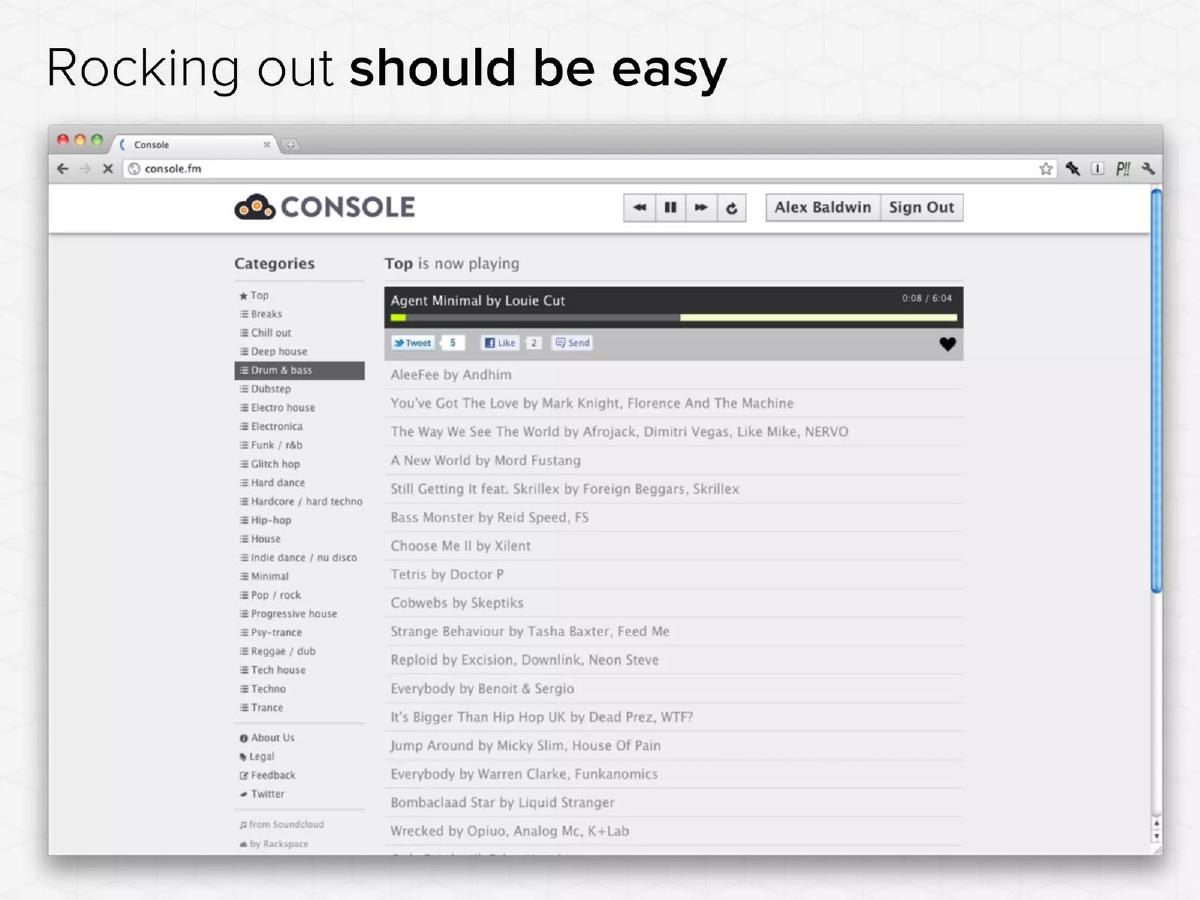
- The product appears to be a web-based aggregator or player, citing SoundCloud and Rackspace as technical partners or sources (Slide 3).
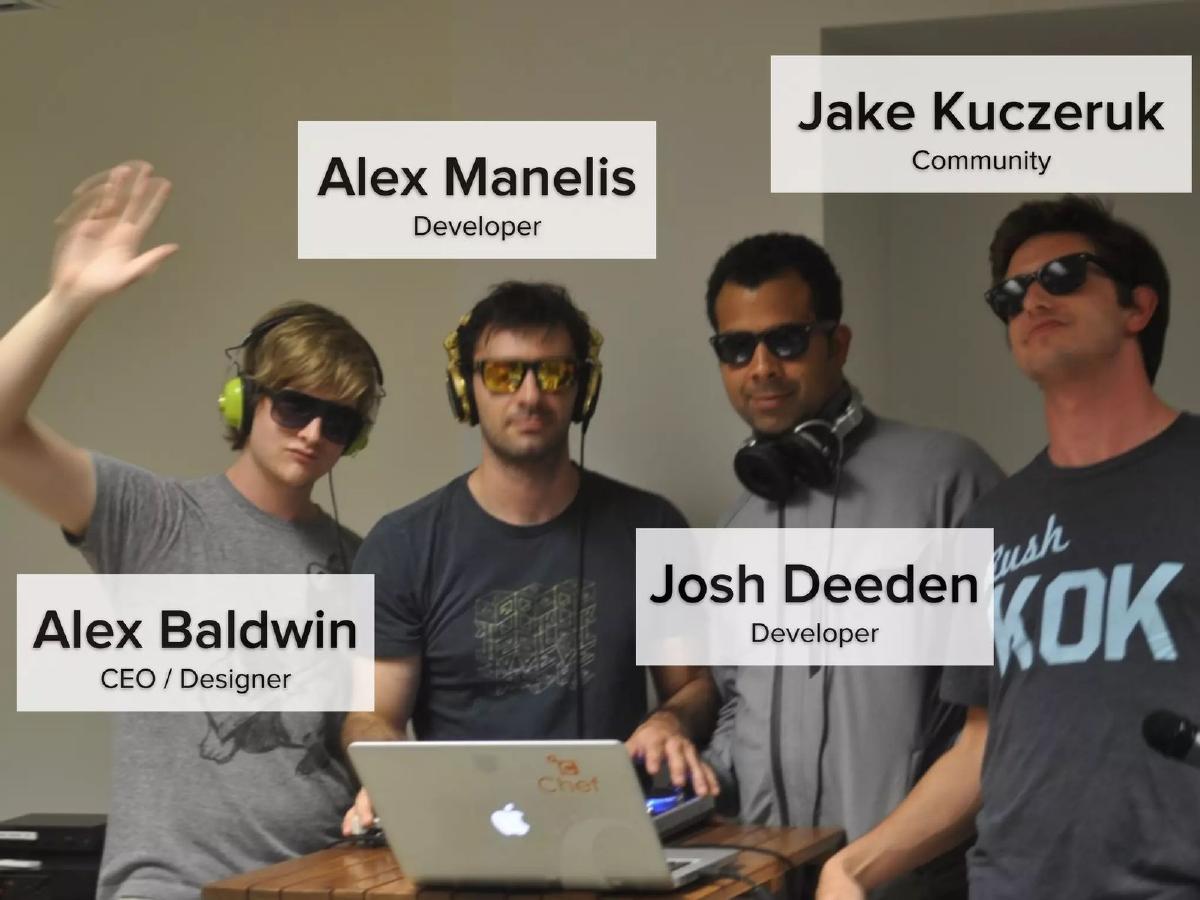
- The deck completely omits a team slide, leaving the founders' backgrounds and technical capabilities unknown.
- There is no stated financial 'Ask' or breakdown of how investment capital would be deployed.
- The business model is hinted at through a reference to advertising revenue in the broader market, but no specific monetization plan for Consolefm is provided (Slide 5).
- The deck relies on an AngelList profile link for further due diligence, suggesting it was designed as a high-level teaser (Slide 6).
Introduction
The Consolefm pitch deck is a study in minimalist communication. Comprising only 11 slides (with 6 provided for this analysis), it eschews the dense text and complex charts typical of modern SaaS decks in favor of a high-impact, visual narrative. The company targets the 'music discovery' problem, a crowded space in the early 2010s that saw the rise and fall of numerous platforms. By focusing almost exclusively on user interface (UI) and user experience (UX), Consolefm makes a bold claim: that the winner in music streaming will not be the one with the most features, but the one that is easiest to use.
Slide 1: Title and Tagline
The deck opens with a clean logo featuring a cloud with three speaker-like circles, immediately signaling a cloud-based audio service. The tagline, "Easy button for awesome music," is a direct value proposition. It identifies the core problem—complexity—and offers a simple solution. The inclusion of the Twitter handle @consolefm suggests a company that is active in the social ecosystem and values direct user engagement.
Slide 2: The Problem - Visual Friction
Slide 2, titled "Rocking out is a big pain," uses a stacked screenshot approach to illustrate the state of the market. It shows the interfaces of Pandora, Turntable.fm, and iTunes. The visual message is clear: these platforms are cluttered, overwhelming, and full of cognitive load. By labeling this a "big pain," the founders are betting that users are frustrated by the amount of clicking and searching required to simply start hearing music.
Slide 3: The Solution - Radical Simplicity
The counterpoint to the problem is Slide 3: "Rocking out should be easy." This slide showcases the Consolefm web interface. It is a stark contrast to the previous slide. The UI features a simple sidebar with music categories (e.g., Chill out, Deep house, Dubstep) and a central playlist. A prominent play bar at the top shows the current track, "Agent Minimal by Louie Cut." Small details, like the "from Soundcloud" and "by Rackspace" attributions in the footer, provide a glimpse into the technical stack, indicating that Consolefm acted as a curated layer on top of existing music hosting services.
Slide 4: Traction Metrics
Slide 4 moves from vision to reality, presenting three key figures: "40,000 listeners," "10,000 users," and "70% active." This is a strong traction slide for an early-stage startup. The distinction between 'listeners' and 'users' suggests a 'freemium' or 'no-account-required' model where a large portion of the audience consumes content without registering. The 70% activity rate is the most impressive metric here, as it implies that once a user finds the service, they return to it frequently. This high retention is a key indicator of product-market fit.
Slide 5: Market Context and Opportunity
Slide 5, titled "It’s time for music," provides the macro-economic justification for the business. It cites a "$3.2 billion IPO valuation" and notes that "86% from advertising." While the deck doesn't name the company, these figures align perfectly with Pandora Media's IPO in June 2011. By highlighting the advertising revenue percentage, Consolefm is signaling its intended business model: a free, ad-supported service that captures a massive audience by being more user-friendly than the incumbent billion-dollar players.
Slide 6: The Call to Action
The final slide in this set is a contact and links page. It features a large red "Console.fm" button and provides the website URL, an AngelList profile link (angel.co/console-fm), the Twitter handle, and a creative email address: makeitrain@console.fm . The use of "makeitrain" is a stylistic choice that reflects the 'startup culture' of the era, though it may come across as less professional in a modern context. The link to AngelList indicates that this deck was likely used as a teaser to drive investors to a more detailed profile where financials and team bios were hosted.
What Consolefm Does Well
The deck excels at visual storytelling . By showing rather than telling, the founders make the case for their UI/UX advantage in seconds. In a sector like consumer music, where the product is the experience, this is the correct approach. The contrast between Slide 2 and Slide 3 is a textbook example of how to frame a competitive advantage without writing a single bullet point about 'features.'
Furthermore, the traction metrics are focused. Instead of a 'vanity metric' dump, the deck highlights the one number that matters most for a discovery platform: activity rate. A 70% active user base is a powerful signal that the 'Easy button' concept actually works for the target demographic.
What is Missing from the Deck
The most glaring omission is the Team Slide . In early-stage fundraising, investors are buying the founders as much as the idea. Without knowing who is building the technology or who is navigating the legal complexities of the music industry, an investor cannot assess execution risk. Music startups are notoriously difficult to scale due to licensing; a team with experience in rights management or high-scale engineering would be a critical detail to include.
Second, the Business Model is only hinted at. While Slide 5 mentions advertising, there is no explanation of how Consolefm specifically will implement ads without ruining the 'simple' UX they are touting. Will there be audio ads? Display ads? A subscription tier? The deck is silent on these points.
Third, there is no Competitive Landscape analysis beyond the UI comparison. In 2011-2012, the music space was becoming incredibly crowded with Spotify's US launch and the rise of other aggregators. Consolefm needed to explain why their simplicity was a defensible moat against competitors with much deeper pockets and larger libraries.
Finally, there is no Ask . A pitch deck should clearly state how much money is being raised and what milestones that money will help the company reach. Without an ask, the deck feels like a product demo rather than a fundraising tool.
Founder Takeaways
Use visual contrasts: If your startup's primary advantage is a better user experience, don't describe it—show it. Side-by-side comparisons of your UI versus the incumbent's UI are incredibly persuasive. · Focus on retention: Total user counts are less important than how many of those users actually come back. Consolefm's 70% active rate is the strongest part of their pitch. · Don't ignore the 'How': Simplicity is a great hook, but investors need to know how the business survives. In the music industry, this means addressing licensing and monetization head-on. · Include your pedigree: Never leave out the team slide. Even if you are a first-time founder, highlight your technical skills or your unique insight into the problem. · Be clear about the money: Every deck should have a slide that says "We are raising $X to achieve Y." This turns a conversation about a product into a conversation about an investment.
Frequently asked questions
- What is the primary value proposition of Consolefm?
- Consolefm positions itself as the 'Easy button for awesome music.' The deck argues that existing platforms like iTunes and Pandora are too cluttered and difficult to use. The solution is a streamlined, single-page web interface that prioritizes immediate playback and simple category navigation, reducing the 'pain' of finding music to listen to.
- How does Consolefm define its market size?
- Rather than using traditional TAM/SAM/SOM calculations, the deck points to a '$3.2 billion IPO valuation' and notes that 86% of that revenue comes from advertising. This is a direct reference to the market conditions following Pandora's IPO, suggesting that Consolefm intends to capture a similar audience through a superior user experience.
- What traction had the company achieved at the time of this deck?
- The company reported 40,000 listeners and 10,000 registered users. Most notably, they claimed a 70% active user rate, which indicates high retention and product-market fit among their early adopter base. These figures suggest an early-stage startup that has moved past the MVP phase and is seeking to scale.
- What are the most significant omissions in this pitch deck?
- The deck lacks several critical components required for a full investment evaluation: a team slide, a detailed business model, a competitive analysis (beyond visual UI comparisons), and a specific funding ask. It functions more as a product vision deck than a comprehensive business plan.
- What technology does Consolefm appear to be built on?
- Based on the product screenshot on Slide 3, the platform integrates with SoundCloud ('from Soundcloud') and was hosted on Rackspace. The interface is a web-based player featuring categories like 'Deep house,' 'Dubstep,' and 'Indie dance,' suggesting a focus on electronic and independent music genres.