Komodor's Series A deck is a highly technical yet accessible presentation that successfully raised $21M in 2021. The deck excels by focusing on the 'Understand' phase of troubleshooting, which it claims consumes 80% of developer resources. By using a persona-driven narrative (Sarah the developer), the deck transforms abstract infrastructure problems into a concrete workflow solution. It leverages significant social proof, listing early traction with major tech firms like Intel and Monday.com, alongside a heavy-hitting roster of angel investors from Snyk, Logz.io, and Aqua Security. While the…
Key takeaways
- The deck identifies a massive efficiency gap, stating that 80% of troubleshooting resources are spent on the 'Understand' phase (Slide 4).
- Komodor uses a 'day-in-the-life' narrative featuring a developer named Sarah to demonstrate the product's value proposition across Slides 11, 12, and 13.
- The company targets a very specific ICP: US-focused companies with 50-500 developers and 50+ microservices running on Kubernetes (Slide 6).
- Social proof is a core pillar of the pitch, showcasing early traction with logos like Intel, Varonis, and Outreach (Slide 5).
- The 'Komodor's brain' slide (Slide 9) provides a high-level visualization of the platform's ability to map 200+ Kubernetes microservices.
- The investor slide (Slide 7) highlights a strategic mix of VCs (NFX, Pitango) and industry-specific angel investors from leading DevOps companies.
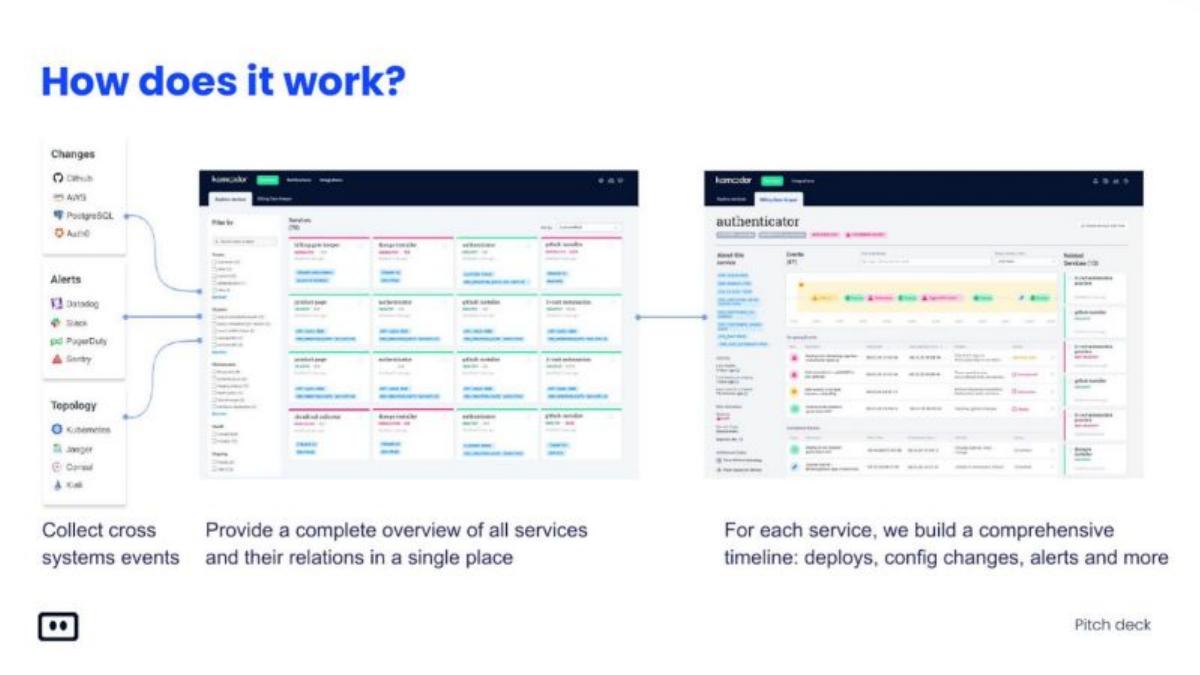
- The product integrates with a wide stack including GitHub, AWS, PagerDuty, and Datadog to provide a unified timeline of events (Slide 3).
- The deck defines a clear evolution of troubleshooting from 'Understand' to 'Manage' and finally 'Prevent' through auto-remediation (Slide 4).
The Narrative of Complexity: How Komodor Sells Kubernetes Simplicity
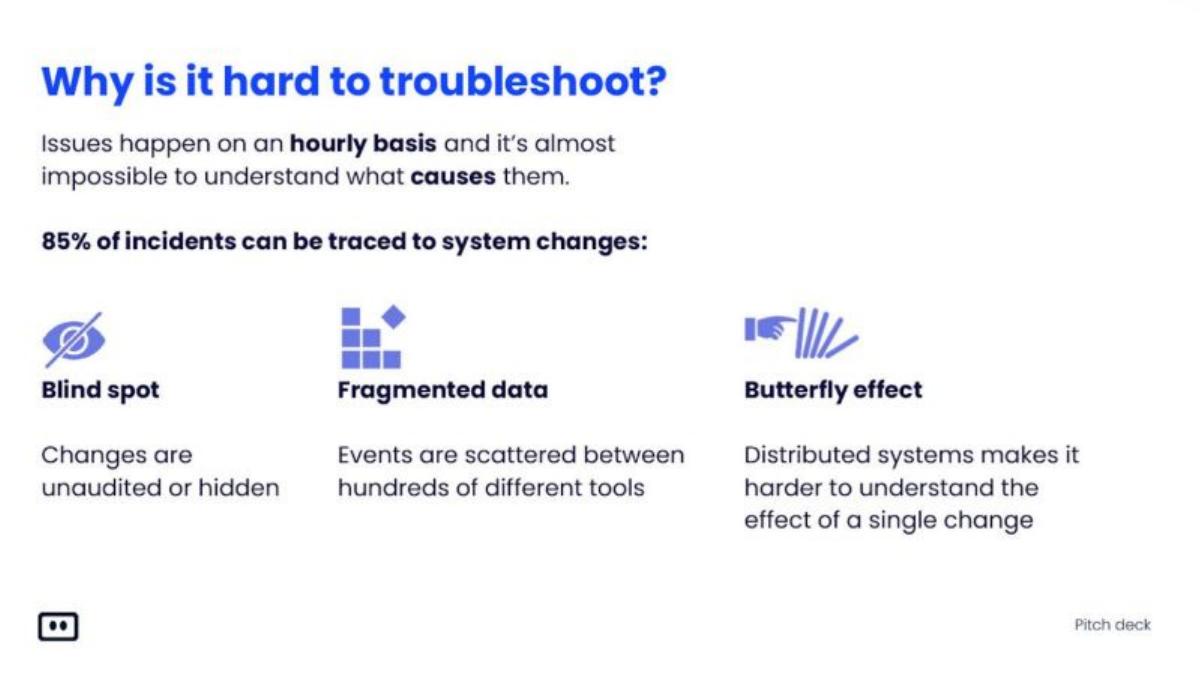
The Komodor Series A deck is a study in technical storytelling. In the world of enterprise software, especially DevOps tools, the temptation is to lead with abstract architecture diagrams or vague promises of 'efficiency.' Instead, Komodor leads with the chaos of the status quo. By the time they raised their $21M Series A in 2021, Kubernetes had become the de facto standard for container orchestration, but it brought with it a troubleshooting nightmare that this deck exploits perfectly.
Slide 1: Title Slide
The deck opens with a clean, dark-themed brand identity. The imagery of nodes and connecting lines subtly hints at the networking and topology focus of the product without being overly literal. It establishes a professional, 'enterprise-ready' aesthetic from the first second.
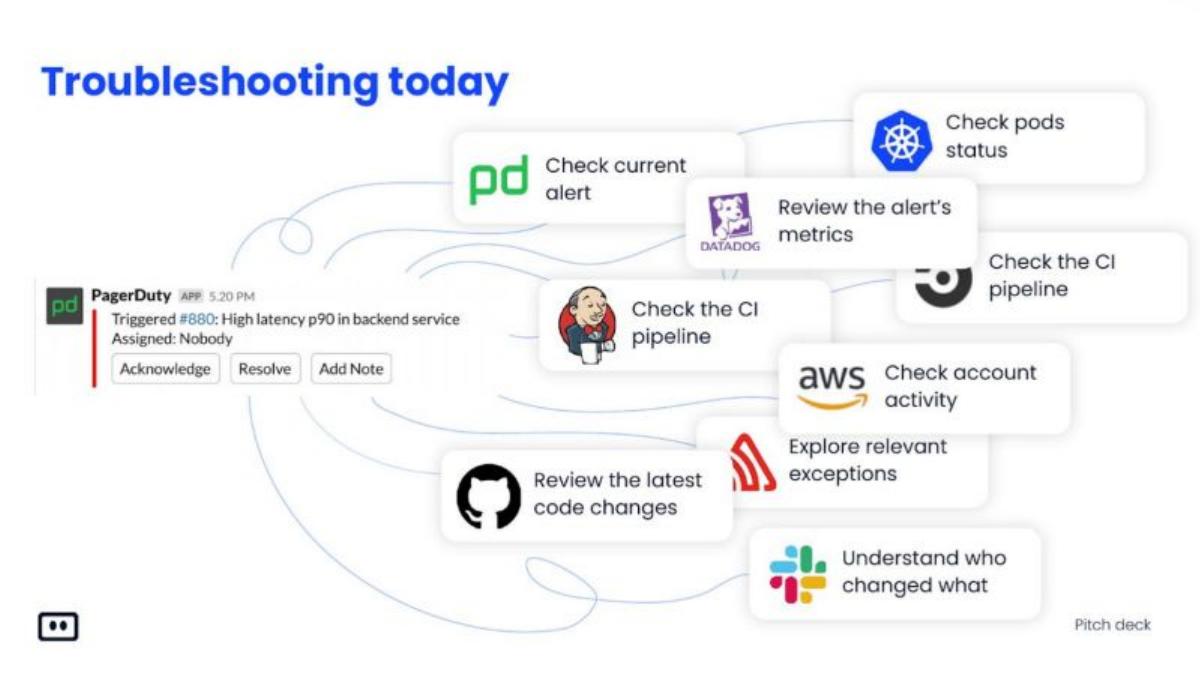
Slide 2: Troubleshooting Today
This is the 'villain' slide. It visualizes the fragmented workflow of a modern developer. An alert is triggered in PagerDuty, and the developer is forced to navigate a 'spaghetti' of tools: Datadog for metrics, Jenkins for CI pipelines, AWS for account activity, GitHub for code changes, and Slack for communication. The slide effectively communicates that the current process is manual, context-switching heavy, and prone to error.
Slide 3: How does it work?
Komodor immediately presents the 'hero' solution. The slide is divided into three clear steps: collecting cross-system events (Changes, Alerts, Topology), providing a complete overview of services in a single dashboard, and building a comprehensive timeline for each service. This slide is crucial because it shows the product UI, proving that the solution is built and functional, not just a concept.
Slide 4: The Three Pillars of Troubleshooting
This slide provides the strategic framework for the company's roadmap. It breaks troubleshooting into Understand, Manage, and Prevent. Most importantly, it includes a handwritten-style annotation: '80% of the resources go here,' pointing to the 'Understand' phase. This justifies Komodor's current focus while showing a path toward 'Auto remediation' and 'self-healing systems' in the 'Prevent' phase, which represents the long-term vision and larger market opportunity.
Slide 5: Early Traction
Social proof is delivered via a logo cloud. The inclusion of Intel and Monday.com is significant, as it demonstrates that the product can scale from high-growth startups to legacy global enterprises. The phrase 'And many more...' suggests a momentum that exceeds the space on the slide.
Slide 6: Target Companies
This slide is refreshingly honest about the company's Ideal Customer Profile (ICP). It doesn't claim to be for everyone. It specifies a 'must' (Kubernetes) and a 'sweet spot' (50-500 developers). By listing specific industries like trading, gaming, and fintech, Komodor shows investors they have a clear, repeatable go-to-market strategy rather than a 'spray and pray' approach.
Slide 7: Investors & Fundraising
This is one of the strongest slides in the deck. Beyond the institutional VCs (NFX, Pitango, 83North), the list of angel investors is a strategic asset. Having the founders of Snyk, Logz.io, and Aqua Security—all successful companies in the same ecosystem—serves as a powerful endorsement of Komodor's technical viability and market need.
Slide 8 & 9: Technical Deep Dive
Slide 8 acts as a transition, while Slide 9 introduces 'The Komodor's brain.' This slide shows a complex graph of 200+ microservices. It’s a 'wow' moment intended to show the platform's ability to handle enterprise-grade complexity. It moves the conversation from 'what it does' to 'how it thinks,' emphasizing the proprietary technology behind the service mapping.
Slide 10, 11, 12, & 13: The Persona Narrative
The final four slides of this sample use a 'day-in-the-life' story featuring 'Sarah.' This is a classic but effective pitch deck technique. We see Sarah receive an alert (Slide 11), deep dive into deploy details (Slide 12), and finally scale up a service using a predefined script (Slide 13). The 'Success!' message on the final slide provides a satisfying emotional conclusion to the problem introduced on Slide 2. It makes the abstract benefits of 'MTTR reduction' feel concrete and personal.
What Works in this Deck
The Persona-Driven Demo: By using 'Sarah' as a proxy for the user, Komodor avoids the dry, feature-list trap. They show the product in action within a real-world scenario, which makes the value proposition undeniable.
Strategic Social Proof: The angel investor list is perfectly curated. In DevOps, where practitioners are the primary buyers, having the respect of other successful DevOps founders is more valuable than almost any other metric at the Series A stage.
Focus on the 'Understand' Phase: By quantifying that 80% of time is spent just trying to understand what went wrong, Komodor identifies a specific, painful bottleneck that every engineering manager recognizes.
What is Missing
Financial Metrics: In this 13-slide sample, there is no mention of ARR, growth rates, or churn. While the traction slide shows logos, it doesn't specify if these are paid enterprise contracts or free pilots. For a Series A, investors would typically expect a slide dedicated to the 'Money'—unit economics, LTV/CAC, and revenue projections.
The Team Slide: This sample omits the core team slide. While the angel investors are impressive, the pedigree of the founders and their specific experience in Kubernetes is a critical component of a Series A raise that is not visible here.
Competitive Landscape: The deck doesn't explicitly address how Komodor differs from existing APM (Application Performance Monitoring) tools like New Relic or Datadog. While Slide 2 shows them as part of the problem, a dedicated slide explaining why those tools can't solve the Kubernetes timeline problem would strengthen the 'Moat' argument.
What a Founder Should Copy
The 'Villain' Slide: Copy the way Slide 2 visualizes the pain. Don't just list the tools your customers use; show the messy, tangled reality of how they have to use them together today.
The ICP Clarity: Be as specific as Slide 6. Telling investors exactly who you are not for makes your 'Target' list much more believable and your sales motion seem more efficient.
The Roadmap as Strategy: Use the 'Three Pillars' approach from Slide 4. It allows you to sell the product you have today (the 'Understand' phase) while getting investors excited about the high-margin, automated future (the 'Prevent' phase).
Frequently asked questions
- What is the primary problem Komodor is solving?
- Komodor addresses the fragmentation and complexity of troubleshooting in Kubernetes environments. According to Slide 2, developers currently have to jump between PagerDuty, Datadog, Jenkins, AWS, GitHub, and Slack to diagnose a single issue. Komodor centralizes these cross-system events into a single timeline to reduce the time spent in the 'Understand' phase of an incident.
- Who is the target customer for Komodor?
- As detailed on Slide 6, Komodor targets US-focused companies with 50 to 500 developers (roughly 200 to 2,000 total employees). The technical requirement is a 'must' for Kubernetes usage, ideally with 50+ microservices and frequent CI/CD changes. They specifically call out industries sensitive to downtime, such as fintech, gaming, and e-commerce.
- How does the product actually work technically?
- The platform collects events from changes (GitHub, AWS), alerts (Datadog, Sentry), and topology (Kubernetes, Consul). Slide 3 shows that it then builds a comprehensive timeline for each service, including deploys and config changes. Slide 9 illustrates a 'graph' or 'brain' that maps the relationships between hundreds of microservices to help developers visualize the blast radius of a change.
- What kind of traction did Komodor have at the time of this deck?
- Slide 5 displays 'Early traction from great companies,' featuring logos for Intel, Monday.com, Outreach, Varonis, Aqua, and TuneIn. While specific revenue or seat counts are not provided in these slides, the caliber of these enterprise logos suggests strong product-market fit within the DevOps and SRE communities.
- Who are the key investors backing Komodor?
- The Series A was led by NFX and Pitango, with participation from 83North. More notably, Slide 7 lists a 'who's who' of DevOps angel investors, including the founders of Snyk, Logz.io, and Aqua Security, as well as former engineering leadership from Yelp. This provides significant industry validation for a technical product.