Kono's 2014 seed deck is a masterclass in 'show, don't tell' for early-stage startups. Spanning 15 slides, the presentation leans heavily on the professional backgrounds of its founders—specifically citing experience at Daum Kakao and a $30M+ exit to Intel—to justify its foray into the competitive AI scheduling market. The deck focuses almost entirely on the user experience across mobile and wearable devices, using high-fidelity mockups to explain its 'Smart Reminder' and 'One-Tap ETA' features. While it lacks traditional sections like a formal market size analysis, competitor matrix, or deta…
Key takeaways
- The deck leads with founder pedigree, highlighting a CEO who was employee #7 at the $7Bn+ company Daum Kakao (Slide 2).
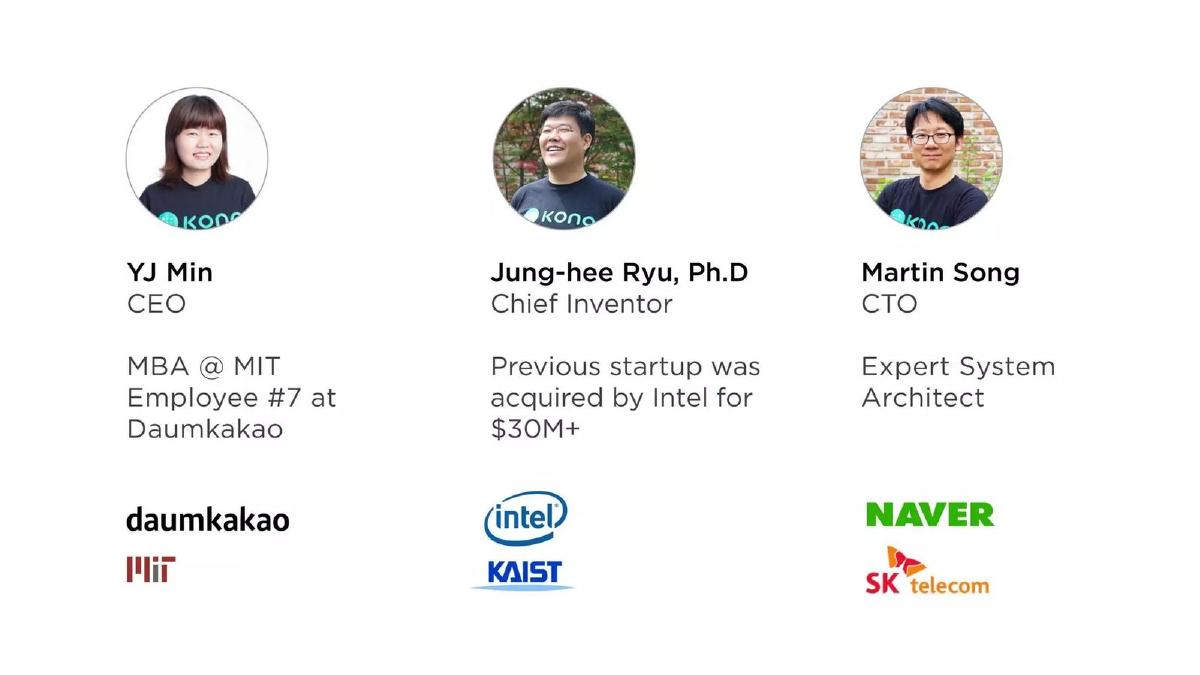
- Technical credibility is established by a Chief Inventor whose previous startup was acquired by Intel for $30M+ (Slide 3).
- The product value proposition is distilled into three core pillars: Time, Place, and Preference (Slide 4).
- Kono positions itself as a cross-platform solution, showing integrations with email bots like x.ai (Slide 7).
- The deck emphasizes wearable technology, dedicating four slides to Apple Watch features like 'Exact Time to Leave' and 'One-Tap ETA' (Slides 10-12).
- Intellectual property is highlighted as a key moat, with a 'Patented' stamp over a diagram showing data inputs from social media and calendars (Slide 13).
- Early traction is quantified as 2,000 active users and 10+ events per week within just three weeks of being live (Slide 14).
- The deck completely omits a business model slide, financial ask, or competitive landscape analysis.
The Pedigree-Driven Seed Pitch
Kono’s 2014 pitch deck is a product of its time, capturing the early excitement surrounding mobile-first AI assistants. At 15 slides, it is concise and visually driven. Rather than overwhelming investors with spreadsheets, Kono makes a bet on founder-market fit . By placing the team slides at the very beginning of the deck, the company signals that its primary asset is the collective experience of its leadership. This teardown examines how Kono used a minimalist aesthetic and high-profile credentials to secure an $880,000 seed round.
Slides 1-3: The Team as the Lead
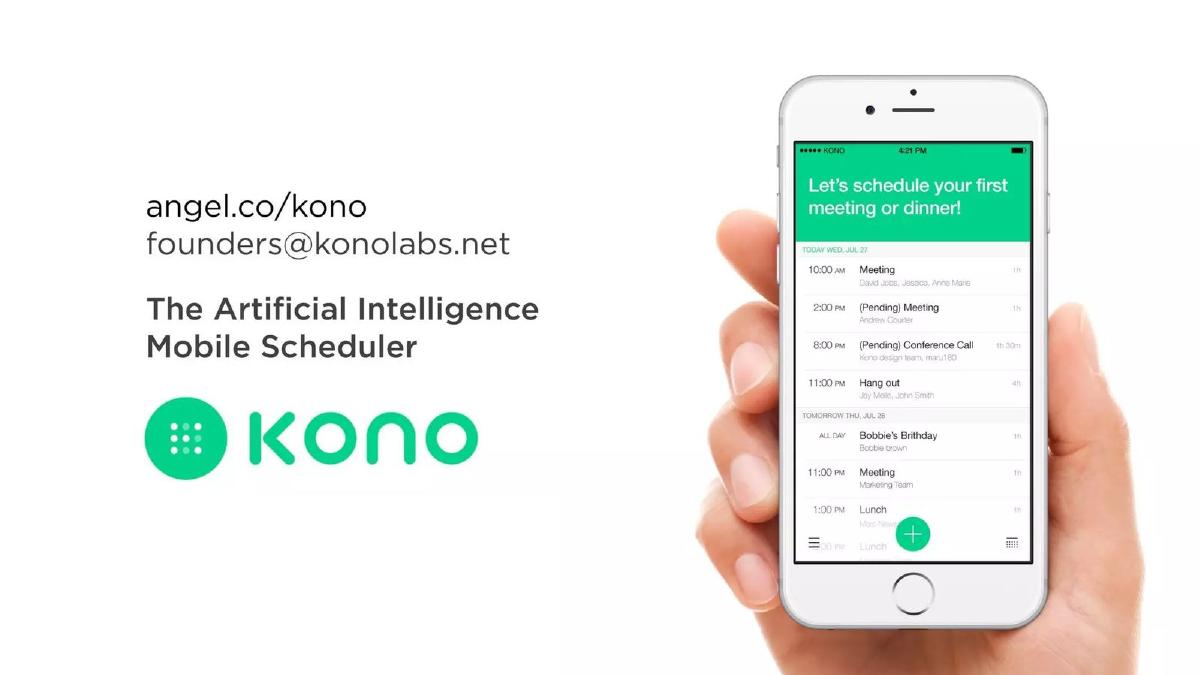
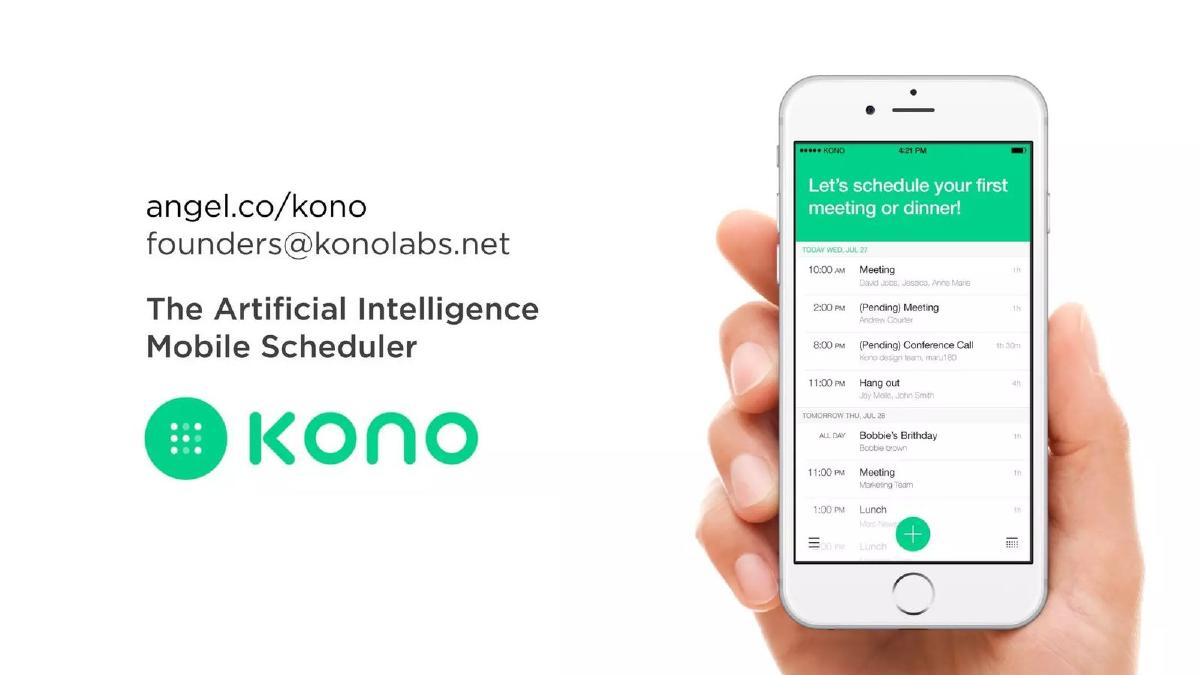
Slide 1: Title The cover slide is functional, featuring the company logo, a mobile mockup, and contact information. It establishes the brand identity immediately: 'The Artificial Intelligence Mobile Scheduler.' The inclusion of an AngelList URL suggests a lean, modern approach to fundraising for 2014.
Slide 2: CEO Profile Unusually, the second slide is a solo profile of the CEO, YJ Min. It highlights her role as Director of New Business Development at daumkakao , a company valued at $7Bn+ , and notes she was Employee No.7 . This is a powerful signal of 'winning' experience, showing she has seen a startup scale from the ground up to a multi-billion dollar entity.
Slide 3: The Full Leadership Team This slide expands on the technical bench. Jung-hee Ryu, the Chief Inventor, is noted for a previous startup acquisition by Intel for $30M+ . CTO Martin Song brings experience from Naver and SK Telecom . By Slide 3, Kono has established that this is not a first-time founder project; it is a team of seasoned operators and technologists with successful exits and big-tech experience.
Slides 4-6: Defining the Problem and Vision
Slide 4: The Core Variables Kono identifies three pillars of scheduling: Time, Place, and Preference . The slide is minimalist, using icons to suggest that current scheduling (represented by an overflowing inbox) fails to account for these contextual factors.
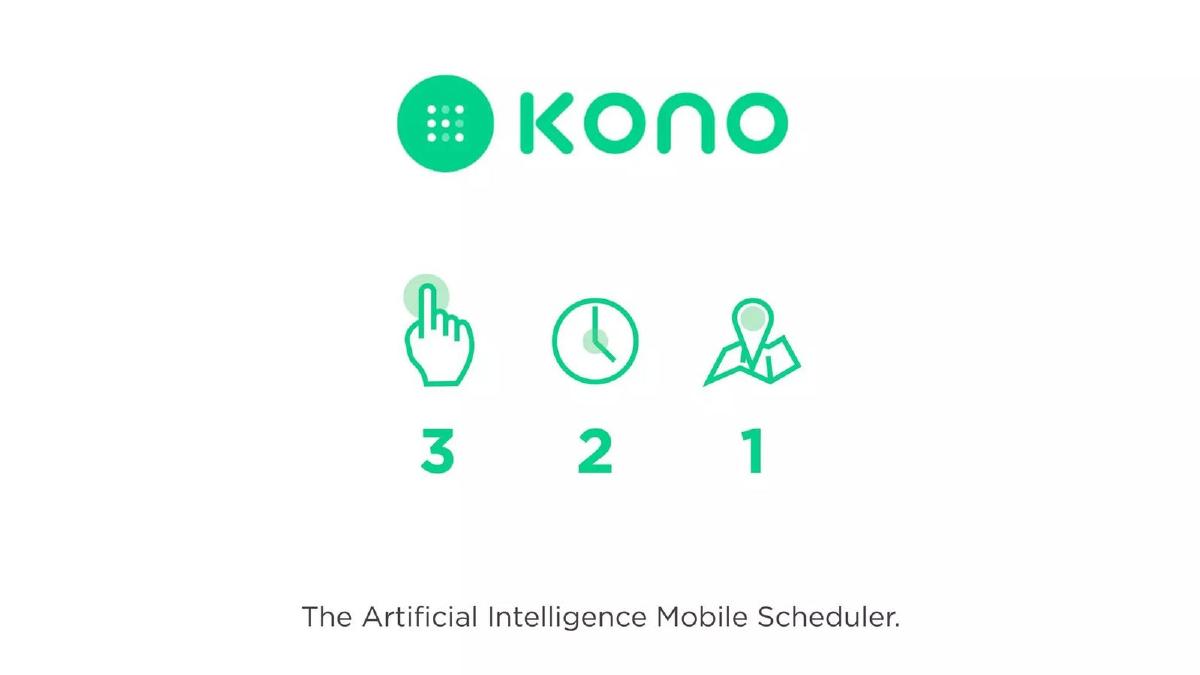
Slide 5: Brand Reinforcement A simple transition slide repeating the logo and the tagline: 'The Artificial Intelligence Mobile Scheduler.'
Slide 6: The 3-2-1 Concept This slide uses a countdown visual (3, 2, 1) paired with icons for a hand, a clock, and a map pin. While somewhat cryptic, it reinforces the idea of simplifying the complex task of coordinating people, times, and locations into a few taps.
Slides 7-8: The Mobile and Bot Interface
Slide 7: Ecosystem Integration This slide shows an iPhone screen with an email draft. It mentions amy@x.ai in the CC field. This is a strategic inclusion; x.ai was a high-profile competitor/contemporary at the time. By showing Kono working alongside other AI bots, the deck suggests that Kono is part of a broader, inevitable shift toward automated personal assistants.
Slide 8: Contact Management A mockup of the Kono app interface shows a list of contacts with @konolabs.net email addresses. This slide demonstrates the 'Place' and 'Time' variables in action within a clean, native mobile UI.
Slides 9-12: The Wearable Strategy
Slide 9: Smart Reminder A blurred image of an Apple Watch with the text 'Smart Reminder.' This begins a four-slide sequence focusing on the then-nascent wearable market.
Slide 10: Exact Time to Leave The deck shows a Kono notification on a smartwatch: 'It’s time to leave for your meeting!' It visualizes the connection between the user and the destination, suggesting the AI is monitoring real-time traffic or transit data.
Slide 11: One-Tap ETA This slide highlights a specific utility: the ability to send a 'running late' message (e.g., '20 mins') with a single tap from the wrist. This addresses a common friction point in professional meetings.
Slide 12: Navigation The final wearable slide shows a map interface on the watch for 'Blue Bottle Coffee.' It completes the user journey from scheduling to arrival.
Slides 13-15: Moats and Traction
Slide 13: The AI Engine and IP Kono visualizes its 'black box.' The diagram shows Contextual Data, Calendar Events, and Social Media Data flowing into the 'Kono AI' engine, resulting in an 'Optimized Event for you.' A large 'PATENTED' stamp is placed in the corner, signaling to investors that the underlying logic is legally protected.
Slide 14: Traction Metrics The deck provides hard numbers to back up the vision. After being live for 3 Weeks , the app recorded 2K Active Users and 10+ Events / Week . For an early seed round, these numbers demonstrate immediate product-market resonance.
Slide 15: Closing A repeat of the cover slide, providing the contact information and AngelList link once more.
What Works in This Deck
Founder Credibility: The strongest element of this deck is the team. By Slide 3, an investor knows the CEO was an early employee at a $7B company and the technical lead has already sold a company to Intel. This significantly de-risks the investment.
Specific Use Cases: Instead of vague promises about 'AI,' Kono shows specific features like the 'One-Tap ETA' and 'Exact Time to Leave.' These are relatable, everyday problems that clearly demonstrate the product's utility.
Platform Agility: Showing the product on mobile, email, and wearables suggests a 'meet the user where they are' philosophy, which was a key trend in the 2014-2015 'invisible app' era.
What Is Missing
Business Model: There is no mention of how Kono intends to make money. Is it a B2B SaaS play, a freemium consumer app, or a data play? The deck is silent on revenue.
Market Size (TAM): The deck lacks the traditional 'Trillion Dollar Market' slide. While the problem of scheduling is universal, investors usually want to see the founder's perspective on the total addressable market.
Competitive Landscape: Aside from a subtle nod to x.ai on Slide 7, there is no analysis of how Kono differs from Google Calendar, Outlook, or other emerging AI scheduling startups.
The Ask: The deck does not state how much money is being raised or what the milestones for the next 18 months will be. This information may have been reserved for the verbal pitch or a separate teaser document.
What a Founder Should Copy
Lead with Your Strength: If you have a world-class team, don't hide them on Slide 12. Kono put their pedigree front and center, which likely earned them the benefit of the doubt on the missing financial slides.
High-Fidelity Visuals: The mockups are clean, professional, and consistent. They make the product feel 'real' and ready for market, even if it was only three weeks old at the time of the pitch.
Quantified Traction: Even with only three weeks of data, Kono found meaningful metrics (active users and events per week) to show that people were actually using the tool. Never pitch with zero data if you can help it.
Focus on the 'Why Now': In 2014, the Apple Watch was the 'new' platform. By dedicating significant real estate to wearable features, Kono positioned itself as a forward-looking company riding the next big wave in hardware.
Frequently asked questions
- How much did Kono raise with this deck?
- According to the catalogue data from pitchdeckhunt.com, Kono raised $880,000 in 2014 during its Seed stage. The deck itself does not state the specific amount being sought or the valuation, which is common in decks shared publicly after a round closes.
- What is Kono's primary product focus?
- Kono describes itself as 'The Artificial Intelligence Mobile Scheduler.' The deck showcases an AI-driven platform that manages meeting scheduling through mobile apps, email bots, and wearable devices, using contextual data to suggest times and locations.
- Who are the key team members mentioned?
- The team includes CEO YJ Min (MIT MBA and early Daum Kakao employee), Chief Inventor Jung-hee Ryu (Ph.D. with a $30M+ exit to Intel), and CTO Martin Song (Expert System Architect with experience at Naver and SK Telecom).
- Does the deck show any traction?
- Yes. Slide 14 indicates that the app was 'LIVE' and had achieved 2,000 active users and an average of 10+ events per week within its first three weeks on the App Store and Google Play.
- What are the 'Smart Reminder' features?
- The deck highlights features specifically for wearables, including an 'Exact Time to Leave' notification based on location data and a 'One-Tap ETA' function that allows users to notify meeting participants if they are running late.