Krepling's 13-slide Seed deck is a masterclass in positioning a 'glue' product as a mission-critical infrastructure layer. By identifying the 'fragmented e-commerce stack' as the primary villain (Slide 3), Krepling positions its no-code orchestration platform as the essential unifier for mid-market and enterprise brands. The deck successfully navigates the complexity of workflow automation by focusing on 'time to value' (Slide 7) and clear Ideal Customer Profiles (Slide 9), specifically targeting brands with $5M to $200M in GMV. While the deck omits a specific 'Ask' slide and detailed unit ec…
Key takeaways
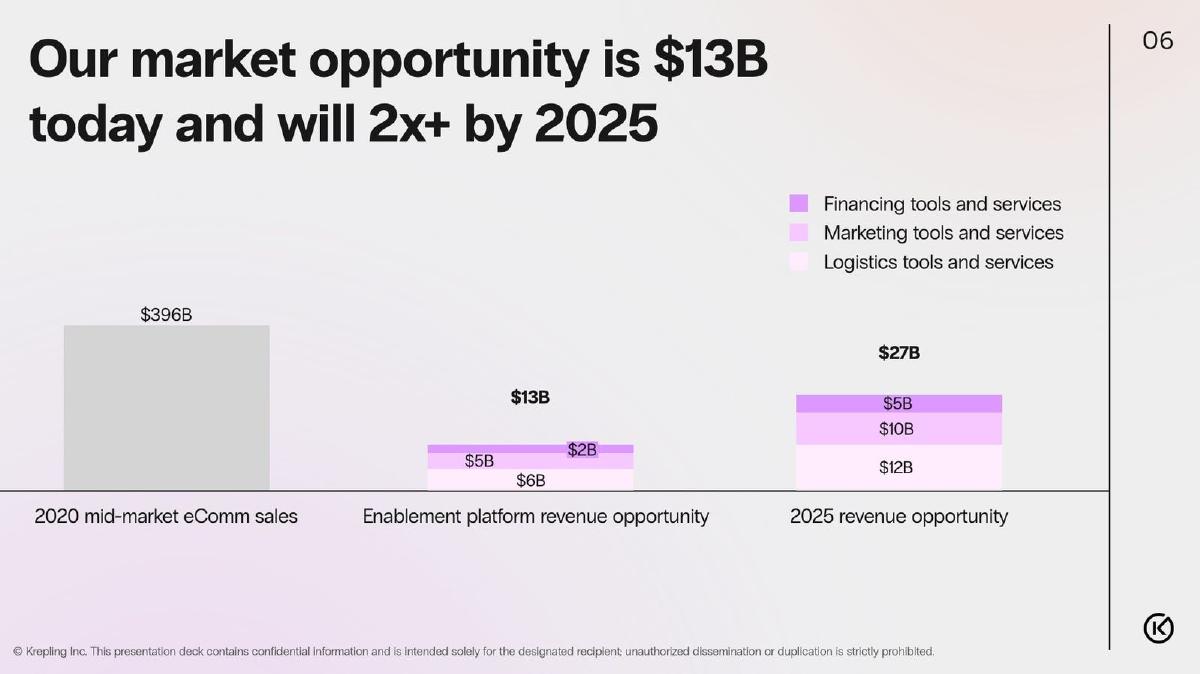
- The deck identifies a $13 billion market opportunity, focusing on the shift toward headless and modular commerce (Slide 6).
- Krepling defines its Ideal Customer Profile (ICP) with high specificity, targeting brands with 10-500 employees and $5M-$200M in annual GMV (Slide 9).
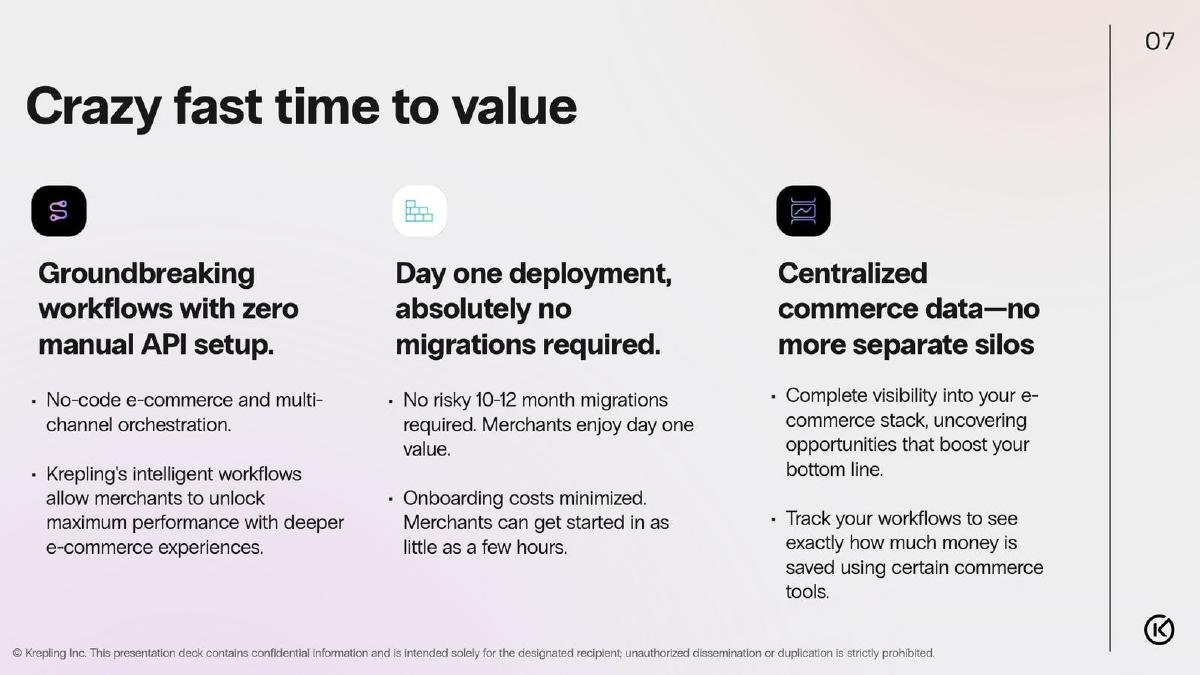
- The value proposition centers on 'crazy fast time to value,' claiming onboarding can take as little as a few hours compared to 10-12 month migrations (Slide 7).
- A dual-reinforcing flywheel explains how aggregating merchant data through integrations strengthens the platform, which in turn attracts more merchants (Slide 11).
- The solution is positioned as a 'no-code' alternative to manual API setups, aiming to eliminate data silos for merchants (Slide 5).
- The deck includes a dedicated slide for ARR, though the specific figures are not disclosed in the public version of the slide (Slide 4).
- The team slide highlights co-founders Liam and Travis Gerada, emphasizing a lean leadership structure (Slide 12).
- The deck omits a formal 'Ask' slide detailing the specific use of funds or the valuation sought during the round.
Introduction: The Glue of the E-commerce Stack
Krepling’s Seed deck, used to raise $3.3 million in 2024, addresses a specific pain point in the maturing e-commerce industry: the complexity of the 'modern stack.' As brands move away from monolithic platforms toward best-of-breed modular tools, they face a new problem—fragmentation. Krepling positions itself not as another tool in the stack, but as the orchestrator that holds them all together. This teardown examines the 13-slide narrative that convinced North American investors to back a no-code approach to enterprise-level channel management.
Slide 1: Title and Vision
The deck opens with a minimalist title slide featuring the Krepling logo and the tagline: "Enabling the modern e-commerce stack." The branding is consistent with modern SaaS aesthetics—purple gradients and clean sans-serif typography. The inclusion of 'Seed Deck' in the bottom right corner immediately sets the context for the stage of the business and the expectations for the metrics to follow.
Slide 2: The Ecosystem Context
Slide 2 uses visual shorthand to establish the company's environment. By displaying various e-commerce app logos (such as Shopify, Mailchimp, and QuickBooks, as seen in the background of Slide 3), the deck visually communicates that Krepling operates in a crowded, highly integrated ecosystem. This sets the stage for the 'fragmentation' argument that follows.
Slide 3: The Problem and Solution
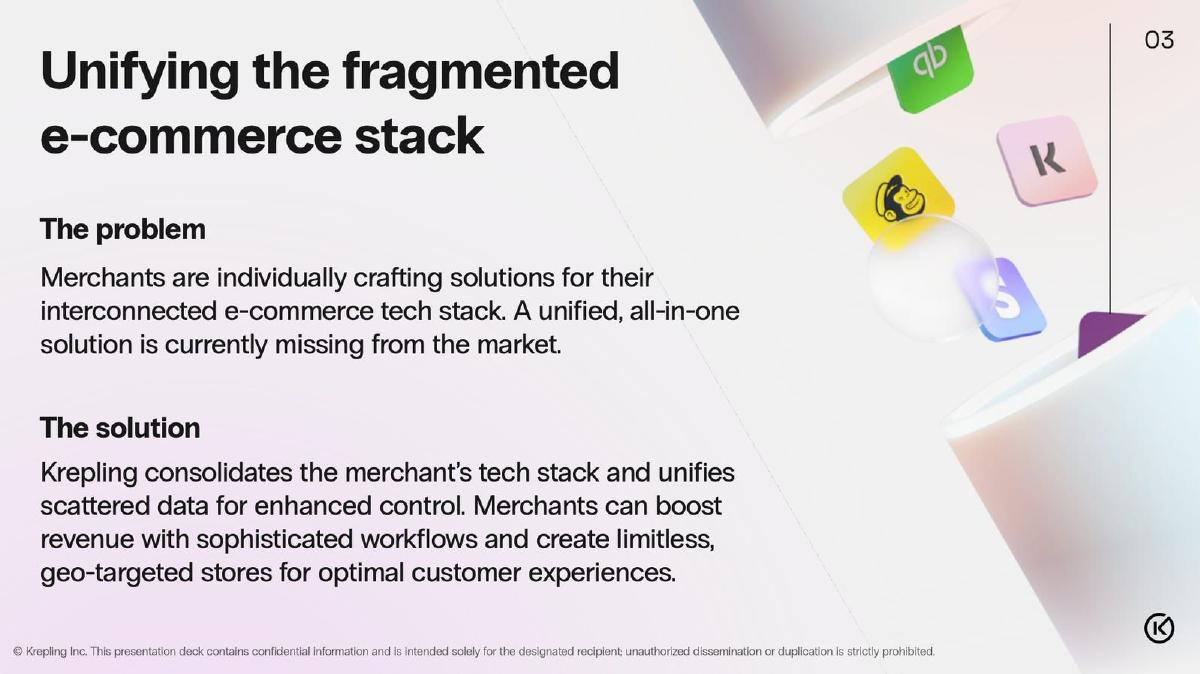
Slide 3 is the core of the deck's logical foundation. It defines The Problem as merchants 'individually crafting solutions' for their tech stacks because a 'unified, all-in-one solution is currently missing.' This is a classic 'gap in the market' play. The Solution is described as a platform that 'consolidates the merchant’s tech stack and unifies scattered data.' The slide mentions two specific outcomes: sophisticated workflows and 'limitless, geo-targeted stores,' suggesting both operational efficiency and revenue growth.
Slide 4: Traction and ARR
Slide 4 focuses on ARR (Annual Recurring Revenue) . While the specific numbers are often redacted in public versions of successful decks, the presence of this slide early in the deck indicates that Krepling had moved past the conceptual stage and had significant commercial validation before raising its Seed round. For a Seed stage company, showing a clear ARR trajectory is often the difference between a 'maybe' and a 'yes' from institutional investors.
Slide 5: The No-Code Value Proposition
Slide 5 doubles down on the 'how.' It uses bold, punchy text: "No coding, no data silos, no hassle — just seamless integration for unstoppable success." By emphasizing 'no coding,' Krepling is positioning itself to be owned by the marketing or operations team rather than requiring constant oversight from expensive engineering resources. This is a key selling point for mid-market brands that may not have massive internal dev teams.
Slide 6: Market Opportunity
Slide 6 quantifies the opportunity, citing a "$13 billion market opportunity." While the slide text provided is brief, this section typically breaks down the Total Addressable Market (TAM). In the context of e-commerce channel management, this likely includes the spend on integration platforms (iPaaS), headless commerce middleware, and workflow automation tools.
Slide 7: Time to Value
Slide 7 is perhaps the most compelling for a skeptical investor. Titled "Crazy fast time to value," it breaks down three pillars: Groundbreaking workflows (zero manual API setup), Day one deployment (no migrations required), and Centralized commerce data . The claim that merchants can get started in 'as little as a few hours' is a direct attack on legacy enterprise software, which often requires 10-12 month implementation cycles. This slide effectively addresses the 'implementation risk' that often kills enterprise software deals.
Slide 8: Merchant Impact
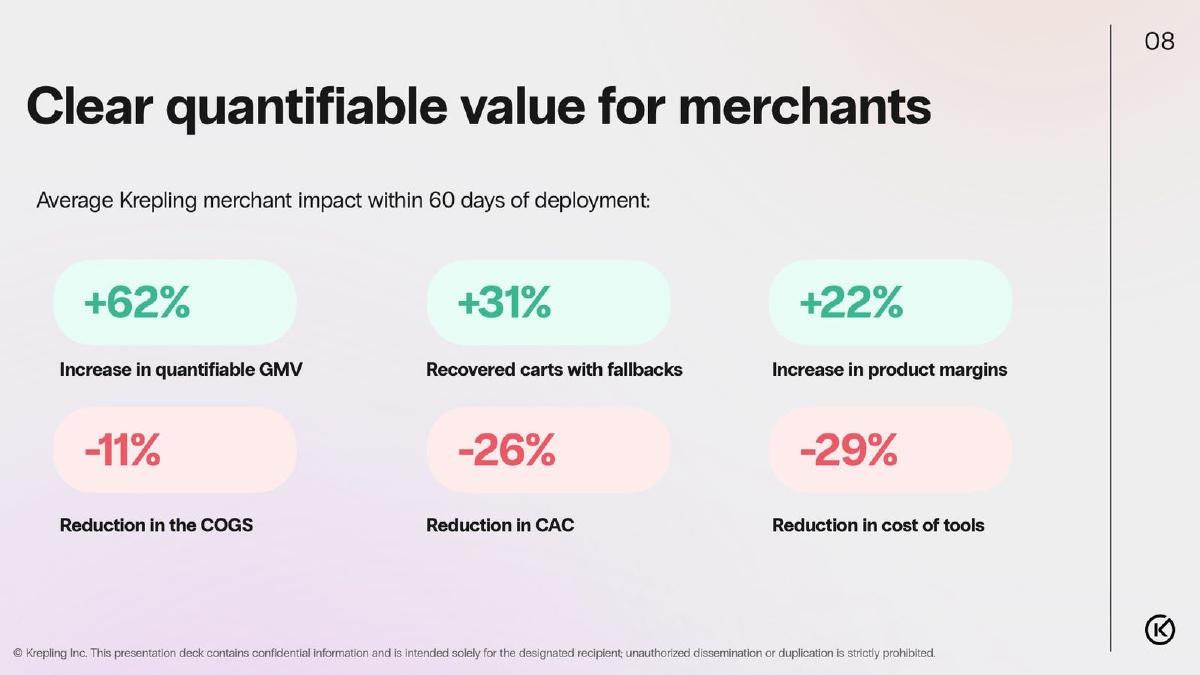
Slide 8 focuses on the impact on the merchant . It uses percentage increases to demonstrate success. While the specific percentages aren't listed in the summary, this slide is designed to show that Krepling isn't just a cost-saver; it's a revenue-driver. By showing how workflows lead to better customer experiences, the deck links technical integration to the bottom line.
Slide 9: The Ideal Customer Profile (ICP)
Slide 9 is a standout for its specificity. It divides the target market into two buckets: Mid-Market ($5m-$50m GMV, Enterprise ($50m-$200m GMV, Slide 10 outlines the Go-To-Market (GTM) strategy . For a Seed round, investors want to see that the founders have moved beyond founder-led sales and have a repeatable process. This slide likely covers their mix of direct sales, partnerships with agencies, and inbound marketing efforts tailored to the ICPs defined on the previous slide.
Slide 11: The Flywheel
Slide 11 introduces a "dual reinforcing flywheel." The first loop shows that integrations lead to merchant value and faster scaling, which allows for more data aggregation. The second loop shows that more data strengthens the platform, attracting more merchants. This is a classic 'data moat' argument—the more people use Krepling, the better the product becomes for everyone, making it harder for competitors to catch up.
Slide 12: The Team
Slide 12 introduces the founders, Liam and Travis Gerada . In a Seed deck, the team slide is often the most important. While the slide doesn't list their full resumes here, it establishes the leadership behind the vision. The fact that they are co-founders suggests a balanced partnership, likely split between technical and commercial roles.
Slide 13: Conclusion
The deck ends with a simple closing slide, maintaining the brand's minimalist aesthetic. It serves as a backdrop for the final Q&A session with investors.
What Works in the Krepling Deck
The most successful element of this deck is its clarity of purpose . Many 'no-code' or 'automation' decks fall into the trap of being too vague—claiming they can do 'anything for anyone.' Krepling avoids this by tethering its technology strictly to the e-commerce stack. By Slide 3, the investor knows exactly what the problem is (fragmentation) and what the solution is (unification).
Another strength is the quantification of the ICP on Slide 9. By setting GMV and integration count boundaries, the founders demonstrate a sophisticated understanding of their market. They aren't chasing small Shopify stores with one integration, nor are they chasing Fortune 500 companies with 500 integrations. They have found the 'sweet spot' of the mid-market where the pain of fragmentation is high but the sales cycle is still manageable.
Finally, the 'Time to Value' slide (Slide 7) is a brilliant piece of de-risking. It anticipates the investor's concern that enterprise software is hard to sell and harder to install. By promising 'day one deployment,' they transform a complex technical product into a friction-less utility.
What is Missing from the Krepling Deck
The most notable omission is a specific 'Ask' slide . While we know from publisher reports that they raised $3.3 million, the deck itself does not state the amount sought, the valuation, or the specific milestones they intend to hit with the capital. While some founders prefer to leave this for a separate document or a verbal discussion, including a 'Use of Funds' slide is generally standard practice to show fiscal responsibility.
Additionally, the deck lacks a detailed competitive landscape . While Slide 3 mentions that an 'all-in-one solution is currently missing,' it doesn't explicitly name or categorize competitors like Zapier, Make, or specialized e-commerce middleware. Investors in the e-commerce space are well-aware of these tools, and failing to address them directly can sometimes be perceived as a lack of market awareness.
Lastly, there is a lack of unit economics . While ARR is mentioned on Slide 4, there is no mention of Customer Acquisition Cost (CAC), Lifetime Value (LTV), or churn rates. For a Seed round, these metrics don't need to be perfect, but showing the 'math of the business' helps prove that the GTM plan on Slide 10 is actually viable.
Founder's Playbook: What to Copy
Specific ICPs: Copy the way Slide 9 uses GMV and integration counts to define the target customer. It makes your sales strategy feel grounded and realistic. · The Flywheel Narrative: If your product generates data, use a flywheel diagram (Slide 11) to show how that data creates a long-term competitive advantage. · Time to Value: If your product is technical, create a slide like Slide 7 that explicitly contrasts your setup time with the industry standard. It’s a powerful way to highlight innovation. · Problem/Solution Pairing: Keep Slide 3 simple. One sentence for the problem, one for the solution. Don't bury the lead in technical jargon. · Visual Consistency: The deck uses a consistent color palette and high-quality assets. This professional polish signals to investors that the founders pay attention to detail—a trait they want to see in the product itself.
Frequently asked questions
- What is the primary problem Krepling solves?
- According to Slide 3, the primary problem is the fragmented e-commerce tech stack. Merchants are currently forced to individually craft solutions for interconnected tools because a unified, all-in-one solution is missing from the market. Krepling aims to consolidate these scattered data points and workflows into a single no-code platform.
- Who is Krepling's target customer?
- Slide 9 explicitly defines two tiers of ideal customers. The first is 'Mid-Market Modern E-Commerce Brands' with 10-100 employees and $5M-$50M in annual GMV. The second is 'Enterprise Modern E-Commerce Brands' with 100-500 employees and $50M-$200M in annual GMV and up to 30 integrations.
- How does Krepling differentiate its deployment process?
- On Slide 7, the company highlights 'Day one deployment' with no migrations required. They contrast this against traditional 'risky 10-12 month migrations,' claiming that their merchants can get started in as little as a few hours with zero manual API setup.
- What is the 'dual reinforcing flywheel' mentioned in the deck?
- Slide 11 describes a two-part growth loop. The first loop shows that access to integrations helps merchants scale, which allows Krepling to aggregate more data. The second loop shows that more data strengthens platform advantages, which attracts more merchants, further fueling the data aggregation.
- Does the deck include financial projections or a funding ask?
- The deck includes a slide for ARR (Slide 4) and mentions a $13 billion market opportunity (Slide 6). However, it does not include a slide detailing the specific 'Ask' (amount of money being raised) or a breakdown of how the $3.3M Seed investment will be spent.