Krew’s 18-slide deck is a masterclass in positioning a consumer app as a deep-tech play. By focusing on the 'extreme complexity' of hardware-less gamification, the founders successfully argued that their proprietary P2P and edge computing technology created a cost advantage 100x better than competitors. The deck leans heavily into the post-COVID shift toward home fitness, citing an 87% change in gym-goer routines (Slide 2). While the business model was redacted in the public version, the technical pedigree of the team—featuring PhDs in distributed networks and computer vision—provides the nec…
Key takeaways
- The deck identifies a massive market shift where 87% of gym-goers are canceling memberships or adding online options (Slide 2).
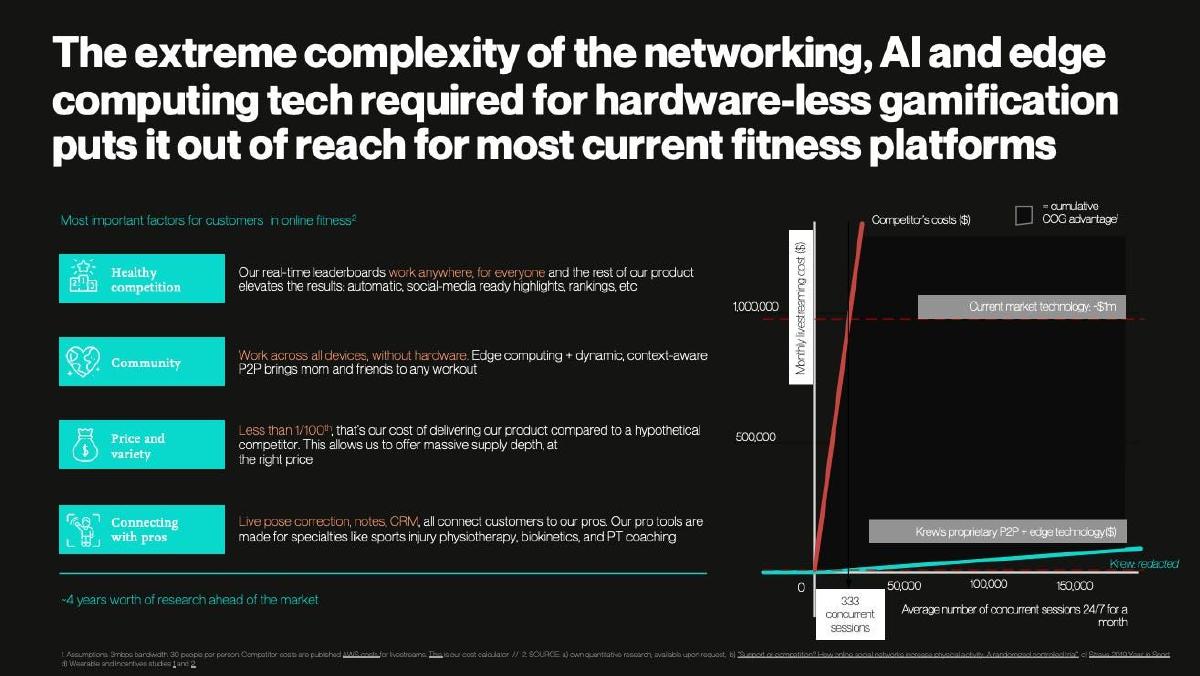
- Krew claims a significant COG advantage, stating their cost of delivery is less than 1/100th of a hypothetical competitor (Slide 3).
- The technical moat is built on proprietary P2P and edge technology, allowing for real-time leaderboards without expensive hardware (Slide 3).
- The team slide highlights deep academic and industry expertise, including a CTO with a PhD in distributed networks and a CEO with experience at Google and McKinsey (Slide 5).
- Krew positions itself against 'entrepreneur enablers' by offering live content for up to 50 participants, exceeding Moxie's 16-participant limit (Slide 4).
- The product vision extends beyond classes to a full ecosystem including nutrition, exercise plans, and social engagement (Slide 6).
- Competitive analysis includes a 'Deep Dive' into funding, noting that competitor Playbook raised $12.3M while Krew was at a £0.08M pre-seed stage (Slide 7).
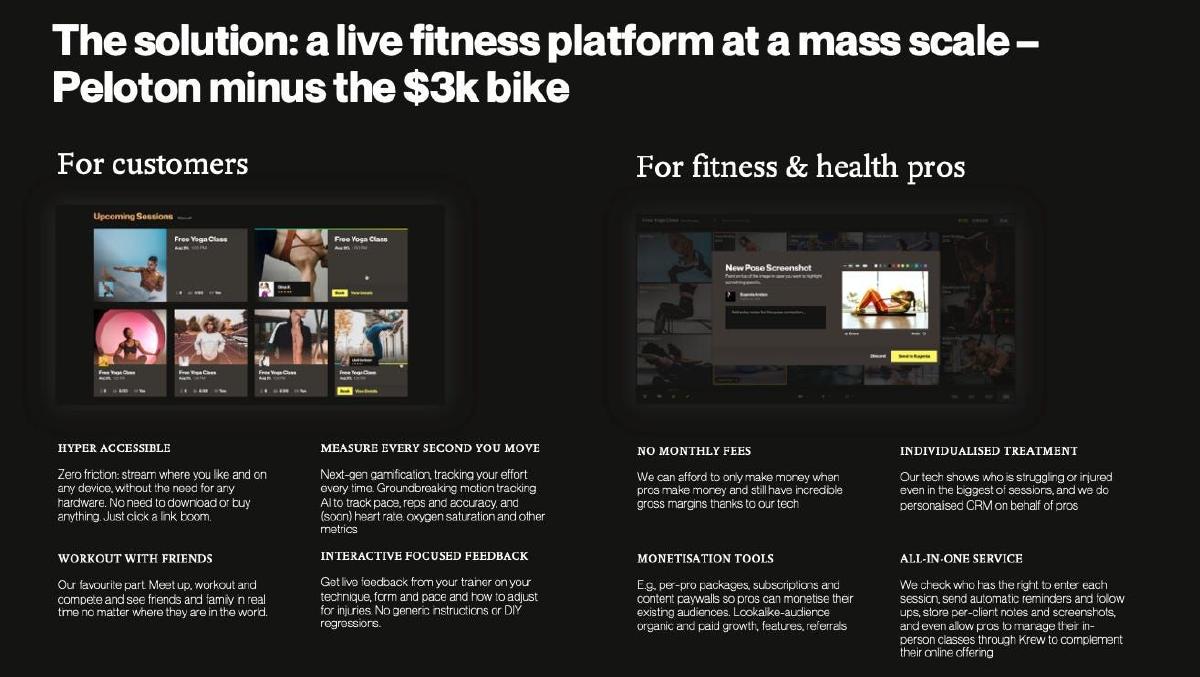
- The platform includes specific 'pro tools' like live pose correction and shared notes for sports injury physiotherapy (Slide 9).
Slide 1: Title Slide
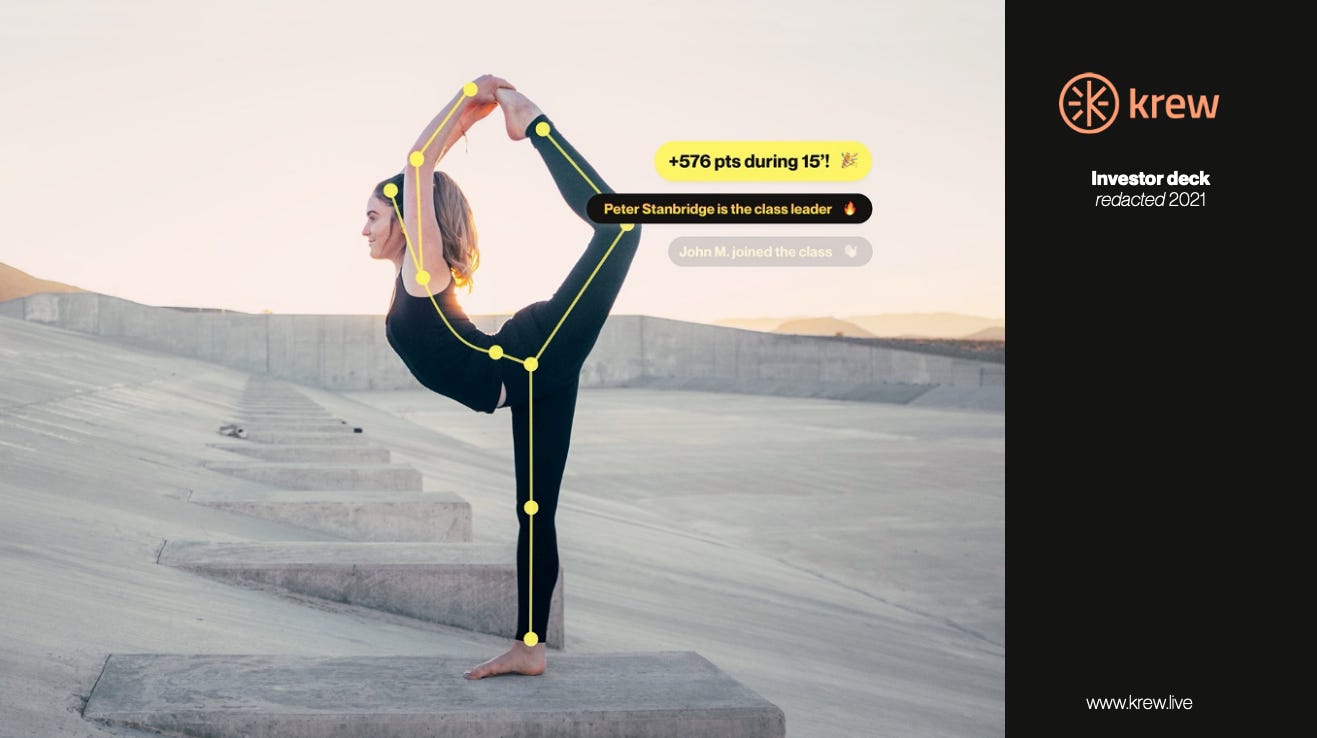
The opening slide features a high-quality image of a yoga practitioner with an overlay of Krew's AI motion tracking interface. It immediately communicates the core product: technology that 'sees' and gamifies movement. The branding is clean, featuring the logo and a redacted date of 2021, though Publisher-reported facts indicate the $1.6M Seed round was finalized in 2024.
Slide 2: The Problem and Market Shift
Krew frames the 'issue' as a seismic shift in fitness consumption post-COVID. The slide is data-heavy, citing that 87% of gym-goers are changing their routines. It highlights a 22.3% CAGR for the global fitness app market, projected to reach $14.6bn by 2027. Crucially, it identifies a supply-side gap: 800k+ professionals struggling to monetize online, including 740,000 under-employed pros in the US. This dual-sided problem (consumers wanting home workouts and pros needing tools) sets the stage for a marketplace solution.
Slide 3: The Technical Moat
This is arguably the most important slide in the deck. Krew argues that the networking, AI, and edge computing required for 'hardware-less gamification' is too complex for current platforms. They present a graph showing a 'cumulative COG advantage,' claiming their proprietary P2P technology costs less than 1/100th of a hypothetical competitor's monthly livestreaming costs (which they peg at ~$1m for 150,000 concurrent sessions). They explicitly state they are '~4 years worth of research ahead of the market.'
Slide 4: Competitive Landscape (Entrepreneur Enablers)
Krew compares itself to 'entrepreneur enablers' like Playbook, Exer, Moxie, and TrueCoach. They use a standard checkmark grid to show they are the only ones offering a complete suite: live content (up to 50 participants), on-demand content, gamification/pose correction, demand-side capture, and creator tools. They highlight that competitors like Playbook are 'mobile only' or have participant limits (Moxie limited to 16), whereas Krew claims 'universal accessibility.'
Slide 5: The Team
The team slide is designed to validate the technical claims made on Slide 3. CEO Jose Martin Quesada brings McKinsey and Google experience, while CTO Dr. Yousef Amar holds a PhD in distributed networks and edge computing. The inclusion of a Chief Research Officer with a background in AI and a Growth lead who is a certified PT covers the three pillars of the business: deep tech, consumer growth, and industry expertise. They also list 'ready to hire' roles, signaling their plan for the Seed capital.
Slide 6: The Long-Term Vision
This slide maps out the 'Vision: one platform for all moments of the day.' It categorizes content from 'Live group classes' (high revenue potential, big tech moat) to 'Likes and comments' (commoditized, small tech moat). By showing a spectrum that includes nutrition plans and 1-1 sessions, Krew demonstrates they aren't just a workout app, but a comprehensive health platform. One category in the high-moat section is redacted, suggesting a stealth feature or specific IP.
Slide 7: Competitor Deep Dive (Funding and Metrics)
In the appendix, Krew provides a transparent look at the competition's financials. They note that Playbook (founded 2016) has raised $12.3M, while Krew was at a £0.08M pre-seed stage at the time of this deck's creation. This slide serves to show that despite being under-capitalized compared to incumbents, Krew's technical efficiency allows them to compete. It lists TrueCoach as having 15,000 coaches, providing a benchmark for what success looks like in the space.
Slide 8: Competitor Comparison (Category View)
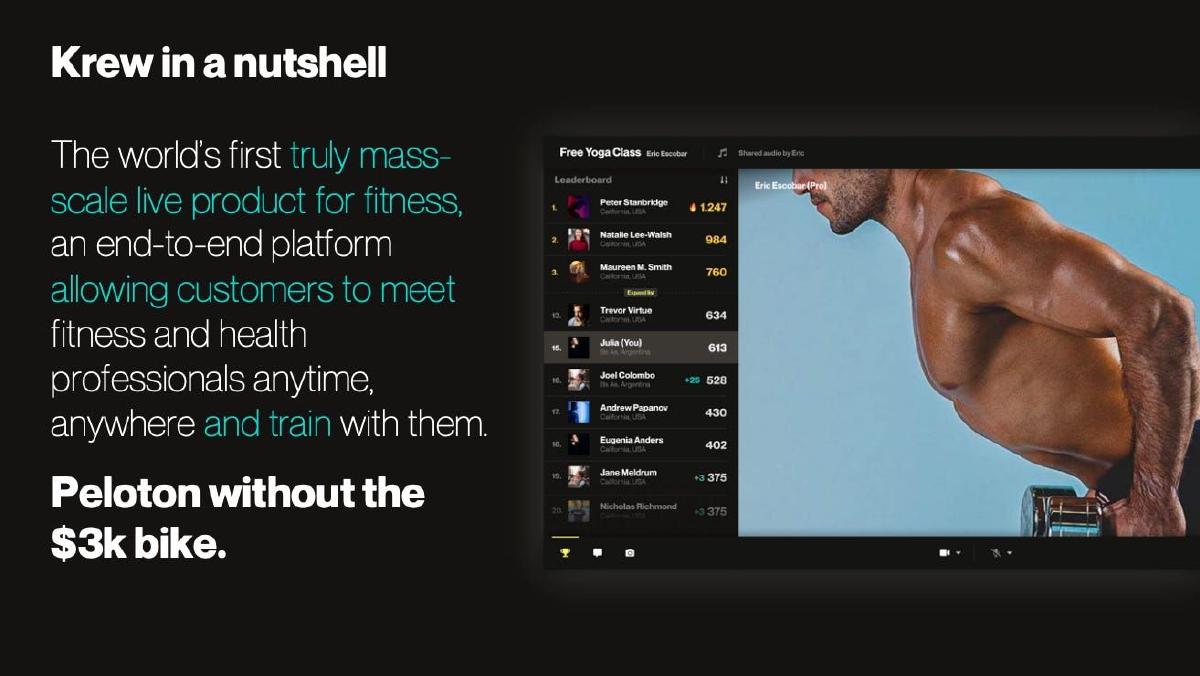
This slide expands the competitive set to include giants like ClassPass, Peloton, and Aaptiv. Krew differentiates itself as a 'Remote open platform.' Unlike Peloton (which requires a bike) or Aaptiv (which requires an Apple Watch for gamification), Krew emphasizes that their live gamified sessions work without proprietary hardware. This 'open' vs 'managed' distinction is key to their scalability argument.
Slide 9: Product Detail (Pose Correction)
The final slide in the provided set shows a UI mockup of the 'notes + pose correction' tool. It illustrates how a trainer can interact with a student (Eugenia Anders) by painting over a screenshot of her form. The text notes that these 'can be shared across pros,' hinting at a collaborative environment for clinics or gyms using the platform. This feature directly addresses the 'Connecting with pros' factor mentioned as a top customer priority on Slide 3.
What Krew Does Well
Krew excels at 'Technical Storytelling.' Most consumer fitness apps pitch on community and content; Krew pitches on unit economics driven by edge computing . By claiming a 100x cost advantage (Slide 3), they turn a commodity service (video streaming) into a high-margin tech play. The deck also does an excellent job of segmenting the competition. Instead of one generic 'Competitors' slide, they provide three different views (Slides 4, 7, and 8), which shows a sophisticated understanding of the market dynamics between B2B tools and B2C marketplaces.
What is Missing from the Deck
The most glaring omission is the Business Model . While 'redacted' in this version, the deck doesn't clearly explain if they take a transaction fee (like Playbook's 20%) or a SaaS subscription (like TrueCoach). There is also a lack of Traction Metrics . While they mention 'massive supply depth,' they don't list their current number of active users, trainers, or MRR. For a Seed round, investors usually want to see early signals of product-market fit beyond the technical prototype. Finally, the 'Ask' slide is missing from this sequence, leaving the specific use of funds and valuation targets unclear.
Founder Takeaways: How to Copy Krew's Strategy
Quantify your Moat: Don't just say your tech is better; say it's '1/100th the cost' or '4 years ahead.' Use specific, aggressive comparisons to define your edge. · Leverage Academic Pedigree: If your team has PhDs or patents, don't just list them. Connect those credentials directly to the 'Problem' slide to show why you are the only ones who can solve it. · Multi-Angle Competitive Analysis: Use different slides to compare yourself against direct startups, indirect incumbents, and different business models. This shows investors you've thought about every threat. · Visual Product Proof: Use annotations on your product screenshots (like Slide 9) to explain why a feature matters to the end-user, rather than just showing a pretty UI.
Frequently asked questions
- What is Krew's primary competitive advantage according to the deck?
- Krew emphasizes a technical moat based on proprietary P2P and edge computing. On Slide 3, they claim this technology allows them to deliver their product at less than 1/100th the cost of competitors. This 'hardware-less gamification' enables real-time leaderboards and pose correction on any device, which they claim puts them four years ahead of the current market technology.
- How does Krew address the post-COVID fitness landscape?
- Slide 2 focuses on the 'seismic shift' in fitness consumption. It cites that 87% of gym-goers are either canceling memberships or seeking online options. Furthermore, it highlights a supply-side problem: over 800,000 professionals are struggling to monetize online demand, with 740,000 under-employed fitness professionals in the US alone, creating a massive opportunity for an 'entrepreneur enabler' platform.
- What specific product features are highlighted for fitness professionals?
- Slide 9 showcases a 'notes + pose correction view' designed for pros. It allows trainers to take screenshots of a user's form, paint corrections directly on the image, and add notes that can be shared across different professionals working with the same client. This is positioned as a tool for high-value specialties like biokinetics and sports injury physiotherapy.
- How does the team's background support the company's technical claims?
- The team slide (Slide 5) is exceptionally strong for a seed round. The CTO holds a PhD in distributed networks and edge computing with patents in load balancing. The Chief Research Officer is a specialist in AI for creative industries. This academic depth supports the claim that their networking and AI tech is 'out of reach' for most existing fitness platforms.
- What is missing from the Krew pitch deck?
- The most notable omission in this version of the deck is the business model and specific financial projections, which are marked as 'redacted' on Slides 4, 7, and 8. Additionally, while the deck mentions a 'massive supply depth,' it does not provide specific user growth numbers or current revenue, likely because it was used for an early-stage raise.