World Fund’s pitch deck is a masterclass in institutional-grade fund marketing. It successfully bridges the gap between environmental impact and financial returns by introducing the 'Climate Performance Potential' (CPP) metric, requiring every investment to have the potential to save 100Mt CO2e annually. The deck highlights a team with a collective track record of over 70 investments and an 8.9x MOIC, providing the necessary credibility for a €350 million target. While the deck is light on specific fund terms like management fees or hurdle rates, it excels at demonstrating a massive top-of-fu…
Key takeaways
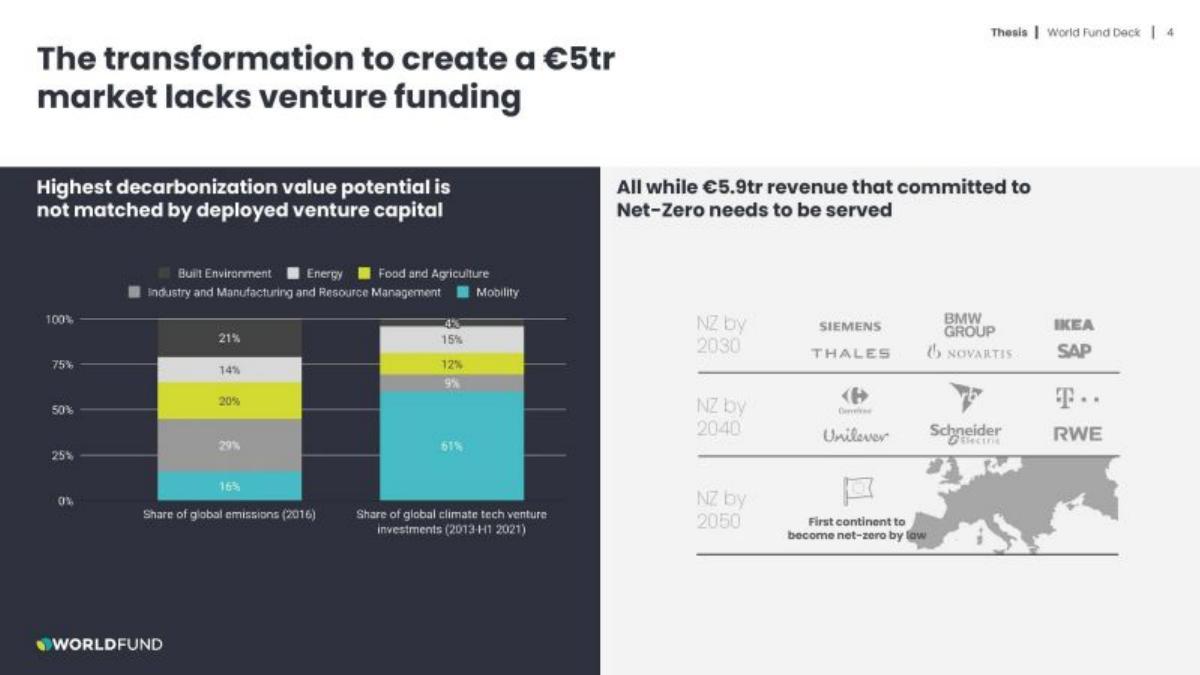
- The fund targets a €5 trillion climate tech opportunity, specifically addressing sectors where decarbonization potential is high but venture funding is currently low (Slide 4).
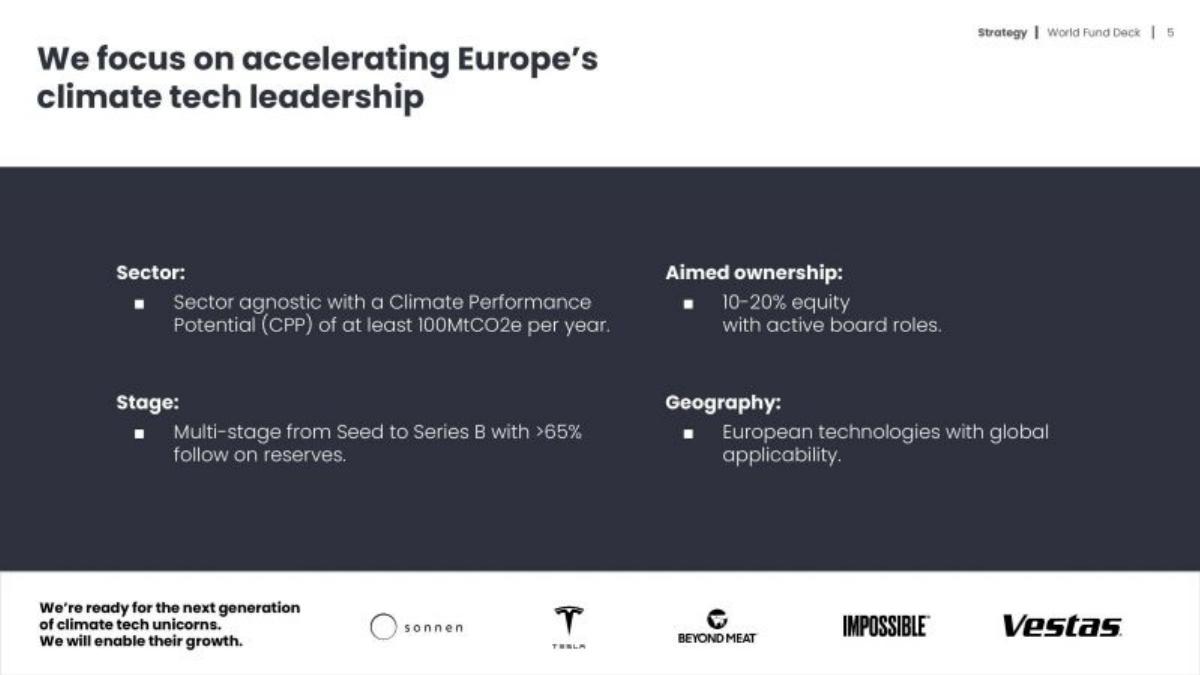
- World Fund utilizes a strict 'Climate Performance Potential' (CPP) threshold of at least 100Mt CO2e per year for every portfolio company (Slide 5).
- The investment strategy is multi-stage, covering Seed to Series B, with a significant reserve of over 65% for follow-on investments (Slide 5).
- The founding team claims a historical track record of 70+ investments yielding an 8.9x Multiple on Invested Capital (MOIC) (Slide 9).
- Deal flow is driven by massive social reach, including over 1 million LinkedIn impressions and 5 million Twitter reach (Slide 10).
- The fund has already demonstrated early execution with six deals performing at a 1.4x MOIC as of the deck's publication (Slide 14).
- Scientific rigor is a core differentiator, with assessments guided by advisors from Project Drawdown, Fraunhofer, and the IPCC (Slide 11).
- The LP base is highly strategic, with 41.3% of capital coming from tech entrepreneurs and 23.2% from climate tech pioneers (Slide 12).
Executive Summary: The Institutionalization of Climate Tech
World Fund’s pitch deck represents a shift in the venture capital landscape from 'impact investing' as a niche to climate tech as a massive, institutional-grade asset class. The deck, dated 2022, was used to raise what became a €350 million fund. It focuses heavily on the 'why now'—citing a €5 trillion market opportunity—and the 'how'—using a proprietary scientific framework. For LPs, the message is clear: this is not a philanthropic endeavor, but a hunt for the next 1,000 unicorns in the most critical sector of the century.
Slide 1-3: Setting the Stage
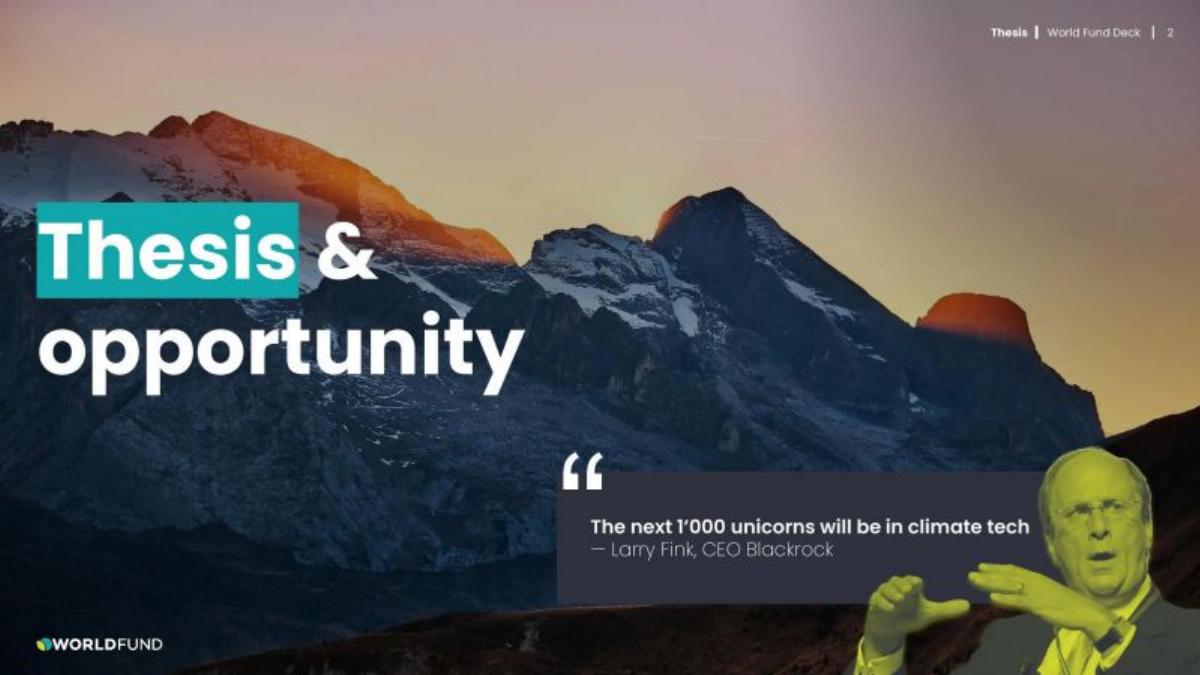
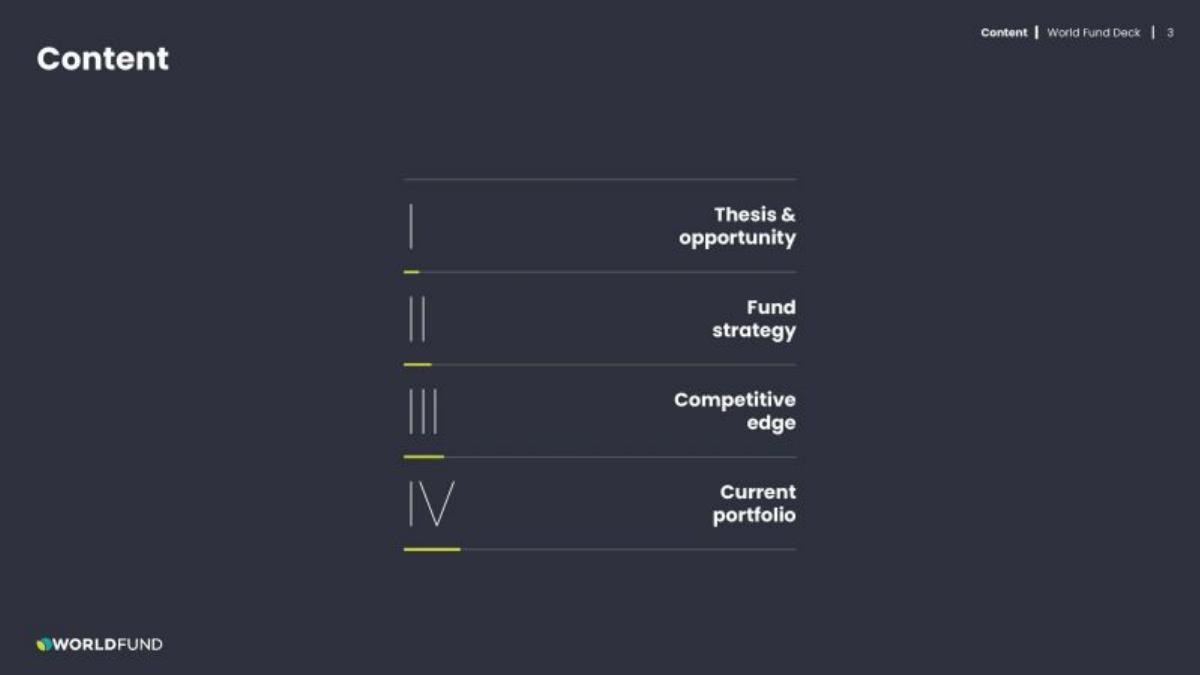
The deck opens with high-production imagery of mountain ranges, immediately signaling the environmental focus. The title, "Capturing the €5tr climate tech opportunity," frames the fund as a financial vehicle first. Slide 2 uses a powerful third-party validation quote from Larry Fink, CEO of Blackrock: "The next 1,000 unicorns will be in climate tech." This is a strategic move to align the fund with the world's largest asset managers. The table of contents on Slide 3 is standard, dividing the pitch into Thesis, Strategy, Competitive Edge, and Portfolio.
Slide 4: The Funding Gap Thesis
This is one of the most important slides in the deck. It uses a bar chart to compare 'Share of global emissions' against 'Share of global climate tech venture investments.' It highlights a massive inefficiency: Mobility accounts for only 16% of emissions but receives 61% of VC funding. Conversely, Energy, Food/Ag, and Industry account for the lion's share of emissions but are starved for capital. This slide justifies World Fund's existence by showing they are looking where others are not. It also lists major corporations (Siemens, BMW, IKEA) and their Net-Zero commitment dates, illustrating the massive corporate demand for the technologies World Fund intends to back.
Slide 5-7: The Investment Strategy
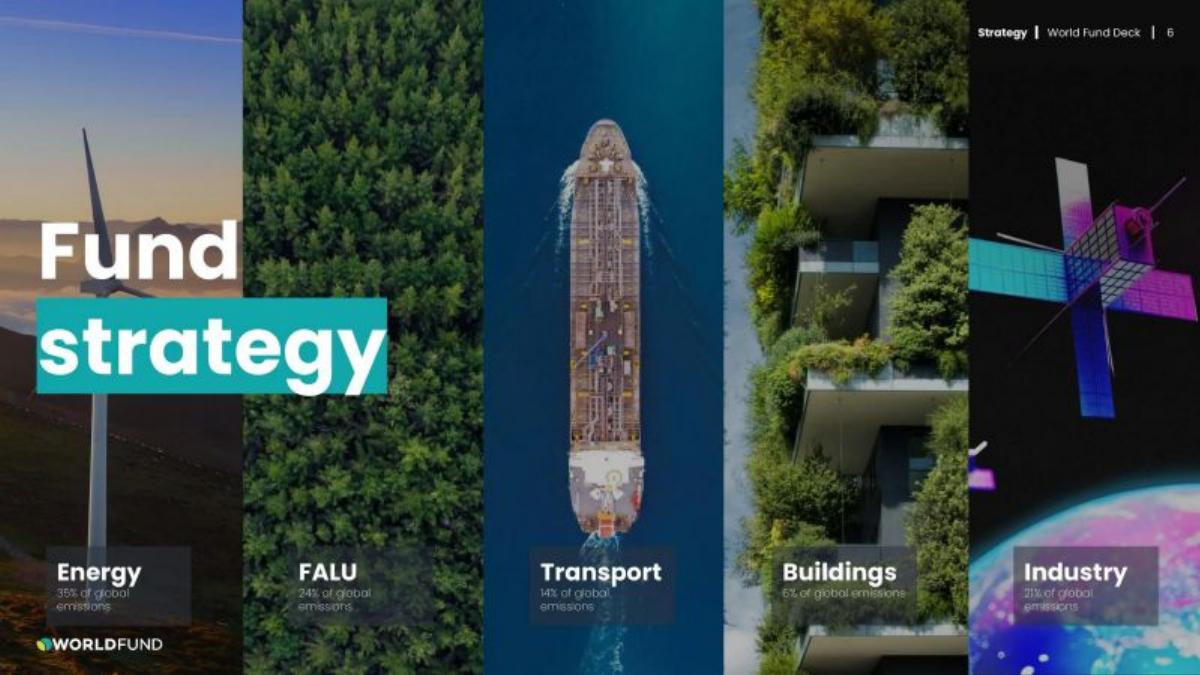
Slide 5 defines the fund's parameters. They are sector agnostic but with a strict Climate Performance Potential (CPP) requirement of 100MtCO2e per year. They target 10-20% equity and are multi-stage (Seed to Series B) . A critical figure here is the ">65% follow on reserves," which tells LPs the fund is designed to support winners through the 'valley of death' often associated with hard-tech climate startups. Slide 6 visually breaks down the sectors: Energy (35% of emissions), FALU (24%), Transport (14%), Buildings (6%), and Industry (21%). Slide 7 visualizes their 'CPP' thesis, showing they only invest in the 'peaks' of the decarbonization waves, and lists an impressive array of co-investors from past deals, including BP Ventures, Octopus Ventures, and Intel Capital.
Slide 8-10: The Team and Thought Leadership
The 'Competitive Edge' section begins on Slide 8. Slide 9 introduces the four core partners. They don't just list bios; they lead with a headline: "A diverse team with a green track record of >70 investments at a 8.9x MOIC." This is the 'proof of work' slide. Tim Schumacher (Ecosia, Sedo), Daria Saharova (Vito ONE), Danijel Visevic (Project A), and Craig Douglas (SET Ventures) represent a mix of entrepreneurial success, venture experience, and communications expertise. Slide 10 focuses on their 'Platform'—their ability to generate deal flow through sheer visibility. They claim >1,650 inbound deals since launch and a monthly social reach of over 6 million people. For an LP, this suggests the fund has the 'first look' at the best European deals.
Slide 11-12: Scientific Rigor and LP Value
Slide 11 details their 'rigid CPP assessments.' They aren't just making guesses; they collaborate with CRANE, Drawdown, and TU Berlin . They also list scientific advisors who are heads of leading climate institutions. This 'science-first' approach is a major differentiator from generalist VCs who might lack the technical depth to vet complex climate technologies. Slide 12 pivots to the LP base. With >150 individuals and families , they have built a network that provides more than just capital. The pie chart shows that 41.3% of their capital comes from tech entrepreneurs, creating a virtuous cycle of founders backing founders.
Slide 13-14: Early Traction and Portfolio
The portfolio section (Slide 13-14) shows that the fund is already active. They have executed six deals performing at a 1.4x MOIC . The companies listed—Space Forge, QOA, Juicy Marbles, FreshFlow, Treecard, and Recup (which is marked as 'Exited')—show a healthy mix of 'Deep Tech' and 'Tech-enabled' solutions. Mapping these on a grid of Seed to Series B helps LPs visualize the current fund deployment and the diversity of the initial bets.
Slide 15-17: Conclusion and Disclaimers
The deck ends with a simple 'Thank you' and two slides of dense legal disclaimers. These disclaimers are standard for a fund of this size, particularly one registered under German and EuVECA regulations, ensuring compliance with professional investor standards.
What World Fund Does Well
1. Quantifiable Impact: By introducing and sticking to the CPP (Climate Performance Potential) metric, World Fund avoids the 'greenwashing' trap. They provide a clear, mathematical North Star for their investment decisions that appeals to both mission-driven and profit-driven LPs.
2. Bridging the Gap: Slide 4 is a masterclass in identifying market opportunity. By showing the delta between where emissions are and where the money is going, they make a compelling case for their specific sector focus without needing to disparage other funds.
3. Leveraging Network: The deck emphasizes their 'Platform' and 'Thought Leadership.' In a crowded VC market, proving you have the best deal flow is essential. Claiming 1,650 inbound deals is a powerful way to demonstrate that the best founders are seeking them out.
What is Missing from the Deck
1. Fund Terms: There is no mention of the management fee, carry structure, or hurdle rate. While these are often reserved for the Private Placement Memorandum (PPM), including a high-level summary can help qualify LPs early.
2. Exit Environment Analysis: While they mention one exit (Recup), the deck lacks a deep dive into the broader exit environment for climate tech. Given that many of these companies are capital-intensive, LPs would likely want to see more on the 'path to liquidity'—whether through IPOs or M&A by the corporates listed on Slide 4.
3. Organizational Structure: Beyond the four partners, the deck doesn't show the broader team (associates, analysts, operations). For a €350M fund, LPs usually want to see the 'engine room' that supports the partners.
What Other Founders (and Fund Managers) Should Copy
1. The 'Why Now' Slide: Any founder in a regulated or rapidly changing industry should copy the layout of Slide 4. Use data to show a misalignment between the current state of the market and the reality of the problem.
2. The Track Record Headline: Don't just list where you worked. Aggregate your wins into a single, punchy headline like "70 investments at a 8.9x MOIC." It provides an immediate anchor for the reader's expectations.
3. Third-Party Validation: Using a quote from a figure like Larry Fink (Slide 2) or logos of scientific institutions (Slide 11) builds 'borrowed credibility.' If the leaders of the industry believe in the thesis, it's much harder for an investor to dismiss it.
4. Clear Investment Mandate: Slide 5 is a perfect example of how to communicate an investment thesis. It covers Sector, Stage, Aimed Ownership, and Geography in four simple bullet points. There is no ambiguity about what they do.
Frequently asked questions
- What is the primary investment criteria for World Fund?
- World Fund is sector-agnostic within climate tech but requires every investment to have a Climate Performance Potential (CPP) of at least 100Mt CO2e per year. This ensures that every company in the portfolio has the capacity to significantly contribute to global decarbonization targets while pursuing venture-scale returns.
- What stages and geographies does the fund target?
- The fund is multi-stage, investing from Seed to Series B. It specifically focuses on European technologies that have global applicability. To support its winners, the fund reserves more than 65% of its capital for follow-on rounds, aiming for 10-20% equity ownership and active board roles.
- How does the team demonstrate its track record?
- The deck highlights four key partners—Tim Schumacher, Daria Saharova, Danijel Visevic, and Craig Douglas. They cite a combined 'green track record' of over 70 investments with an 8.9x MOIC. Individual achievements include co-founding Ecosia and Sedo, and leadership roles at Project A and SET Ventures.
- What sectors does World Fund identify as underserved?
- Slide 4 points out a misalignment in current venture capital. While Mobility receives 61% of climate tech venture investment, it only accounts for 16% of global emissions. World Fund looks to bridge the gap in higher-emitting sectors like Energy (35%), FALU (24%), and Industry (21%).
- Who are the Limited Partners (LPs) in World Fund?
- The fund boasts a 'powerhouse' LP base of over 150 individuals and influential families. According to the deck, 41.3% of capital comes from tech entrepreneurs, followed by climate tech pioneers (23.2%), Mittelstand & DAX executives (19.5%), and seasoned VCs/PEs (16.0%). PwC is noted as an anchor LP in external catalogue facts.