Woven’s 13-slide deck from November 2016 serves as a high-level product vision and architectural roadmap for a next-generation calendar. Led by Facebook’s first CIO, the company raised $4.8 million by identifying three core failures in existing systems: fragmentation, lack of intelligence, and poor sharing capabilities. The deck leans heavily on the founders' technical credibility and detailed UI mockups for 'Exec' and 'Admin' views. However, it is a 'pure' product deck; it contains zero information on monetization, market size (TAM), or specific go-to-market strategies. For investors, the be…
Key takeaways
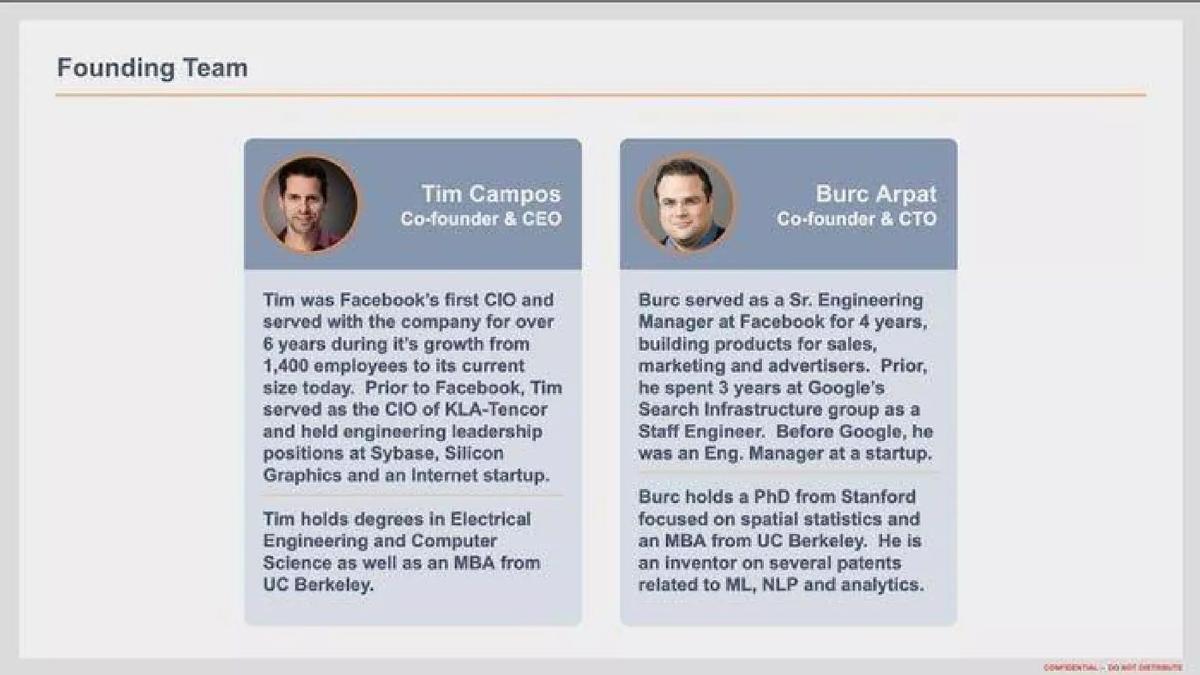
- The deck leads with a high-pedigree team slide, highlighting Tim Campos as Facebook's first CIO and Burc Arpat's background at Google and Facebook (Slide 2).
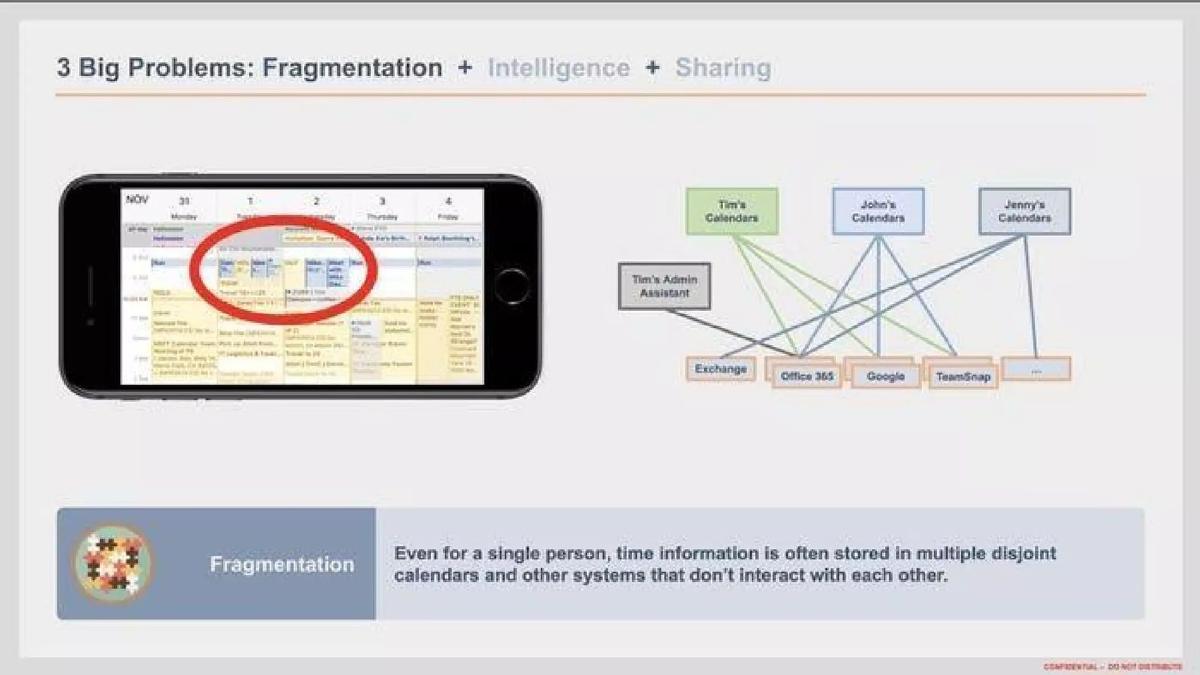
- Woven identifies three specific pain points: Fragmentation, Intelligence, and Sharing, using visual diagrams to show how users juggle multiple disjointed systems (Slides 3-5).
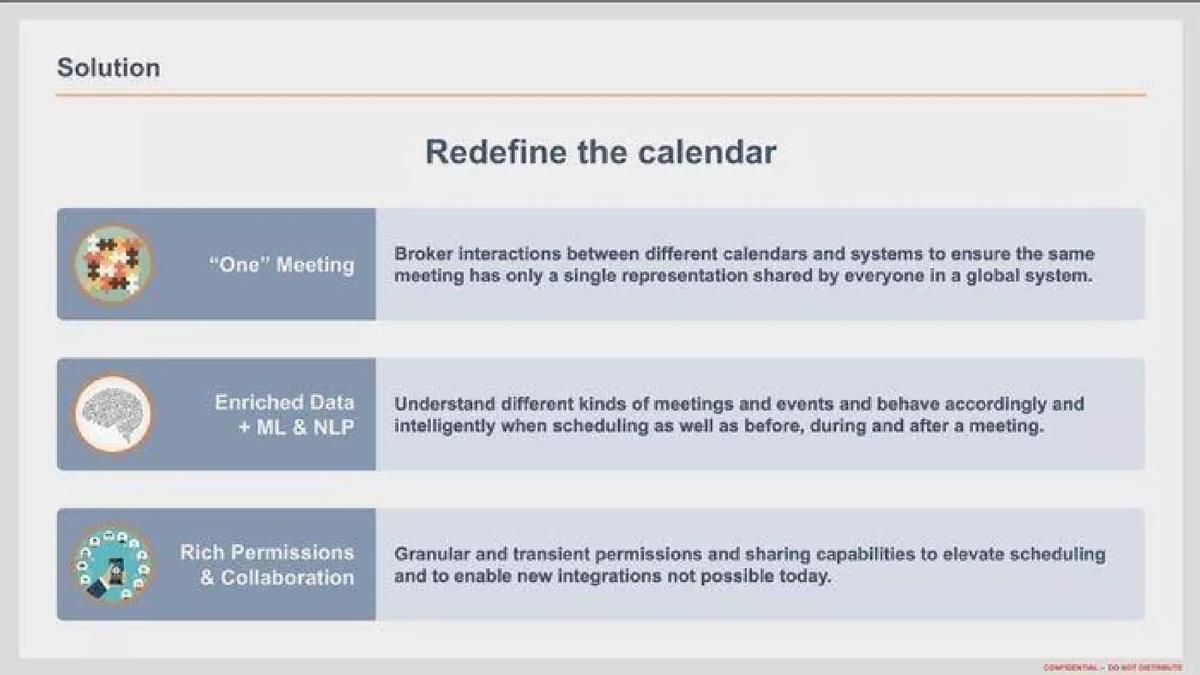
- The solution is framed as 'Redefining the calendar' through a single representation of meetings and ML-driven data enrichment (Slide 6).
- A detailed system architecture slide introduces 'Pulsra' as the core engine connecting various backends like Exchange, Office 365, and Google (Slide 7).
- The deck provides granular UI mockups for different user personas, specifically an 'Exec View' for mobile and an 'Admin View' for desktop (Slides 9-11).
- Product features include natural language input, machine-calculated 'availability scores,' and real-time goal tracking (Slides 10-11).
- Competition is categorized into four tiers, dismissing most as 'Weak Competition' while acknowledging Microsoft and Google as 'Strong Competition' (Slide 12).
- There is no mention of a business model, pricing, or revenue targets anywhere in the 13 slides.
The Vision: Organizing the World's Time
Woven’s November 2016 pitch deck is a focused, product-centric presentation that relies heavily on the professional reputation of its founders. The company positions itself not just as another calendar app, but as a fundamental re-engineering of how time is managed across digital platforms. With only 13 slides, the deck moves quickly from the 'who' to the 'how,' spending the majority of its real estate on product architecture and user interface mockups.
Slide 1: Title and Mission
The cover slide is minimalist, featuring the Woven logo and the tagline: "Organize and optimize the world’s time." Dated November 2016, it sets a broad, ambitious tone similar to Google’s mission to organize the world’s information. This suggests the company views time as a data problem to be solved through engineering.
Slide 2: The Founding Team
This is arguably the most important slide in the deck for a 2016-era raise. Tim Campos (Co-founder & CEO) is introduced as Facebook’s first CIO, having overseen the company's growth from 1,400 employees to its scale at the time. Burc Arpat (Co-founder & CTO) is highlighted for his 4-year tenure as a Sr. Engineering Manager at Facebook and 3 years at Google’s Search Infrastructure group. Citing a PhD from Stanford and patents in ML and NLP, the slide establishes 'founder-market fit' by showing the team has the pedigree to handle massive data infrastructure and enterprise-scale systems.
Slides 3-5: The Problem Statement
Woven breaks the problem into three pillars: Fragmentation, Intelligence, and Sharing.
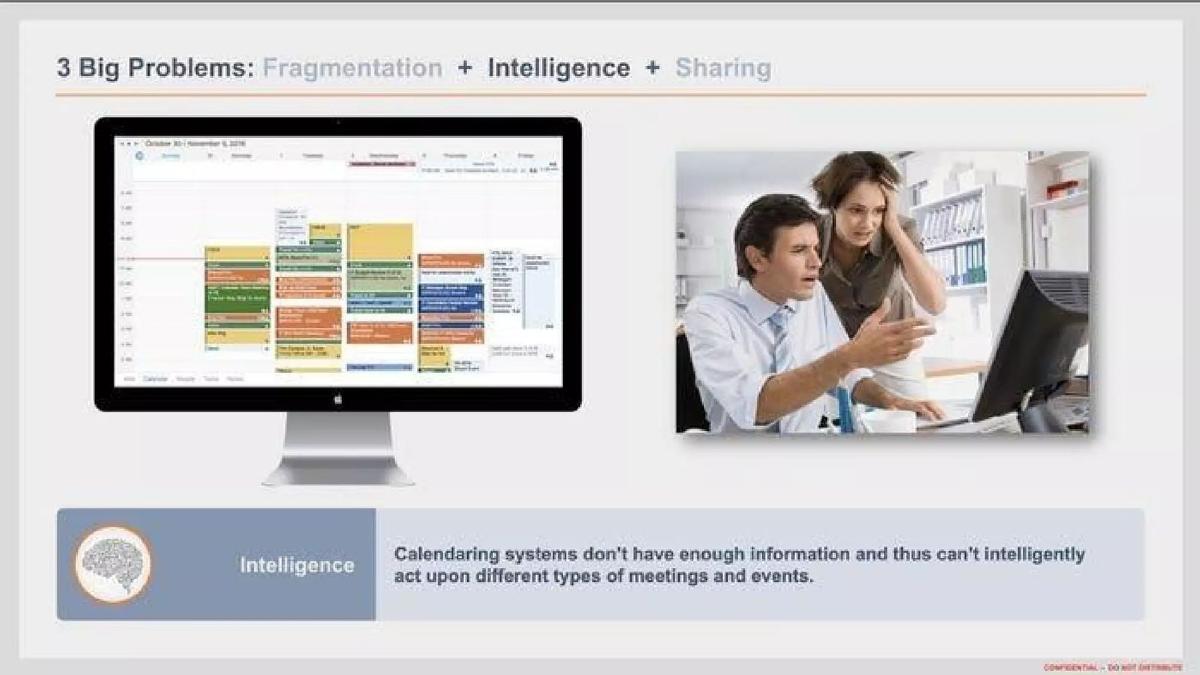
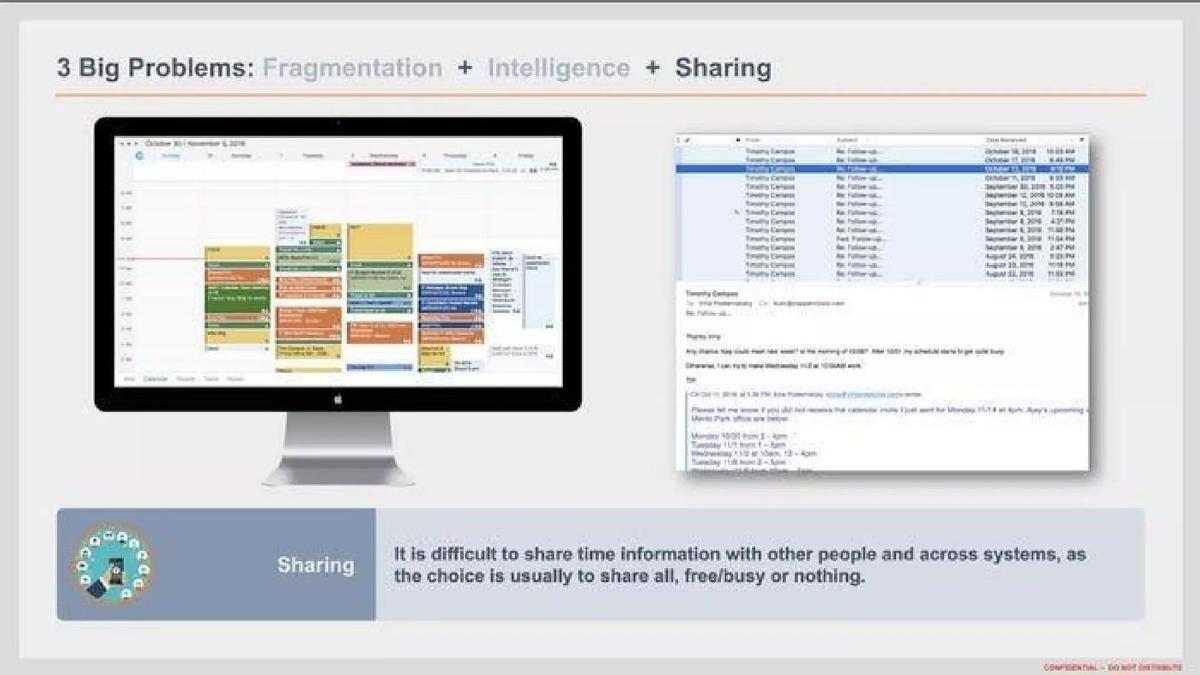
Slide 3 (Fragmentation): Uses a diagram to show how a single person’s time is split across Exchange, Office 365, Google, and TeamSnap. The slide notes that these systems "don't interact with each other." · Slide 4 (Intelligence): Argues that current systems lack the context to "intelligently act upon different types of meetings." It features a stock photo of a frustrated couple/colleagues, emphasizing the emotional friction of scheduling. · Slide 5 (Sharing): Highlights the binary nature of current sharing (all, free/busy, or nothing), making it difficult to collaborate across different organizational boundaries.
Slide 6: The Solution
The solution is framed as a "Redefine the calendar" initiative. Woven proposes three fixes: "One" Meeting (a single representation shared by everyone), Enriched Data + ML & NLP (understanding meeting context before, during, and after), and Rich Permissions & Collaboration (enabling granular, transient sharing).
Slide 7: System Architecture (Pulsra)
This slide introduces "Pulsra," the internal name for the Woven engine. It is a dense technical diagram showing Pulsra as a central hub. It connects to 3rd party integrations (HR, CRM, Recruiting) on the left, scheduling/notifications (Email, SMS, Slack, Facebook) on the right, and calendar backends (Google, Office 365, CalDAV) at the bottom. This slide is intended to prove that Woven is a platform, not just a skin over an existing calendar.
Slides 8-11: Product Walkthrough and Personas
These slides transition into high-fidelity mockups. Slide 8 is a simple transition showing a mobile calendar view. Slide 9 introduces the "Exec View," highlighting features like "warnings about at-risk events," "links to important documents (resume)," and "customizable actions per meeting type" (e.g., a 'Hire' or 'No Hire' button for an interview).
Slide 10 continues the Exec View, showing "Natural language input auto-parsed" for creating meetings and a "task list" for requests. It also introduces the concept of "karma" (private or public attendance ratings). Slide 11 shifts to the "Admin View" on a laptop. This view is significantly more complex, featuring a "machine-calculated 'availability score'" and a "real time goals status" tracker. It demonstrates how an assistant could manage multiple calendars with context-aware data.
Slide 12: Competitive Landscape
Woven categorizes its competitors into four buckets. Microsoft and Google are labeled as "Strong Competition." The other three categories— Calendar Apps (Fantastical, Calendars 5), Bots & Smart Assistants (WizCal, Clara Labs, x.ai), and Optimizers & Analytics (Esper, Priority Matrix)—are all labeled as "Weak Competition." This positioning suggests that while the giants own the ecosystem, the smaller players are too niche or lack the architectural depth to compete with Woven’s platform approach.
Slide 13: Closing
The deck ends with a repeat of the mission statement: "Organize and optimize the world’s time." There is no contact information, no summary of the raise, and no roadmap on this final slide.
What Works in This Deck
1. Credibility First: By placing the team slide immediately after the title, Woven answers the "Why you?" question before the investor even sees the problem. For a technical product in a crowded space, the Facebook/Google pedigree is the strongest asset.
2. Clear Problem Segmentation: Breaking the problem into Fragmentation, Intelligence, and Sharing allows the founders to address specific technical solutions for each, rather than just saying "calendars are hard."
3. Persona-Based Design: Showing different views for the 'Exec' and the 'Admin' demonstrates a deep understanding of how high-value scheduling actually happens in the real world. It moves the product beyond a consumer utility into a professional tool.
What Is Missing From This Deck
1. Business Model: There is no mention of how Woven intends to make money. Is it a SaaS subscription? An enterprise license? A freemium model? The deck is silent on monetization.
2. Market Size (TAM): The deck assumes the investor already knows that "time" is a massive market. It provides no data on the number of enterprise calendar users or the potential dollar value of the productivity market.
3. Traction and Roadmap: There are no metrics. We don't know if there is a beta, how many users are on the platform, or what the development milestones are for the next 12-18 months.
4. The Ask: While we know from catalogue data that they raised $4,800,000 , the deck itself does not state how much they are looking for or what the funds will be used for (e.g., hiring, marketing, R&D).
What a Founder Should Copy
1. The Architectural Hub Slide: Slide 7 is a great example of how to visualize a complex "middleware" product. It shows how the startup sits between existing giants and provides value through a centralized engine.
2. Feature Callouts: The use of boxes and arrows on Slides 9, 10, and 11 to explain specific UI elements is effective. It prevents the investor from having to guess what makes the screenshot special.
3. Categorized Competition: Instead of a standard 2x2 grid, Slide 12’s categorical approach is more honest. It acknowledges the "Strong" threat of incumbents while grouping smaller competitors by their functional limitations.
Frequently asked questions
- What is the primary value proposition of Woven?
- Woven aims to 'organize and optimize the world’s time' by creating a unified calendar layer. According to Slide 6, it focuses on 'One Meeting' representation (ensuring a single source of truth across systems), using ML and NLP to enrich meeting data, and providing granular permissions for better collaboration.
- How does Woven handle the technical challenge of multiple calendar providers?
- Slide 7 illustrates a complex architectural hub called 'Pulsra.' This engine performs a two-way sync with traditional backends like Exchange, Office 365, Google, and CalDAV, while providing a unified interface for users on Web, iOS, and Android.
- Who is the target user based on the pitch deck?
- The deck specifically highlights two personas: the 'Exec' and the 'Admin.' Slides 9 and 10 show mobile views for executives to manage 'at-risk events' and 'meeting materials,' while Slide 11 shows a dense 'Admin View' for assistants to manage complex scheduling tasks and availability scores.
- What is missing from the Woven pitch deck?
- The deck is notably missing all financial and commercial data. There is no slide for business model, pricing, go-to-market strategy, traction metrics, or a specific funding request. It functions more as a product manifesto and technical roadmap than a traditional business plan.
- How does Woven view its competition?
- On Slide 12, Woven classifies Microsoft and Google as 'Strong Competition' in the Office Suite category. It dismisses 'Calendar Apps' (like Fantastical), 'Bots' (like x.ai), and 'Optimizers' (like Priority Matrix) as 'Weak Competition,' suggesting Woven believes its architectural approach is superior to simple app wrappers or niche bots.