Wrkyr presents a specialized marketplace solution for the UK healthcare staffing crisis, specifically targeting the 20.5 million agency nurse hours booked annually across NHS England (Slide 5). The deck leans heavily on the sheer scale of the problem—citing £17 billion in adult and social care spending (Slide 9)—and proposes a transaction-based revenue model of £2 per payment. While the product interface appears straightforward, focusing on user profiles and job specifics (Slides 13, 17), the deck's strength lies in its detailed, region-by-region financial forecasting. By projecting growth fr…
Key takeaways
- The platform targets a massive inefficiency: 20,547,945 agency nurse hours booked annually in NHS England alone (Slide 5).
- Revenue is driven by a £2 payment processing fee per shift, with a forecast of £3m monthly income from London alone by year 5 (Slide 9).
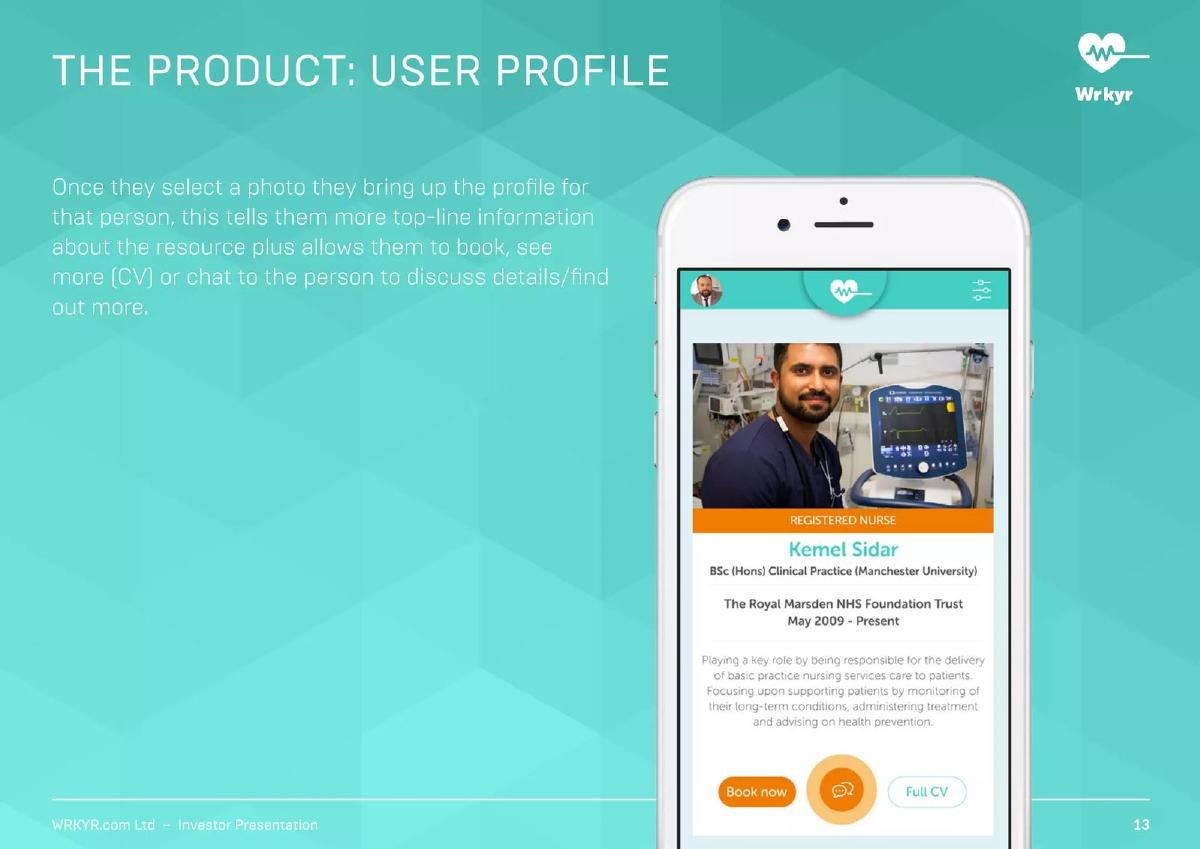
- The product facilitates direct booking through detailed nurse profiles including CVs and chat functions (Slide 13).
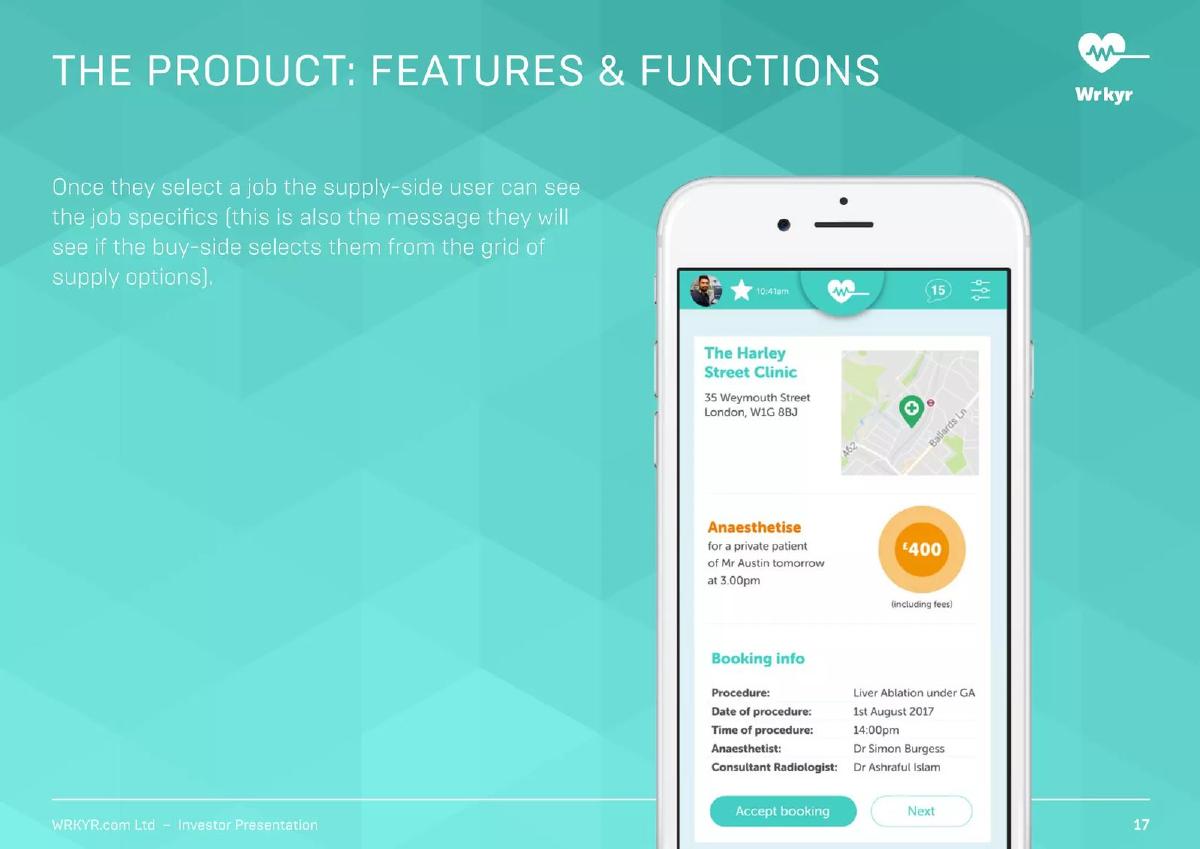
- Supply-side users (nurses) can view specific job details, including procedure types and fees, such as a £400 liver ablation shift (Slide 17).
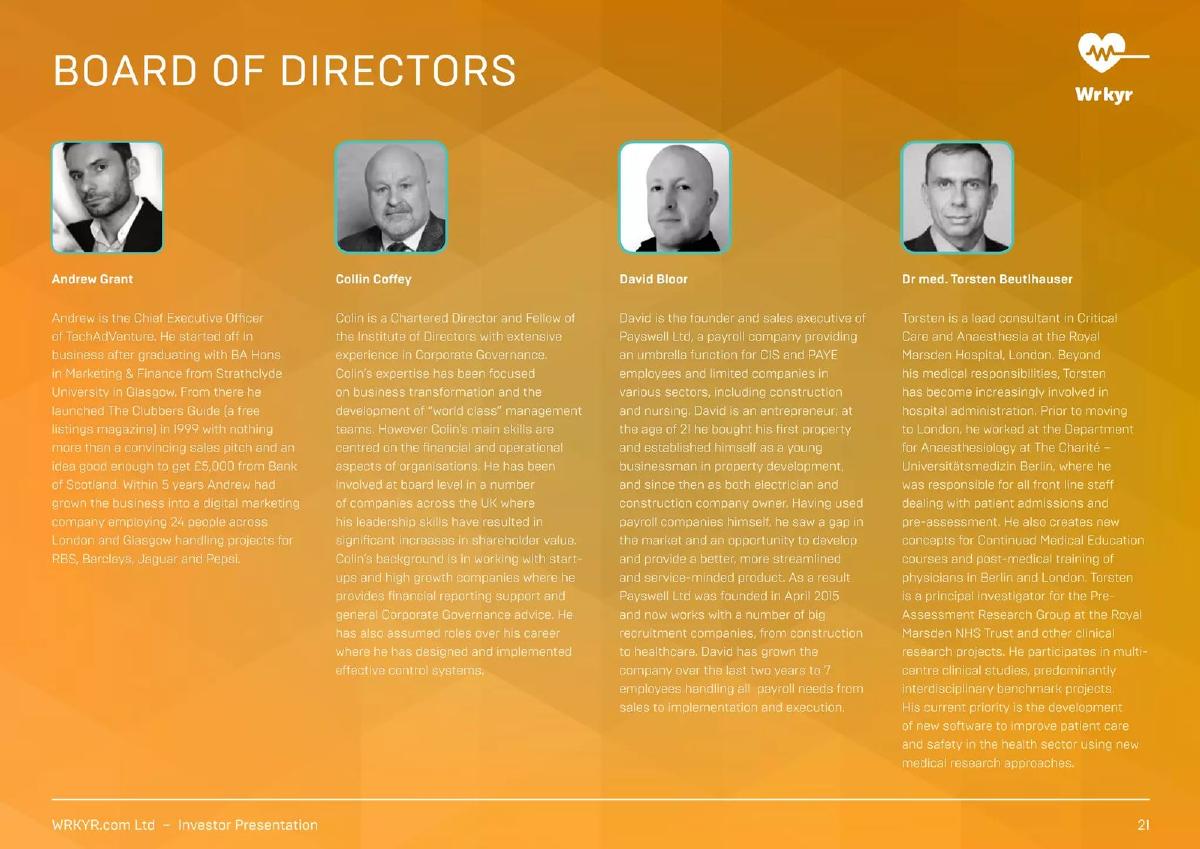
- The Board of Directors includes a mix of marketing, corporate governance, payroll, and clinical expertise, including a lead consultant at Royal Marsden Hospital (Slide 21).
- Go-to-market strategy relies on enterprise licensing sold at major industry events like EHI Live (Slide 25).
- Financial projections are extremely granular, breaking down hourly bookings and license income across 12 UK regions through September 2022 (Slide 29).
- The deck projects reaching a quarterly EBITDA of £5.39 million by the end of the forecast period (Slide 29).
Executive Summary: The Digital Staffing Play for the NHS
The Wrkyr investor presentation, dated August 2017, positions the company as a digital solution to the UK's chronic healthcare staffing shortages and the high costs associated with traditional nursing agencies. By focusing on the 20.5 million agency hours booked annually within the NHS, Wrkyr attempts to build a marketplace that connects healthcare providers directly with qualified professionals. The deck is characterized by a heavy emphasis on regional market data and long-term financial forecasting, though it remains light on the specific mechanics of the fundraise itself.
Slide 1: Title and Branding
The cover slide introduces Wrkyr.com Ltd and labels the document as a 'Seed Investor Presentation.' The branding uses a medical-themed heart and pulse-line logo. It identifies Andrew Grant as the presenter and provides a date of 28/08/2017. The visual theme is consistent with a modern mobile application, featuring a smartphone mockup showing the app's splash screen.
Slide 5: The Problem Statement
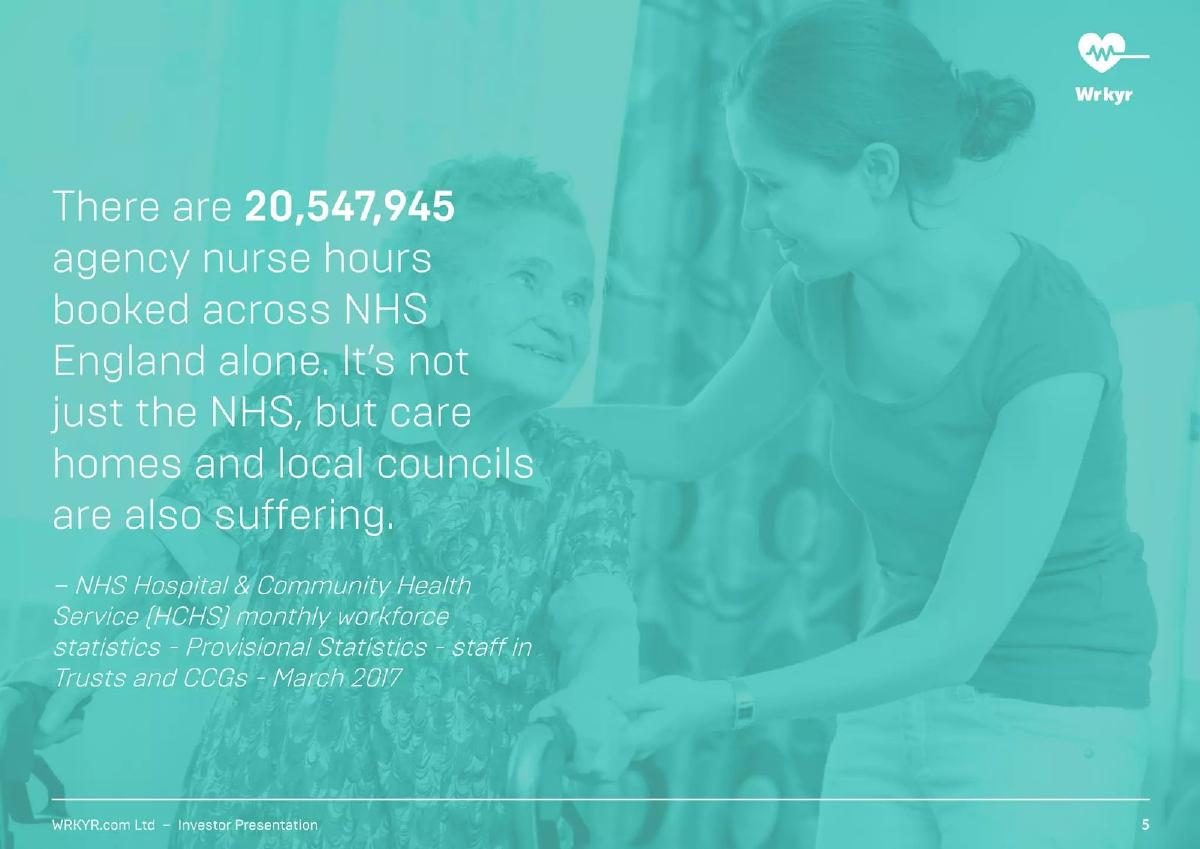
This slide establishes the scale of the nursing crisis. It cites a specific figure: 20,547,945 agency nurse hours booked across NHS England. The text notes that the problem extends beyond the NHS to care homes and local councils. The data is attributed to the NHS Hospital & Community Health Service (HCHS) monthly workforce statistics from March 2017. This slide serves to validate the 'Pain Point' by using official government statistics to prove a massive, recurring demand for temporary labor.
Slide 9: The Market Opportunity
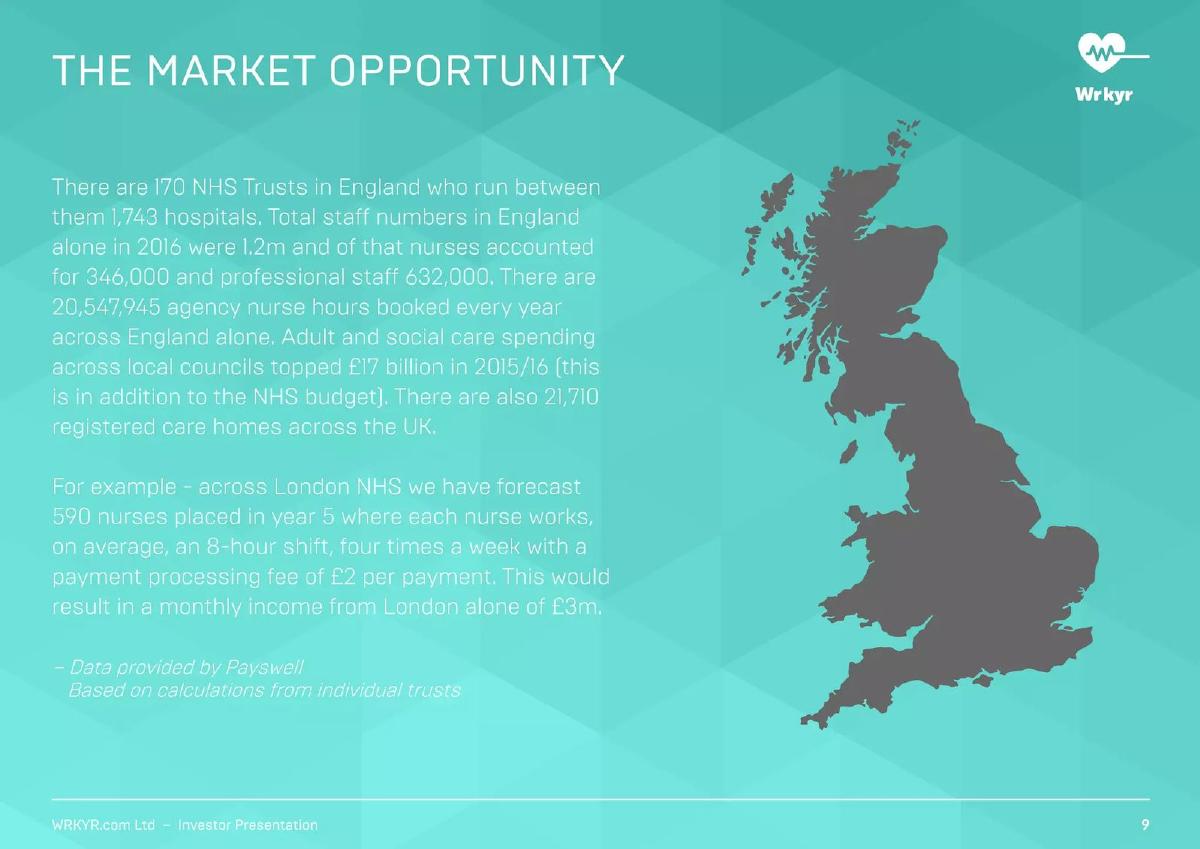
Slide 9 quantifies the Total Addressable Market (TAM) in the UK. It notes there are 170 NHS Trusts running 1,743 hospitals, with a total staff count of 1.2 million. Crucially, it mentions that adult and social care spending by local councils topped £17 billion in 2015/16 . The slide provides a concrete revenue example: if 590 nurses are placed in London by Year 5, each working four 8-hour shifts a week with a £2 processing fee, the monthly income from London alone would be £3 million. This calculation is attributed to data provided by Payswell.
Slide 13: Product - User Profile
This slide showcases the 'supply side' of the marketplace. The interface allows 'buy-side' users (hospitals/clinics) to view a nurse's profile. The mockup for 'Kemel Sidar' includes a photo, professional title (Registered Nurse), education (BSc Hons from Manchester University), and current employment (The Royal Marsden NHS Foundation Trust). Features include a 'Book now' button, a chat function to discuss details, and a link to a 'Full CV.' This suggests the platform aims to be a comprehensive HR tool rather than just a simple booking app.
Slide 17: Product - Features & Functions
Slide 17 demonstrates the 'supply-side' view, where the nurse sees job specifics. The example shown is a shift at 'The Harley Street Clinic' for an 'Anaesthetist' for a private patient. The shift is priced at £400 (including fees) . The screen provides granular details: the specific procedure (Liver Ablation under GA), the date, the time, and the names of the Anaesthetist and Consultant Radiologist. This level of detail is intended to reduce friction in the booking process by providing all necessary clinical context upfront.
Slide 21: Board of Directors
The leadership team is presented with a focus on diverse professional backgrounds. Andrew Grant (CEO) is highlighted for his marketing and digital agency experience. Collin Coffey brings corporate governance and board-level experience. David Bloor is the founder of Payswell Ltd, a payroll company, which is a strategic fit for a platform handling high-volume payments. Dr med. Torsten Beutlhauser provides the necessary clinical credibility, being a lead consultant at the Royal Marsden Hospital and a researcher in patient care software. The inclusion of a practicing lead consultant is a strong signal for a healthcare startup.
Slide 25: Go-To-Market Strategy
This slide is minimalist, featuring a photo of a trade show floor. The text states the company will sell 'Enterprise licences to NHS Trusts and hospitals' at the UK national digital NHS procurement exhibition, EHI Live in October 2018 . This indicates a B2B enterprise sales model rather than a purely bottom-up user adoption strategy. It identifies a specific high-intent event for customer acquisition.
Slide 29: Profit and Loss Projections
The final slide in this selection is a dense financial table covering June 2020 through September 2022. It breaks down 'Hourly Bookings' and 'License Income' across 12 UK regions. Total Quarterly Revenue is projected to grow from £37.5 million in June 2020 to £62.4 million by September 2022 . The 'Total Quarterly EBITDA' is forecasted to rise from £3.0 million to £5.39 million in the same period. The table also tracks 'Net Quarterly Cash Flow,' showing a consistently positive trend, ending the period with a cash balance of over £57.8 million. These figures suggest an extremely optimistic growth trajectory and high margins once the regional rollout is complete.
What Wrkyr Does Well
Wrkyr excels at grounding its pitch in massive, verifiable data points. By citing the exact number of agency hours (over 20.5 million) and the total social care spend (£17 billion), they make the market opportunity feel undeniable. The product mockups are clean and address the specific information needs of both the hospital (CVs, chat) and the nurse (procedure details, exact fees). Furthermore, the board of directors is well-balanced; having a payroll founder and a lead consultant from a major NHS Trust addresses the two biggest hurdles in healthcare staffing: compliance/payments and clinical trust.
What is Missing from the Deck
The most glaring omission is the 'Ask.' There is no slide indicating how much money Wrkyr is seeking in this seed round, what the valuation expectations are, or how the funds will be allocated (e.g., % to engineering vs. % to sales). Additionally, the deck lacks a competitive landscape slide. In 2017, several other platforms were targeting the NHS staffing crisis; failing to mention how Wrkyr differs from incumbents or other startups is a risk. Finally, while the P&L is detailed, there is no explanation of the 'Total Quarterly Costs' (which exceed £57 million by 2022). Without a breakdown of these costs, an investor cannot assess the efficiency of the business model.
Founder Takeaways: Regional Rollouts and Data Sourcing
Use Specific Stats: Instead of saying 'the market is big,' Wrkyr uses the figure '20,547,945 hours.' Specificity builds credibility. · Phased Expansion: The P&L shows a staggered entry into different regions (e.g., North East starting in Sep-20, South West in Jun-21). This demonstrates a realistic understanding that a startup cannot launch nationwide on day one. · Strategic Board Composition: A healthcare startup needs a doctor on the board. Wrkyr’s inclusion of Dr. Beutlhauser is a textbook example of how to build industry-specific authority. · Revenue Clarity: Stating a clear '£2 per payment' fee makes the business model easy to grasp, even if the total revenue figures in the P&L become complex later on. · Event-Based GTM: Identifying a specific event (EHI Live) for the go-to-market strategy shows investors that the founders have a concrete plan for where their first customers will come from.
Frequently asked questions
- What is the core problem Wrkyr is trying to solve?
- Wrkyr targets the high cost and administrative burden of agency nursing in the UK. According to Slide 5, there are over 20.5 million agency nurse hours booked annually in NHS England. The company aims to replace traditional, expensive agencies with a digital platform that allows hospitals, care homes, and local councils to book staff directly, potentially saving significant portions of the £17 billion spent on social care (Slide 9).
- How does Wrkyr plan to make money?
- The deck outlines two primary revenue streams. First, a transaction-based 'payment processing fee' of £2 per payment (Slide 9). Second, the 'Profit and Loss' statement on Slide 29 introduces 'License Income' categorized by region. For example, in the London area, they project a steady £15,600 in license income per quarter alongside massive hourly booking volumes.
- Who are the key people behind the company?
- The Board of Directors (Slide 21) features Andrew Grant (CEO), who has a background in marketing and digital agencies; Collin Coffey, a specialist in corporate governance; David Bloor, founder of payroll company Payswell Ltd; and Dr. Torsten Beutlhauser, a lead consultant in Critical Care and Anaesthesia. This combination suggests a strategy of blending tech-marketing with deep clinical and payroll compliance knowledge.
- What is the projected scale of the business by 2022?
- By September 2022, Wrkyr projects a total quarterly revenue of £62,455,207 (Slide 29). This growth is predicated on a phased regional rollout, starting with London and Scotland and eventually expanding into areas like the North East, North West, and South West. The company expects to maintain a quarterly EBITDA of approximately £5.4 million at this scale.
- What is missing from this investor presentation?
- The deck is missing a specific 'Ask' slide detailing how much capital is being raised and the intended use of funds. It also lacks a dedicated competitor analysis, which is vital in the crowded healthcare staffing space. Furthermore, while it shows the product interface, it does not explain the technical integration requirements for NHS Trust legacy systems.