Worthix presents a compelling case for a post-Seed or Series A round by focusing on the failure of traditional metrics like NPS and CSAT. The deck highlights a significant shift from free trials to a paid model in Q3 2017, which rapidly accelerated their growth to a projected $3.3M ARR by Q4 2018. With a heavy emphasis on social proof, the deck showcases a roster of global enterprise clients including HP, Verizon, and L'Oréal. While the deck is visually sparse on technical architecture, it compensates with strong market validation through strategic partnerships with FICO and Accenture. The na…
Key takeaways
- The company identifies a massive market opportunity, noting that $33B is invested annually in customer surveys (Slide 10).
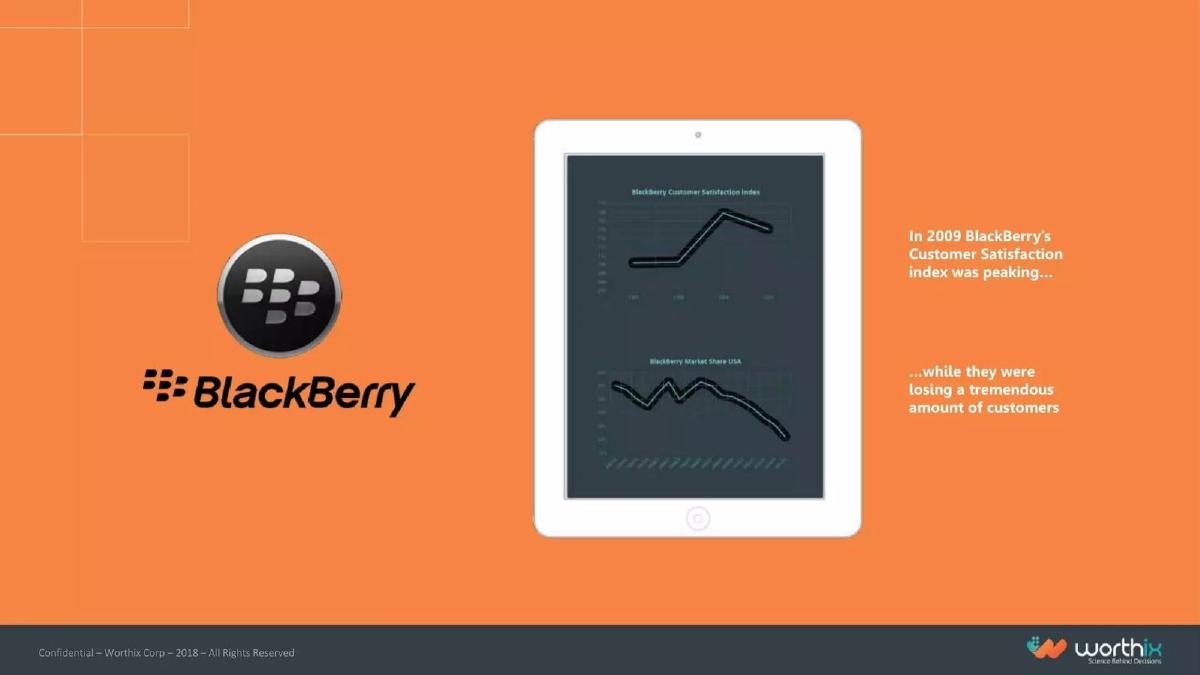
- Worthix positions itself as a replacement for flawed legacy metrics, citing that BlackBerry’s CSAT was peaking even as they lost market share (Slide 5).
- The startup demonstrated significant commercial momentum, growing from $1M ARR in Q1 2017 to a projected $3.3M ARR by Q4 2018 (Slide 14).
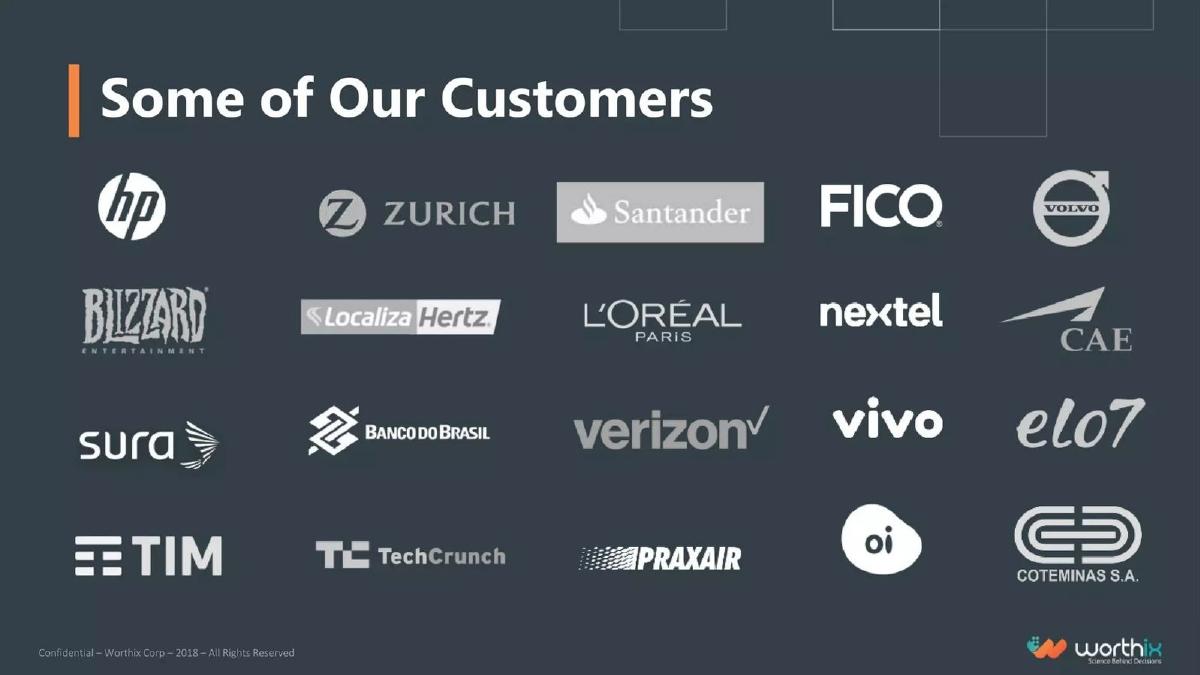
- The deck leans heavily on enterprise validation, listing 20+ high-profile logos including Blizzard, Volvo, and Santander (Slide 3).
- A strategic pipeline of 75 deals worth $6.7M as of April 2018 suggests a strong short-term growth trajectory (Slide 15).
- The team combines 15+ years of CX industry experience with academic backing from Georgia Tech (Slide 9).
- Strategic partnerships with FICO and Accenture are highlighted as key distribution and credibility drivers (Slide 16).
- The product is marketed as a 'no-design' survey that takes less than 2 minutes for customers to complete (Slide 11).
Introduction: The Evolution of Customer Experience
Worthix enters the market at a time when 'Customer Experience' (CX) has become a board-level priority, yet the tools used to measure it remain rooted in the early 2000s. This 18-slide deck, dated 2018, positions Worthix not just as a survey tool, but as a decision-science platform. By leveraging the logos of 500 Startups and ATDC on the cover, they immediately establish institutional credibility.
Slides 1-3: The Hook and Social Proof
Slide 1 is a standard title slide featuring a brain graphic, which reinforces their 'Science Behind Decisions' tagline. Slide 2 delivers the 'Solution' statement: 'The First Customer Survey Built with Artificial Intelligence to measure decisions.' It is a bold claim that sets the stage for a high-tech disruption of a legacy industry.
Slide 3 is perhaps the strongest slide in the deck. Instead of waiting until the end to show traction, Worthix displays a wall of enterprise logos. Notable names include HP, Zurich, Santander, FICO, Volvo, Blizzard, L'Oréal, Verizon, and TechCrunch. For a B2B SaaS company, this level of logo density suggests that the product has already passed the rigorous procurement and security hurdles of global corporations.
Slides 4-8: The Problem - The Failure of NPS and CSAT
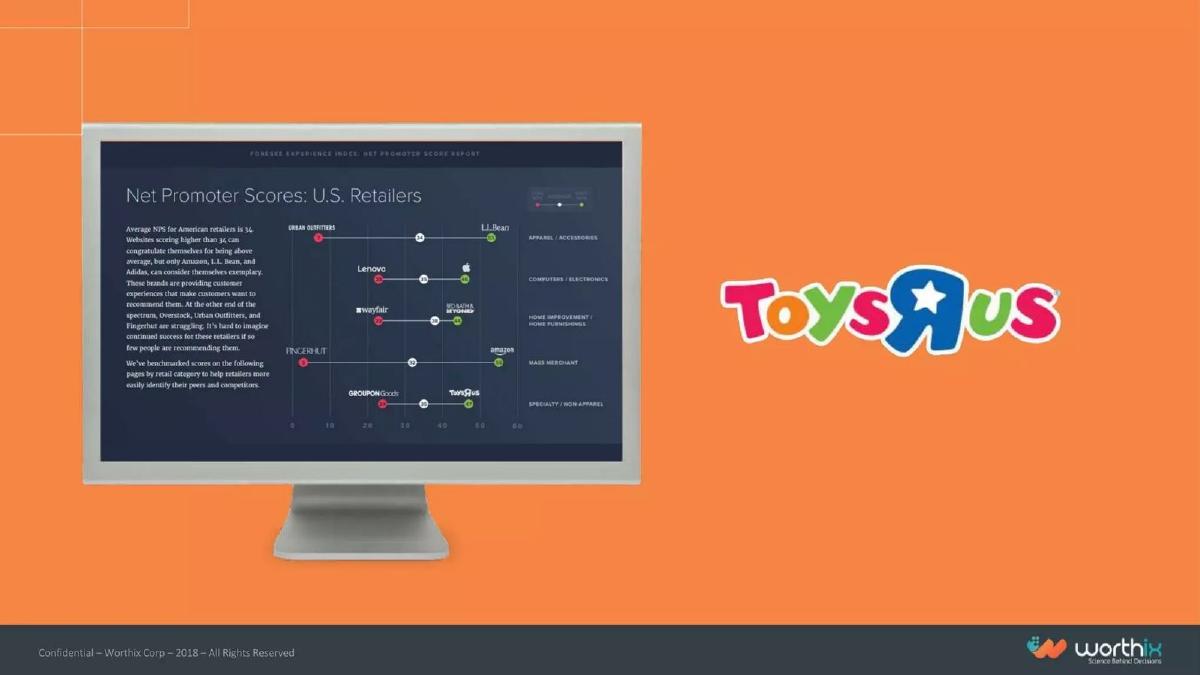
The 'Problem' section (Slides 4 through 8) uses a narrative of 'hidden failure.' Slide 4 states that CSAT and NPS alone cannot explain decisions. Slide 5 provides a historical case study: in 2009, BlackBerry's Customer Satisfaction index was peaking even as its market share was in a freefall. Slide 6 uses a similar visual for Toys 'R' Us, showing them with a respectable NPS score shortly before their decline.
Slide 7 raises the stakes with a macro-economic stat: '52% of the Fortune 500 firms since 2000 are gone!' This creates a sense of urgency. Slide 8 anchors this problem in academic and professional authority by quoting a Harvard Business Review cover story: 'What customers value in a product or a service can be hard to pin down.'
Slides 9-10: The Team and the Market
Slide 9 introduces the leadership. Guilherme Cerqueira (CEO) and Rogerio Monteito (CCO) are credited with 15+ years in the CX industry and 800+ customer research projects. Kevin Berry is highlighted for Senior AI Research and Development at Georgia Tech, providing the technical 'heft' needed to back up their AI claims. Slide 10 defines the Total Addressable Market (TAM) simply: '$33B is the total amount of money invested every year in Customer Surveys.'
Slides 11-12: The Product and the 'Why'
Slide 11 explains the product's value proposition. By using Econometrics, NLP, and Machine Learning, Worthix eliminates the need for companies to design questionnaires. The 'less than 2 minutes to respond' metric is a key selling point for reducing survey fatigue. Slide 12 uses a simple graphic to reiterate that they are capturing the 'why' behind the buy to help companies keep up with the 'speed of change.'
Slides 13-15: Traction and Financials
The traction slides (13 and 14) show a clear inflection point. In Q1 2017, they raised a $1.3M seed round. By Q3 2017, they made the strategic decision to stop doing free trials and start selling. Slide 14 shows the result: a jump to $1M ARR (listed as Q1 2017, but contextually likely Q1 2018) and a projected $3.3M ARR by Q4 2018. The red circle around the $3.3M figure emphasizes their growth target.
Slide 15 focuses on the future. As of April 2018, they report 75 deals in the pipeline totaling $6.7M. They list 'Hot Deals' with companies like GM, Microsoft, Citi, and Hyundai, suggesting that their sales team is successfully targeting the top of the market.
Slides 16-18: Partners and Closing
Slide 16 highlights strategic partners and resellers, specifically FICO and Accenture. In enterprise SaaS, having a reseller like Accenture is a massive force multiplier for a small startup. Slide 17 shows the founders at 'FICO World 18,' providing a 'boots on the ground' feel to their partnership claims. Slide 18 concludes with contact information for the CEO.
What Works in This Deck
Strong Social Proof: By leading with a massive logo slide, Worthix bypasses the 'does this work?' question and moves straight to 'how does it work?'
Counter-Intuitive Problem: Attacking NPS and CSAT is a smart move. Most enterprises use these tools but are frustrated by their lack of predictive power. Worthix validates that frustration with the BlackBerry and Toys 'R' Us examples.
The 'Free to Paid' Pivot: Showing the transition from free trials to a $3.3M ARR run rate demonstrates a product-market fit that investors find highly attractive. It shows the product is 'must-have' rather than 'nice-to-have.'
What Is Missing
The Raise Details: There is no slide indicating how much they are raising in this round or what the valuation expectations are. This is a significant omission for a pitch deck.
Unit Economics: While ARR is shown, there is no mention of Gross Margins, Customer Acquisition Cost (CAC), or Lifetime Value (LTV). For a 'Later' stage deck (as categorized), these metrics are usually mandatory.
Competitive Landscape: The deck assumes the only competition is legacy NPS/CSAT. It does not address other modern CX players like Qualtrics or Medallia, which were already significant players in 2018.
What a Founder Should Copy
The Case Study Approach: Using well-known corporate failures (BlackBerry) to illustrate why current industry standards are failing is a masterclass in 'Problem' slide construction.
Pipeline Transparency: Listing the specific logos currently in the sales pipeline (Slide 15) is a high-conviction move. It allows investors to perform due diligence on the quality of the revenue growth.
The 'No-Design' Value Prop: In a world of complex enterprise software, the promise of 'No need to design questionnaires' is a powerful 'Ease of Use' hook that appeals to the end-user, not just the buyer.
Frequently asked questions
- What is the core problem Worthix is solving?
- Worthix argues that traditional metrics like Net Promoter Score (NPS) and Customer Satisfaction (CSAT) are 'lagging indicators' that fail to explain the actual motivations behind customer churn or purchase decisions. They use the examples of BlackBerry and Toys 'R' Us to show that high satisfaction scores do not prevent market share collapse if the company doesn't understand the 'why' behind the buy.
- How does the technology differ from a standard survey tool?
- Unlike static surveys, Worthix uses 'self-adaptive' AI, Econometrics, and Natural Language Processing. This allows the system to generate questions in real-time based on customer responses, eliminating the need for companies to manually design questionnaires and keeping the response time under two minutes.
- What does the company's financial traction look like?
- The deck shows a pivot in Q3 2017 where the company stopped offering free trials and began selling. This led to a $1M ARR mark in early 2017 (likely a typo in the deck's timeline, intended for 2018) and a projected $3.3M ARR by the end of 2018. They also report a $6.7M pipeline.
- Who are the key investors and partners?
- The deck lists 500 Startups and Valor Capital Group as primary investors. They also highlight a mentoring relationship with ATDC (Georgia Tech). Crucially, they have established reseller or strategic partnership agreements with FICO and Accenture to scale their enterprise reach.
- What is missing from this pitch deck?
- The deck lacks a specific 'Ask' slide detailing how much capital they are raising and the planned use of funds. It also omits detailed unit economics (CAC, LTV, Churn rates) and a competitive landscape slide, relying instead on the general obsolescence of NPS/CSAT as their primary competitive foil.