Atexto’s 15-slide deck from 2018 presents a compelling case for a human-in-the-loop transcription platform targeting the AI training data market. The deck is notable for its progressive build-up of market use cases and a stark comparison of capital efficiency against heavily funded competitors. While the presentation lacks a traditional 'Problem' slide, it compensates with strong unit economics—reporting a 64% unitary margin—and clear revenue traction following their time in the 500 Startups accelerator. The deck successfully positions Atexto as a 'faster and cheaper' alternative in a $60 bil…
Key takeaways
- The deck identifies a +$60 billion market opportunity across five distinct use cases for audio transcription on slide 8.
- Atexto claims a 99.99% accuracy rate achieved through a combination of Artificial Intelligence and a 'Human Layer' on slide 9.
- The company positions itself as 8x cheaper and 14x faster than competitors on slide 10.
- A capital efficiency argument is made on slide 11, comparing Atexto's $75k raised to a competitor's $76M while maintaining a superior market position.
- Unit economics are clearly defined on slide 12: $41 CAC, 64% Unitary Margin, and $262 LTV.
- Revenue traction shows growth from $11k in Q1-17 to $26k in Q1-18, following their 500 Startups participation on slide 13.
- The team slide (14) features logos from 500 Startups, Start-Up Chile, Accenture, and Globant, suggesting strong institutional backing and pedigree.
- The specific ask in this deck version is for $200k, as stated on slide 15, though catalogue data indicates they eventually raised $1.1M.
The Atexto Pitch Deck Teardown
Atexto entered the market at a pivotal moment when the demand for high-quality training data for machine learning was exploding. This 15-slide deck, used during their 2018 Seed round, focuses heavily on the efficiency of their 'human-in-the-loop' model. By leveraging a global crowd to verify and correct AI-generated transcriptions, Atexto aimed to undercut the pricing of traditional transcription services while maintaining higher accuracy than pure AI solutions.
Slide 1: Title Slide
The deck opens with a clean, minimalist title slide. It features the Atexto logo and the tagline: Humans on-Demand Platform for Audio Transcription . This immediately establishes the 'what' and 'how' of the business. It signals a marketplace or crowdsourced model rather than a pure software-as-a-service (SaaS) play.
Slides 2-8: The Market and Use Cases
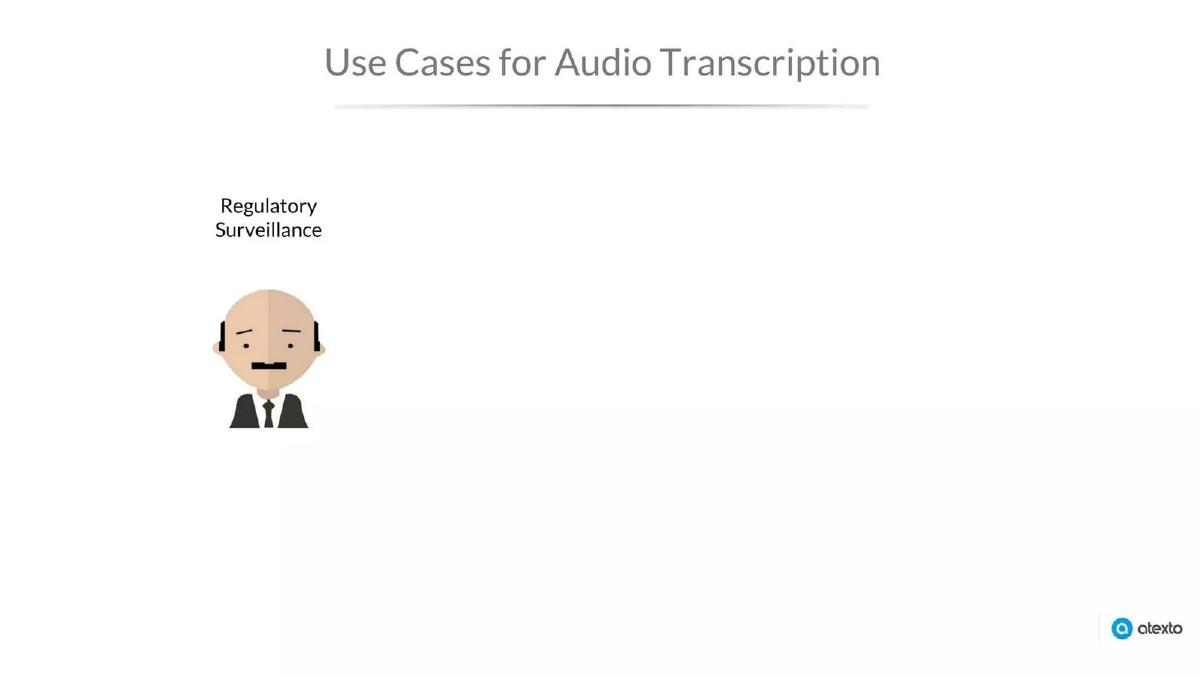
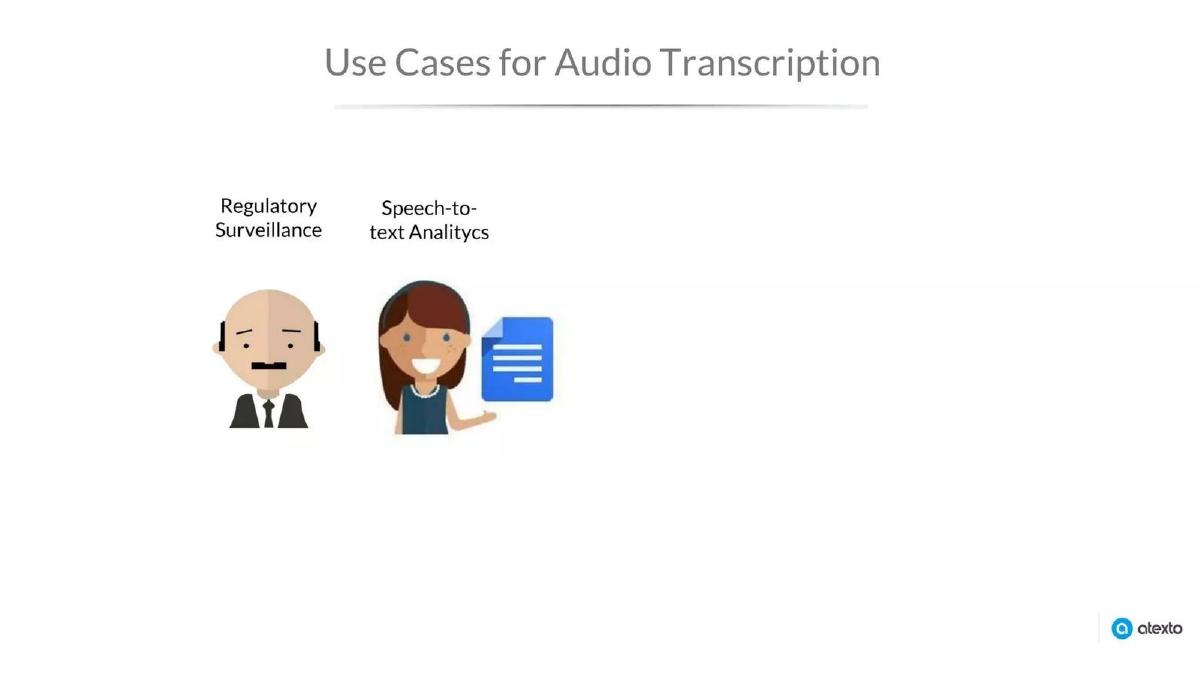
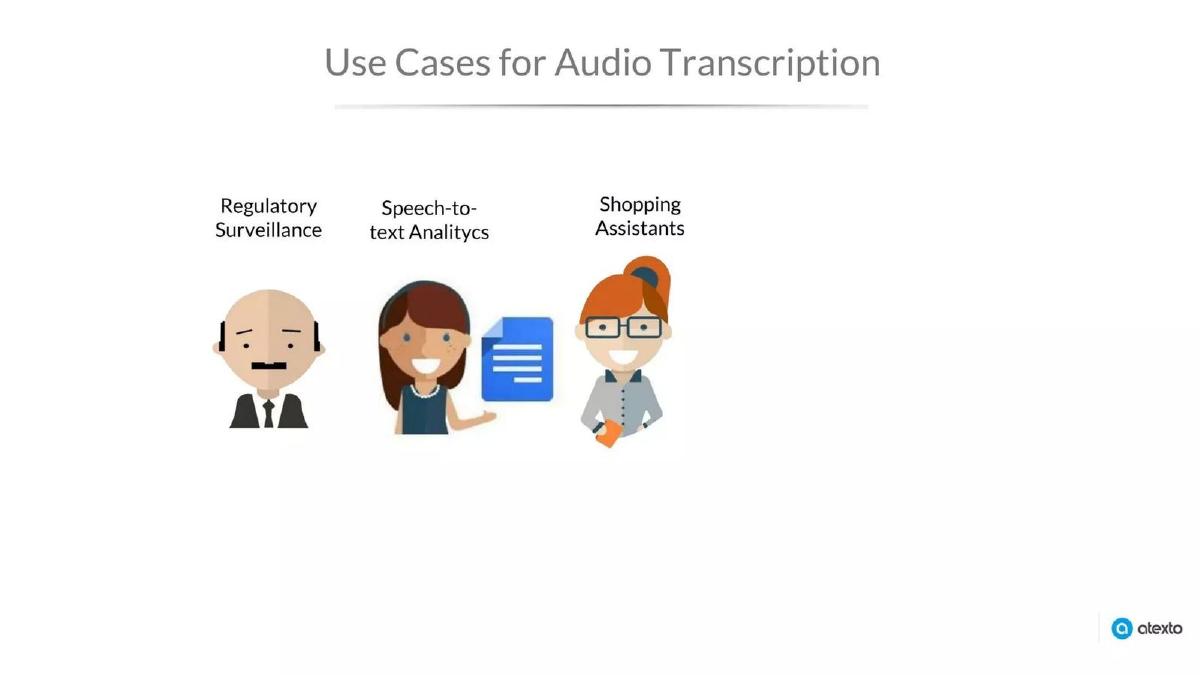
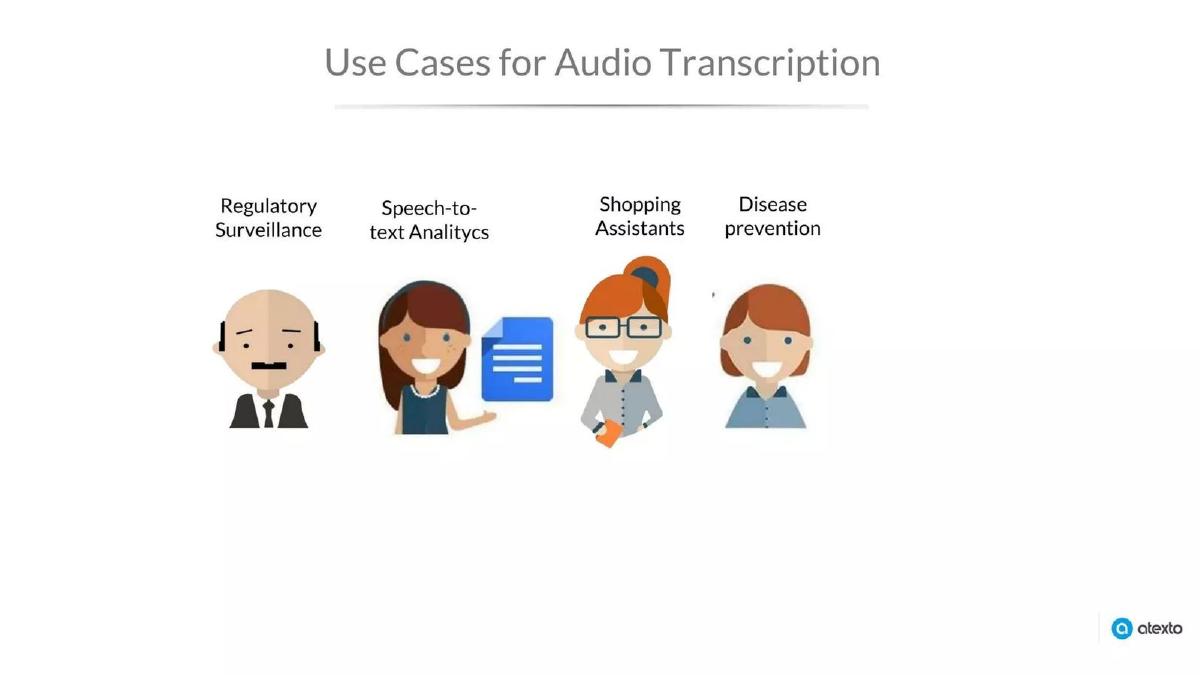
Atexto uses a progressive reveal strategy for its market slides. This is a common technique in live presentations to keep the audience focused on one point at a time. Slide 2 is a blank template titled 'Use Cases for Audio Transcription.' Slides 3 through 7 introduce specific verticals: Regulatory Surveillance, Speech-to-text Analytics, Shopping Assistants, Disease Prevention, and Automated Call Centers. Each is accompanied by a simple vector illustration.
Slide 8 brings these together to claim a +$60 BILLIONS MARKET . While the number is massive, the deck lacks a slide explaining the 'Problem'—the specific pain point within these $60 billion worth of use cases. It assumes the investor already understands that transcription is currently too slow, too expensive, or too inaccurate.
Slide 9: The Solution and Accuracy
Titled 'The Secret behind our 99.99% Accuracy,' this slide explains the operational model. It shows a brain icon split between Artificial Intelligence and a Human Layer , wrapped in a circular arrow labeled Language Agnostic . This is a classic 'Human-in-the-Loop' (HITL) diagram. It promises the best of both worlds: the speed of AI and the precision of human oversight.
Slides 10-11: Competitive Positioning and Capital Efficiency
Slide 10 uses a standard 2x2 matrix, plotting 'Cheaper' on the Y-axis and 'Faster' on the X-axis. Atexto places itself in the top-right corner, claiming to be 8x CHEAPER and 14x FASTER than competitors like CrowdFlower, Verbit, and TranscribeMe.
Slide 11 is the most aggressive slide in the deck. It overlays fundraising data onto the competitive matrix. It highlights that Atexto achieved its position with only $75k FUND RAISED , contrasted against a competitor (implied to be Verbit or CrowdFlower) that had raised $76M . This is a powerful 'doing more with less' narrative designed to appeal to Seed investors looking for capital efficiency.
Slide 12: Unit Economics
This is a high-impact slide for a Seed stage company. Atexto presents three key figures: $41 CAC , 64% UNITARY MARGIN , and $262 LTV . Providing these numbers shows a level of operational maturity often missing in early-stage decks. The 64% margin is particularly impressive for a business that involves paying human workers, suggesting a highly optimized workflow or a low-cost labor source.
Slide 13: Traction and Revenue
The traction slide shows a revenue line graph from Q2-16 to Q1-18. It highlights two key milestones: the launch of their Proprietary Technology in Q1-17 (where revenue was $11K ) and their participation in the 500 Startups Accelerator program in Q4-17. The graph ends at $26K for Q1-18. While the absolute dollar amounts are modest, the upward trend and the acceleration post-500 Startups provide the necessary 'hockey stick' visual.
Slide 14: The Team
The team slide features three leads: Esteban Gorupicz (Founder & CEO) , Brenda Mana Pastrian (Operations) , and Amalia Gerpe (Marketing) . Below the headshots is a 'logo wall' of previous affiliations and supporters, including 500 Startups, Start-Up Chile, Globant, Avaya, Accenture, and several universities. This builds 'borrowed credibility,' showing that the team has been vetted by major accelerators and has experience at large enterprise firms.
Slide 15: The Ask
The final slide is simple: WE ARE RAISING $200K . It includes a WhatsApp icon and the CEO's direct contact information. According to the catalogue facts, the company eventually raised $1.1 million, which suggests this deck was used early in the round or that the round was significantly oversubscribed.
What Works in the Atexto Deck
The strongest element of this deck is its capital efficiency narrative . By directly comparing their $75k raise to a competitor's $76M raise on Slide 11, Atexto makes a bold claim about their technological superiority and operational leanness. This is a highly effective way to stand out in a crowded market.
Additionally, the Unit Economics slide (Slide 12) is excellent. Many Seed decks focus on vague market sizes; Atexto focuses on the math of their business. Showing a clear LTV/CAC ratio and a healthy 64% margin gives investors confidence that the business can scale profitably.
What is Missing from the Atexto Deck
The most glaring omission is a Problem slide . The deck jumps straight into use cases without explaining why current solutions are failing. Are they too expensive? Do they have a 20% error rate? Without defining the 'pain,' the '8x cheaper' claim lacks context. We don't know 8x cheaper than what specifically in terms of dollar-per-hour or dollar-per-word.
The deck also lacks a Product slide . While we see illustrations of people and brains, we never see the actual software interface. For a company that describes itself in its listing as 'software for companies to access labeled speech data,' seeing the platform would have helped ground the pitch in reality.
Finally, there is no Roadmap or Use of Funds . The deck asks for $200k but doesn't explain how that money will be spent. Will it go toward hiring more engineers, marketing to new verticals, or expanding the human crowd layer?
What a Founder Should Copy
The Efficiency Comparison: If you are a lean startup competing against 'Goliaths' with massive war chests, use a slide like Slide 11 to show how much more you've achieved per dollar spent. · Specific Unit Economics: Don't wait for the Due Diligence phase to show your CAC and LTV. Putting them front and center (Slide 12) proves you understand the mechanics of your business. · Progressive Use Cases: If your product has many applications, introducing them one by one (Slides 3-7) prevents the audience from getting overwhelmed and helps build a narrative of a massive, multi-faceted market. · Direct Contact Info: Including a WhatsApp number or direct email on the final slide (Slide 15) lowers the friction for an investor to reach out immediately after a demo day or a quick review.
Frequently asked questions
- What is Atexto's core value proposition?
- Atexto positions itself as a 'Humans on-Demand Platform for Audio Transcription.' Their core value proposition, as detailed on slides 9 and 10, is providing 99.99% accuracy by combining AI with a human layer, while being significantly faster (14x) and cheaper (8x) than existing market alternatives.
- How does Atexto justify its market size?
- On slide 8, the company aggregates five major use cases: Regulatory Surveillance, Speech-to-text Analytics, Shopping Assistants, Disease Prevention, and Automated Call Centers. They value this collective market at over $60 billion, though the deck does not provide a specific source or breakdown for this figure.
- What are the company's unit economics?
- Slide 12 provides specific metrics: a Customer Acquisition Cost (CAC) of $41, a Lifetime Value (LTV) of $262, and a Unitary Margin of 64%. This roughly 6.4x LTV/CAC ratio suggests a highly efficient and scalable customer acquisition model for a seed-stage company.
- Who are Atexto's main competitors according to the deck?
- Slide 10 and 11 identify several competitors in the transcription and crowd-work space, including Verbit, CrowdFlower (now Figure Eight), and TranscribeMe. Atexto uses a 2x2 matrix to place itself in the 'Cheaper' and 'Faster' quadrant relative to these players.
- What was the result of this fundraising round?
- While slide 15 shows an ask for $200,000, catalogue data from pitchdeckhunt.com indicates that Atexto successfully raised a total of $1,100,000 in 2018. This suggests the deck was either highly effective or was part of a rolling close that exceeded initial expectations.