Shapes, a Tel Aviv-based HR tech startup, utilized a concise 10-slide deck to secure a $24M Series A in 2023. The presentation leans heavily on the 'AI-native' narrative, positioning the company as the next logical step in the evolution of HR software—moving beyond the 'User Experience revolution' of companies like Rippling and HiBob. The deck is notable for its lack of traditional metrics like ARR or CAC, instead focusing on breadth of adoption across 79 countries and 14 industries. By framing the current HR landscape as a 'fragmented mess' of rigid, manual tools, Shapes pitches a modular pl…
Key takeaways
- The deck identifies a 'huge market' with hundreds of billions in opportunity but notes a lack of a global leader (Slide 2).
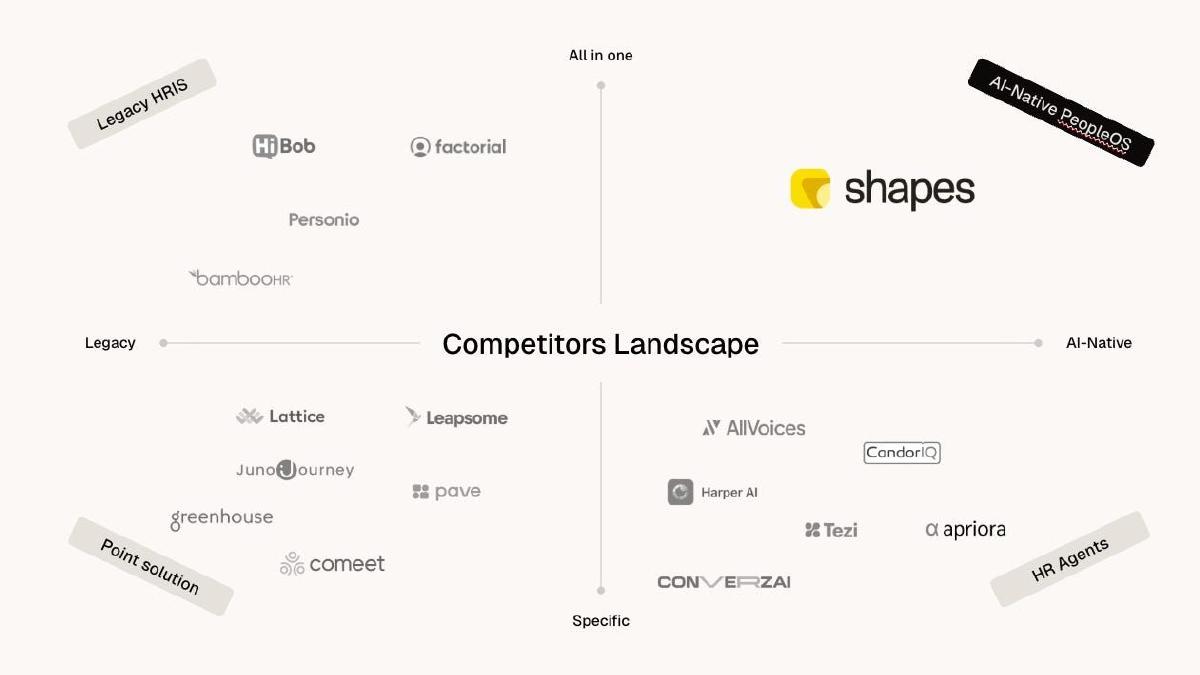
- Shapes positions itself in the 'AI-Native PeopleOS' quadrant, distinct from legacy HRIS and specific HR agents (Slide 3).
- Current HR tools are critiqued as being 'Rigid,' 'Silod,' and 'Manual,' with setup times often taking months (Slide 4).
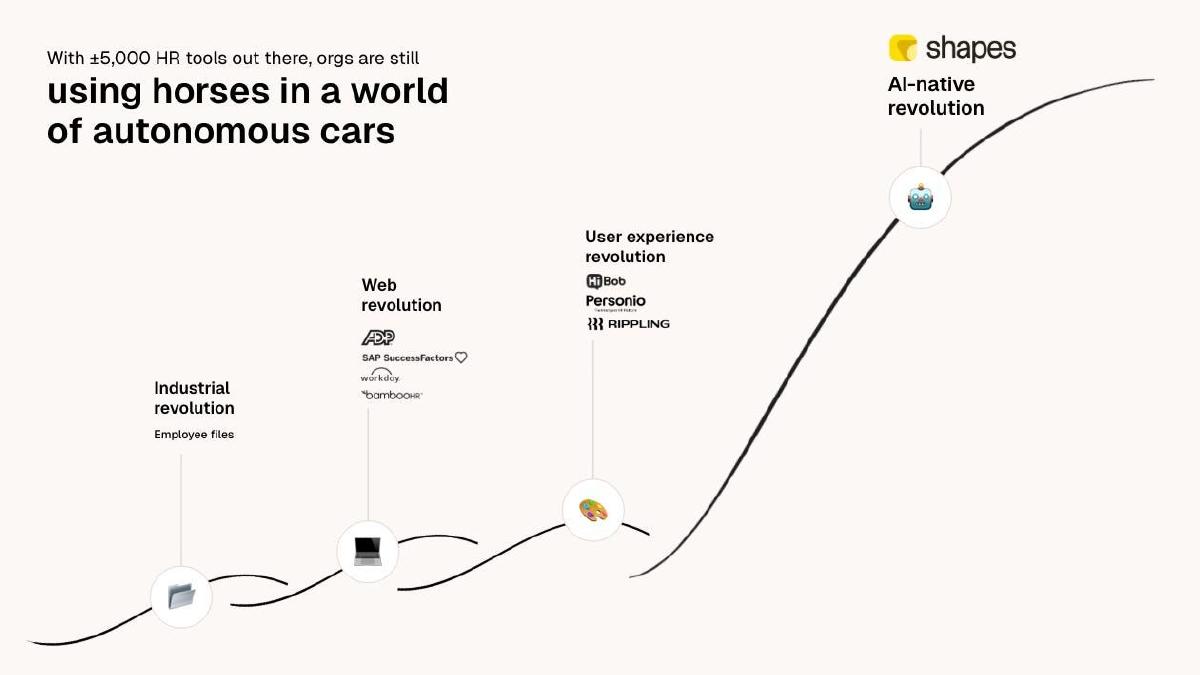
- The company frames the current state of HR as 'using horses in a world of autonomous cars,' placing themselves at the peak of an 'AI-native revolution' (Slide 6).
- The product architecture is described as a four-layer stack: Data, OS, Apps & AI agents, and Deep AI Insights (Slide 7).
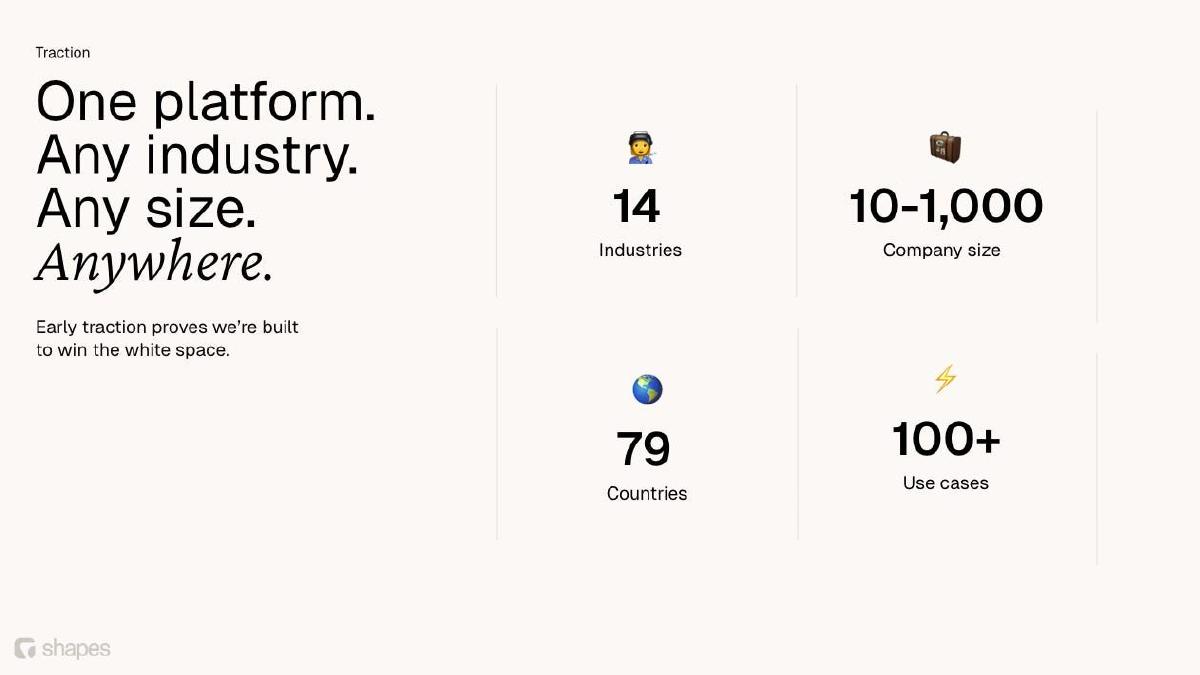
- Traction is demonstrated through breadth rather than depth, citing presence in 79 countries and 14 industries (Slide 9).
- The deck completely omits a team slide, financial projections, and a specific funding ask, focusing entirely on the platform vision.
- As reported by Business Insider, the company successfully raised $24M in a 2023 Series A round based on this modular AI agent approach.
The Visionary Pitch: Selling the 'PeopleOS'
The Shapes pitch deck is a masterclass in high-level strategic positioning. In an HR tech market that many investors consider saturated, Shapes managed to raise $24M in 2023 (as reported by Business Insider) by reframing the problem. Rather than pitching a better HRIS, they pitched an operating system for people processes. The deck is brief, visual, and aggressive in its dismissal of the current status quo.
Slide 1-2: The Hook and the Market Landscape
Slide 1 introduces the company with the tagline 'The new era of people management.' It is a standard title slide, listing founders Arnon Nir and Shirley Baumer. Slide 2 immediately pivots to the market opportunity, which it characterizes as a 'Huge market waiting for disruption.' The slide lists 'hundred of billions of market opportunity' and notes that the market is 'highly fragmented' with 'no global leader.'
This slide is particularly effective because it categorizes the competition into four buckets: All-in-one Payroll & HR (Enterprise), All-in-one HRIS (Mid-market), Point solutions, and HR Agents. By grouping giants like Oracle, SAP, and Workday as 'Legacy, rigid,' and mid-market players like Rippling and HiBob as 'Segmented by GEOs & verticals,' Shapes creates a 'white space' for a new type of player.
Slide 3: The Competitive Quadrant
Slide 3 uses a standard 2x2 matrix to place Shapes in the top-right corner. The axes are 'Legacy' vs. 'AI-Native' and 'Specific' vs. 'All in one.' Shapes positions itself as the only 'AI-Native PeopleOS' that is also an 'All in one' solution. Interestingly, it places 'HR Agents' like Harper AI and Tezi in the bottom-right (AI-Native but Specific), suggesting that while these tools are modern, they are too narrow to solve the broader organizational problem. This slide sets the stage for the 'why now' argument.
Slide 4-5: Defining the Pain Points
Slide 4 identifies three core problems with current tools: they are 'Rigid,' 'Silod,' and 'Manual.' The text notes that existing tools are 'one size fits all,' consist of a 'fragmented mess of point solutions' that don't talk to each other, and require 'months of setup.' Slide 5 adds urgency to these pain points, citing 'Mass layoffs,' 'AI displacing roles,' and 'New types of businesses' as reasons why organizations are 'scrambling to catch up.'
Slide 6: The Evolutionary Timeline
Slide 6 is perhaps the most important slide for their Series A narrative. It presents an evolutionary curve of HR technology. It starts with the 'Industrial revolution' (employee files), moves to the 'Web revolution' (ADP, Workday), then the 'User experience revolution' (HiBob, Rippling), and finally peaks at the 'AI-native revolution' where Shapes sits. By framing companies like Rippling—often seen as the gold standard of modern HRIS—as a previous 'revolution,' Shapes makes a bold claim that the market is ready for a fundamental architectural shift, not just a better UI.
Slide 7-8: The Modular Architecture
Slide 7 explains how the product is 'built differently.' It shows a 3D exploded view of a four-layer stack. The bottom layer is 'Data' (one source of truth), followed by the 'OS' (modular by design), then 'Apps & AI agents' (specific use cases), and finally 'Deep AI Insights.' Slide 8 summarizes this as a 'PeopleOS' that allows organizations to run processes 'their own unique way.' This modularity is the answer to the 'Rigid' and 'Silod' problems identified earlier in the deck.
Slide 9: Traction and Breadth
Slide 9 provides the only hard data in the deck, though it is focused on adoption breadth rather than financial depth. The slide claims traction across:
14 Industries · 79 Countries · 10-1,000 Company size range · 100+ Use cases
The phrase 'Early traction proves we're built to win the white space' suggests that the founders are prioritizing the platform's versatility as their primary proof of concept. For a Series A, investors usually look for ARR and growth rates, but Shapes appears to have sold the round on the technical scalability and global applicability of their agent-based model.
Slide 10: Closing
Slide 10 is a repeat of the title slide, serving as a contact page for the founders. It offers no new information but maintains the clean, minimalist aesthetic of the rest of the deck.
What Works in the Shapes Deck
Strong Categorization: The deck does an excellent job of bucketizing a crowded market. By defining the 'User Experience revolution' as a past event, they effectively 'old-school' their most dangerous modern competitors. This is a classic strategy for startups entering a red ocean: redefine the categories so you are the only occupant of the new, desirable category.
Architectural Clarity: Slide 7 uses a visual metaphor (the layered stack) to explain a complex technical concept. For a modular platform, showing how data flows into an OS and powers agents is much more effective than a list of features. It communicates that the product is a platform, not just a tool.
Urgency through Macro Trends: Slide 5 connects the product to the current zeitgeist of AI displacement and organizational restructuring. It makes the need for a flexible HR system feel like a survival requirement rather than a 'nice to have' upgrade.
What is Missing from the Shapes Deck
The Team Slide: There is no slide dedicated to the founders' backgrounds or the engineering team. In a $24M Series A, the 'who' is usually as important as the 'what.' While the names are on the cover, their specific expertise in AI or HR tech is not highlighted within the 10 slides provided.
Financial Metrics: The deck is entirely devoid of revenue figures, churn rates, or customer acquisition costs. While the publisher reports a $24M raise, the deck itself relies on the '79 countries' and '14 industries' metrics to imply scale. This suggests the deck was likely a 'vision deck' used to support a narrative, with the hard numbers reserved for a separate data room.
The 'Ask': There is no mention of how much money is being raised or how it will be spent. Usually, a Series A deck concludes with a slide detailing the roadmap and the capital required to reach the next milestone.
Unit Economics: There is no explanation of the business model. Is it per-employee-per-month? Is it a usage-based model for AI agents? The deck explains the 'OS' but not how the OS makes money.
What Founders Should Copy
The 'Revolution' Slide: Founders building in established categories should copy the approach on Slide 6. By mapping out the history of your industry and placing yourself at the start of the next 'revolution,' you force investors to decide if they believe in that shift. If they do, you are the natural choice to lead it.
Breadth as a Proxy for Product-Market Fit: If you have a platform play that isn't yet generating massive revenue but is being used in diverse ways, use the 'Use Cases' and 'Industries' metrics. Slide 9 shows that the product works for a 10-person startup and a 1,000-person mid-market firm across nearly 80 countries. This is a powerful way to demonstrate that your 'OS' is truly an 'OS' and not just a niche tool.
Minimalist Design: The deck uses a consistent, high-contrast color palette and very little text. It is designed to be spoken over, not read as a document. This keeps the focus on the founder's narrative during a pitch meeting.
Final Analysis
The Shapes deck is a high-conviction play on the future of work. It succeeds by being reductive—reducing a complex market to a few simple revolutions and a modular stack. While it lacks the traditional 'meat' of a Series A deck (financials and team), its success in raising $24M proves that in the current AI hype cycle, a compelling architectural vision and early signs of broad adaptability can be enough to win over top-tier investors.
Frequently asked questions
- What is the primary value proposition of Shapes?
- Shapes positions itself as an 'AI-native PeopleOS.' According to Slide 8, the platform allows organizations to run any people process in their own unique way by using a modular architecture. This contrasts with what Slide 4 describes as 'one size fits all' legacy tools that are rigid and siloed.
- How does Shapes differentiate itself from competitors like Rippling or HiBob?
- Slide 6 categorizes companies like HiBob, Personio, and Rippling as part of the 'User experience revolution.' Shapes claims to represent the next stage, the 'AI-native revolution,' moving from better interfaces to autonomous agents that handle manual work.
- What traction metrics did Shapes share in this deck?
- Instead of revenue or growth rates, Slide 9 highlights reach: 14 industries, 79 countries, 100+ use cases, and a customer size range of 10 to 1,000 employees. This suggests the platform is highly adaptable across different regulatory and vertical environments.
- What are the core components of the Shapes platform?
- Slide 7 illustrates a four-layer modular design: a 'Data' layer as a single source of truth, a 'Modular OS' layer, an 'Apps & AI agents' layer for specific use cases, and a 'Deep AI Insights' layer for intelligence.
- Is there a specific funding ask or use of proceeds in the deck?
- No. The 10-slide deck provided does not include a slide detailing the amount of capital sought, the valuation, or how the funds will be allocated. The $24M Series A figure is a publisher-reported fact from 2023.