Set Scouter’s 2012 pitch deck is a masterclass in brevity and social proof. The company positions itself as the 'Airbnb for film sets,' connecting brands with residential spaces for production. The deck relies heavily on visual evidence of traction, showcasing 250 paying customers including global giants like Samsung and P&G. While the deck lacks a detailed financial forecast or a specific 'Ask' slide regarding the funding amount, it succeeds in defining a clear, painful problem—the inefficiency of traditional scouting—and offering a quantifiable solution. By reducing scouting time from 5 day…
Key takeaways
- The company claims a massive market opportunity with 10 million commercials produced every year (Slide 5).
- Set Scouter demonstrates significant early traction with 250 paying customers, including P&G, Samsung, and Home Depot (Slide 4).
- The platform offers a clear value proposition by reducing scouting time from 4-5 days to less than 1 day (Slide 7).
- Price disruption is a core pillar, lowering daily location rates from $5,000+ to a range of $1,200-$2,500 (Slide 7).
- The business model shows strong retention signals with 50% repeat customers over a 3-month period (Slide 11).
- The team slide highlights relevant domain expertise, featuring a former broadcaster and a former producer (Slide 12).
- The deck omits a specific financial 'Ask' or a breakdown of how the raised funds will be allocated.
- The platform is positioned as a full-service end-to-end solution, handling viewings, bookings, and online payments (Slide 8).
Introduction: The Marketplace for Production Spaces
Set Scouter entered the market in 2012 with a clear mission: to modernize the fragmented and expensive world of film location scouting. This teardown examines their 12-slide deck, which was used during their time with the 500 Startups accelerator. The deck is a quintessential example of a 'traction-first' presentation, where the founders let their customer list and efficiency metrics do the heavy lifting rather than relying on complex financial modeling or long-winded industry histories.
The Hook and the Vision (Slides 1-2)
Slide 1: Title Slide The deck opens with a high-resolution image of a residential property, immediately signaling the company's focus. The tagline is simple: "Find unique film locations faster." The inclusion of the 500 Startups logo and links to their AngelList profile provides immediate institutional credibility.
Slide 2: The Mission Statement Slide 2 defines the business model in one sentence: "Set Scouter is a marketplace connecting brands with unique residential spaces for production." By underlining "residential," the company carves out its niche, distinguishing itself from commercial real estate platforms or traditional high-end film location agencies.
Validation Through Traction (Slides 3-4)
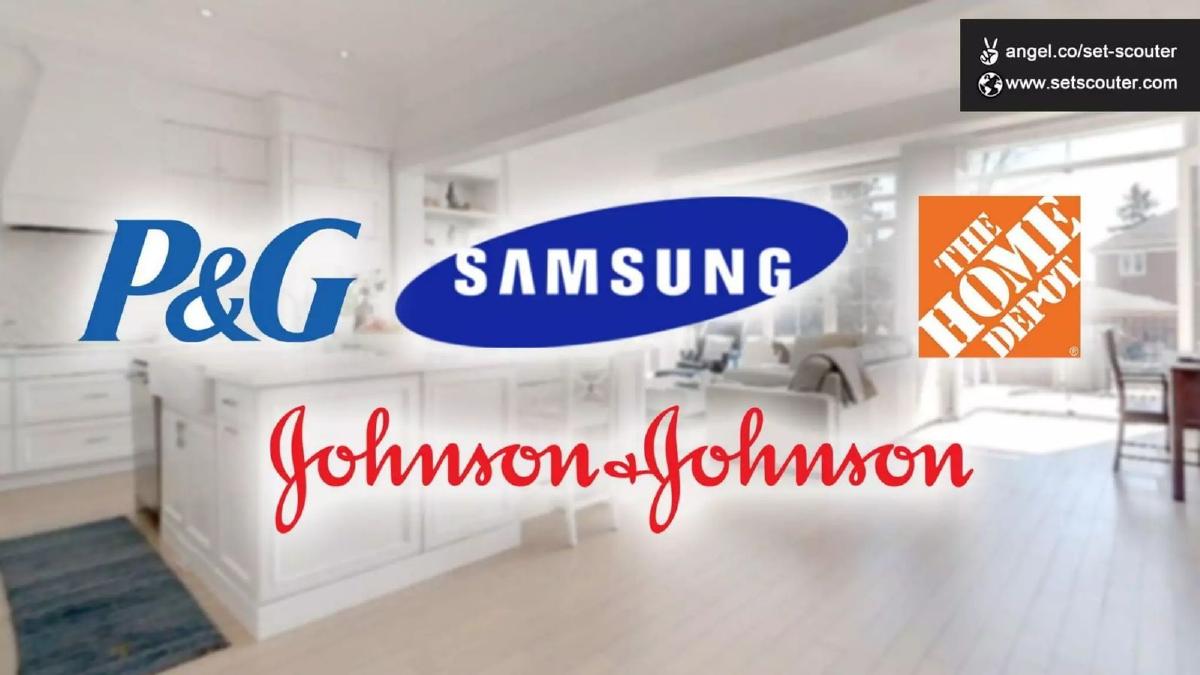
Slide 3: Major Logos Instead of explaining the problem immediately, Set Scouter leads with social proof. Slide 3 displays four massive logos: P&G, Samsung, The Home Depot, and Johnson & Johnson. This tells investors that the world's largest advertisers are already using the platform, effectively de-risking the investment before the business mechanics are even explained.
Slide 4: The Customer Base Slide 4 expands on this by stating they have "250 paying customers." The slide is a wall of logos including Dyson, Bell, Canon, Philips, and Universal Music. For a startup in 2012, having this level of enterprise-grade traction was a significant differentiator. It proves that the 'residential' angle isn't just for student films; it is a viable solution for professional commercial production.
Market Size and The Pain Point (Slides 5-6)
Slide 5: Market Opportunity The deck quantifies the market with a single, bold figure: "10 Million commercials every year." While it doesn't break down the Total Addressable Market (TAM) in dollars, it establishes the sheer volume of production activity that requires locations.
Slide 6: The Problem Slide 6 is a minimalist 'problem' slide, stating simply that "scouting locations is the worst." This is a classic emotional hook designed to resonate with anyone who has worked in production. It sets the stage for the 'Solution' slide by highlighting the frustration inherent in the status quo.
The Solution and Product (Slides 7-10)
Slide 7: The Comparison This is the most critical slide in the deck. It uses a side-by-side comparison to show how Set Scouter disrupts the "Traditional Method."
Scouting Time: Reduced from 4-5 days to "Less than 1 day." · Daily Rate: Reduced from $5,000+ to "$1,200-$2,500." · Payment: Shifted from "Pay by check" to "Online payment." · Inventory: Shifted from "Outdated catalogs" to "Fresh spaces."
This slide clearly articulates the value proposition: it is faster, cheaper, and more modern.
Slide 8: The Platform Slide 8 showcases the UI, describing Set Scouter as the "only full service end-to-end platform." It lists three key features: connecting with homeowners, scheduling viewings, and booking production dates. The screenshot shows a "Luxury Designer Family Home" listing, reinforcing the high-quality nature of the marketplace inventory.
Slide 9: Search Functionality Slide 9 emphasizes the scale of the inventory, stating users can "Search hundreds of residential locations in key cities." The visual shows a grid of high-end homes in Coral Gables, Florida, suggesting geographic expansion beyond a single local market.
Slide 10: The User Experience This slide focuses on the ease of use for the location owner. It features a profile for "Minya," a film school graduate and writer who lists her home. This humanizes the supply side of the marketplace and suggests that the platform is built by and for people within the industry.
Retention and Team (Slides 11-12)
Slide 11: Retention Metrics To prove the marketplace isn't a one-off utility, Slide 11 highlights "Repeat customers per month." It claims a "50%" rate over "3 months." In marketplace businesses, high repeat usage is the holy grail, as it lowers customer acquisition costs (CAC) and increases lifetime value (LTV).
Slide 12: The Team The final slide introduces the founders. Alex Kolodkin (CEO) and Lidia Bit-Yunan (Co-founder) bring industry experience from broadcasting and production. Lauren Foster adds commercial brokerage expertise, and Kyle Chessman provides the technical foundation as a full-stack developer. The inclusion of logos from Ryerson University, UCLA, and Cushman & Wakefield adds further professional weight to the team profile.
What Works in This Deck
Clarity of Value Proposition: Slide 7 is a masterclass in explaining why a startup should exist. By quantifying the time and money saved, Set Scouter makes their utility undeniable. Investors love '10x' improvements, and moving from 5 days to 1 day of scouting fits that narrative perfectly.
Aggressive Social Proof: Leading with 250 paying customers and household-name logos like Samsung and P&G is a powerful move. It shifts the conversation from "Will this work?" to "How big can this get?"
Visual Consistency: The deck uses high-quality photography of the actual locations available on the platform. This serves a dual purpose: it makes the deck look professional and acts as a product demo, showing the caliber of the inventory.
What Is Missing
The Ask: The most glaring omission is a funding slide. There is no mention of how much money is being raised, the terms of the round, or what the specific milestones are for the next 18 months. While this may have been handled in a separate document or a verbal pitch, its absence in the deck leaves a gap in the narrative.
Unit Economics: While the deck mentions daily rates for locations, it does not explain Set Scouter's take rate (commission). We don't know if they take 10%, 20%, or a flat fee. Understanding the margin is essential for evaluating the scalability of the marketplace.
Competitive Landscape: The deck mentions the "Traditional Method," but it doesn't address other emerging digital competitors or how they protect their supply (the homeowners) from being poached by other platforms.
What a Founder Should Copy
The Comparison Table: Founders should emulate Slide 7. If you are disrupting a legacy industry, a simple bulleted list comparing the old way to your way is the most effective way to communicate your value prop.
Logo Density: If you have traction, show it early. Set Scouter didn't wait until slide 10 to show their customers; they put them on slide 3. This builds immediate confidence.
Minimalist Problem/Solution: Don't over-explain the problem. If the pain point is real, a simple statement like "scouting locations is the worst" is enough to get the audience nodding. Save the slide real estate for your traction and your product.
Final Thoughts
Set Scouter’s deck is a lean, effective tool that focuses on the two things investors care about most in an early-stage marketplace: traction and efficiency. By proving they could win enterprise customers early and significantly undercut the cost of traditional agencies, they built a compelling case for a modern production economy. Despite the lack of detailed financials in this specific version of the deck, the strength of the customer list and the clarity of the time-saving metrics make it a standout example of a seed-stage pitch.
Frequently asked questions
- What is the primary problem Set Scouter is solving?
- According to slide 6, 'scouting locations is the worst.' The deck elaborates on slide 7 by detailing the 'Traditional Method,' which involves 4-5 days of manual scouting, outdated paper catalogs, and high daily rates exceeding $5,000. Set Scouter digitizes this process to save time and money for production teams.
- How does Set Scouter's pricing compare to traditional location agencies?
- Slide 7 explicitly compares the two. Traditional agencies typically command daily rates of $5,000 or more. Set Scouter leverages a residential marketplace model to offer locations for between $1,200 and $2,500 per day, representing a significant cost saving for brands and producers.
- Who are Set Scouter's customers?
- The deck lists 250 paying customers on slide 4. Notable logos include global brands like Samsung, P&G, Dyson, Canon, and Philips, as well as media entities like Universal Music and BNN. This variety suggests the platform serves both large corporate marketing departments and independent production houses.
- What is the team's background?
- The team consists of four key members shown on slide 12. Alex Kolodkin (CEO) is a former broadcaster, and Lidia Bit-Yunan is a former producer, providing industry-specific insights. They are supported by Lauren Foster, who has a background in commercial brokerage, and Kyle Chessman, a full-stack developer.
- Is there a specific funding goal mentioned in the deck?
- No. The 12-slide deck provided does not include a slide detailing the amount of capital being raised, the valuation, or the specific milestones the company intends to reach with new funding. It focuses almost entirely on the product-market fit and existing traction.