Sesh, a Los Angeles-based fan engagement platform, successfully raised $5M in 2023 to bridge the gap between music artists and their most dedicated followers. The 13-slide deck focuses heavily on the 'superfan' economy, citing that 15% of the population falls into this category. By positioning themselves as a Western alternative to K-pop giant Weverse, Sesh outlines a dual-revenue model combining SaaS fees from artists with a 20% take rate on fan transactions. While the deck is visually minimalist and high-level, it leans on the massive scale of the music industry ($34.5BN market size) and th…
Key takeaways
- The company identifies a $34.5BN market size for music industry fan communities on Slide 2.
- Sesh estimates that 15% of the population are 'superfans,' providing a high-value target demographic (Slide 2).
- The business model relies on a hybrid approach: monthly SaaS fees (B2B) plus a 20% take rate on fan spending (B2C) as shown on Slide 10.
- The deck sets a long-term goal of $200M in annual revenue once they reach 10,000 active communities (Slide 10).
- Product features include mobile wallet fan cards, push notifications, and goal-driven in-app sessions (Slide 6).
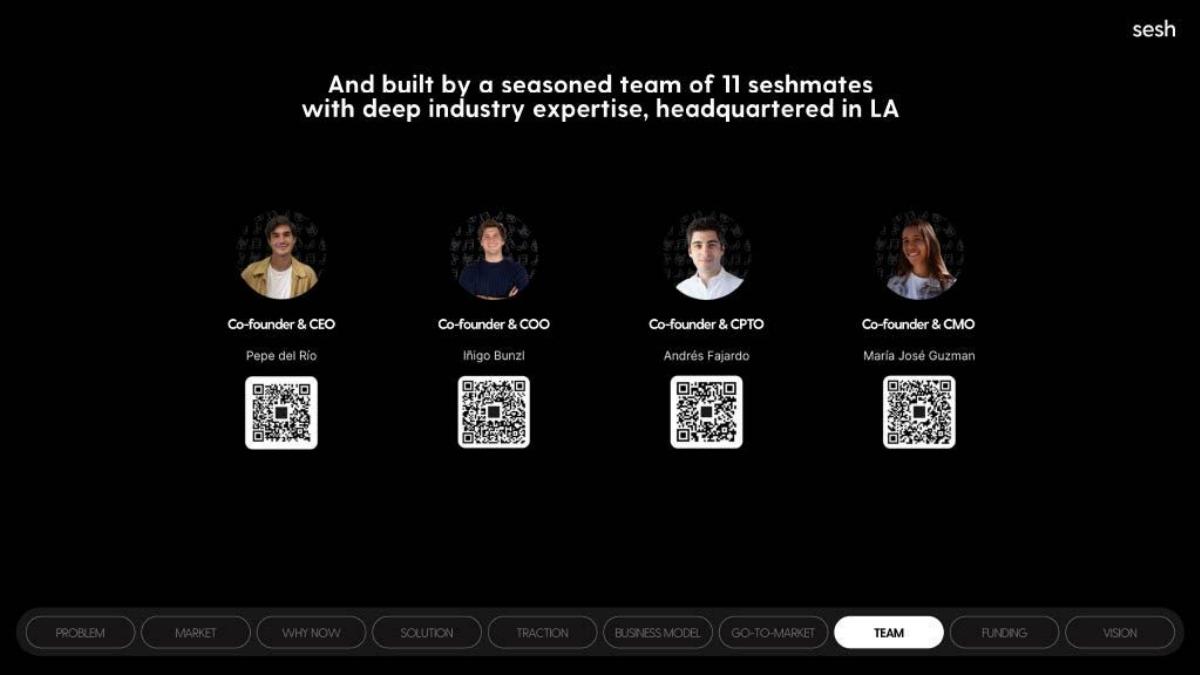
- The team consists of 11 members, led by four co-founders, and is headquartered in Los Angeles (Slide 12).
- Sesh explicitly benchmarks its potential against Weverse, the K-pop fan platform, to validate the profitability of fan-driven ecosystems (Slide 2).
- The deck omits specific current traction metrics, such as active users or current revenue, focusing instead on market potential and product vision.
The Vision: Powering the Next-Gen Fan Communities
Sesh entered the market in 2023 with a clear objective: to monetize the 'superfan.' As social media platforms become increasingly crowded and algorithmic, artists have struggled to maintain direct lines of communication and commerce with their most loyal supporters. Sesh’s 13-slide deck, which helped secure a $5M Seed round, positions the company as the infrastructure layer for these high-value relationships.
Slide 1: Title Slide
The deck opens with a minimalist black-and-white aesthetic. The logo 'sesh' is paired with the tagline: 'POWERING THE NEXT-GEN FAN COMMUNITIES.' It is a standard, clean entry point that establishes the brand identity without distraction.
Slide 2: The Market Opportunity
Slide 2 is the heavy hitter for market validation. It identifies a $34.5BN market size for music industry fan communities. The slide breaks down the ecosystem into three key stats: 15% of the population are superfans, there are 25M reported music artists, and 250K full-time music artists. Crucially, the slide uses Weverse (the K-pop platform) as a proof of concept, stating that Sesh intends to apply a similar model to the 'vastly larger Latin and U.S. markets.' This slide also teases expansion into Sports, Gaming, and Lifestyle.
Slide 3: The Problem/Solution Transition
Slide 3 serves as a simple transition, stating the core offering: 'ALL-IN-ONE ECOSYSTEM FOR OPTIMIZING AND MANAGING FAN COMMUNITIES.' A small 'HOW DOES IT WORK?' button suggests this is where the technical or functional deep dive begins.
Slide 4-6: Product and Features
Slide 6 (labeled as part of the 'Solution' section in the navigation bar) details 'Smart Campaigns.' It explains that artists can launch unlimited campaigns with custom claims and tracking. The slide showcases four specific capabilities: launching custom fan campaigns, sending personalized email communications, sending wallet alerts to mobile wallet cardholders, and hosting goal-driven in-app community sessions. The visual mockups show an artist profile (Anitta) with metrics like '3.5M Streams' and '50x Superfan Index,' illustrating how the platform visualizes fan data.
Slide 7-9: The Solution Continued
These slides continue the product walkthrough, though the specific text for slides 7, 8, and 9 in the provided sequence reinforces the 'all-in-one' nature of the platform. The focus remains on the CRM and AI insights that allow artists to understand their audience better than they could on generic social platforms.
Slide 10: Business Model
This is the most critical slide for investors. Sesh outlines a hybrid revenue model: B2B + B2C . The B2B component is a 'MONTHLY SAAS FEE PER COMMUNITY.' The B2C component is a '20% TAKE RATE ON EVERY DOLLAR SPENT BY FANS.' The slide concludes with a bold financial target: '$200M PER YEAR AT 10K COMMUNITIES.' This provides a clear path to scale and demonstrates how the company intends to capture a portion of the $34.5BN market mentioned earlier.
Slide 11: Go-To-Market
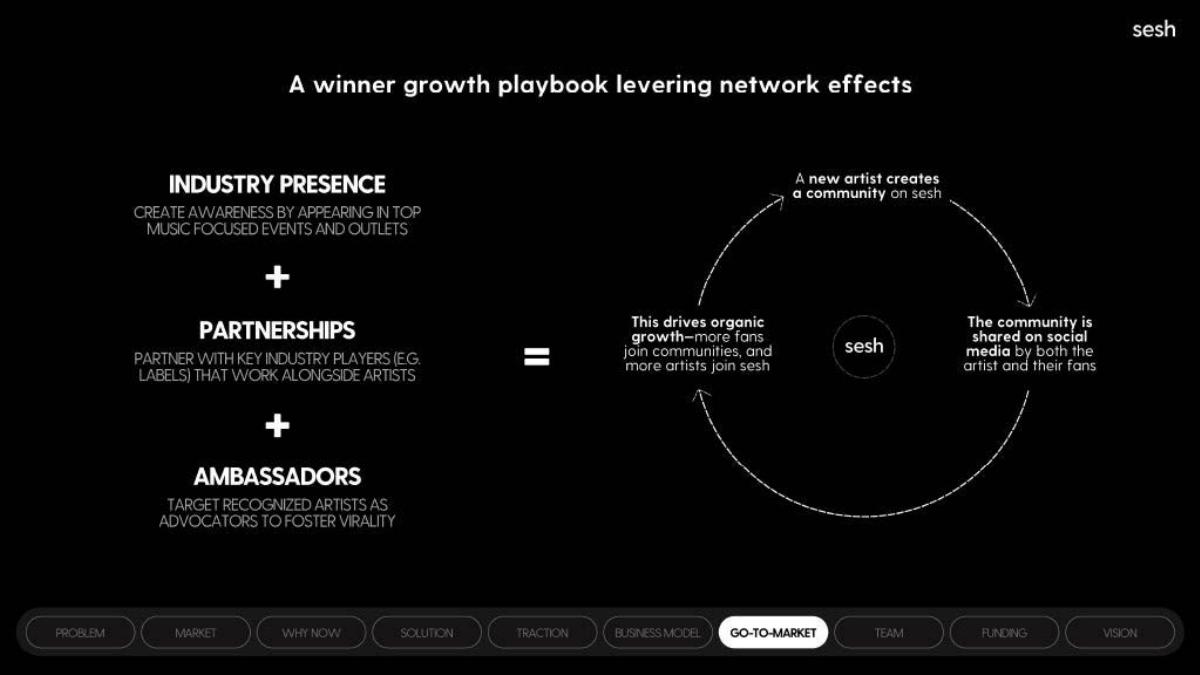
While the specific text for the Go-To-Market strategy is summarized in the navigation, the deck emphasizes the 'seasoned team' and 'deep industry expertise' as the primary drivers for artist acquisition. The strategy relies on the founders' existing networks within the LA and Latin music scenes.
Slide 12: The Team
Slide 12 introduces the four co-founders: Pepe del Rio (CEO), Iñigo Bunzl (COO), Andrés Fajardo (CPTO), and María José Guzman (CMO). The slide mentions a total team of 11 'seshmates' and notes they are headquartered in Los Angeles. Uniquely, each founder has a QR code under their headshot, presumably linking to their LinkedIn profiles or professional portfolios, a modern touch for a digital-first deck.
Slide 13: Closing
The deck ends with the phrase 'THE BEST KEPT SECRET FOR FAN COMMUNITIES' and a 'JOIN HERE' button. It maintains the minimalist aesthetic found at the start of the presentation.
What Works in the Sesh Deck
Clear Benchmarking: By citing Weverse on Slide 2, Sesh avoids the 'first-mover' risk. They aren't trying to prove that fan communities work; they are proving that a Western version of a successful Eastern model is a billion-dollar opportunity. This is a highly effective way to de-risk a Seed round for investors.
Monetization Clarity: Many consumer-facing apps struggle to explain how they will eventually make money. Sesh puts their 20% take rate front and center on Slide 10. This transparency regarding the 'Superfan' tax makes the path to $200M ARR easy to calculate and understand.
Visual Consistency: The deck uses a dark mode, high-contrast design that feels 'premium' and 'entertainment-focused.' The use of a navigation bar at the bottom of every slide (Problem, Market, Why Now, Solution, etc.) helps the viewer keep track of the narrative flow, which is especially useful in a 13-slide deck.
What is Missing from the Sesh Deck
Current Traction: The most notable omission is a dedicated traction slide. While the deck mentions 'proven and solid business model' on Slide 10, it does not list current revenue, the number of artists currently on the platform, or fan engagement rates. For a $5M Seed round, investors usually want to see some evidence of product-market fit beyond mockups.
Competitive Landscape: The deck mentions Weverse as a benchmark but does not address direct competitors in the U.S. and Latin markets, such as Patreon, Discord, or other artist-specific platforms like Fanfix. Explaining why Sesh is better than a Discord server or a Patreon page is a missed opportunity to define their 'moat.'
Unit Economics: While the 20% take rate is mentioned, the deck lacks detail on the cost of acquisition (CAC) for artists versus the lifetime value (LTV) of a community. Given the B2B2C nature of the business, understanding the cost to onboard a '10k community' artist would be vital for late-stage Seed investors.
What Founders Should Copy
The 'Superfan' Index Concept: On Slide 6, Sesh shows a 'Superfan Index' metric. Founders building in the creator economy should follow this lead by creating proprietary metrics that demonstrate value to their users (in this case, artists). It moves the conversation from 'we have fans' to 'we have data on who matters.'
The Hybrid Revenue Model: Combining SaaS (stability) with transaction fees (upside) is a classic 'best of both worlds' strategy. If your platform facilitates commerce, don't be afraid to pitch a take rate alongside a subscription fee.
QR Codes for Team Bios: The use of QR codes on Slide 12 is a clever way to keep the slide uncluttered while providing as much information as an investor could want. It shows a level of technical fluency and respect for the reader's time.
Final Thoughts
Sesh’s deck is a masterclass in 'Vision Pitching.' It identifies a massive, underserved market and provides a simple, scalable solution. While it lacks the granular data of a Series A deck, its focus on the 'Superfan' economy and the success of international parallels like Weverse makes for a compelling narrative. The $5M raised suggests that the team's 'deep industry expertise' and the clear $200M ARR roadmap were enough to overcome the lack of public-facing traction metrics in the presentation.
Frequently asked questions
- What is Sesh's primary value proposition for artists?
- Sesh provides an 'all-in-one ecosystem' that allows artists to own their audience data and engage fans directly. According to Slide 6, this includes launching unlimited custom campaigns, sending wallet alerts to cardholders, and hosting in-app community sessions, moving away from reliance on third-party social media algorithms.
- How does Sesh plan to make money?
- The company employs a two-pronged revenue strategy detailed on Slide 10. They charge artists a monthly SaaS fee per community (B2B) and take a 20% commission on every dollar spent by fans within the platform (B2C). They project this can reach $200M ARR at 10,000 communities.
- Which specific markets is Sesh targeting?
- While the music industry is the primary focus, Slide 2 highlights the Latin and U.S. markets as the immediate opportunities. The deck also notes future growth potential in other verticals such as Sports, Gaming, and Lifestyle.
- Who are the founders of Sesh?
- The leadership team featured on Slide 12 includes Pepe del Rio (CEO), Iñigo Bunzl (COO), Andrés Fajardo (CPTO), and María José Guzman (CMO). The slide notes a total team size of 11 'seshmates' based in Los Angeles.
- Does the deck show current user growth?
- No. The provided slides focus on the market opportunity, product features, and the business model. There are no charts showing historical growth, current monthly active users, or existing revenue figures, which is common in early-stage decks focusing on vision.