The SEOmoz (now Moz) 2011 pitch deck is a transparent look at a company scaling through the 'Inbound Marketing' explosion. At the time of this deck, the company was projecting $12.5 million in revenue for 2011, a significant jump from $5.7 million in 2010. The narrative centers on the 'unsustainable dichotomy' where organic search drives 90% of traffic but receives only 14% of the investment compared to paid search. By positioning themselves as the 'default productivity suite' for organic marketers, SEOmoz successfully argued for a $20M-$25M raise. The deck is notable for its extreme financia…
Key takeaways
- The company successfully pivoted from consulting to software, dropping consulting entirely in 2009 (Slide 8).
- SEOmoz achieved 83%+ margins and projected its first 8-figure revenue year ($12.5M) in 2011 (Slide 8).
- The 'Problem' is framed as a fragmented workflow where marketers must log into 10+ different tools to track KPIs (Slide 14).
- Organic marketing is presented as a massive, under-invested opportunity, driving 90% of traffic but receiving only ~$5B in investment vs $31B for paid (Slide 12).
- The deck includes a rare level of operational detail, citing $650K/month in staffing costs and $180K/month in crawling/hosting costs (Slide 17).
- The funding ask was specifically $20M-$25M, with a stated intent to use $6M-$7M for founder equity/liquidity (Slide 18).
- The product roadmap aimed to expand beyond SEO into local search, social media, and brand monitoring by 2012 (Slide 4).
The Narrative of the Pivot
The 2011 SEOmoz pitch deck is more than a fundraising tool; it is a historical document of the transition from the 'Wild West' of SEO to the structured era of Inbound Marketing. The deck, presented by Rand Fishkin in July 2011, captures a company at an inflection point. They had already proven the SaaS model, but they needed capital to transition from a niche SEO tool into a broad marketing platform.
Slides 1-3: The Vision and the Risks
Slide 1 sets a bold tone: 'How a tiny Mom + Son consultancy became the world leader in SEO Software.' It establishes the 'Seattle’s next $1 Billion company' goal immediately. This is a classic 'hometown hero' narrative designed to appeal to regional and national investors alike.
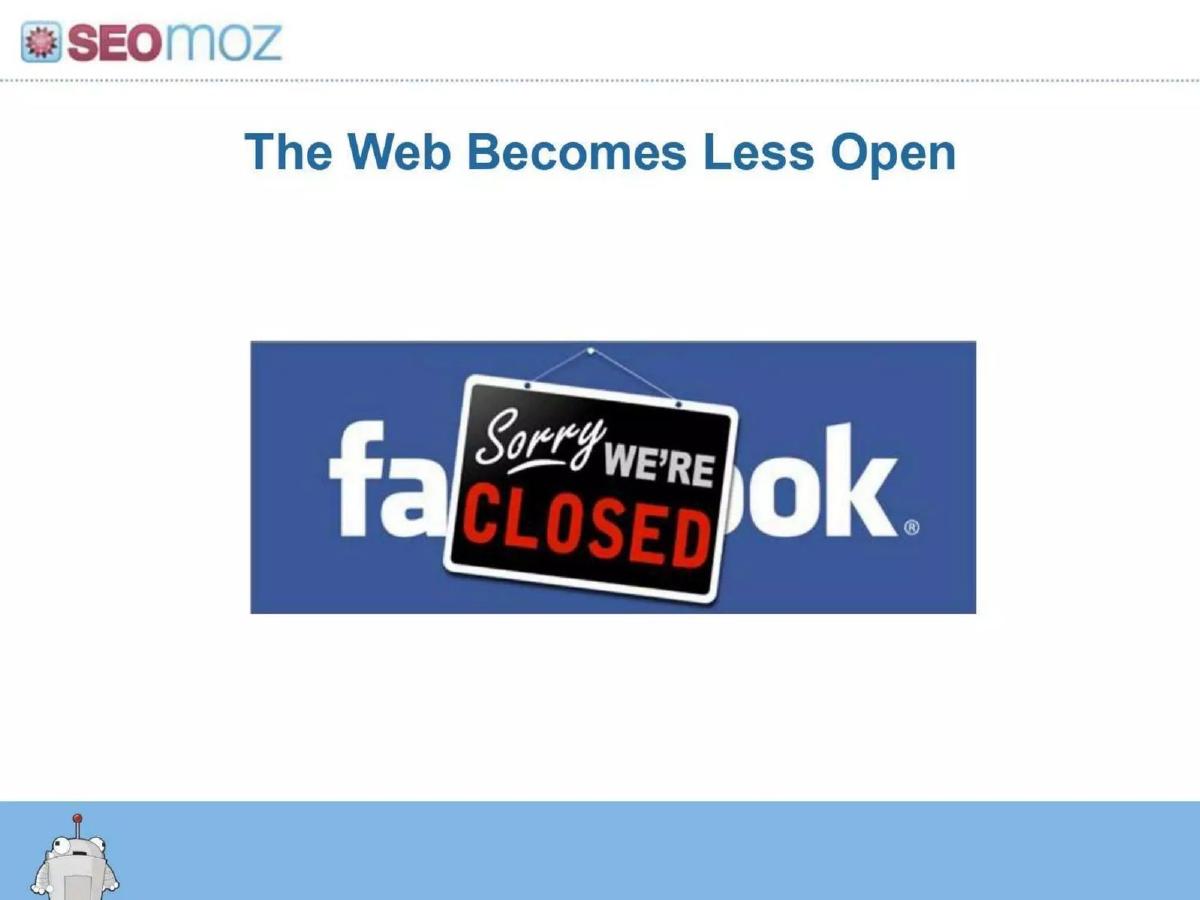
Slide 2 introduces a macroeconomic threat: 'The Web Becomes Less Open.' By showing a 'Closed' sign over the Facebook logo, SEOmoz hints at the rising 'walled gardens' of social media, which makes organic discovery more difficult and, therefore, makes SEOmoz’s analytics more valuable.
Slide 3 is a surprisingly candid 'Risk' slide. It features a photo of Anthony Weiner (a topical reference to reputation collapse in 2011) and admits that the company’s reputation is vulnerable to 'missteps in Culture, Data Quality or Reliability.' This level of transparency regarding brand risk is rare in Series B decks.
Slides 4-5: The Product Roadmap and Investment Areas
Slide 4 outlines the 'Expanded Product' strategy. In 2011, they were focused on Organic Search and Social Networks. By 2012, they planned to move into Local Search, Brand/Link Monitoring, and Social Content Sharing. The goal was to 'Become the Default Productivity + Research Suite for Organic Web Marketers,' explicitly using the icons of Microsoft Office to illustrate the 'suite' concept.
Slide 5 breaks down where the money will go. It categorizes investments into Sales/Marketing (Organic, Paid, Branding), Technology (Web Crawl, Social Graph), and Product (Low Price Model, Moz Alerts). Notably, they mention 'Classifying the Web' by 'Employing Human Raters,' showing that even in 2011, they understood that pure algorithms weren't enough for high-quality data.
Slides 7-8: The Financial Proof of Concept
Slide 7 is a transition slide that leads into the meat of the deck: the numbers. Slide 8 is arguably the most important slide in the deck. It shows a bar chart of Software Revenue vs. Consulting Revenue from 2007 to 2011. In 2007, the split was nearly even ($400k software vs $375k consulting). By 2011, consulting was $0, and software revenue was projected at $12,500,000. It also highlights an 83%+ margin, a key metric for any SaaS investor.
Slides 9-12: The Market Opportunity
Slide 9 defines 'Inbound Marketing' as the sum of all 'free' traffic sources, including SEO, Blogging, Social Media, and Podcasting. This was an attempt to own a category that HubSpot was also vying for at the time.
Slide 12 presents the 'Unsustainable Dichotomy.' A pie chart shows that Search and 'Other Referring Sites' drive the vast majority of traffic, yet the green box notes that Paid Search drives less than 10% of traffic but receives $31B+ in investment. SEOmoz positions itself as the tool to capture the value in the under-invested 90% of organic traffic.
Slides 14-15: The Problem and Target Market
Slide 14 visualizes 'The Web Marketer’s Weekly Analytics Challenge.' It lists 15+ different tools (Google Analytics, Facebook Insights, Yelp, etc.) that marketers have to log into. The value proposition is simple: 'Moz can (and should) put this all in one place.'
Slide 15 and Slide 16 define the target market. They use a 2x2 grid (Slide 16) to show they are targeting 'Moderate' to 'Expert' practitioners with a 'Heavy' to 'Exclusive' focus on organic practices. They claim to have captured ~5% of this market as paying customers, suggesting a massive 95% headroom for growth.
Slides 17-18: Unit Economics and The Ask
Slide 17 provides a 'Where are We Today?' snapshot. The metrics are impressive: a ~57% trial-to-paid conversion rate and ~1.25 million monthly visits. However, it also shows a ~25% churn rate in the first two months, which is a significant hurdle they needed to address with the new capital. They also disclose their burn/costs: $650K/month for staff and $180K/month for infrastructure.
Slide 18 is the 'The Ask.' They were seeking $20M-$25M. The most striking part of this slide is the 'Founder Equity' line of $6M-$7M. In 2011, discussing secondary liquidity so openly was unconventional. It showed a company that was mature enough to want to de-risk its founders while still having $13M-$19M of 'primary' capital to grow the business.
What Works in This Deck
The Pivot Narrative: The transition from consulting to 83% margin software is clearly documented and proves the team can execute a difficult business model shift. · Extreme Transparency: By sharing exact staffing costs, server costs, and even churn rates, SEOmoz builds immediate trust with sophisticated investors. · Category Ownership: They don't just call themselves an SEO tool; they use the deck to define 'Inbound Marketing' and position themselves as its essential suite. · The 'Dichotomy' Argument: Comparing the $31B spent on paid traffic (10% of clicks) to the $5B spent on organic (90% of clicks) is a compelling 'gap in the market' story.
What Is Missing
Team Slide: In this 18-slide selection, there is no slide detailing the experience of the executive team or the engineering talent required to 'crawl the web.' · Competitive Landscape: While they list tools marketers use, they don't provide a direct comparison against other emerging SEO platforms like Raven Tools or Conductor. · Churn Analysis: While they admit to a 25% churn in the first two months, they don't explain why it happens or how the new capital will fix it.
What a Founder Should Copy
The 'Productivity Suite' Comparison: If you are building a platform of multiple tools, use the Microsoft Office analogy. It's a mental shortcut investors understand instantly. · The Revenue Mix Chart: If you are pivoting from services to product, Slide 8 is the gold standard for how to show that transition. · The 'Problem' as a Workflow: Slide 14 shows the problem isn't just 'lack of data,' but 'too many tabs.' Solving for 'marketer fatigue' is a relatable pain point. · Honesty About Secondary: If you are raising a Series B or C and want liquidity, being upfront about it on the 'Ask' slide (as seen on Slide 18) prevents it from becoming a 'gotcha' during due diligence.
Frequently asked questions
- How did SEOmoz justify their market expansion beyond SEO?
- They used a 'Productivity Suite' argument. Slide 4 shows a roadmap moving from organic search in 2011 to local search, social content sharing, and brand monitoring in 2012. They compared their future state to a Microsoft Office-style suite for marketers, aiming to be the one-stop shop for all 'free' traffic sources.
- What were the key financial metrics shared in this deck?
- The deck is incredibly detailed. Slide 17 lists a ~57% free trial conversion rate, a ~25% churn rate in the first two months, and ~82% gross margins. They also disclosed an estimated net profit of ~$1 million for 2011 and monthly staffing costs of $650,000.
- How did the founders handle the topic of secondary liquidity?
- Unlike most modern decks that hide secondary sales in the fine print, SEOmoz put it directly on the 'The Ask' slide. Slide 18 explicitly states that of the $20M-$25M being raised, $6M-$7M was earmarked for 'Founder Equity,' with the remaining $13M-$19M going onto the balance sheet.
- What was the core 'Why Now' argument for the 2011 raise?
- The 'Why Now' was the 'unsustainable dichotomy' of web traffic. Slide 12 highlights that while paid search wins $31B in investment, it only drives 10% of traffic. SEOmoz argued that as the web becomes 'less open' (Slide 2), the need for sophisticated tools to capture the 90% of organic traffic would skyrocket.
- What is missing from this 18-slide selection?
- The most glaring omission in this set is a dedicated 'Team' slide. While Rand Fishkin is mentioned on the cover and the board slide, the broader leadership and engineering talent are not showcased. There is also no detailed 'Competitor' matrix, though Slide 14 lists tools marketers currently use.