Sensi.AI’s 10-slide deck is a masterclass in momentum-driven fundraising. By leading with a 3.9x YoY growth metric on slide 2, the company immediately establishes itself as a high-velocity winner in the healthcare sector. The deck focuses on the 'Agentic Care Engine,' a vertical AI solution that monitors over 100 types of actionable insights—ranging from cognitive decline to fall risks—via audio sensors. With a reported $45M Series C raise in 2024, the deck successfully argues that Sensi.AI is the operating system for the $165B aging-in-place market. While it lacks a traditional team slide or…
Key takeaways
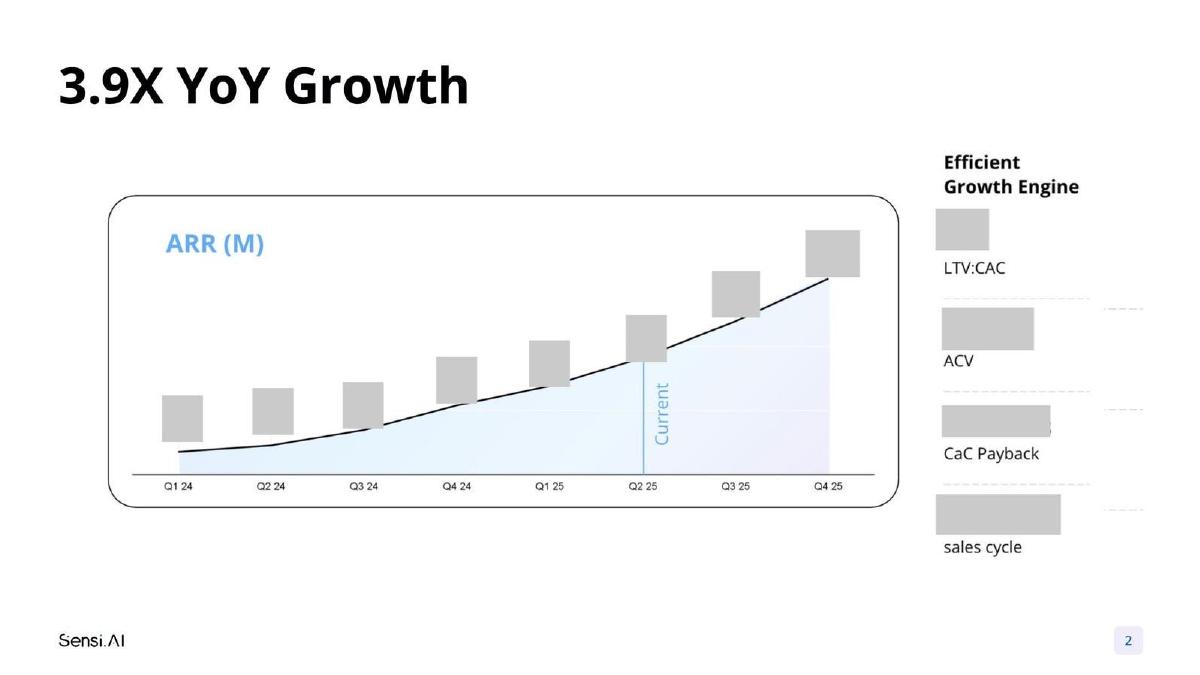
- The company leads with a massive 3.9x YoY growth headline to establish immediate credibility (Slide 2).
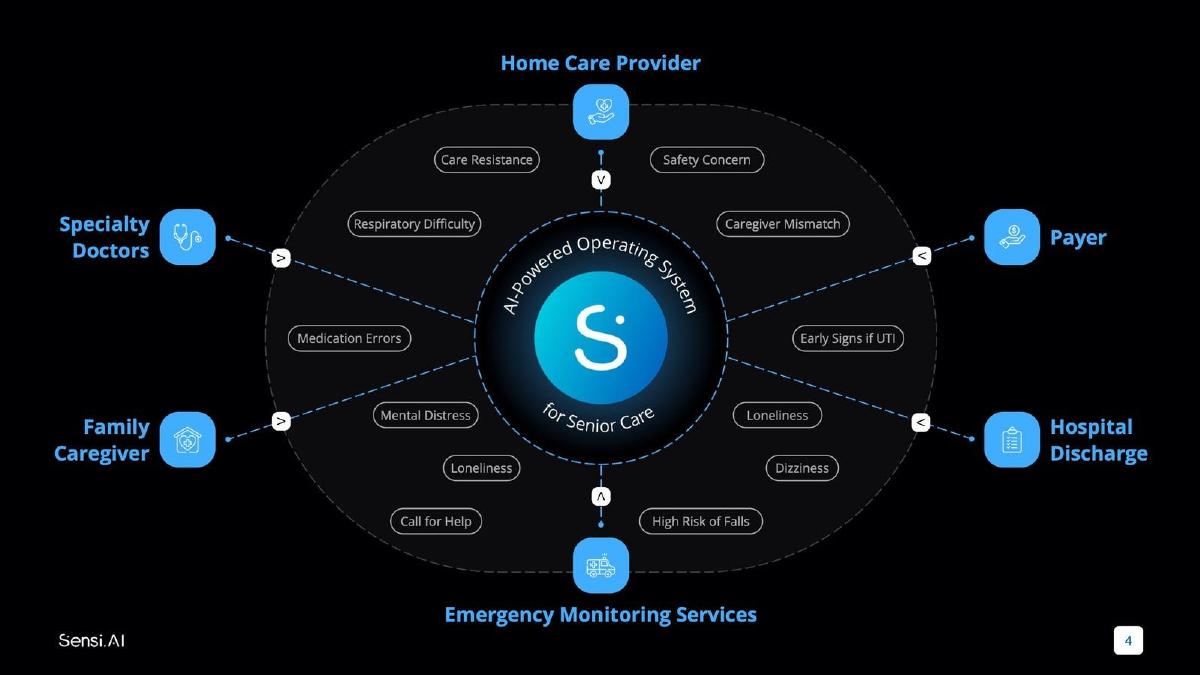
- Sensi.AI positions itself as an 'AI-Powered Operating System' connecting six major healthcare stakeholders, including payers and doctors (Slide 4).
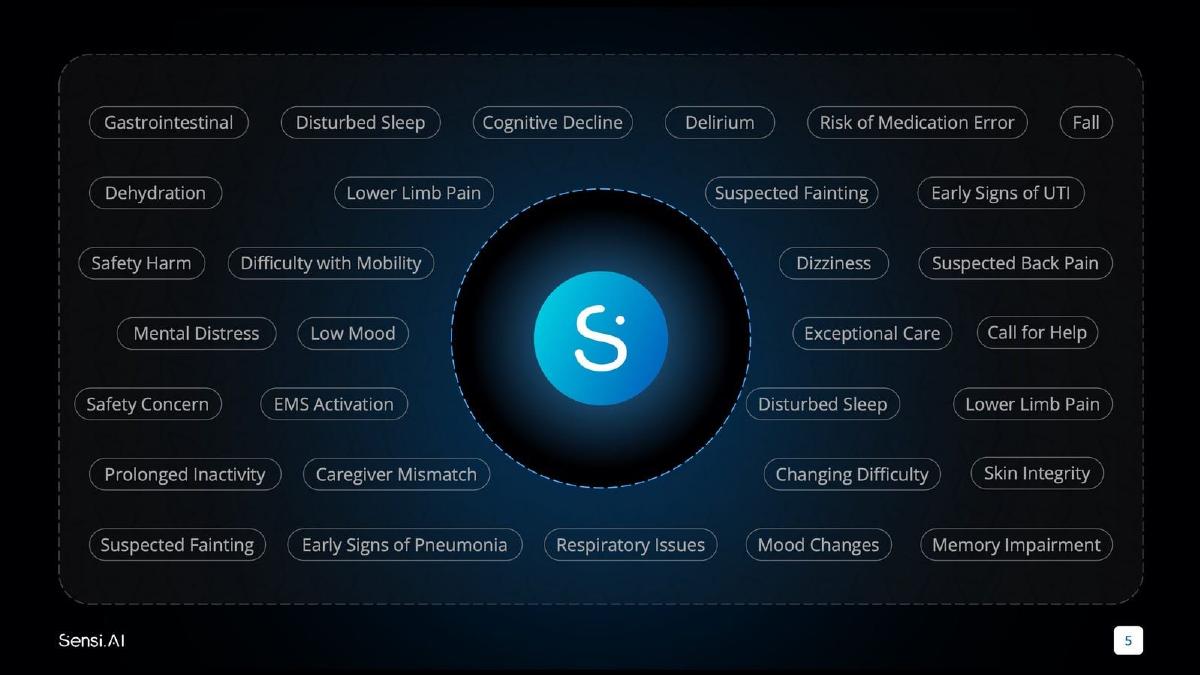
- The platform monitors for highly specific clinical and safety events, such as UTIs, pneumonia, and caregiver mismatch (Slide 5).
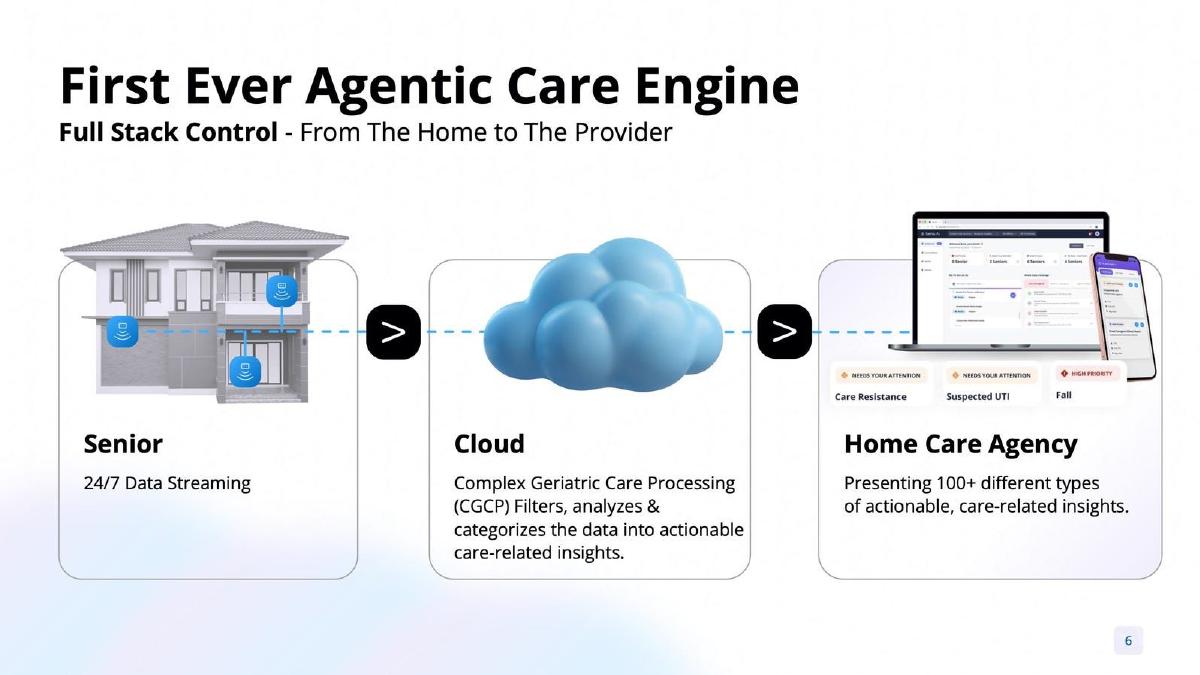
- The 'Agentic Care Engine' provides full-stack control from 24/7 home data streaming to actionable agency insights (Slide 6).
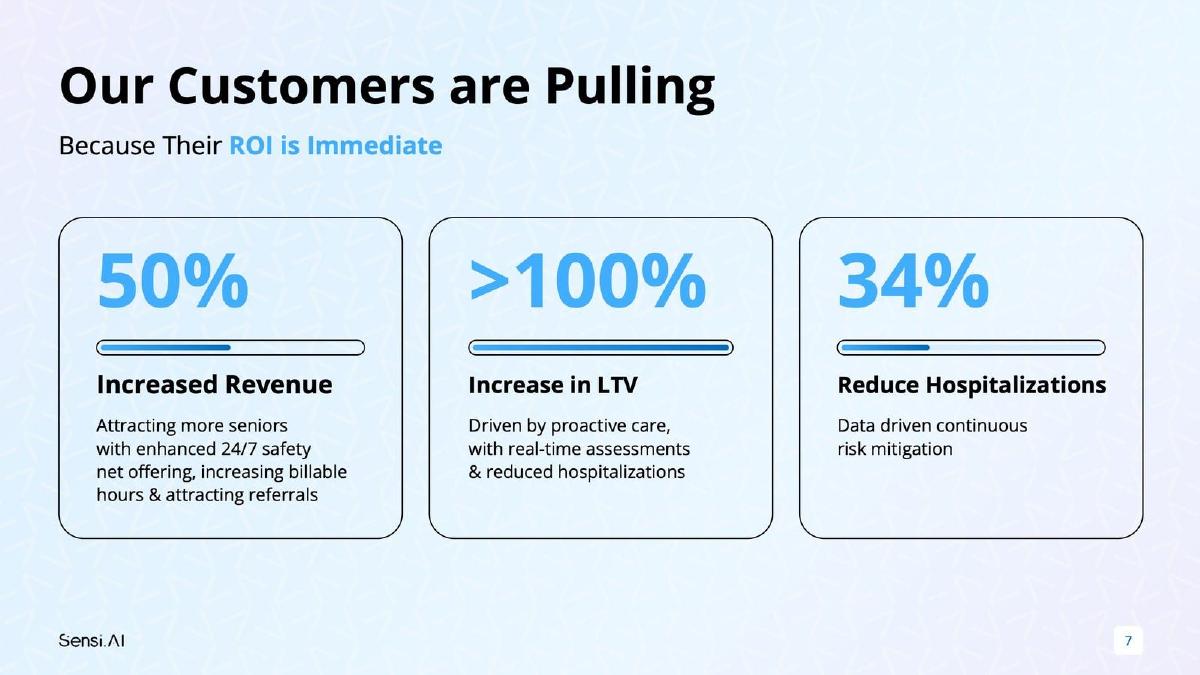
- Customer ROI is quantified through a 50% increase in revenue and a 34% reduction in hospitalizations (Slide 7).
- The product roadmap expands into 'Growth,' 'Operations,' and 'Care' agents to automate agency workflows (Slide 8).
- Market size is defined as a $165B TAM with a $5B Serviceable Obtainable Market in non-medical home care (Slide 9).
- The deck omits a team slide, detailed competition analysis, and a specific use-of-funds breakdown.
Executive Summary: The Momentum Play
Sensi.AI’s pitch deck is a concise, 10-slide presentation that focuses heavily on market timing and business traction. According to publisher reports from Business Insider, this deck supported a $45M Series C round in 2024. The healthcare technology sector, particularly 'AgeTech,' is currently benefiting from a massive demographic shift, and Sensi.AI positions itself at the center of this transition. The deck avoids technical jargon in favor of clear ROI metrics and a 'platform' narrative that suggests the company is more than just a sensor provider—it is an operating system for the entire senior care ecosystem.
Slide 1: Title Slide
The deck opens with the tagline "Navigating Aging with Grace." It is a minimalist start that focuses on the emotional and human aspect of the business. The Sensi.AI logo is prominent, but the slide provides no immediate indication of the 'how'—only the 'why.'
Slide 2: The Hook – 3.9x YoY Growth
Sensi.AI makes a bold move by placing its traction slide second. The headline "3.9X YoY Growth" is the primary takeaway. Below the headline is a bar chart showing ARR (Annual Recurring Revenue) growth from Q1 2024 through a projected Q4 2025. While the specific dollar amounts on the Y-axis are blurred or omitted, the upward trajectory is steep. To the right, the slide lists components of their "Efficient Growth Engine," including LTV:CAC, ACV, CaC Payback, and sales cycle. However, the actual values for these metrics are obscured by gray boxes, suggesting this version of the deck was intended for public release or that these figures were discussed verbally during the pitch.
Slide 3: The Inflection Point
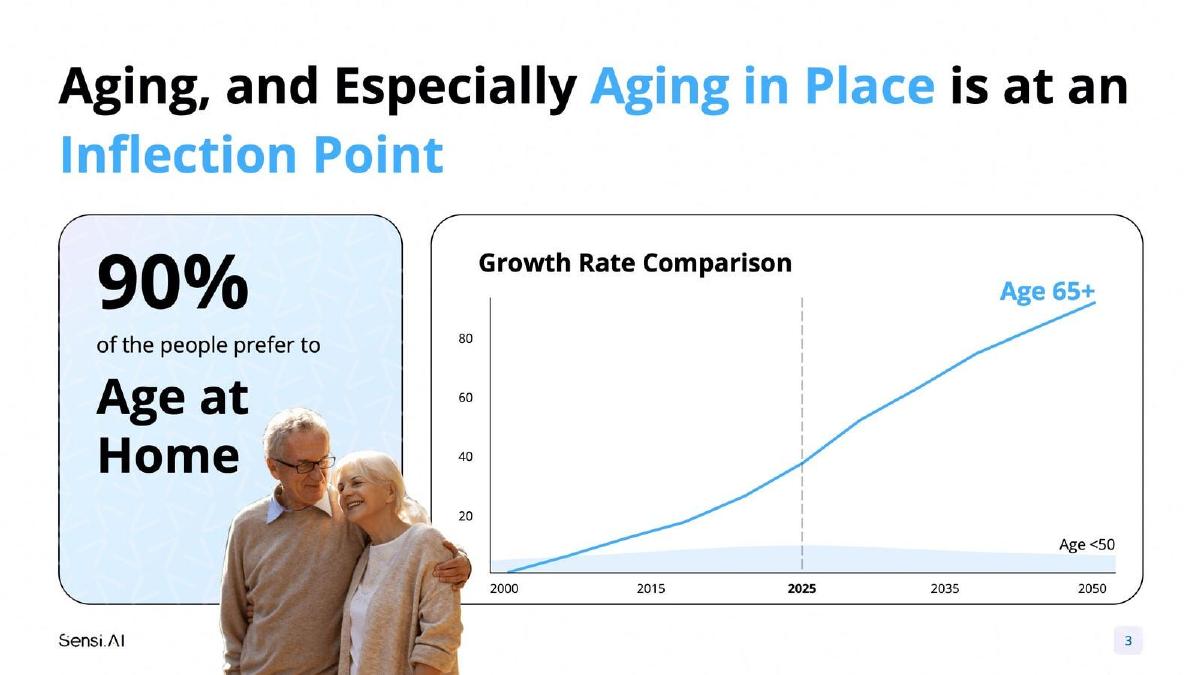
This slide establishes the 'Why Now.' It notes that "90% of the people prefer to Age at Home." A growth rate comparison chart shows the population of those aged 65+ skyrocketing toward 2050, while the population under 50 remains relatively flat. By labeling 2025 as the "Inflection Point," Sensi.AI creates a sense of urgency for investors to enter the market now.
Slide 4: The Ecosystem Play
Slide 4 transitions Sensi.AI from a product to a platform. It depicts an "AI-Powered Operating System for Senior Care" at the center of a hub-and-spoke model. The system connects six key stakeholders: Home Care Providers, Payers, Hospital Discharge, Emergency Monitoring Services, Family Caregivers, and Specialty Doctors. The slide lists specific data points shared between these groups, such as "Medication Errors," "Early Signs of UTI," and "Caregiver Mismatch." This slide is crucial for justifying a Series C valuation, as it shows the company's potential to capture value across the entire healthcare value chain.
Slide 5: Monitoring Capabilities
This slide is a 'feature cloud' that details exactly what the AI detects. It is a comprehensive list including clinical issues (Gastrointestinal, Pneumonia, Dehydration), safety risks (Falls, Safety Harm, EMS Activation), and mental health indicators (Loneliness, Low Mood, Cognitive Decline). By listing "Exceptional Care" alongside these risks, the company suggests the AI also identifies positive caregiver performance, not just emergencies.
Slide 6: The Agentic Care Engine
Here, the deck explains the technical workflow. It describes a "Full Stack Control" model: 24/7 data streaming from the senior's home goes to the "Cloud," where "Complex Geriatric Care Processing (CGCP)" filters and analyzes the data. This results in "100+ different types of actionable, care-related insights" delivered to the Home Care Agency via a dashboard. The visual shows a laptop and smartphone interface, emphasizing the accessibility of the data.
Slide 7: The Economic Value Proposition
Slide 7 is perhaps the most important for a Series C investor. It quantifies the ROI for the customers (Home Care Agencies):
50% Increased Revenue: Attracting more seniors and increasing billable hours. · >100% Increase in LTV: Driven by proactive care and reduced hospitalizations. · 34% Reduce Hospitalizations: Through data-driven risk mitigation.
These figures provide a clear 'reason to buy' for the agencies, which in turn fuels Sensi.AI's B2B2C growth model.
Slide 8: Vertical AI Roadmap
This slide looks toward the future, describing "Vertical AI in Home Care." It introduces three 'Agents' that the Agentic Care Engine powers:
Growth Agent: Handles Sales & Marketing (Demand Gen, CRM). · Operations Agent: Manages Scheduling, Payroll, and Hiring. · Care Agent: Manages Care Plans and Reassessments.
This indicates that Sensi.AI intends to move deeper into the back-office operations of care agencies, increasing their 'stickiness' and potential ACV (Annual Customer Value).
Slide 9: Market Size (TAM/SOM)
The market slide is straightforward. It claims a "$165B TAM" encompassing Home Health Care, Independent Living Facilities (ILFs), and Payers. The "SOM" (Serviceable Obtainable Market) is narrowed down to "$5B" for "Non Medical Home Care" in North America. This shows a realistic path to near-term revenue while maintaining a massive long-term ceiling.
Slide 10: Closing
The deck ends as it began, with the phrase "Navigating Aging with Grace" and a call to action: "Let's Go!"
What Sensi.AI Does Well
The deck is exceptionally strong at communicating momentum and ROI . By leading with growth and following up with specific percentage improvements for their customers (50% revenue increase), they make the business case feel like a mathematical certainty rather than a speculative bet. The use of the term "Agentic Care Engine" is also a clever piece of positioning, aligning the company with the current 'AI Agent' trend in Silicon Valley, which likely helped secure the $45M round in a competitive AI investment landscape.
What is Missing from the Deck
Team Slide: There is no mention of the founders or the leadership team. In a Series C, investors usually want to see the bench strength of the executive team. · Competition: The deck does not address other players in the remote patient monitoring (RPM) or ambient sensing space. · Unit Economics: While growth is mentioned, there is no data on gross margins or the cost of the hardware/sensors. · The Ask: The deck does not explicitly state how much they are raising or how the funds will be used, though publisher reports confirm the $45M outcome.
Founder Takeaways
Founders should study how Sensi.AI quantifies the 'Soft' benefits of their technology. 'Peace of mind' for seniors is hard to sell to a VC, but '34% reduction in hospitalizations' is a clinical metric that translates directly to saved costs for payers and agencies. Additionally, the transition from a 'monitoring tool' (Slide 6) to an 'operational suite' (Slide 8) is a textbook example of how to expand a company's narrative to support a larger valuation. If you are building a hardware-enabled service, focus your deck on the data insights and the ecosystem rather than the specs of the device itself.
Frequently asked questions
- What is the core technology behind Sensi.AI?
- Based on the publisher summary and slide 6, Sensi.AI uses discreet audio-based sensors for 24/7 data streaming. This data is processed by their 'Complex Geriatric Care Processing' (CGCP) in the cloud to identify over 100 types of actionable insights, which are then delivered to home care agencies via a digital dashboard.
- How does Sensi.AI help home care agencies make more money?
- Slide 7 explicitly states that customers see a 50% increase in revenue. This is achieved by attracting more seniors with a 24/7 safety offering, increasing billable hours, and generating more referrals. Additionally, they claim to increase Lifetime Value (LTV) by over 100% through proactive care.
- What clinical conditions can the AI detect?
- Slide 5 lists a wide array of conditions the AI monitors for, including early signs of UTI, pneumonia, cognitive decline, delirium, and respiratory issues. It also tracks physical safety risks like falls, suspected fainting, and 'prolonged inactivity.'
- What is the 'Agentic Care Engine' mentioned in the deck?
- As shown on slide 8, the Agentic Care Engine is a vertical AI framework that goes beyond monitoring. it includes a 'Growth Agent' for sales and marketing, an 'Operations Agent' for scheduling and payroll, and a 'Care Agent' for care plans and reassessments, effectively acting as an end-to-end business suite for care providers.
- What is the target market size for Sensi.AI?
- Slide 9 identifies a Total Addressable Market (TAM) of $165B, which includes home health care, independent living facilities (ILFs), and payers. Their immediate Serviceable Obtainable Market (SOM) is valued at $5B, specifically targeting non-medical home care in North America.