Media Competition Slides: 9 Real Pitch Deck Examples
How media, creator and content startups show competition in a pitch deck: a feature grid with your own column, recorded head-to-head tests.
Media Competition Slide: Show the Platforms Creators and Audiences Already Use
Media startups compete with free, familiar platforms: Medium, WordPress, YouTube, Yelp, TV networks. A good competition slide names the platforms creators or audiences already use and shows, in a way a reader can check, what the startup does that they do not. This guide compares nine real media competition slides, including three from music startups,, from a feature grid to a slide that answers competition with a joke photo.
TL;DR
Name the platforms your users already use and give yourself a column. beehiiv compares itself with Medium, WordPress, Mailchimp, Substack and Revue on seven features, two of which only beehiiv ticks. NeoSound links to recorded side-by-side tests against three named music apps. cheesefree groups rivals into four categories with logos, then lists its own advantages. Miso Media gives each of six named sheet-music rivals its strengths and gaps in its own words. Rattle Radio puts itself in a tick grid with SiriusXM, iHeart and Apple/Beats 1 for one audience. Music Coco names three acquired rivals and a local one but does not compare itself. Bothsider names three rivals and eleven more without comparing them. FameBit sets YouTube against six TV networks with no numbers, and Smell shows a falling horse next to Yik Yak.
Media competition slides from real pitch decks
Each example shows the exact stored slide above its analysis and links to the full teardown. The most complete comparisons come first; weaker ones follow for contrast. Claims are as shown on the slides; comments are ours.
beehiiv competition slide — slide 6
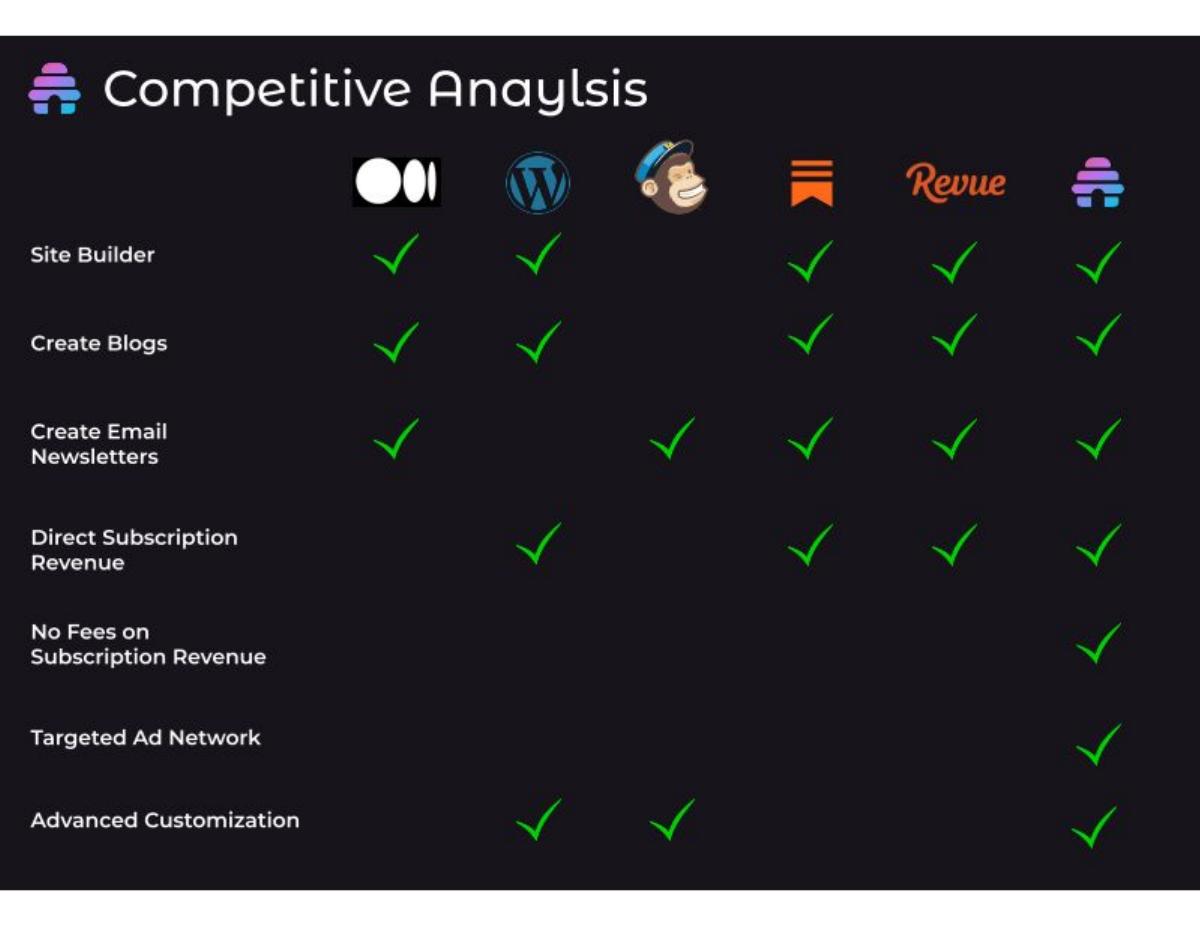
Newsletter platform for creators. Slide titled "Competitive Anaylsis" (sic), shown as a grid of logos and ticks.
beehiiv deck, slide 6. Exact stored slide matched to this analysis.
Our analysis: It names every platform a writer would consider and makes two clear, money-related differences.
Evidence and limitation: The ticks are the company's own reading of each rival; no date or source. At the time, Substack took a share of paid subscriptions, which is what the fee row targets.
What a founder can adapt: List the platforms your users would otherwise pick, keep your own column, and make the rows that only you tick the ones customers pay for.
Supporting analysis
What the deck claims: Columns (logos): Medium, WordPress, Mailchimp, Substack, Revue, beehiiv. Rows: Site Builder, Create Blogs, Create Email Newsletters, Direct Subscription Revenue, No Fees on Subscription Revenue, Targeted Ad Network, Advanced Customization. beehiiv ticks all seven. Substack and Revue tick the first four. Only beehiiv ticks "No Fees on Subscription Revenue" and "Targeted Ad Network".
Presentation choice: A creator chooses a platform by what it costs and how it pays; "no fees" and "ad network" speak to both. Substack and Revue matching on four rows makes the grid more believable.
When it does not fit: Ticks alone. Add the fee each rival takes (a percentage is easy to check), and date the comparison, since platforms change features.
App that turns hummed or sung melodies into sheet music. Slide titled "Competitors".
NeoSound deck, slide 5. Exact stored slide matched to this analysis.
Our analysis: Instead of claiming to be better, it shows three recorded side-by-side tests against named apps.
Evidence and limitation: The tests are recorded and linked, so a reader can watch them; we have not. The earlier slide in the deck says its algorithm "recognizes better than competitors".
What a founder can adapt: Record the same input through your product and two rivals, publish it, and put one result on the slide (for example, notes recognised out of 100).
Supporting analysis
What the deck claims: Three video thumbnails: "NeoSound vs Hummark" (1:16), "NeoSound vs HumOn" (0:52), "NeoSound prototype vs Casio Chordana Composer" (1:16). Link: https://www.youtube.com/c/NeosoundBiz. "...and they do not provide Cloud subscription."
Presentation choice: For a product whose value is accuracy, a head-to-head demo is the most convincing evidence a small team can produce.
When it does not fit: Relying on the viewer to follow a link during a pitch. Put the outcome of each test on the slide itself.
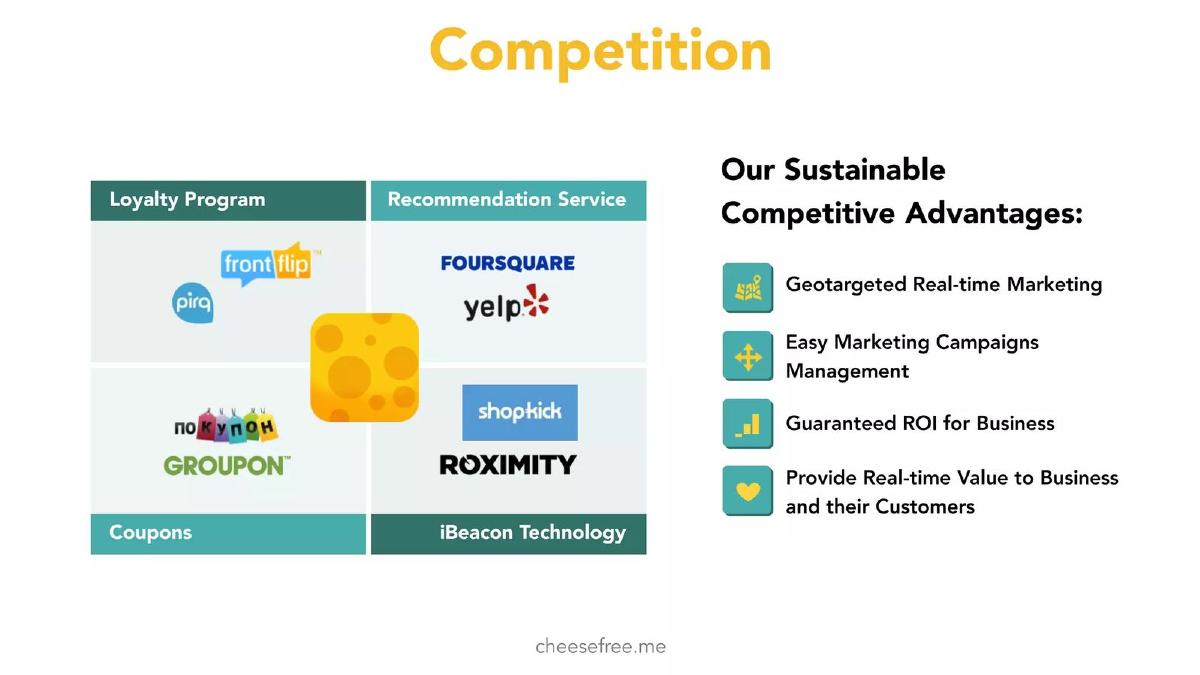
Local deals and marketing app for small businesses, tagged as media in our library. Slide titled "Competition".
cheesefree deck, slide 6. Exact stored slide matched to this analysis.
Our analysis: Grouping rivals by what they do shows cheesefree understands four categories and sits across them.
Evidence and limitation: No figures; "Guaranteed ROI" is not explained.
What a founder can adapt: Keep the categories, then say for each which customer need it misses and how you meet it.
Supporting analysis
What the deck claims: Four boxes around the cheesefree logo: Loyalty Program (frontflip, pirq), Recommendation Service (Foursquare, Yelp), Coupons (Pokupon, Groupon), iBeacon Technology (shopkick, Roximity). "Our Sustainable Competitive Advantages: Geotargeted Real-time Marketing; Easy Marketing Campaigns Management; Guaranteed ROI for Business; Provide Real-time Value to Business and their Customers."
Presentation choice: Shown as a middle example: the grouping is useful, but the advantages are not tied to any rival, so a reader cannot tell which box it beats and how.
When it does not fit: "Sustainable" advantages that any rival could claim, and guarantees without terms.
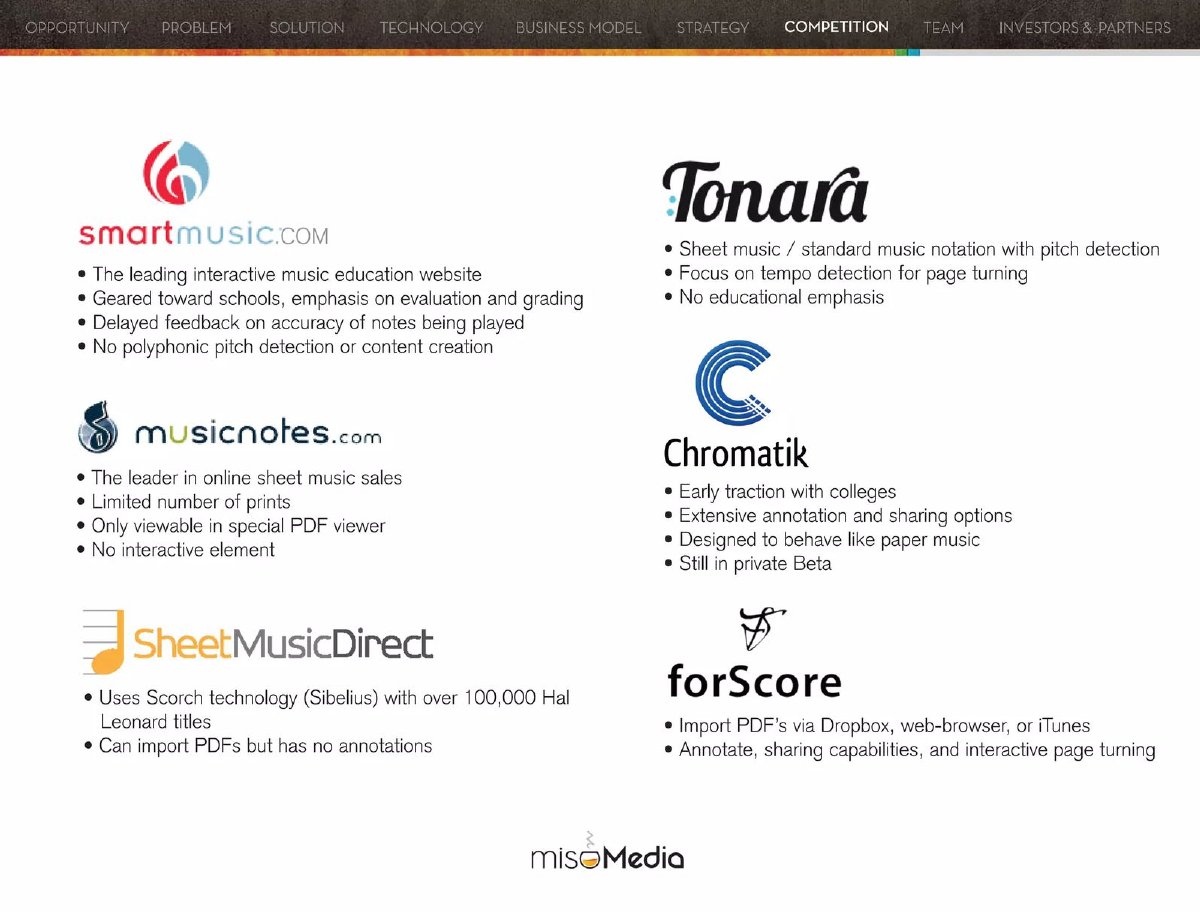
Music learning app with interactive sheet music. Untitled slide in the deck's "Competition" section.
Miso Media deck, slide 12. Exact stored slide matched to this analysis.
Our analysis: Each rival gets its strengths before its gaps, and the gaps point at what Miso Media builds: real-time feedback, pitch detection and interactivity.
Evidence and limitation: Claimed; rivals' features are as described by Miso Media, undated. No Miso Media column.
What a founder can adapt: Add a final box for Miso Media with the same kinds of bullets, and date the comparison, since apps add features quickly.
Supporting analysis
What the deck claims: Six rivals, each with bullets. SmartMusic: "The leading interactive music education website", "Geared toward schools", "Delayed feedback on accuracy of notes being played", "No polyphonic pitch detection or content creation". Musicnotes: "The leader in online sheet music sales", "Limited number of prints", "No interactive element". Sheet Music Direct: "over 100,000 Hal Leonard titles", "Can import PDFs but has no annotations". Tonara: pitch detection for page turning, "No educational emphasis". Chromatik: "Early traction with colleges", "Still in private Beta". forScore: PDF import, annotation and page turning.
Presentation choice: Calling SmartMusic and Musicnotes "the leader" in their areas shows the founders are not hiding the strongest rivals, which makes the listed gaps more believable.
When it does not fit: Leaving readers to work out your own position from rivals' gaps; say it directly.
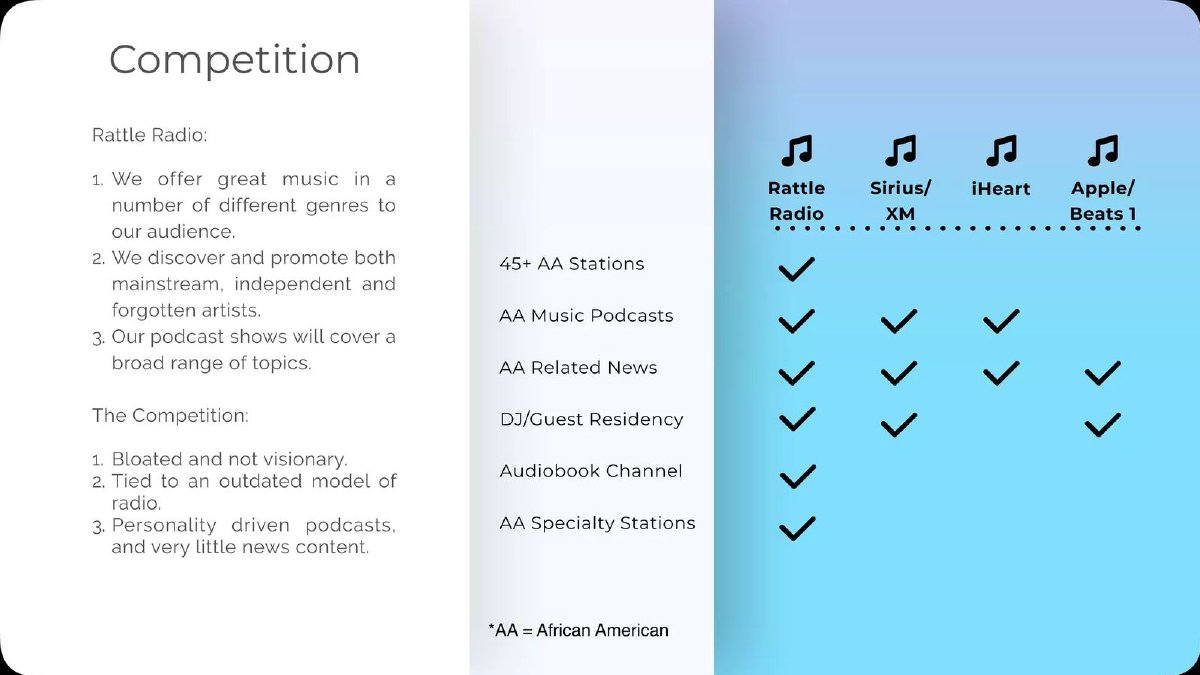
Online radio and podcast network for African American listeners. Slide titled "Competition".
Rattle Radio deck, slide 18. Exact stored slide matched to this analysis.
Our analysis: It narrows a crowded market to one audience and shows where large services have little for it.
Evidence and limitation: Claimed; rivals' offerings are as described by Rattle Radio, undated. Rivals' audience size is not shown.
What a founder can adapt: Add the audience size for the segment and a row where the big services win, such as music catalogue or listeners, then explain why listeners will still switch.
Supporting analysis
What the deck claims: Grid with Rattle Radio, Sirius/XM, iHeart and Apple/Beats 1 on six rows ("*AA = African American"): 45+ AA Stations, AA Music Podcasts, AA Related News, DJ/Guest Residency, Audiobook Channel, AA Specialty Stations. Rattle Radio ticks all six; Sirius/XM ticks three, iHeart two, Apple/Beats 1 two. Text on the competition: "Bloated and not visionary", "Tied to an outdated model of radio", "Personality driven podcasts, and very little news content."
Presentation choice: Naming the big services listeners already use is honest; ticking every row for itself and calling rivals "bloated" is what weakens it.
When it does not fit: Describing rivals as "bloated and not visionary"; it is opinion, and investors may know those companies well.
Music data company focused on African markets. Slides titled "Competition" and "Local Competition".
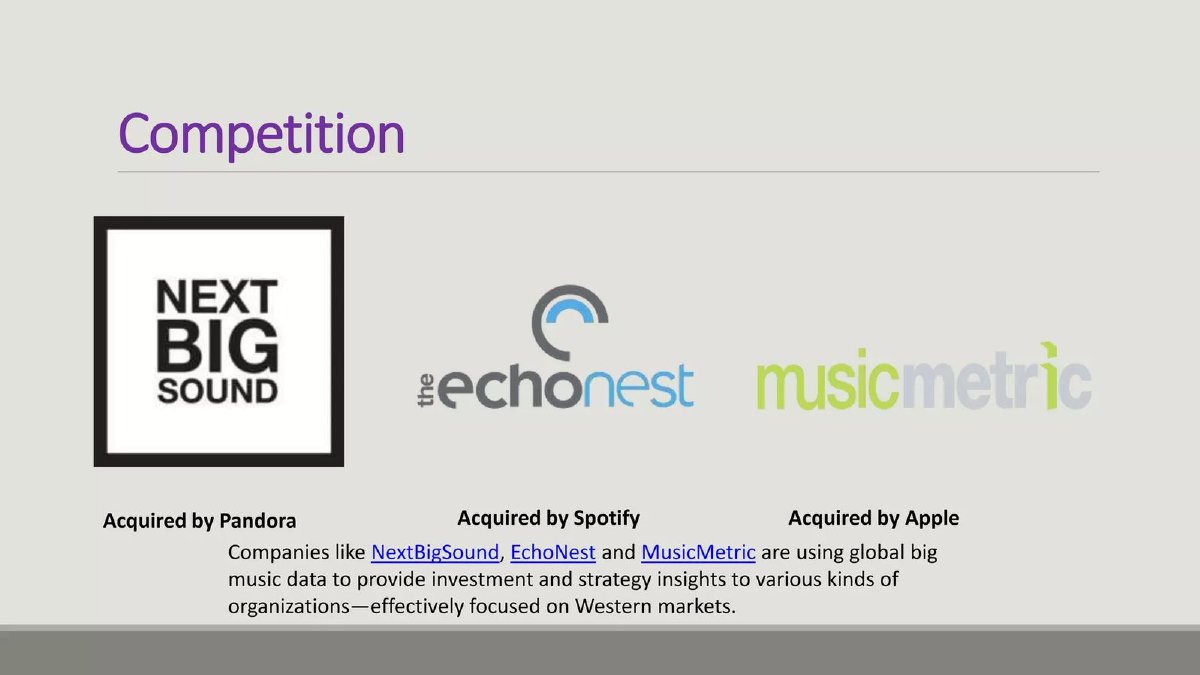
Music Coco deck, slide 14. Exact stored slide matched to this analysis.Music Coco deck, slide 16. Exact stored slide matched to this analysis.
Our analysis: It names global rivals and their buyers, then a local one, and implies its gap is African markets.
Evidence and limitation: Claimed; acquisitions are stated on the slide without dates or sources. No comparison of features, prices or coverage.
What a founder can adapt: Put both groups on one slide with a line for each on market coverage and data sources, and add Music Coco's own line.
Supporting analysis
What the deck claims: Slide 14: Next Big Sound "Acquired by Pandora", The Echo Nest "Acquired by Spotify", Musicmetric "Acquired by Apple". "Companies like NextBigSound, EchoNest and MusicMetric are using global big music data to provide investment and strategy insights to various kinds of organizations—effectively focused on Western markets." Slide 16: PlayData, "Owned by musician-entrepreneur, Eldee. They provide airplay data (Radio and TV) for musicians and advertisers."
Presentation choice: Shown for contrast. The acquisitions hint at possible buyers, but the slide never says what Music Coco does that these companies or their new owners do not.
When it does not fit: Splitting global and local rivals across slides with no comparison; the reader cannot see your position.
Debate and opinion platform. Slide titled "Competitors:".
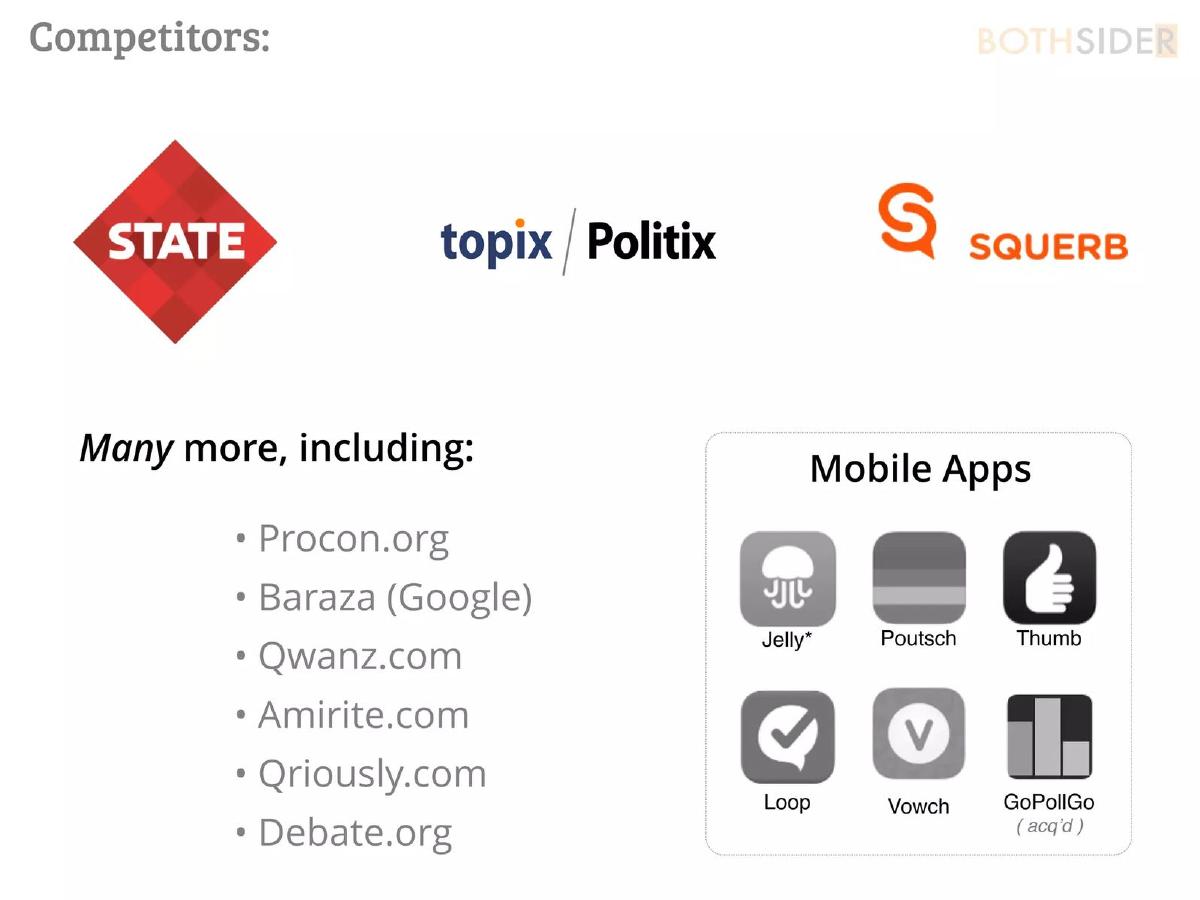
Bothsider deck, slide 5. Exact stored slide matched to this analysis.
Our analysis: Thorough on names, including an acquisition, which shows the founders researched the field.
Evidence and limitation: Names only; no comparison, users or funding for any rival.
What a founder can adapt: Pick the three closest rivals, compare on two things users care about, and note what happened to the ones that closed or sold.
Supporting analysis
What the deck claims: Three large logos: STATE, topix / Politix, Squerb. "Many more, including: Procon.org, Baraza (Google), Qwanz.com, Amirite.com, Qriously.com, Debate.org." Mobile apps: Jelly*, Poutsch, Thumb, Loop, Vowch, GoPollGo (acq'd).
Presentation choice: Shown as weaker: fourteen rivals and no reason a user would choose Bothsider makes the market look crowded.
When it does not fit: Long logo lists; they raise the question you haven't answered.
Marketplace connecting brands with YouTube creators. Slide headed "Greater reach than any network".
FameBit deck, slide 6. Exact stored slide matched to this analysis.
Our analysis: It frames the competition as TV advertising, the budget FameBit wants brands to move, rather than other creator marketplaces.
Evidence and limitation: No audience figures, dates or source.
What a founder can adapt: If you compete for a budget, show one comparable figure, such as audience or cost per view against a TV spot, with its source, and list direct rivals too.
Supporting analysis
What the deck claims: "GREATER REACH THAN ANY NETWORK". YouTube logo "vs." logos for ABC, CBS, NBC, HBO, AMC, Showtime.
Presentation choice: Shown for contrast: naming the budget you compete for is a useful idea, but the claim needs a number, and other influencer platforms go unmentioned.
When it does not fit: Big-logo claims without numbers; a reader cannot check "greater reach".
Anonymous local social app. Slide titled "Competitors".
Smell deck, slide 6. Exact stored slide matched to this analysis.
Our analysis: It names one real rival and gives a user count, but the joke carries the argument.
Evidence and limitation: No source for either figure; "easier to use" is not tested.
What a founder can adapt: Name the rival, then show one usage figure you can compare, such as retention or weekly posts per user.
Supporting analysis
What the deck claims: Photo of a rider falling off a horse with the Yik Yak logo: "raised more than 10 mln $ in US". Photo of a rider on a calm horse with the Smell logo: "3000 users with no money because is more easy to use than Yik Yak".
Presentation choice: Shown as the weakest: 3,000 users against a rival that raised over $10 million needs an explanation of why users stay, not a picture.
When it does not fit: Mocking a rival; it can read as dismissive, and it replaces evidence.
Whether each slide names rivals, compares itself with them, and gives something a reader could check.
Example
Rivals named
Own column or head-to-head
Checkable basis
beehiiv
Yes (five platforms)
Yes (seven features)
Partly (features are public)
NeoSound
Yes (three apps)
Yes (recorded tests)
Yes (linked videos)
cheesefree
Yes (eight, in four groups)
Partly (own advantages)
No
Miso Media
Yes (six)
No (rivals only)
Partly (features are public)
Rattle Radio
Yes (three)
Yes (six rows)
No
Music Coco
Yes (four)
No
No
Bothsider
Yes (fourteen)
No
No
FameBit
Yes (six TV networks)
Partly ("vs.")
No
Smell
Yes (one)
Partly (user count)
No
Key Takeaways
Include your own column with the same rows as every rival.
Features only you tick are the point of the slide; name them plainly.
A recorded head-to-head test is stronger than a claim; link to it.
Logo maps show you know the field, not why a user would switch.
"Greater reach than any network" needs a number and a source.
Build your media competition slide
Start from where your creators or audience spend time today.
User. Is your customer the creator, the audience, or the advertiser?
Platforms. Which three or four platforms would they use if you did not exist?
Rows. Which features or terms decide the choice: fees, ad income, reach, ownership of the audience?
Proof. Can you show a side-by-side test, a fee comparison or an audience figure with a source?
Where you lose. Where does a big platform beat you (audience size, brand), and why will users still switch?
Copyable framework: Creators today use [platform A] ([fee/term]) or [platform B] ([fee/term]). We offer [our fee/term] plus [feature only we have]. Checked [date].
Illustrative example 1 — written by us
Before: Greater reach than any network.
After: Our 1,200 creators reached 40 million viewers last month; a 30-second prime-time spot on a US network reaches about 5 million at many times the cost per view. Figures from our dashboard and a 2026 industry report.
What improved: Our illustrative rewrite; figures are invented for the example. It puts a number and source behind the reach claim and compares on cost.
What this guide adds
The general competition slide guide covers any business. Media adds a specific problem: the biggest rivals are free, famous platforms, and investors want to know why creators or audiences would move. The strongest slides here compare features creators pay for, such as subscription fees and ad income.
The media problem, solution, product, market and traction guides cover other slides from similar decks. Here we look only at how each deck handles rivals.
How we read each slide
We quote the text on the stored slide images. We have not checked any rival's features, the linked videos or any audience figure.
Music startups: rivals that were acquired, and rivals people already pay
Music decks in this guide show two common situations. Music Coco competes with data companies that large streaming services bought (Next Big Sound by Pandora, The Echo Nest by Spotify, Musicmetric by Apple, as its slide states). Naming the buyers tells investors who might buy a company like this one, but it also shows that the biggest platforms now own those tools in-house, so the slide needs to say why customers in Music Coco's market would not simply use them.
Rattle Radio competes with services listeners already pay for or know. Its slide narrows the comparison to one audience, African American listeners, which makes an otherwise crowded market look open. That works only if the narrower audience is large enough and the big services are unlikely to add the same channels; both points need a figure or a source.
Miso Media's slide does the careful part: each rival gets a line on what it does well, such as Musicnotes as "the leader in online sheet music sales", before its gap. Admitting rivals' strengths is what makes the gaps believable.
Questions investors ask about a media competition slide
Who owns the audience? Creators and listeners often stay where their followers already are, so the slide should explain what makes them move or use both.
Can a big platform copy this? Large services add features quickly; investors look for something harder to copy, such as a community, exclusive content or lower fees for creators.
Is the comparison current? Feature lists change every few months, so date the slide and check each rival's features shortly before sending the deck.
Is the narrower audience large enough? A niche such as one community or one country can be a good starting point, but the slide needs its size and a source.
Common mistakes
No column for yourself. Every grid needs your own column with the same rows.
Logo walls. Fourteen names show research, not advantage.
Claims without a test. "Recognizes better" becomes credible when a recorded test and result sit beside it.
Undated feature ticks. Platforms change features; date the comparison.
Insulting rivals. Rattle Radio calls big services "bloated"; show a gap instead.
Jokes in place of evidence. A falling horse is memorable but proves nothing.
Diagnostic checklist
Names the platforms users already use.
Includes your own column or a head-to-head test.
Rows cover fees, income or reach, not only features.
States where figures come from and when.
Admits where a big platform is ahead.
Frequently asked questions
Who should a media or creator startup list as competitors?
The platforms creators or audiences would use instead, usually large free ones. beehiiv lists Medium, WordPress, Mailchimp, Substack and Revue.
How can a small media startup prove it is better than a big platform?
Pick one or two things users pay for or measure, such as fees or accuracy, and show a side-by-side comparison. NeoSound links to recorded tests against three named apps.
How should a music startup show competition?
Name the services or tools people already use and say what each does well before its gap. Miso Media does this for six sheet-music rivals; Rattle Radio compares with SiriusXM, iHeart and Apple for one audience.
Is comparing yourself with TV networks a good competition slide?
Only with numbers. FameBit's "greater reach than any network" names the budget it competes for but gives no audience or cost figures.
How we chose these examples
Update (2026-10-01): added Miso Media p12, Rattle Radio p18 and Music Coco p14 and p16 after searching the full slide corpus for competition wording near podcast, streaming, video, newsletter, publisher, music and news terms. Not used: Alpe p13 and Play2be p8 (used in the edtech competition guide), Listin p9 (used in music guides), CreatorDB (used in other guides), GAPPBooks p14 ("no competitors", already represented by weaker examples), Rokoko p5 (market slide), and slides that mention competition in passing.
Corpus: published pitch deck teardowns on StartupFundraising.com. Founder-uploaded private decks are excluded.
Selection (2026-09-27): we searched extracted slide text in decks tagged media for competition, competitors, competitive analysis, alternatives, differentiation and "vs". About 40 slides matched; most were agendas, market or product slides.
Kept six with stored slide images. Excluded: slides already used in other guides (YouTube p6, Mivesta p6, CornFinger p6), Canela Media p7, Golfalong p8, Local Space p8, Fund-a-Beat p10 and evvnt p8 (no stored image; no new uploads requested), GAPPBooks p5 (compares categories, not rivals), and listed-company decks.
cheesefree is a local marketing app and NeoSound a music tool; both are tagged media in our library, and the guide says so.
Review: stored slide text and images were checked on 2026-09-27 (first six) and 2026-10-01 (three added) and matched to company, deck and slide number (editorial model review). No person has yet completed an editorial review of this page. We make no claim that any slide caused a fundraising outcome.