The July 2020 investor presentation for Liberty Health Sciences (LHS) serves as a status report for a mature, vertically integrated cannabis operator in Florida. Rather than a traditional 'problem-solution' startup pitch, this deck functions as an operational summary for a company that was already profitable as of August 2019 (Slide 2). The deck emphasizes physical infrastructure, citing 387 total acres in Gainesville and a cultivation capacity of 19,500 kg per year (Slide 3). With 26 active dispensaries and 14 more planned, LHS positions itself as a dominant regional player. However, the pro…
Key takeaways
- LHS claims to be profitable since August 2019, a rare milestone in the cannabis sector at the time (Slide 2).
- The company operates a massive 387-acre production facility in Gainesville, Florida, with 247 acres still available for expansion (Slide 3).
- Cultivation capacity is stated at 19,500 kg per year, yielding approximately 40g of dry flower per plant (Slide 3).
- Retail operations are highly efficient, reporting a retail inventory turn of over 88% (Slide 3).
- The retail footprint includes 26 active dispensaries across Florida, ranking them #4 in the state (Slide 2, Slide 4).
- The business is fully vertical, encompassing cultivation (190,000 sq. ft.), processing (50,000 sq. ft.), and retail (115,000 sq. ft.) (Slide 2).
- LHS manages a diverse brand portfolio including internal brands like Zentient and Pretty Pistil alongside partners like PAX and Mary's Medicinals (Slide 5).
- The deck highlights high-volume manufacturing capabilities, such as oil filling and capping at 900 units per hour (Slide 3).
Executive Summary and Operational Overview
The Liberty Health Sciences (LHS) investor presentation from July 2020 is a clinical, data-driven look at a vertically integrated cannabis operator. Unlike early-stage startup decks that spend significant time on the 'why' and the 'problem,' LHS assumes the market opportunity for medical cannabis in Florida is understood. Instead, they focus on their ability to execute at scale, highlighting their infrastructure, production metrics, and retail dominance.
Slide 1: Title Slide
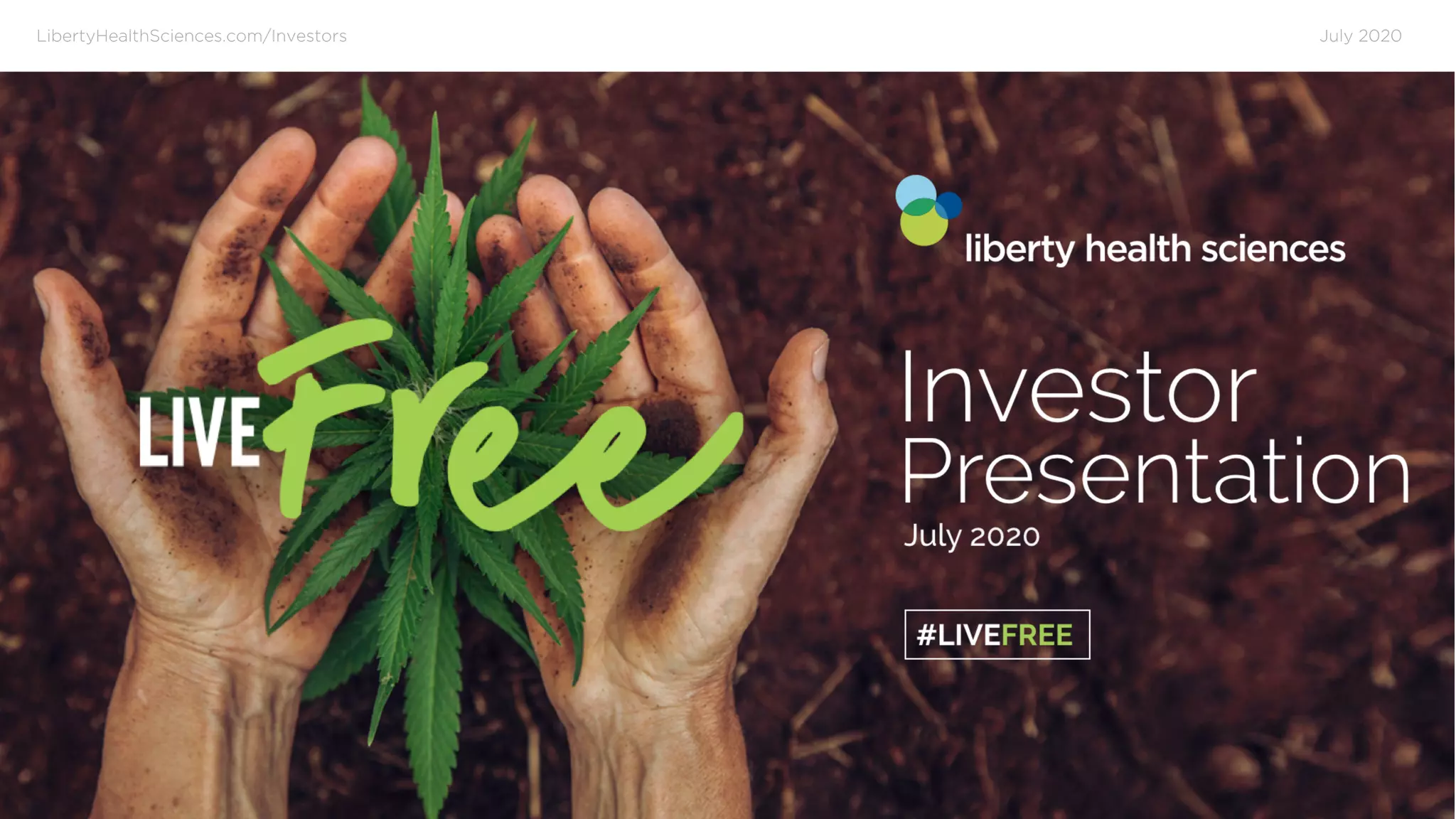
The cover slide establishes the brand identity with the '#LIVEFREE' hashtag and the 'Liberty Health Sciences' logo. The imagery of hands holding a cannabis plant over soil emphasizes the agricultural roots of the business. The date, July 2020, is clearly marked, which is crucial for context in the rapidly evolving cannabis regulatory environment.
Slide 2: Summary
This is the most information-dense slide in the deck, serving as a 'Traction' slide. It lists several key performance indicators (KPIs):
Established: 2017. · Headcount: 300+ team members. · Retail Scale: 26 dispensaries, ranked #4 in Florida, with 14 more upcoming. · Transaction Volume: 50,000+ monthly transactions. · Infrastructure: 115,000 sq. ft. of retail, 190,000 sq. ft. of cultivation, and 50,000 sq. ft. of processing. · Financial Health: Profitable since August 2019. · Compliance: GMP Certified 2020-2021.
By leading with profitability and vertical licensing, LHS immediately separates itself from the 'cash-burn' reputation of many cannabis startups.
Slide 3: Liberty Operations
This slide provides a deep dive into the Gainesville, Florida facility. It breaks down land usage (387 total acres) and production capacity. The inclusion of specific metrics like '40g dry flower yield per plant' and '900 units per hour' for oil filling demonstrates a high level of operational maturity. The retail metrics are equally impressive, noting an average ticket size of $96 and a retail inventory turn of 88%+. This suggests that product is moving through the system quickly, minimizing capital tied up in stock.
Slide 4: Retail Footprint
Slide 4 visualizes the company's market penetration in Florida. It lists 26 dispensary locations and identifies 7 'Hubs' (Dania Beach, Bonita Springs, Merritt Island, Gainesville, Tallahassee, Miami, and St. Petersburg). The map shows a concentration along the coasts and major population centers, illustrating a strategic approach to retail placement that covers the state's most lucrative demographics.
Slide 5: Our Brands
LHS showcases a 'House of Brands' strategy. The slide features internal brands like Zentient and Pretty Pistil alongside well-known third-party brands such as PAX , Mary's Medicinals , Incredibles , and Papa's Herb . This variety suggests that LHS is positioning itself not just as a grower, but as a sophisticated retailer capable of catering to different consumer segments, from value-seekers to premium connoisseurs.
Slide 6: Cultivation
This is a visual transition slide showing the scale of the indoor/greenhouse growing environment. It features young plants under purple LED grow lights and a healthy clone being held, reinforcing the 'science' and 'health' aspects of the company name. It provides visual proof of the 190,000 sq. ft. cultivation space mentioned earlier.
Slide 7: Processing
This slide focuses on the extraction and laboratory side of the business. Images of lab technicians in PPE and distillation equipment highlight the technical complexity of producing cannabis oils and concentrates. This reinforces the 'Vertical Cannabis License' claim, showing they control the value chain from seed to extract.
Slide 8: Manufacturing
The final slide in the provided sequence shows the end-of-line production. It features automated filling of 'Lemon and Grass' branded bottles and packaged 'Zentient' concentrate syringes. This slide completes the narrative of a fully integrated supply chain, showing the transition from raw plant material to a finished, consumer-ready retail product.
What Works in This Deck
Hard Data: LHS avoids vague promises. Every slide is backed by specific numbers—square footage, acreage, units per hour, and transaction counts. For an investor, this level of transparency regarding operational throughput is highly reassuring.
Vertical Integration Story: The deck successfully walks the viewer through the entire lifecycle of the product. By the time you reach Slide 8, you have seen the land, the plants, the lab, and the final packaging. This proves the company isn't reliant on third-party suppliers, which is a major risk-mitigation factor in the cannabis industry.
Profitability: Mentioning profitability on Slide 2 is a powerful hook. In a sector where many companies struggle with 280E tax implications and high overhead, being EBITA positive (or simply 'profitable' as stated) is a major competitive advantage.
What Is Missing
The Team: There is no slide introducing the leadership. In a highly regulated industry like cannabis, the background of the C-suite (legal, agricultural, and retail experience) is critical for investor due diligence.
Financial Projections: While they mention being profitable, the deck lacks a forward-looking financial roadmap. Investors want to see how the addition of the 14 'upcoming' dispensaries will impact the bottom line over the next 12-24 months.
The Ask: The deck does not state how much capital they are looking to raise or what the specific terms of the investment are. This suggests the deck may be used for general investor relations or as a preliminary teaser rather than a formal round-closing tool.
Founder Takeaways
Use 'Proof of Life' Photos: LHS uses high-quality, original photography of their facilities and products. This is far more effective than stock photos of generic cannabis leaves. It proves the assets exist and are operational.
Lead with Traction: If you are profitable or have significant market share (like being #4 in a state), put that on Slide 2. Don't bury your best metrics at the end of the deck.
Quantify Everything: If you claim to have a manufacturing advantage, define it in units per hour. If you claim retail success, define it in inventory turns and ticket size. Specificity builds trust.
Frequently asked questions
- What is the primary geographic focus of LHS?
- Based on the retail footprint and operations slides, LHS is exclusively focused on the Florida market. Slide 4 shows a map of 26 dispensaries and 7 hubs all located within Florida, and Slide 3 confirms their primary production location is in Gainesville, Florida. They hold a vertical cannabis license specifically for the state of Florida.
- Is LHS a profitable company according to this deck?
- Yes, Slide 2 explicitly states that the company has been 'Profitable since August 2019.' This is a significant data point for an investor presentation, as it shifts the narrative from speculative growth to operational scaling and sustainability.
- How much cannabis can LHS produce annually?
- According to Slide 3, the cultivation production capacity is 19,500 kg per year. The facility harvests between 3,500 and 5,000 plants per week, with an average dry flower yield of 40g per plant.
- What does the retail operation look like?
- LHS operates 26 dispensaries and has 14 more 'coming soon' (Slide 2). They serve over 84,000 patients year-to-date with an average ticket size of $96. Their retail efficiency is high, with an inventory turn rate of over 88% (Slide 3).
- What is missing from this investor presentation?
- The provided slides lack a management team overview, detailed financial statements (beyond the mention of profitability), a specific funding ask, and a competitive landscape analysis. It functions more as an operational update than a traditional venture capital pitch deck.