The Microsoft × Activision Blizzard acquisition deck is a highly polished corporate presentation designed to sell a $68.7 billion vision to investors and regulators. Spanning 24 slides, the deck moves away from traditional startup 'problem/solution' mechanics toward a narrative of global scale and ecosystem dominance. It centers on three pillars: Content (legendary franchises), Community (400M monthly active players), and Cloud (Xbox Cloud Gaming). By highlighting Activision’s massive mobile footprint via King and its 'billion-dollar franchises' like Call of Duty and World of Warcraft, Micros…
Key takeaways
- The deal is valued at $95 per share, totaling a $68.7 billion enterprise value in an all-cash consideration (Slide 24).
- Microsoft identifies a total addressable market of 3 billion players out of 8 billion people globally (Slide 8).
- The strategic framework is built on three pillars: Content, Community, and Cloud (Slide 9).
- Activision Blizzard brings nearly 400 million monthly active players (MAUs) to the Microsoft ecosystem (Slide 11).
- The acquisition adds 'billion-dollar franchises' including Call of Duty, Candy Crush, World of Warcraft, and Diablo (Slide 16).
- Microsoft Gaming's subscriber base was stated at 25M+ Game Pass subscribers at the time of the announcement (Slide 11).
- The organizational plan involves Activision Blizzard reporting directly to Phil Spencer, CEO of Microsoft Gaming (Slide 24).
- The deal was projected to be accretive to non-GAAP EPS upon closing (Slide 24).
The $68.7 Billion Narrative: Scaling to 3 Billion Players
The Microsoft acquisition of Activision Blizzard is not a typical startup pitch; it is a massive corporate consolidation deck. However, the principles of the deck remain remarkably similar to a Series A or B pitch: define a massive market, show why your combined entity is the only one that can capture it, and prove the unit economics (or in this case, the enterprise value) make sense. The deck is clean, high-level, and focused on the synergy of two giants.
Slides 1-4: The Introduction and Legal Guardrails
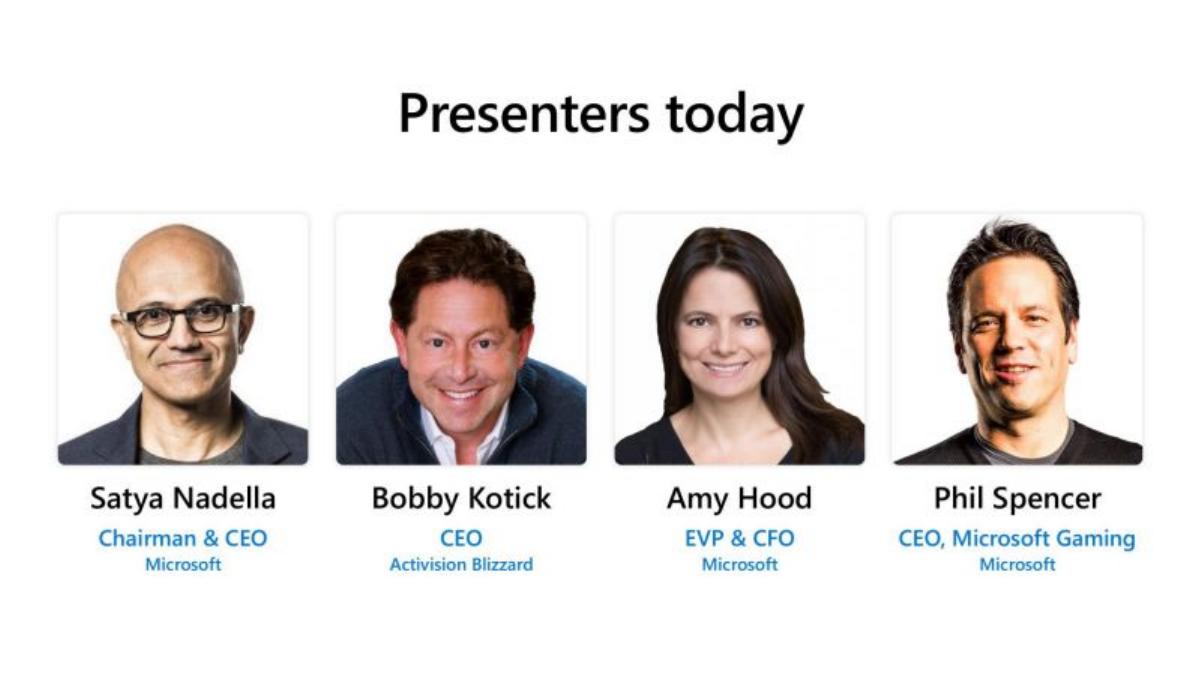
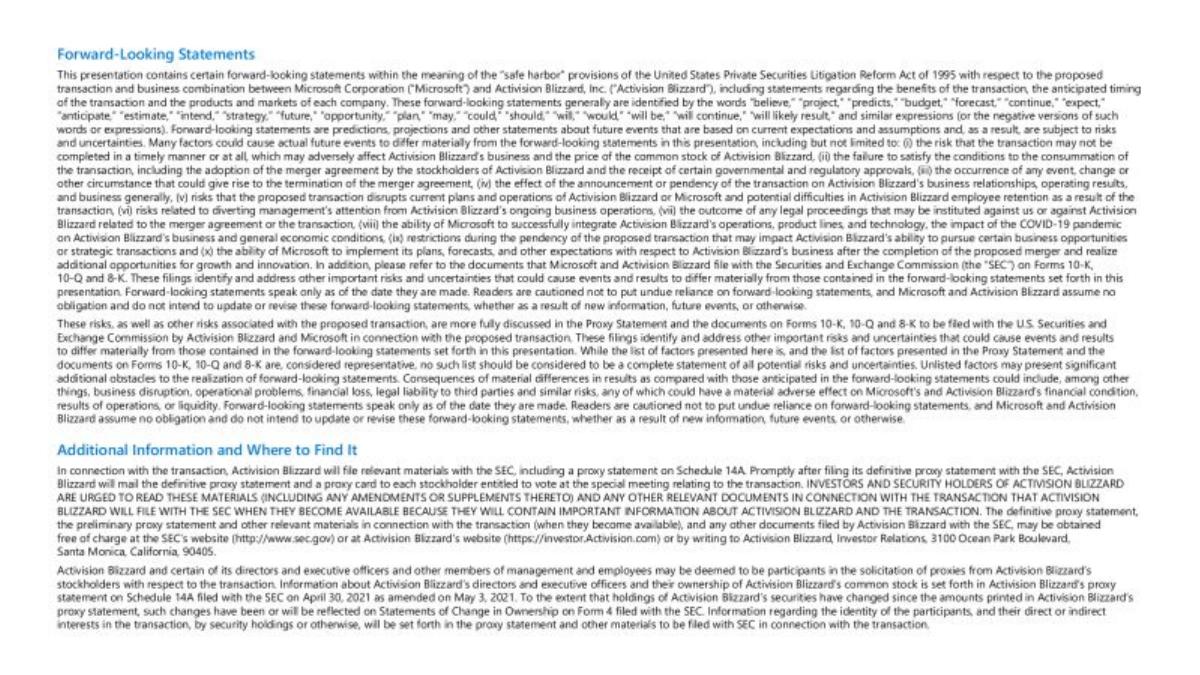
The deck opens with a simple co-branded title slide (Slide 1) dated January 18, 2022. This is followed by a series of speaker introductions. Brett Iversen, GM of Investor Relations, opens the floor (Slide 2), leading into the heavy hitters: Satya Nadella, Bobby Kotick, Amy Hood, and Phil Spencer (Slide 3). For a deal of this magnitude, the presence of both CEOs and the CFO is mandatory to signal stability to the markets. Slide 4 is a dense 'Forward-Looking Statements' disclaimer, a standard requirement for public company disclosures regarding acquisitions.
Slides 5-8: The Vision and the 3 Billion Player Opportunity
Satya Nadella takes the lead in Slide 5. Slide 6 reiterates Microsoft’s mission: 'Empower every person and every organization on the planet to achieve more.' Slide 7 creates a bridge between this mission and Activision Blizzard’s mission: 'Connecting and engaging the world through epic entertainment.' This alignment is crucial for regulatory and cultural buy-in. Slide 8 presents the 'Why Now' and the 'TAM' (Total Addressable Market). It uses a simple earth graphic to show that out of 8 billion people, 3 billion are players. This slide justifies the $68.7B price tag by framing gaming as a universal human activity.
Slides 9-12: The Three Pillars - Content, Community, Cloud
Slide 9 introduces the core framework of the deal: Content, Community, and Cloud. This is the 'Solution' slide of the deck. Slides 10, 11, and 12 drill into each pillar. Content (Slide 10) is defined by 'Legendary games' and 'Billion-dollar franchises.' Community (Slide 11) highlights the scale: nearly 400M Activision Blizzard monthly active players and 25M+ Microsoft Game Pass subscribers. Cloud (Slide 12) mentions 'Millions of Xbox Cloud Gaming users' across 26 countries. This section effectively argues that Microsoft provides the platform (Cloud) and the audience (Community), while Activision provides the 'must-have' reasons to use them (Content).
Slides 13-16: Culture and the Activision Portfolio
Slide 13 addresses 'Our culture,' featuring photos of employees in collaborative and gaming environments. This is a subtle nod to the integration challenges inherent in M&A. Slide 15 introduces Bobby Kotick, who presents the Activision Blizzard side. Slide 16 is the 'Traction' slide for the target company. It lists 10,000 employees and nearly 400M MAUs, alongside the logos of their most powerful IP: Call of Duty, Candy Crush, World of Warcraft, Diablo, and Overwatch. The inclusion of Candy Crush is particularly important as it represents the mobile gaming segment where Microsoft was previously weaker.
Slides 17-21: The Xbox Ecosystem and Synergy
Phil Spencer, CEO of Microsoft Gaming, takes over on Slide 17. Slide 18 focuses on the 'Joy and community of gaming,' emphasizing accessibility. Slide 19 is a visual 'Wall of Content,' showing the combined power of Activision Blizzard titles (Starcraft, Crash Bandicoot) and existing Xbox titles (Halo, Minecraft, Forza, Sea of Thieves). Slide 20 is a technical ecosystem slide titled 'You are the center of gaming.' It shows how Game Pass Ultimate connects the Series X, Series S, PC, and mobile devices via the cloud. This slide illustrates the 'Flywheel' effect: better content leads to more Game Pass subs, which leads to more data and revenue to build better cloud infrastructure.
Slides 22-24: The Financials and Deal Structure
After a transition slide (Slide 22), Amy Hood (CFO) presents the 'Deal overview' on Slide 24. This is the most data-dense slide in the deck. It explicitly states the Structure : $95 per share, $68.7 billion enterprise value, and all-cash consideration. It sets a closing expectation for Fiscal Year 2023. The Financial impact is noted as 'Accretive to non-GAAP EPS upon close.' Finally, it outlines the Organizational structure , confirming that Activision Blizzard will report to Phil Spencer. This slide is designed to satisfy analysts by showing a clear path to ROI and a defined management hierarchy.
What Works in This Deck
The Three-Pillar Framework: Content, Community, and Cloud is a simple, repeatable mantra that makes a complex $69B deal easy to understand for the press and investors. · Massive Visuals: The deck uses high-quality game art and simple iconography. It doesn't get bogged down in spreadsheets, which are likely handled in the 10-K filings and private data rooms. · Clear Hierarchy: By ending with the organizational chart and the reporting lines, Microsoft answers the 'Who is in charge?' question immediately, reducing internal and external anxiety. · TAM Justification: Slide 8's 3-billion-player stat is a powerful way to make a $68.7B investment seem like a reasonable play for global dominance.
What is Missing
Competitive Analysis: There is no mention of Sony/PlayStation, Tencent, or Nintendo. In a standard startup deck, this would be a red flag, but in a mega-merger deck, founders often avoid naming competitors to prevent giving regulators ammunition for antitrust arguments. · Risk Factors: Beyond the legal boilerplate on Slide 4, the deck does not address the significant regulatory hurdles the deal eventually faced in the UK and US. · Detailed Unit Economics: We see the 'Accretive to EPS' claim, but no breakdown of the margins for individual franchises or the cost of customer acquisition (CAC) for Game Pass.
What Founders Should Copy
The 'Center of the Universe' Slide: Slide 20 is an excellent example of how to visualize a complex product ecosystem. It shows the user at the center and the various touchpoints (devices, services) revolving around them. · The Use of Logos for Credibility: Slide 19 uses a grid of recognizable logos to convey 'Scale' much faster than a list of bullet points ever could. · Mission Alignment: Slide 7's side-by-side mission statement comparison is a great way for any startup to justify a partnership or a strategic pivot.
Frequently asked questions
- What was the primary financial justification for the $68.7B price tag?
- The deck justifies the $68.7 billion enterprise value ($95 per share) by highlighting Activision Blizzard's 'billion-dollar franchises' and its massive reach of nearly 400 million monthly active players. Slide 24 also notes that the deal is expected to be accretive to non-GAAP EPS upon closing, suggesting that the cash flow from these established IPs would immediately benefit Microsoft's bottom line.
- How does Microsoft define the 'Gaming World' market size?
- On Slide 8, Microsoft presents a nested circle graphic showing the global population at 8 billion people, internet users at 4 billion, and 'players' at 3 billion. This suggests Microsoft views gaming not as a niche hobby, but as a primary activity for 75% of the world's connected population.
- What role does mobile gaming play in this acquisition?
- While the deck features console and PC hits, the inclusion of Candy Crush (Slide 16) and the mention of 400M MAUs are heavy indicators of the mobile strategy. By acquiring King (via Activision Blizzard), Microsoft immediately gains a massive foothold in the mobile market, which is essential for their 'anywhere, anytime' cloud gaming vision shown on Slide 20.
- Who are the key executives leading this transition?
- Slide 3 identifies the four primary presenters: Satya Nadella (Chairman & CEO, Microsoft), Bobby Kotick (CEO, Activision Blizzard), Amy Hood (EVP & CFO, Microsoft), and Phil Spencer (CEO, Microsoft Gaming). Slide 24 confirms that post-acquisition, the Activision Blizzard business reports to Phil Spencer.
- What are the three pillars of Microsoft's gaming strategy?
- The strategy is explicitly broken down into Content, Community, and Cloud (Slide 9). Content refers to the IP and franchises; Community refers to the 400M+ active players and 25M+ Game Pass subscribers; Cloud refers to the infrastructure allowing games to be played across 26 countries on any device.