HR Tech Competition Slides: 8 Real Pitch Deck Examples
How HR, recruiting and payroll startups show competition in a pitch deck: positioning maps, feature tables, overlapping circles and a written memo.
HR Tech Competition Slide: Show Where You Fit Among Hiring and Payroll Rivals
HR and recruiting is one of the most crowded software markets a founder can enter. Every company already has some way to find, hire, pay and manage people: a job board, a recruiting agency, a payroll provider, a spreadsheet or a large all-in-one system. That means an HR competition slide has two jobs. It has to show investors which of these options a customer would drop to use you, and it has to explain why a giant such as LinkedIn, Indeed or ADP will not simply add your feature. This guide compares eight real competition slides from HR, recruiting, hiring and payroll decks. They use five different formats: two-axis maps, tick-box feature tables, overlapping circles, a written comparison with prices, and a page of prose from an investor memo.
TL;DR
Name the tools your buyer uses today for hiring or HR, group them by the job they do, and say plainly which one you replace. Rippling's memo splits its rivals into three groups (payroll and HR, identity, device management) and says which ones it usually replaces and which ones customers have not bought yet. Empion places twelve recruiting and employer-review companies on a culture-versus-recruiting map and adds each one's funding or valuation. micro1 uses a two-axis map of hiring versus managing a team. CareerApp writes out four differences, including its average price of $10K a year against two named rivals. Hiringhood and Hourly use tick-box tables; Hourly blurs its rivals' names, which leaves readers unable to check anything. CultiNet draws overlapping circles of corporate networks and arts recruiters with itself in the middle.
HR tech competition slides from real pitch decks
Each example shows the exact stored slide above its analysis and links to the full teardown. The slides that explain the company's position come first; weaker ones follow for contrast. Claims are as shown on the slides; comments are ours.
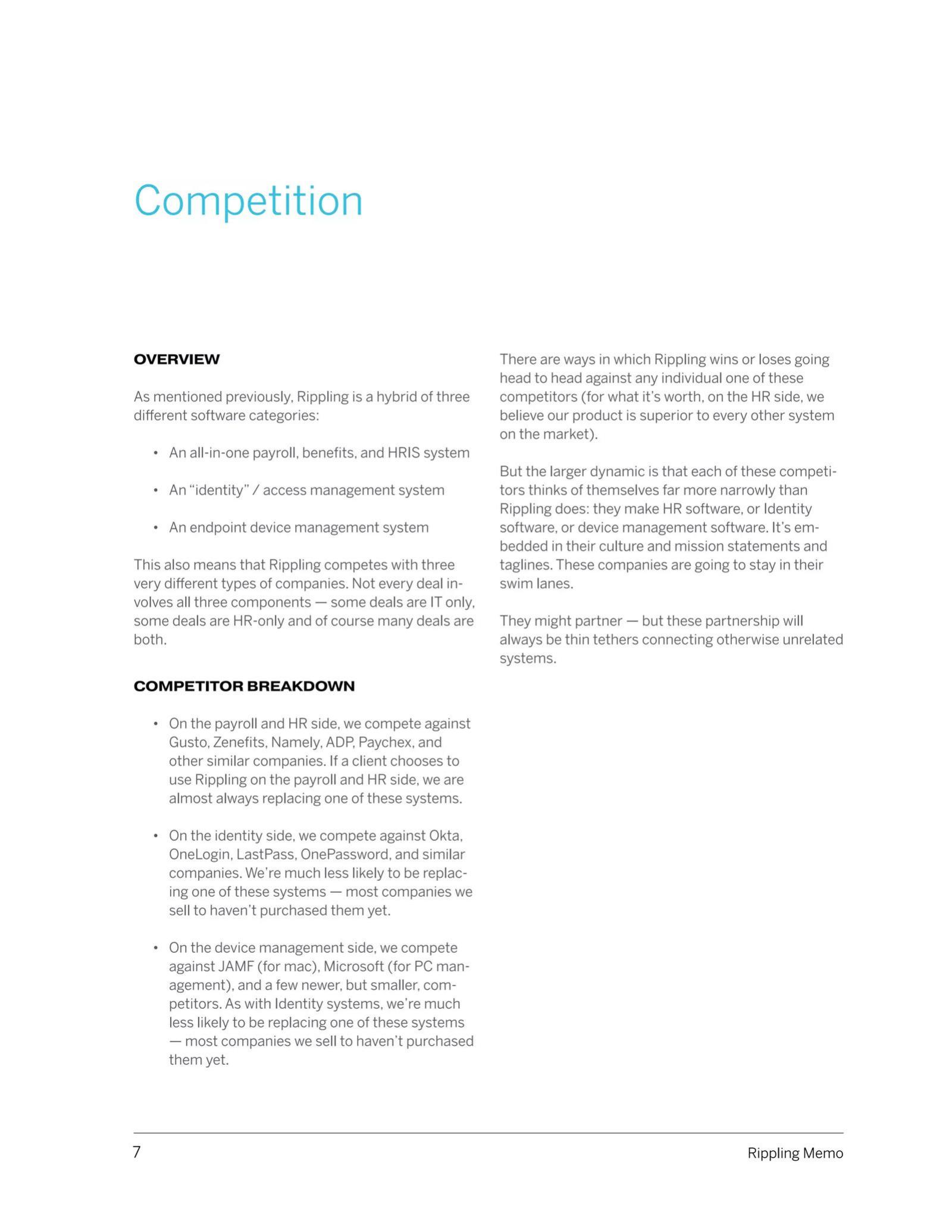
Rippling competition slide — slide 7
Employee management software covering payroll, HR, identity and devices. Page 7 of the investor memo the company used instead of a pitch deck for its Series A.
Rippling deck, slide 7. Exact stored slide matched to this analysis.
Our analysis: It groups rivals by the job they do, says for each group whether Rippling replaces or precedes them, and argues rivals will not broaden.
Evidence and limitation: Claimed; no figures. The company says it raised a $45M Series A led by Kleiner Perkins using this memo instead of a deck.
What a founder can adapt: Use the three-part breakdown even on a slide: one line per rival group, naming who they are and whether you replace them.
Supporting analysis
What the deck claims: "Rippling is a hybrid of three different software categories: An all-in-one payroll, benefits, and HRIS system; An 'identity' / access management system; An endpoint device management system." "On the payroll and HR side, we compete against Gusto, Zenefits, Namely, ADP, Paychex... we are almost always replacing one of these systems." "On the identity side, we compete against Okta, OneLogin, LastPass, OnePassword... most companies we sell to haven't purchased them yet." Device management: "JAMF (for mac), Microsoft (for PC management)". "These companies are going to stay in their swim lanes."
Presentation choice: The replace-or-precede distinction tells investors how each type of sale works, and the swim-lanes argument answers why rivals won't copy it.
When it does not fit: Unsupported lines such as "our product is superior to every other system"; the memo itself adds the hedge "for what it's worth".
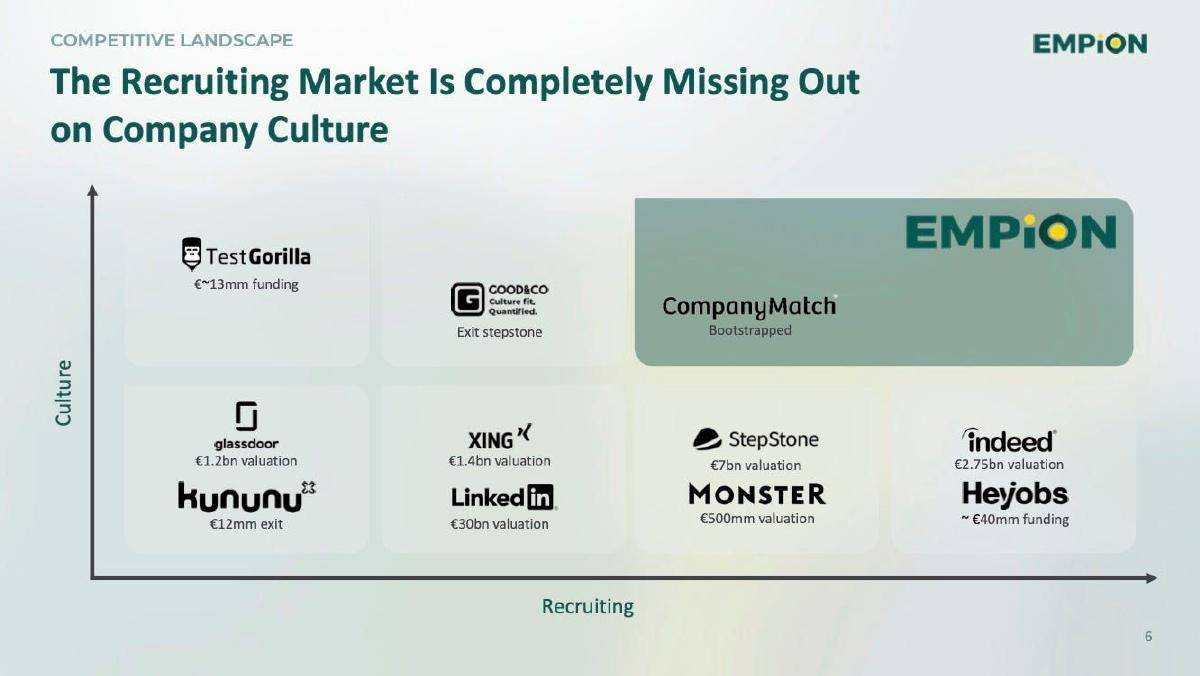
German recruiting service that matches candidates on culture fit, founded 2022. Slide titled "The Recruiting Market Is Completely Missing Out on Company Culture".
Empion deck, slide 6. Exact stored slide matched to this analysis.
Our analysis: It argues that large recruiting brands are worth billions while doing little on culture, and that the culture-plus-recruiting corner is nearly empty.
Evidence and limitation: Funding and valuation figures are as shown; no sources or dates. Empion's site, checked on 2026-10-01, says Factorial has acquired the company.
What a founder can adapt: Keep the figures, add a source and year for each, and give one reason for placing each rival low or high on culture.
Supporting analysis
What the deck claims: Map with "Culture" up and "Recruiting" across. Low on culture: Glassdoor (€1.2bn valuation), kununu (€12mm exit), XING (€1.4bn valuation), LinkedIn (€30bn valuation), StepStone (€7bn valuation), Monster (€500mm valuation), Indeed (€2.75bn valuation), Heyjobs (~€40mm funding). Higher on culture: TestGorilla (€~13mm funding), Good&Co ("Exit stepstone"). Top right, highlighted: Empion, with CompanyMatch ("Bootstrapped").
Presentation choice: Adding a funding or valuation figure to each rival shows the size of the money in the market, and placing one bootstrapped rival in its own corner is more honest than claiming it alone.
When it does not fit: Mixing funding raised, valuations and exits in one set of labels without saying they measure different things.
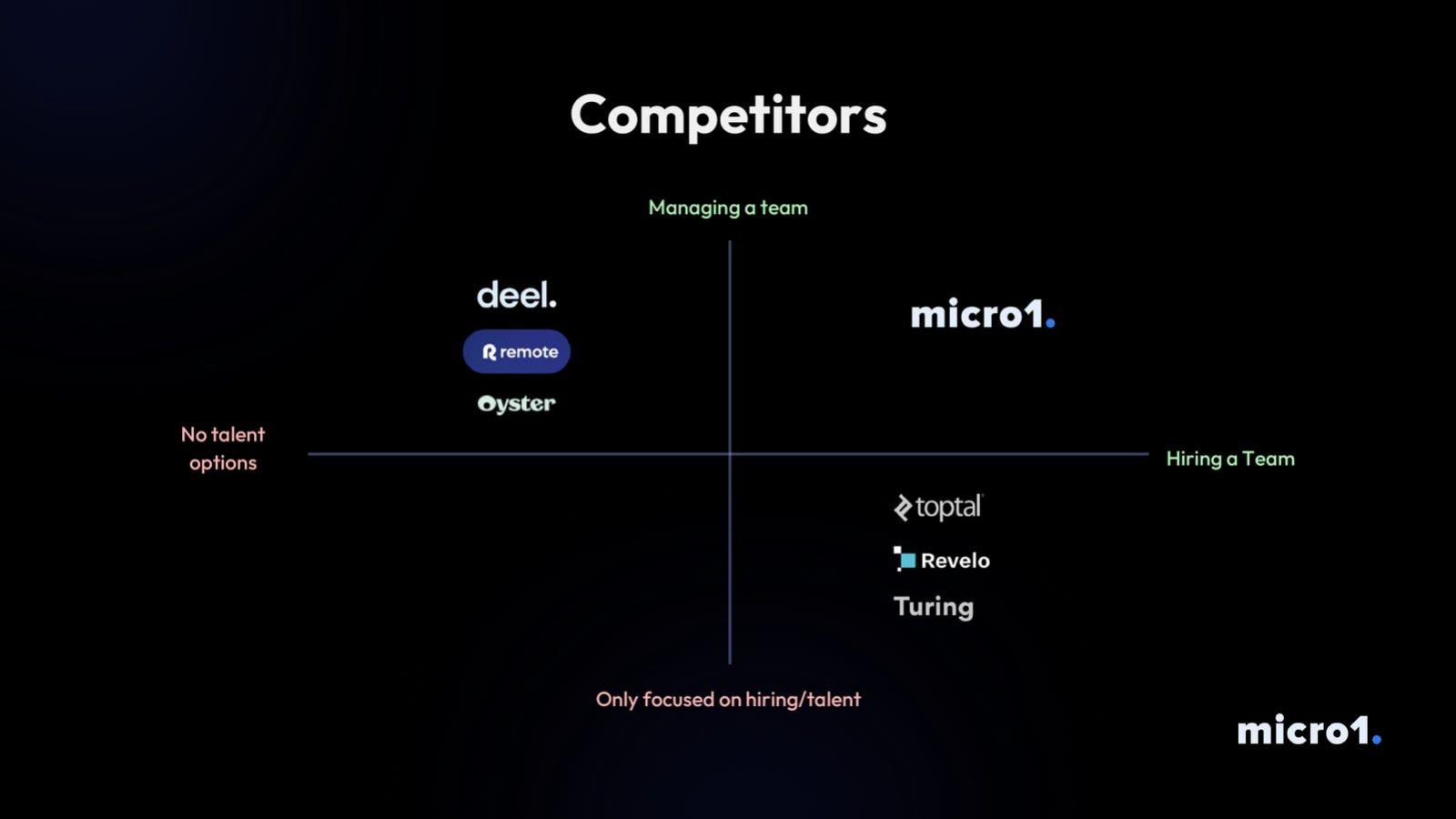
Service that vets software engineers with an AI interviewer and manages them for clients. Slide titled "Competitors", a two-axis map.
micro1 deck, slide 12. Exact stored slide matched to this analysis.
Our analysis: It argues that employment platforms manage teams but don't supply talent, and talent marketplaces supply talent but don't manage it.
Evidence and limitation: Positions are the company's own judgement; no basis given. TechCrunch reported in September 2025 that micro1 raised $35M at a $500M valuation, by then focused on supplying human data to AI labs.
What a founder can adapt: Add one fact behind each placement, such as whether Turing offers payroll, and say which group customers move budget from.
Supporting analysis
What the deck claims: Axes: "No talent options" to "Hiring a Team" and "Only focused on hiring/talent" to "Managing a team". Deel, Remote and Oyster sit top left (managing, no talent). Toptal, Revelo and Turing sit bottom right (hiring only). micro1 sits alone at top right.
Presentation choice: The axes describe two real jobs a customer needs done, and the six rivals are well-known names, so the claimed gap is easy to understand.
When it does not fit: Placing yourself alone in the best corner without saying why the rivals can't move there.
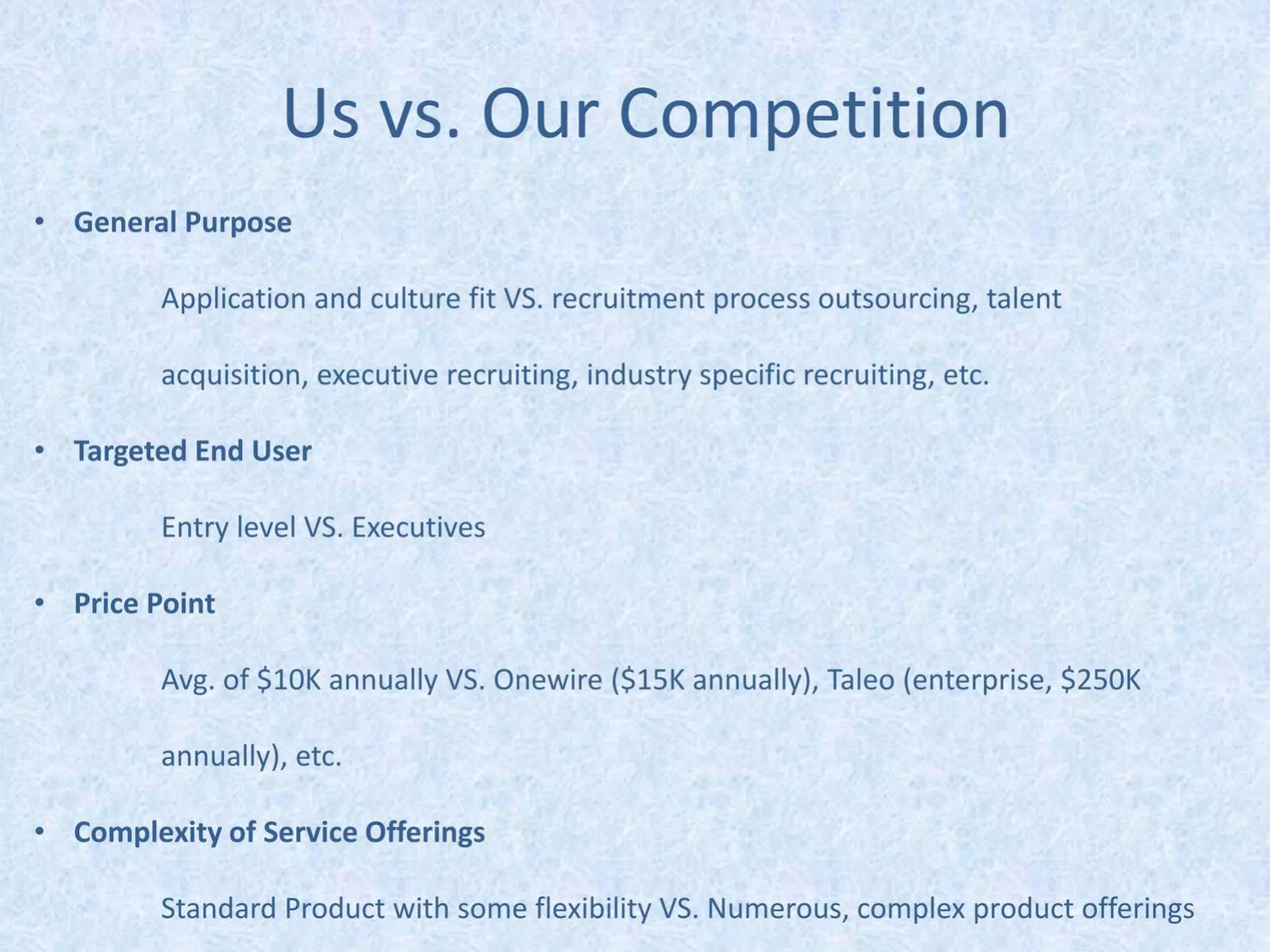
Boston startup from around 2013 offering a "Common App for jobs" for entry-level hiring. Slide titled "Us vs. Our Competition", written as four contrasts.
CareerApp (Prospective Plus) deck, slide 13. Exact stored slide matched to this analysis.
Our analysis: It sets itself apart on four points: purpose, user, price and simplicity, with real prices for two named rivals.
Evidence and limitation: Claimed prices; no source for rival prices. A 2013 Serious Startups profile describes the founder and product. Outcome unknown.
What a founder can adapt: Keep the four contrasts, name rivals on every line rather than only on price, and add the source and date for each rival price.
Supporting analysis
What the deck claims: "General Purpose: Application and culture fit VS. recruitment process outsourcing, talent acquisition, executive recruiting, industry specific recruiting, etc." "Targeted End User: Entry level VS. Executives." "Price Point: Avg. of $10K annually VS. Onewire ($15K annually), Taleo (enterprise, $250K annually), etc." "Complexity of Service Offerings: Standard Product with some flexibility VS. Numerous, complex product offerings."
Presentation choice: It is the only slide here with prices. Showing $10K against $15K and $250K tells investors which customers it can win.
When it does not fit: Comparing an entry-level product with executive recruiting and enterprise systems; the buyers may not be the same.
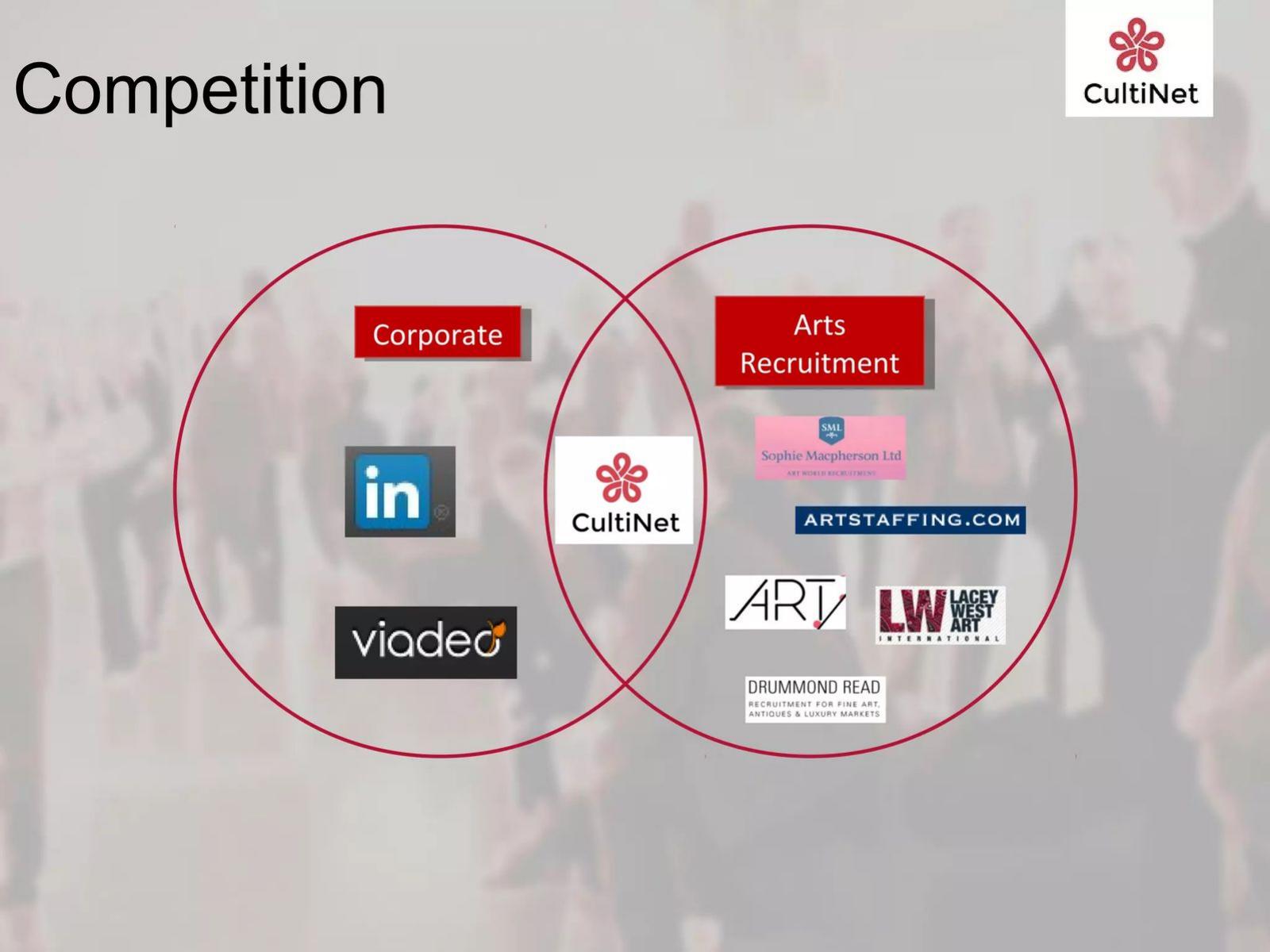
Greek platform from around 2015 matching visual artists with arts managers. Slide titled "Competition", drawn as two overlapping circles.
CultiNet deck, slide 9. Exact stored slide matched to this analysis.
Our analysis: It places itself between general professional networks and specialist arts recruiters.
Evidence and limitation: Logos only; no prices or figures. A 2015 interview on Platform.gr describes the founders and product. Outcome unknown.
What a founder can adapt: Add one line on what each group lacks for an artist seeking a manager, and the price of an arts recruiter against CultiNet's subscription.
Supporting analysis
What the deck claims: Left circle, "Corporate": LinkedIn, Viadeo. Right circle, "Arts Recruitment": Sophie Macpherson Ltd, ArtStaffing.com, ART (logo), Lacey West Art International, Drummond Read. CultiNet sits in the overlap.
Presentation choice: Shown as a niche example: the circles make the position clear in seconds, unlike several fashion and HR diagrams that leave the company off.
When it does not fit: Treating LinkedIn as a rival without saying why artists don't simply use it.
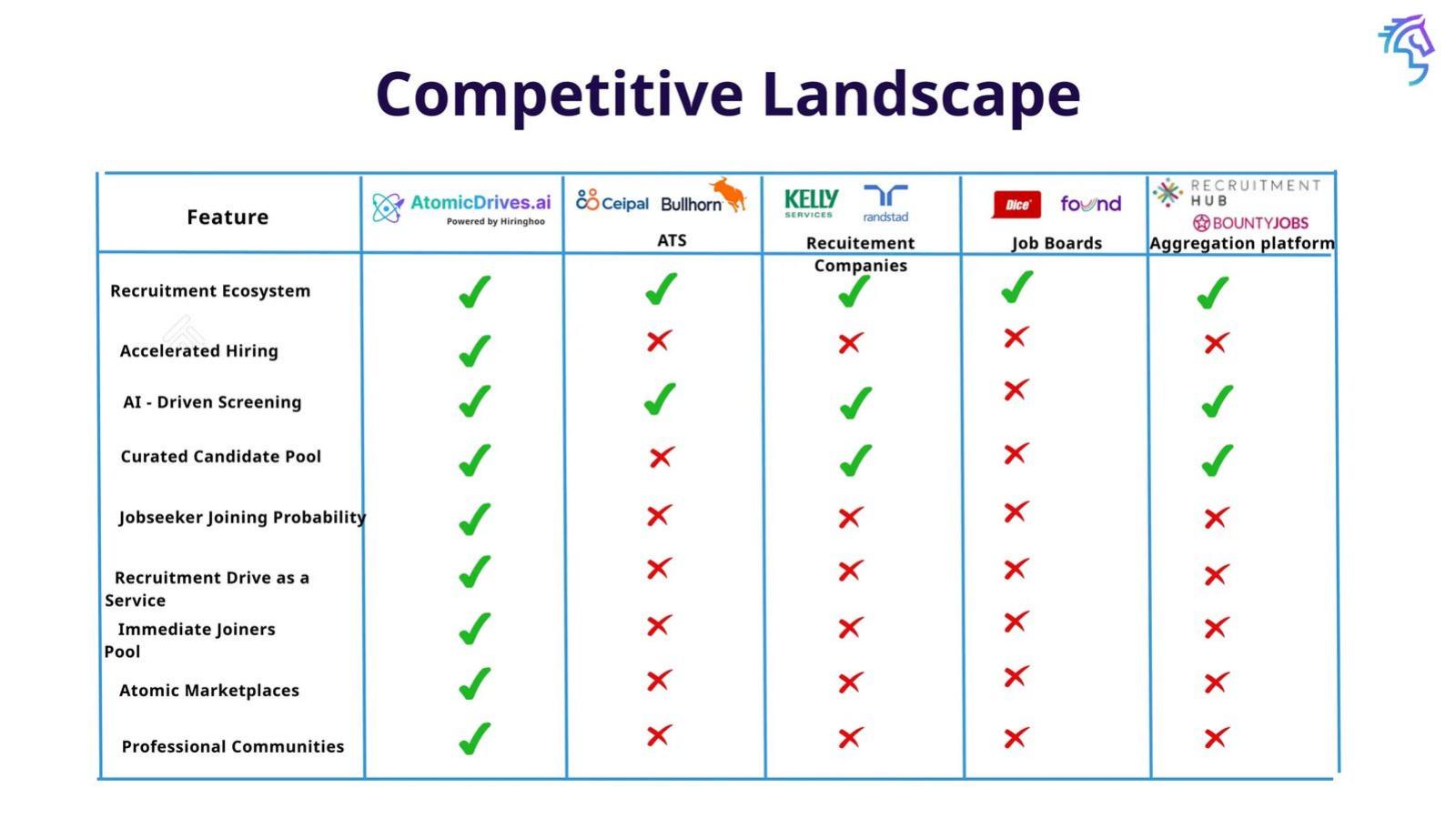
Hyderabad recruiting marketplace that pools recruiters, founded 2021. Slide titled "Competitive Landscape", a tick-box table.
Hiringhood deck, slide 12. Exact stored slide matched to this analysis.
Our analysis: It groups rivals into four types and argues none combines all of its features.
Evidence and limitation: Claimed; no figures. The company's site, checked on 2026-10-01, describes it as founded in 2021 and now focused on AI and machine-learning hiring.
What a founder can adapt: Cut rows to the three that buyers care about most, add one row where a rival leads, and add time-to-hire figures.
Supporting analysis
What the deck claims: Columns: AtomicDrives.ai ("Powered by Hiringhood"), ATS (Ceipal, Bullhorn), Recruitment Companies (Kelly Services, Randstad), Job Boards (Dice, Found), Aggregation platform (Recruitment Hub, BountyJobs). Rows include Recruitment Ecosystem, Accelerated Hiring, AI-Driven Screening, Curated Candidate Pool, Jobseeker Joining Probability, Recruitment Drive as a Service, Immediate Joiners Pool, Atomic Marketplaces, Professional Communities. AtomicDrives.ai ticks all nine.
Presentation choice: Grouping rivals by type (tracking software, agencies, job boards, aggregators) is useful, because a buyer thinks in those categories.
When it does not fit: Rows that only the company could tick, such as its own product names; they prove nothing about rivals.
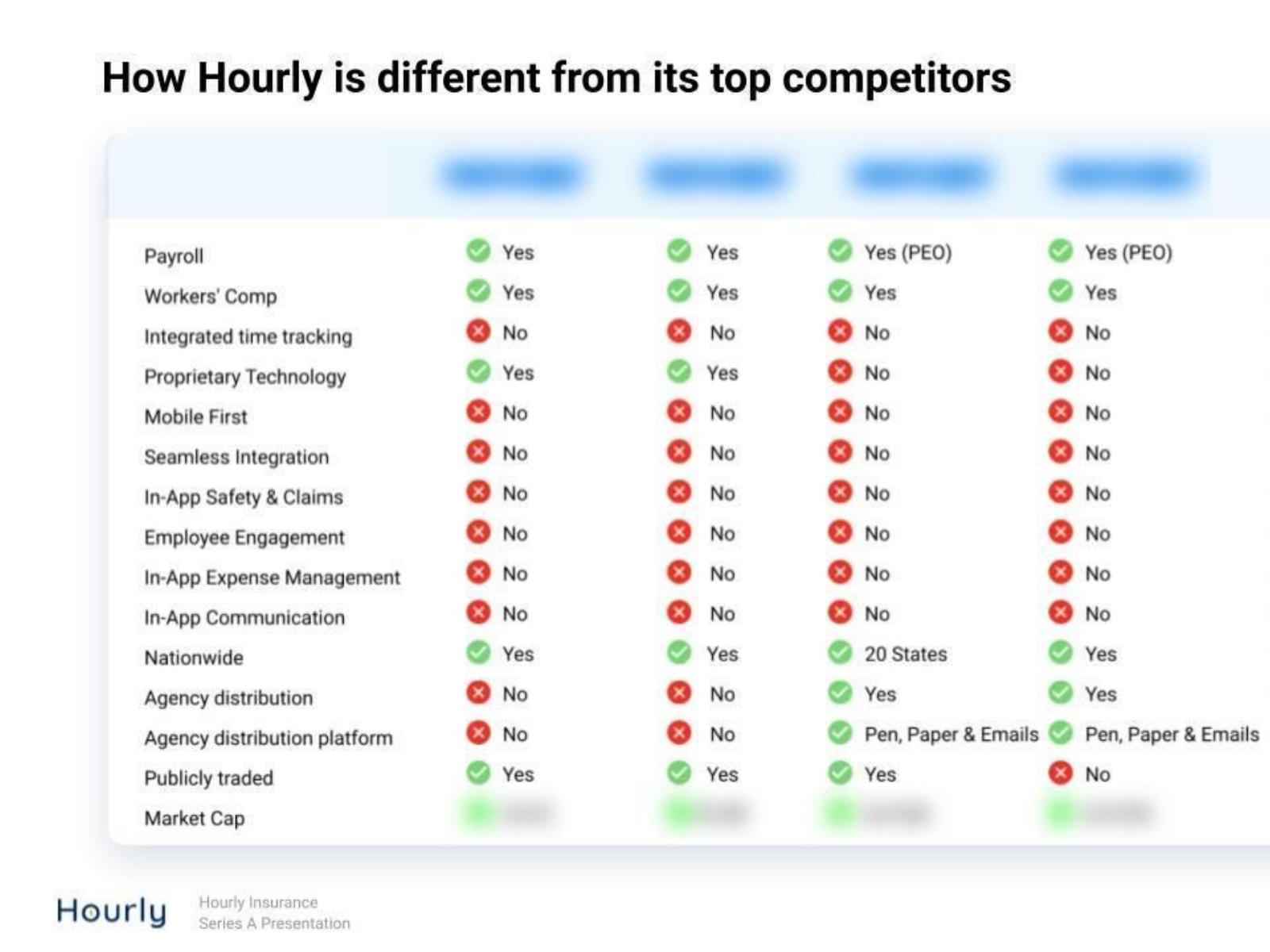
Payroll, time tracking and workers' compensation insurance for small businesses with hourly staff. Series A slide titled "How Hourly is different from its top competitors".
Hourly deck, slide 11. Exact stored slide matched to this analysis.
Our analysis: It argues that rivals offer payroll and insurance but not time tracking, mobile use or in-app tools.
Evidence and limitation: Rival names and market caps are blurred on the stored image, and Hourly's own column is not visible. TechCrunch reported a $27M Series A in June 2022.
What a founder can adapt: Show the names, keep Hourly's column in view, and replace yes/no rows with a measured difference such as how premiums are calculated.
Supporting analysis
What the deck claims: Four rival columns, names blurred. Rows: Payroll, Workers' Comp, Integrated time tracking, Proprietary Technology, Mobile First, Seamless Integration, In-App Safety & Claims, Employee Engagement, In-App Expense Management, In-App Communication, Nationwide, Agency distribution, Agency distribution platform, Publicly traded, Market Cap (blurred). Two rivals are marked "Yes (PEO)" for payroll; one is "20 States"; two use "Pen, Paper & Emails" for agency distribution.
Presentation choice: Shown as the weakest for readers: with names blurred and the company's own column cut off, nothing on the slide can be checked. The row choices (mobile, time tracking, agency platform) are still a useful list of what matters to this buyer.
When it does not fit: Sharing a competition slide with names hidden; a reader cannot test any row.
Whether each slide names rivals, shows the company's own position, and gives something a reader could check.
Example
Rivals named
Own position shown
Checkable basis
Rippling
Yes (in three groups)
Yes (in words)
Partly (replace or precede, no figures)
Empion
Yes (eleven, with figures)
Yes (map corner)
Partly (figures without sources)
micro1
Yes (six)
Yes (map corner)
No
CareerApp
Partly (two by name)
Yes (in words)
Partly (prices without sources)
CultiNet
Yes (seven logos)
Yes (overlap)
No
Hiringhood
Yes (eight, in four groups)
Yes (table column)
No
Hourly
No (blurred)
No (column not visible)
No
Key Takeaways
Group rivals by the job they do: sourcing, screening, payroll, management.
Say which tool you replace and which you sit alongside.
A map needs a reason for every position, including yours.
Tick-box tables lose trust when every row favours you.
Hidden rival names make a comparison impossible to check.
Build your HR tech competition slide
Start from the tools your buyer pays for today.
Buyer. Who signs the contract, and who uses the product every day?
Today. Which agencies, job boards, payroll systems or spreadsheets do they use now?
Groups. How would you group those tools by the job they do?
Replace. For each group, do you replace it, work alongside it, or create a new budget?
Proof. Can you show time to hire, cost per hire, price or churn against a named alternative?
Copyable framework: Today [buyer] uses [group A] for [job] at about [price] and [group B] for [job]. We replace [group] and work alongside [group], cutting [measure] from [figure] to [figure], measured [when and how].
Illustrative example 1 — written by us
Before: Feature table: us vs four blurred competitors. We tick every row.
After: Small contractors pay for payroll from a large provider and buy workers' insurance through an agent, based on a yearly payroll estimate. We combine both and charge insurance on actual hours worked; pilot customers' end-of-year insurance adjustments fell by half.
What improved: Our illustrative rewrite; figures are invented for the example. It names the alternative, says what is replaced and gives one result a reader could ask about.
What this guide adds
The general competition slide guide covers any kind of business. HR tech adds its own problems. The buyer is often not the user: an HR director or finance lead signs the contract, while recruiters, managers and candidates use the product. Many tools overlap, so one company can be a rival, a partner and a data source at the same time. And the largest players, such as LinkedIn, Indeed, Workday and ADP, are household names that sell to almost every company already.
The HR market guide covers how these decks size the opportunity. Here we look only at how each deck handles rivals: who it names, how it groups them, where it places itself and what a reader could check.
How we read each slide
We quote the text on the stored slide images, read at full size. We have not checked any rival's features, prices, funding or valuation as shown on the slides. "Claimed" means the company states something on the slide without a source. Where we checked what happened to a company after its deck, we say what we found and where; where we found nothing, we say the outcome is unknown.
These decks span roughly 2013 to 2024. Several rivals have since raised money, been bought or changed focus, and several valuations shown on slides are out of date. Readers should judge each slide against its own time.
Five formats, and what each one shows
Two-axis maps (Empion, micro1) show a gap in one glance, but the founder picks the axes, so the gap can be a product of that choice. Tick-box tables (Hiringhood, Hourly) are easy to scan and suit products with many features, but they invite doubt when the company wins every row and rivals lose almost all of them. Overlapping circles (CultiNet) show that a product sits between two groups. A written comparison (CareerApp) can include prices and explain trade-offs. Prose (Rippling) takes the most space but can explain how competition changes from deal to deal, which no table can.
Whichever format you pick, a reader needs three things: who the rivals are, where you sit among them, and what that position is based on. All seven slides name rivals. Most show a position. Few give a basis a reader could check.
Replace, sit alongside, or create a new budget
The most useful line on an HR competition slide is often the one that says what happens to the rival when a customer signs. Rippling's memo is the clearest example: on payroll and HR it is "almost always replacing" an existing system, while on identity and device management "most companies we sell to haven't purchased them yet". That one distinction tells investors how hard each sale will be and where the money comes from.
Recruiting tools face the same question. Is the customer moving budget away from an agency, a job board or an applicant tracking system, or adding a new line? CareerApp hints at this by comparing its price with recruitment outsourcing firms; most of the other slides leave the reader to guess.
Questions investors ask about an HR competition slide
Who signs, and who uses it? A slide that compares candidate features when the buyer is a finance lead may be answering the wrong question.
Why won't the giant copy you? LinkedIn, Indeed, ADP and Workday appear on many of these slides. Investors want one sentence on what stops them adding the feature.
Are the rivals named and current? Blurred names, logos too small to read, or valuations from years ago all weaken a slide.
Is the comparison fair? A table where rivals answer "No" to almost every row reads as a sales page. Include at least one row where a rival is stronger.
Mistakes HR tech slides make most often
The most common gap is evidence. Only CareerApp gives a price, and only Empion gives any figures for rivals (funding and valuations), without sources or dates. A single measured result, such as time to hire, cost per hire or churn, set against a named alternative would make almost every slide here stronger.
The second gap is fairness. Hiringhood and Hourly each show the company ahead on nearly every row. Hourly's own column is not visible on the stored image at all.
Common mistakes
Hiding rival names. Hourly blurs its rivals; nothing can be checked.
Winning every row. Hiringhood and Hourly show rivals losing almost everywhere.
Self-scored ratings. A 5 against 2 with no method reads as marketing.
The empty best corner. Maps where you alone own the top right need a reason.
Figures without sources. Valuations and prices need a source and a year.
Ignoring replace vs add. Say which tool loses budget when a customer signs.
Diagnostic checklist
Names the tools your buyer uses today.
Groups them by the job they do.
Puts your company on the slide.
Says which group you replace and which you sit alongside.
Includes at least one area where a rival is stronger.
Gives a source and year for every figure.
Explains why the largest player won't add your feature.
Frequently asked questions
Who should an HR tech startup list as competitors?
The tools a buyer pays for today, grouped by job: agencies, job boards, tracking software, payroll providers. Rippling's memo groups rivals into payroll and HR, identity, and device management.
Is a feature table a good HR competition slide?
It can be, if rivals are named and the rows are fair. Hiringhood's table groups rivals usefully, but its company ticks every row; Hourly's table hides rival names entirely.
Should I show competitors' funding on the slide?
It can show how much money is in the market, as Empion does with figures for eleven rivals, but give a source and year for each figure and don't mix valuations with money raised.
Should I include prices on an HR competition slide?
Yes, if you can source them. CareerApp's $10K a year against $15K and $250K rivals is the only price comparison among these seven slides, and it tells investors which buyers it can win.
How we chose these examples
Corpus: published pitch deck teardowns on StartupFundraising.com. Founder-uploaded private decks are excluded.
Selection (2026-10-01): we searched extracted slide text across the full corpus for competition, competitor and landscape wording near recruiting, hiring, payroll and HR terms. Nine candidates were viewed at full size; eight HR, recruiting, hiring and payroll competition slides that no other guide uses were kept. v2 (2026-10-05) removed Hackmania because a page of its deck carries a restriction notice, leaving seven.
Not used: Complyant p8 (tax and bookkeeping software, not HR); legal and insurance competition slides were screened separately and did not reach six examples.
Status checks (2026-10-01): Rippling's own blog; Empion's site; TechCrunch for micro1 and Hourly; Hiringhood's site; Serious Startups for CareerApp; Platform.gr for CultiNet. No public outcome was found for CareerApp or CultiNet.
Review: stored slide text and images were checked on 2026-10-01 against company, deck and slide number (editorial model review). No person has yet completed an editorial review of this page. We make no claim that any slide caused a fundraising outcome.