Hive's pitch deck is a textbook example of a B2B SaaS presentation, emphasizing high-quality recurring revenue and a structured product roadmap. The company positions itself as the 'Employee Voice Platform,' solving the gap between rising employee expectations and the lack of effective listening tools in large organizations. With 94% of revenue being recurring—split between platform fees (84.6%) and professional services (9.4%)—Hive demonstrates strong business fundamentals. The deck seeks £4m to accelerate growth, backed by a diverse customer base including the NHS, Travelodge, and Hermes. W…
Key takeaways
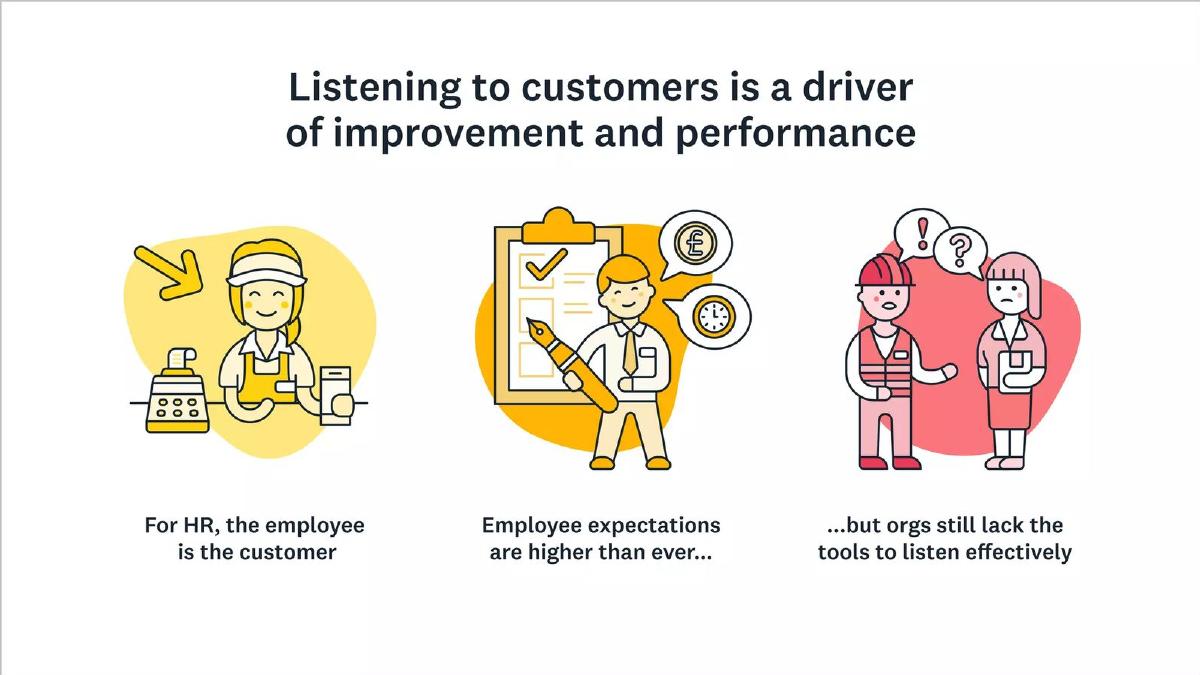
- The company identifies a core problem where organizations lack the tools to listen to employees effectively despite rising expectations (Slide 2).
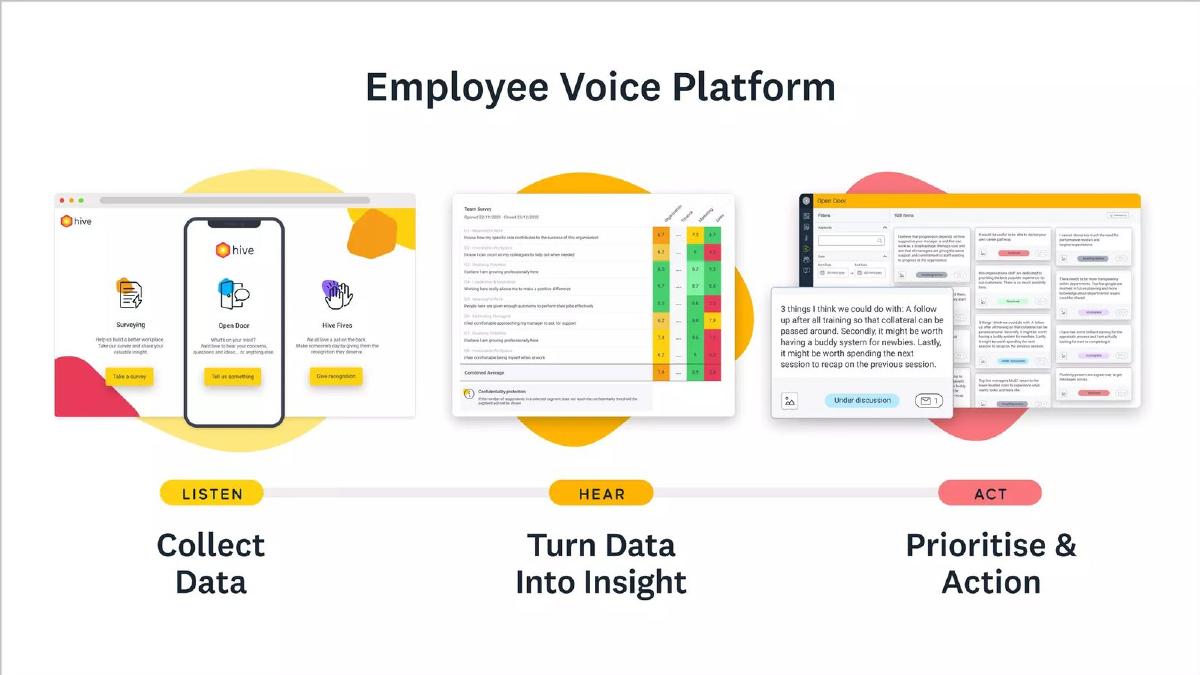
- Hive defines its platform through a three-step process: Listen (Collect Data), Hear (Turn Data Into Insight), and Act (Prioritise & Action) (Slide 3).
- The business boasts a high-quality revenue mix, with 94% of all revenue being recurring as of the 2020 audited accounts (Slide 5).
- Platform fees account for the majority of income at 84.6%, while recurring professional services add another 9.4% (Slide 5).
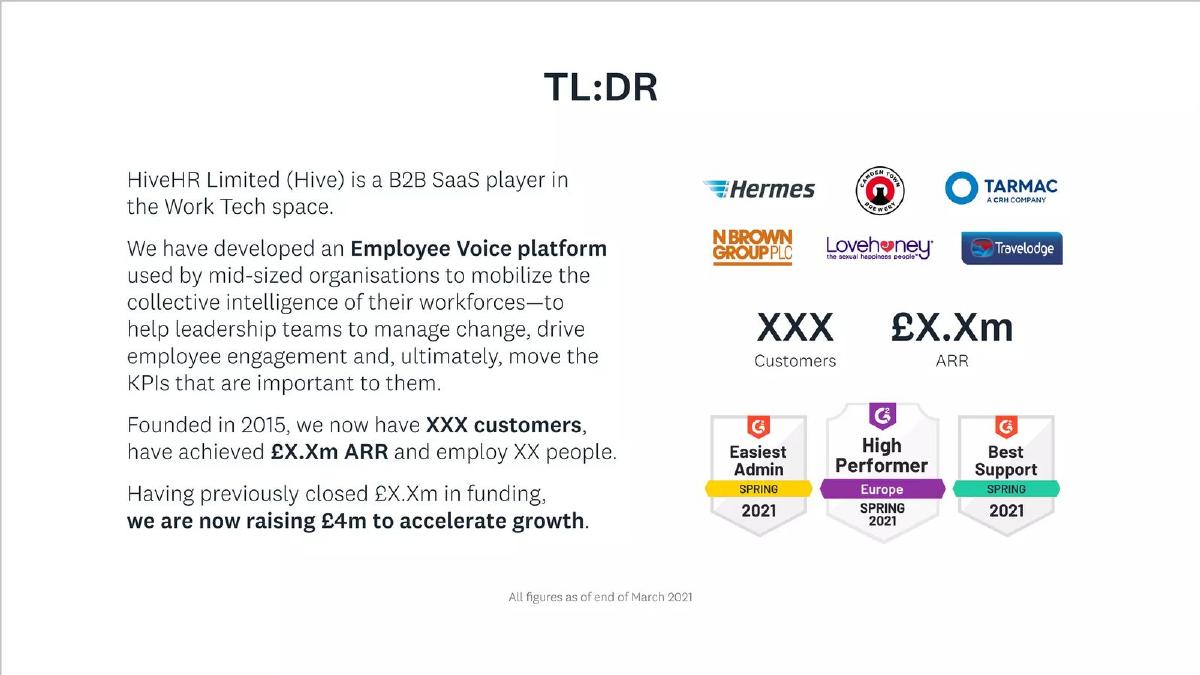
- The customer base is diversified across verticals, featuring logos like Hermes, Travelodge, NHS, and Northumbria Police (Slide 4).
- Hive uses a structured 'Built, Next, Future' roadmap to communicate product evolution, including upcoming features like 'Digital Focus Groups' (Slide 7).
- The financial projections span from 2019 to 2025, showing a target for positive operating cash flow starting around 2024 (Slide 8).
- The funding ask is explicitly stated as £4m to accelerate growth and support mission-critical decision-making (Slide 9).
Executive Summary
Hive’s investor deck is a highly structured, professional presentation that leans heavily on the 'Classic B2B SaaS' narrative. By framing employees as the 'internal customer' of HR, Hive taps into the well-established market for Customer Experience (CX) tools and applies those principles to Human Resources. The deck is notable for its transparency regarding revenue composition and its clear, three-stage product roadmap.
Slide 1: Title Slide
The deck opens with a clean, dark blue aesthetic featuring the Hive logo—a stylized hexagonal honeycomb. The subtitle, "The Employee Voice Platform," immediately categorizes the company within the HR Tech space. The footer identifies the entity as HiveHR Limited and provides their web address.
Slide 2: The Problem Statement
This slide uses simple illustrations to bridge the gap between customer service and employee management. It posits that "Listening to customers is a driver of improvement and performance," then draws a parallel: "For HR, the employee is the customer." The slide identifies two pain points: employee expectations are higher than ever, yet organizations still lack the effective tools to listen. This sets up the 'why now' for the platform.
Slide 3: The Solution - Employee Voice Platform
Hive breaks its platform down into three functional pillars: Listen, Hear, and Act.
Listen: Data collection via Surveying, an 'Open Door' feedback channel, and 'Hive Fives' for peer recognition. · Hear: Turning data into insight using a dashboard that segments scores by department (e.g., Finance, Marketing, Sales). · Act: A workflow tool to prioritize and action feedback, shown as a task management interface.
Slide 4: Social Proof and Traction
The company demonstrates significant market validation by listing a "broad spectrum of verticals." The slide features 12 prominent logos, including Travelodge, NHS, Hermes, Guide Dogs, and Northumbria Police. This variety suggests that the problem Hive solves is not industry-specific but universal to large workforces.
Slide 5: Revenue Model
This is a standout slide for its clarity. Hive explicitly labels its strategy as a "Classic B2B SaaS Revenue Model." A donut chart breaks down the revenue based on 2020 audited accounts:
84.6% is recurring platform revenue. · 9.4% is recurring professional services revenue. · 6% is non-recurring revenue.
The total recurring revenue stands at 94% , which is a high-water mark for SaaS valuations. The slide notes that licenses are based on headcount.
Slide 6: The Growth Engine
This slide focuses on sales velocity and capital efficiency. It uses a funnel graphic to show the progression of ARR (Annual Recurring Revenue) from leads to closed deals. While the specific figures are redacted as £XXXk , the slide highlights two critical SaaS metrics: Sales Efficiency and CAC/LTV (Customer Acquisition Cost to Lifetime Value). This indicates the management team is focused on the right unit economics for scaling.
Slide 7: Product Roadmap
Hive uses a "Built / Next / Future" framework to show product evolution. Built features include sentiment analysis and real-time reporting. The Next phase focuses on integrations (Partner Channels, Mobile App) and predictive analytics. The Future column lists ambitious goals like "Digital Focus Groups" and "Globalisation," giving investors a view of the long-term vision for the technology.
Slide 8: Financials and Projections
The financials slide provides a table and three charts covering 2019 through 2025. The table tracks ARR, Revenue, Gross Profit, EBITDA, Cash, Customer Count, and ACV (Average Contract Value). The charts show a projected hockey-stick growth in Closing Cash Balance and Operating Cashflow , with the company appearing to target break-even/profitability around the 2024 mark. Again, specific pound values are redacted, but the trendlines are clearly upward.
Slide 9: The Ask
The final slide is direct: "We’re raising £4m to accelerate Hive’s growth." It includes a call to action titled "Choose Your Own Adventure," providing contact details for John Ryder (CEO & Founder) for those interested, while politely offering a link to their LinkedIn page for those who decline. This is a unique, personality-driven way to end a professional deck.
What Works in This Deck
Revenue Transparency: By breaking down the 94% recurring revenue into platform vs. services, Hive builds immediate trust. Investors often fear that 'SaaS' companies are actually disguised consultancy firms; Hive proves their revenue is truly product-led.
Vertical Agnostic Proof: Showing that the police, a brewery, a university, and a sex toy retailer (Lovehoney) all use the same platform is a powerful way to demonstrate a massive Total Addressable Market (TAM) without needing a dedicated TAM slide.
Metric-Driven Culture: Even with the numbers redacted, the presence of LTV/CAC and Sales Efficiency placeholders shows that the founders understand how to measure a scaling software business.
What Is Missing
The Team Slide: The provided slides do not include a dedicated team page. While the CEO is mentioned on the final slide, investors need to see the pedigree of the engineering and sales leadership to feel confident in a £4m investment.
Competitive Landscape: There is no mention of competitors like Glint, Peakon, or Culture Amp. A slide explaining Hive's unique 'moat' or differentiation against these incumbents would strengthen the case.
Detailed Use of Funds: While the ask is £4m, there is no breakdown of how that money will be spent (e.g., 50% Sales/Marketing, 30% R&D, 20% Ops). Accelerating growth is a generic goal; specific hiring or expansion targets would be better.
Founder Takeaways
Standardize Your Model: If you are a SaaS company, use the language of SaaS. Hive’s use of terms like ARR, ACV, and LTV/CAC makes it easy for institutional investors to 'read' the business quickly.
The 'Built/Next/Future' Roadmap: This is one of the most effective ways to present a product roadmap. It shows you have delivered in the past, have a plan for the immediate future, and possess a long-term vision that justifies a high valuation.
Focus on Recurring Services: Hive’s inclusion of 'recurring professional services' (9.4%) is a clever way to show that their service arm isn't just one-off implementation fees, but a consistent, scalable part of the relationship that adds to the LTV.
Frequently asked questions
- What is Hive's primary product offering?
- Hive describes itself as an 'Employee Voice Platform.' According to Slide 3, the platform functions by collecting data through surveying, 'Open Door' feedback, and 'Hive Fives' (peer recognition). It then translates this data into insights via a dashboard and provides tools for management to prioritize and take action on employee feedback.
- How does Hive generate revenue?
- Hive utilizes a classic B2B SaaS model. Slide 5 states that customers buy a recurring annual license based on headcount. This is supplemented by recurring professional services. The deck notes that 94% of total revenue is recurring, with only 6% coming from non-recurring sources.
- Who are Hive's current customers?
- The company serves a broad spectrum of verticals. Slide 4 displays logos for major UK entities including the NHS (Manchester University NHS Foundation Trust), Travelodge, Hermes, Tarmac, and the Northumbria Police. This suggests the platform is scalable across both private and public sectors.
- What are the key metrics Hive uses to demonstrate growth?
- Slide 6 focuses on 'Capital Efficiency,' highlighting Sales Efficiency (XX%) and CAC/LTV (X.X/X) as core KPIs. It also uses a sales funnel visual to track ARR progress, moving from Leads to Qualified Opportunities to Weighted Value, though the specific pound amounts are redacted in this version of the deck.
- What is the specific funding goal and use of proceeds?
- As stated on Slide 9, Hive is seeking to raise £4m. The stated purpose of these funds is to 'accelerate Hive’s growth' and help organizations make mission-critical decisions using workforce data. The slide also identifies John Ryder as the CEO and Founder.