HMBradley’s pitch deck is a masterclass in narrative-driven fundraising for the fintech sector. By framing legacy banks as stagnant 'Blockbusters' and themselves as the 'Netflix' of finance, the company established a clear, urgent reason for their existence. The deck focuses heavily on product-led growth, showcasing a tiered savings system that incentivizes deposits and a 'One Click Credit' feature designed to lower acquisition costs for high-margin lending products. While the deck is light on detailed financial projections and unit economics, it compensates with strong visual evidence of dep…
Key takeaways
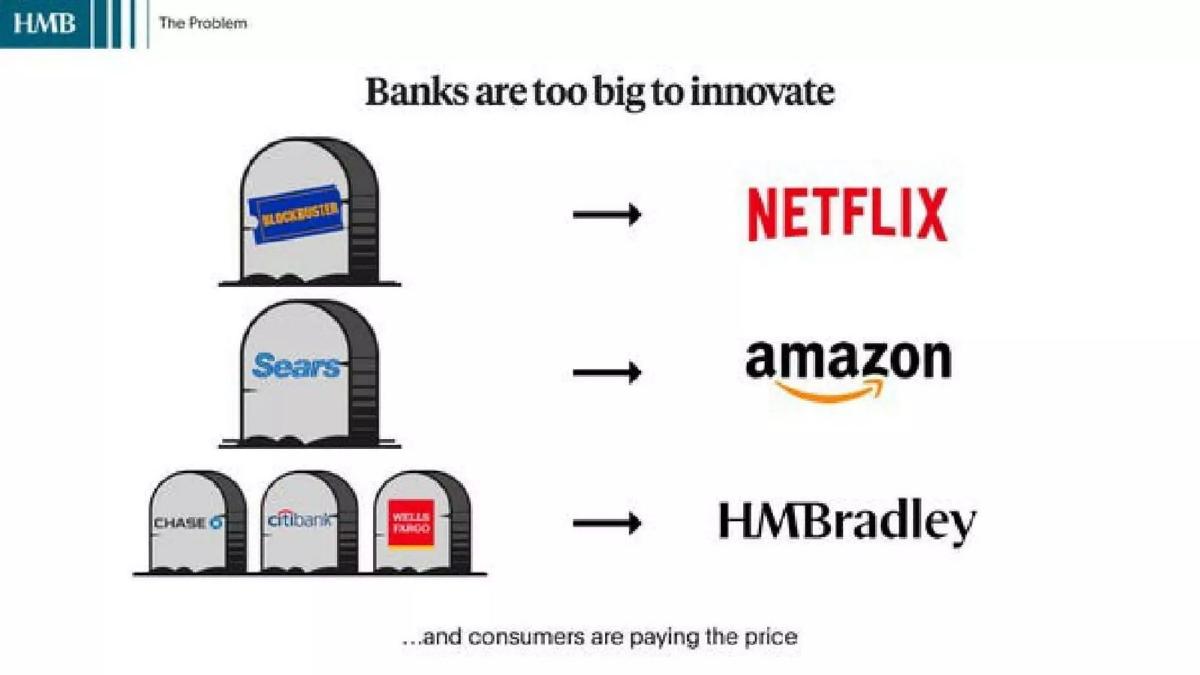
- The deck uses a 'tombstone' analogy on slide 2 to position legacy banks like Chase and Citibank as obsolete incumbents.
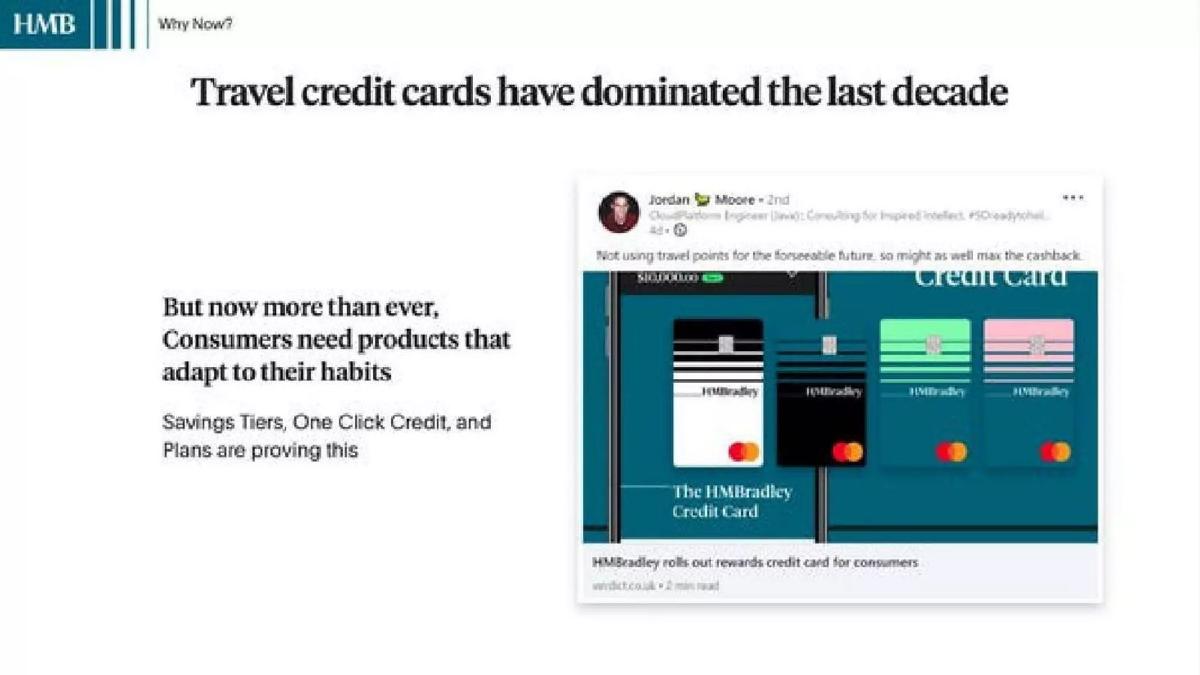
- HMBradley identifies a specific 'Why Now' by citing the decline of travel rewards cards in favor of habit-adapting products on slide 5.
- The company reports an extremely low Customer Acquisition Cost (CAC) of $14 on slide 9.
- Traction is demonstrated through a steep deposit balance growth curve on slide 8, though specific dollar amounts on the Y-axis are obscured.
- The product strategy relies on 'One Click Credit' to minimize lending CAC and improve acceptance rates through time-series data as shown on slide 10.
- The vision slides (11 and 12) explicitly map HMBradley's roadmap to Netflix's evolution from DVDs to original content.
- The team slide (13) emphasizes deep industry experience with logos from Goldman Sachs, Chase, Capital One, and Varo.
- The deck concludes with a direct $15 million ask on slide 14, omitting a specific breakdown of fund allocation.
The Narrative of the Disrupter
HMBradley’s pitch deck is built on a foundation of inevitable disruption. In the fintech world, founders often struggle to explain why another neobank needs to exist. HMBradley solves this by not just presenting a product, but by presenting a historical parallel. By comparing the banking industry to the fall of Blockbuster and Sears, they create a sense of urgency for investors to back the 'Netflix' of the space. The deck is concise, visually driven, and focuses on the transition from a simple savings tool to a comprehensive lending platform.
Slides 1-2: The Problem and the Analogy
The deck opens with a minimalist title slide, followed immediately by a bold 'Problem' slide. Slide 2 uses a tombstone graphic to illustrate that 'Banks are too big to innovate.' It places Blockbuster and Sears in the graveyard, showing their successors as Netflix and Amazon. The bottom row features Chase, Citibank, and Wells Fargo tombstones pointing toward HMBradley. This is a classic 'David vs. Goliath' framing that sets the stage for a high-stakes investment opportunity. It doesn't dwell on technical banking flaws; it focuses on the cultural and innovative stagnation of incumbents.
Slides 3-4: The Solution and Product Tiers
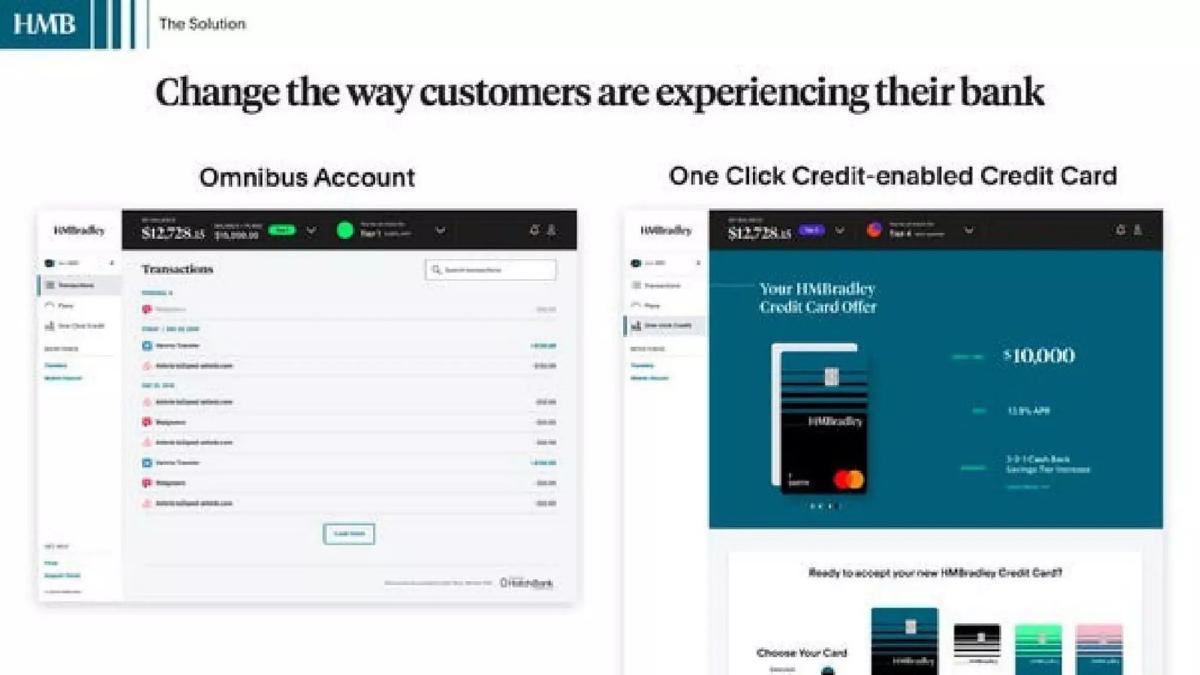
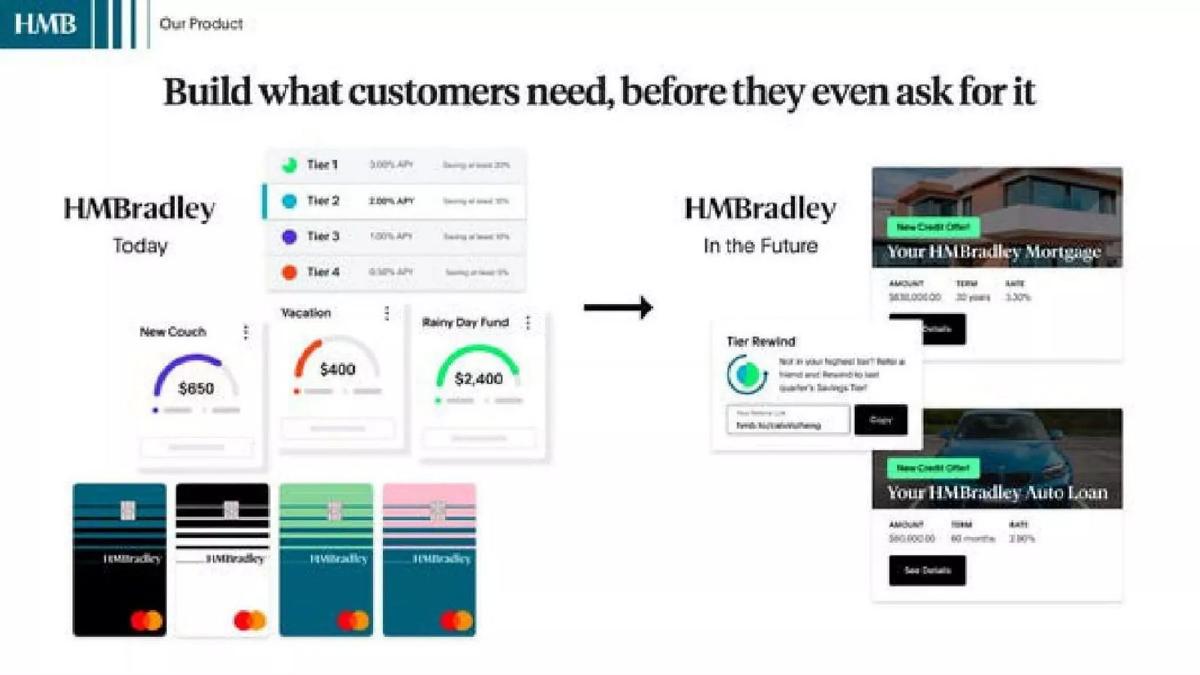
Slide 3 introduces the 'Omnibus Account' and 'One Click Credit-enabled Credit Card.' The visuals are clean dashboard screenshots, emphasizing a modern user interface. Slide 4 gets into the mechanics of their 'Today vs. Future' roadmap. 'Today' consists of four savings tiers: Tier 1 offers 3.00% APY for saving at least 20% of income, down to Tier 4 at 0.50% APY for saving less than 5%. This is the 'hook'—a product that gamifies savings. The 'Future' side of the slide introduces mortgages and auto loans, signaling that the current product is merely a customer acquisition vehicle for more lucrative financial services.
Slides 5-6: Market Timing and Audience
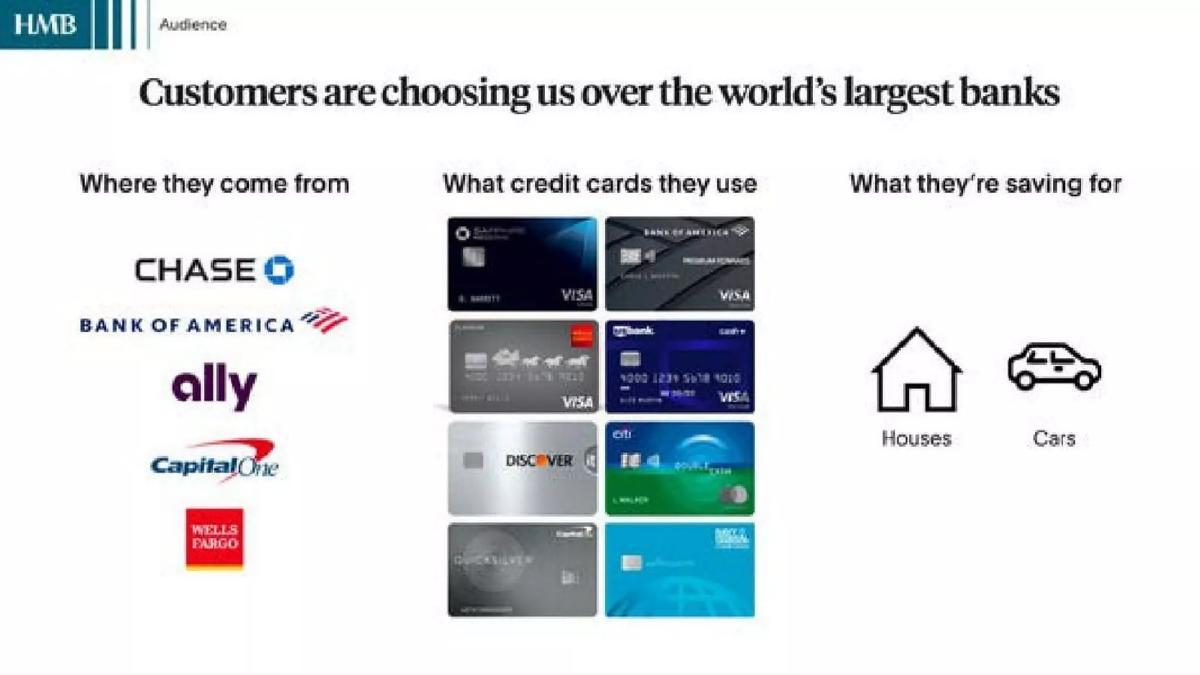
Slide 5 addresses 'Why Now?' It claims travel credit cards have dominated the last decade but argues that consumers now need products that adapt to their habits. It even includes a social media screenshot to provide 'social proof' of this shift in consumer sentiment. Slide 6 identifies the 'Audience.' It shows that HMBradley is successfully poaching customers from Chase, Bank of America, Ally, Capital One, and Wells Fargo. It also lists the premium cards these users currently carry, such as the Chase Sapphire and Amex Platinum, indicating that HMBradley is attracting a high-value, 'prime' customer base rather than the underbanked segment often targeted by other neobanks.
Slides 7-8: Market Opportunity and Traction
Slide 7 quantifies the 'Opportunity.' It notes the Top 4 banks are worth ~$1.1T, while banks 5-100 are worth ~$1.4T. Crucially, it points out that 'Current challengers' (like Chime, Varo, and MoneyLion) are worth less than $10B combined. This suggests there is still massive room for a new dominant player. Slide 8 presents the traction. The headline 'Growth makes it clear – we’ve struck a nerve' sits above a chart showing a steep upward trend in 'Deposit Balance.' While the Y-axis units are '$000', the specific numbers are small and hard to read, but the visual 'hockey stick' curve is the intended takeaway. It marks milestones like 'Began Advertising' and 'Announced Credit and App' to show how product launches directly correlate with growth.
Slides 9-10: Acquisition and Lending Strategy
Slide 9 is perhaps the most important for a Series A/B investor. It breaks down acquisition into Organic (NerdWallet, Fortune, Business Insider) and Paid (Instagram). The standout metric here is 'CAC extremely low at $14.' In the fintech space, where CAC often exceeds $100, a $14 acquisition cost is a powerful signal of product-market fit. Slide 10 explains the 'What’s Next' for lending. It outlines a four-step process: Better targeting -> Minimize Lending CAC -> Time-series data -> Improve Acceptance Rates. This slide articulates the business model: use cheap deposits to gather data, then use that data to sell high-margin loans with lower risk and lower cost than competitors.
Slides 11-12: The Netflix Vision
HMBradley returns to the Netflix analogy on Slide 11 , showing Netflix’s evolution from 'Mailing DVDs' to 'Personalized Content Library' to 'Original Content.' Slide 12 maps HMBradley’s plan to this trajectory. 'Plans' (savings) are the DVDs, 'Push, not pull' (one-click credit) is the personalized library, and 'Personalized credit offers' (mortgages/auto) are the original content. It includes a 'You are here' arrow pointing to the transition between savings and credit, clearly defining the purpose of the current funding round: to move into the 'Personalized credit' phase.
Slides 13-14: Team and The Ask
Slide 13 showcases the team. It is a 'logo-heavy' slide, featuring three founders with backgrounds at Cyndx, Goldman Sachs, and HVF. The broader team includes experience from Capital One, Farmers Insurance, Procore, Soylent, Medallia, Chase, Varo, Fair, and Microsoft. This is designed to de-risk the investment by showing the founders have both 'old guard' banking experience and 'new guard' tech experience. Finally, Slide 14 delivers a blunt 'Raising $15m' ask with a contact email. There are no details on valuation, terms, or use of proceeds, which is common in decks intended to start a conversation rather than close a deal on the spot.
What Works in This Deck
The strongest element of this deck is its narrative consistency . By using the Netflix analogy at both the beginning and the end, the founders create a cohesive story that is easy for an investor to repeat to their partners. The 'Netflix of Banking' is a high-concept pitch that sticks. Furthermore, the $14 CAC mentioned on slide 9 is a 'mic drop' metric. In a crowded neobank market, proving that you can acquire users for a fraction of the industry average is the most effective way to demonstrate a competitive advantage. The deck also does an excellent job of segmenting its audience . By showing logos of premium credit cards on slide 6, they signal that they are going after the 'profitable' bank customer, not just the 'unbanked' customer, which significantly changes the potential LTV (Lifetime Value) calculations for an investor.
What Is Missing
Despite its narrative strength, the deck leaves several critical questions unanswered. First, there is a total absence of unit economics . While a $14 CAC is impressive, we don't see the LTV or the payback period. Second, the revenue model is theoretical . The deck focuses on 'deposits' and 'future lending,' but it doesn't show current revenue or interest income. Third, there is no competitive landscape analysis beyond a few logos on slide 7. It doesn't explain how HMBradley specifically beats Chime or Varo, other than the implication that their 'tiered savings' model is superior. Finally, the use of proceeds is missing. A $15 million ask usually requires a high-level breakdown of how much will go to engineering, marketing, or regulatory capital.
What a Founder Should Copy
Founders should emulate HMBradley’s use of analogies to simplify a complex business model. If you are entering a crowded space, you need a 'mental model' that investors already understand. The 'Netflix' comparison does the heavy lifting for them. Additionally, the visual roadmap on slide 12 is excellent. It shows exactly where the company is today and where it is going, making the 'ask' feel like a bridge to a specific, lucrative future. Lastly, the traction chart on slide 8, while lacking specific Y-axis labels, effectively uses 'event markers' (like 'Began Advertising') to show that the founders have levers they can pull to drive growth. This demonstrates an understanding of their own growth engine, which is exactly what Series A and B investors are looking for.
Frequently asked questions
- What is HMBradley's core value proposition?
- HMBradley rewards users for sound financial habits regardless of income. As shown on slide 4, they offer a tiered savings model where higher savings rates (up to 3.00% APY) are unlocked by saving a higher percentage of monthly income. This turns the traditional banking model on its head by prioritizing habit over net worth.
- How does HMBradley plan to make money?
- The deck outlines a transition from a deposit-focused 'Omnibus Account' to high-margin lending. Slide 10 and 12 detail a 'Push, not pull' strategy for personalized credit offers, including auto loans and mortgages, leveraging the user's banking data to offer 'One Click Credit' with high acceptance rates.
- What competitive advantage does the deck highlight?
- Their primary advantage is data-driven lending efficiency. By acting as the user's primary bank, they collect time-series data (slide 10) that allows them to pre-approve credit products. This reduces the cost of acquisition for loans, which they claim is a 'unique lending opportunity' that legacy banks cannot match.
- Is there a detailed financial roadmap in this deck?
- No. The deck is notably missing a slide on unit economics, revenue projections, or a detailed breakdown of how the $15 million will be spent. It relies almost entirely on the growth of deposit balances and the pedigree of the team to justify the investment.
- Who is the target audience for HMBradley according to the deck?
- Slide 6 suggests they are targeting customers from major institutions like Chase, Bank of America, and Ally. These are typically 'savers' who currently use premium credit cards (like Chase Sapphire) but are looking for products that adapt to their specific saving and spending habits.