Design Partners on a Pitch Deck: How to Show What They
'Design partner' can mean a signed, paying customer or a friendly call. Four real decks show how to say who your design partners are.
Design Partners on a Pitch Deck: Say Who, What They Give and How They Convert
Early B2B founders often describe their first customers as design partners: companies that help shape the product in return for early access, influence or a discount. It is a useful arrangement and a common line in pitch decks. It is also one of the vaguest. The same two words can describe a signed agreement with a paying enterprise, a pilot under negotiation, or a contact who agreed to give feedback on a call. Investors know this, so a design-partner claim on its own carries little weight. This guide looks at four real decks that mention design partners and shows what makes the claim informative: who the partners are, what they have committed, what stage the relationship is at, and how it is meant to turn into revenue.
TL;DR
Name the design partners if you can, say what each has committed (time, data, money, a signed agreement), say whether the arrangement is signed, live or still being negotiated, and show the route from design partner to paying customer, with any conversions so far. Macrometa, in a Series A deck, names three: 'VMware, intuit, Awake Security as design partner customers', next to 'High ACV (> $250K) Enterprise Sales wins in 2020 at Verizon & Cox Communications', so the reader can see design partners alongside paying wins but not whether the partners themselves pay. Apteo heads a go-to-market slide 'We Are Finalizing Paid Pilots With Initial Design Partners' and says it is 'Currently in talks to close design partners among banks and asset managers', which is honest about stage but names no one. Footprint, in a written Series A memo, says of TreasuryPrime: 'we're working with them as a design partner on our tool here', tying one named partner to one product and one problem. Holdbar makes design partners step one of a go-to-market plan: 'Getting first 10-20 strong reference customers and "Design partners" through outbound', in '1-2 months of focused work with fast product iteration loop', which turns them into a target with a number and a time frame.
Four decks that describe design partners
Each page is read at full size. Quotes are exact.
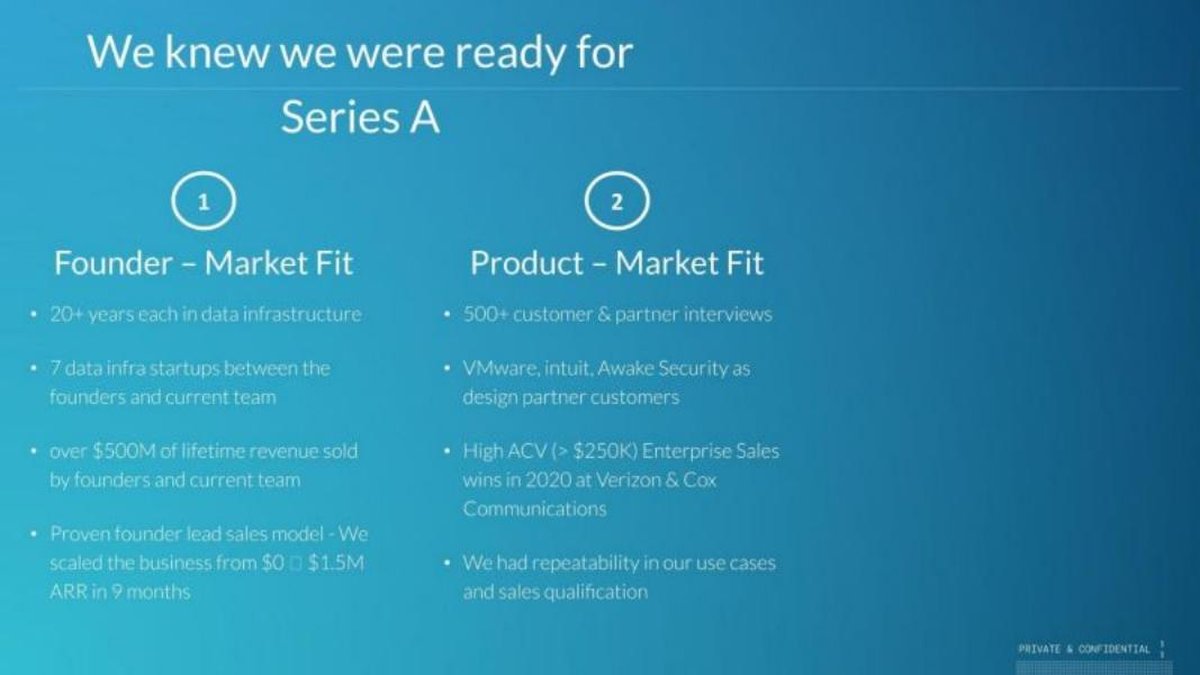
Macrometa traction slide — slide 33
Data infrastructure. Series A readiness slide.
Macrometa deck, slide 33. Exact stored slide matched to this analysis.
Our analysis: Names make the claim checkable; payment status is open.
Evidence and limitation: Three named design partners beside named paying wins; whether partners pay is not stated.
What a founder can adapt: Add paid or unpaid, and any conversions.
Supporting analysis
What the deck claims: "VMware, intuit, Awake Security as design partner customers"; "High ACV (> $250K) Enterprise Sales wins in 2020 at Verizon & Cox Communications".
Presentation choice: Shows the value of naming design partners.
When it does not fit: 'Design partner customers' without saying if they pay.
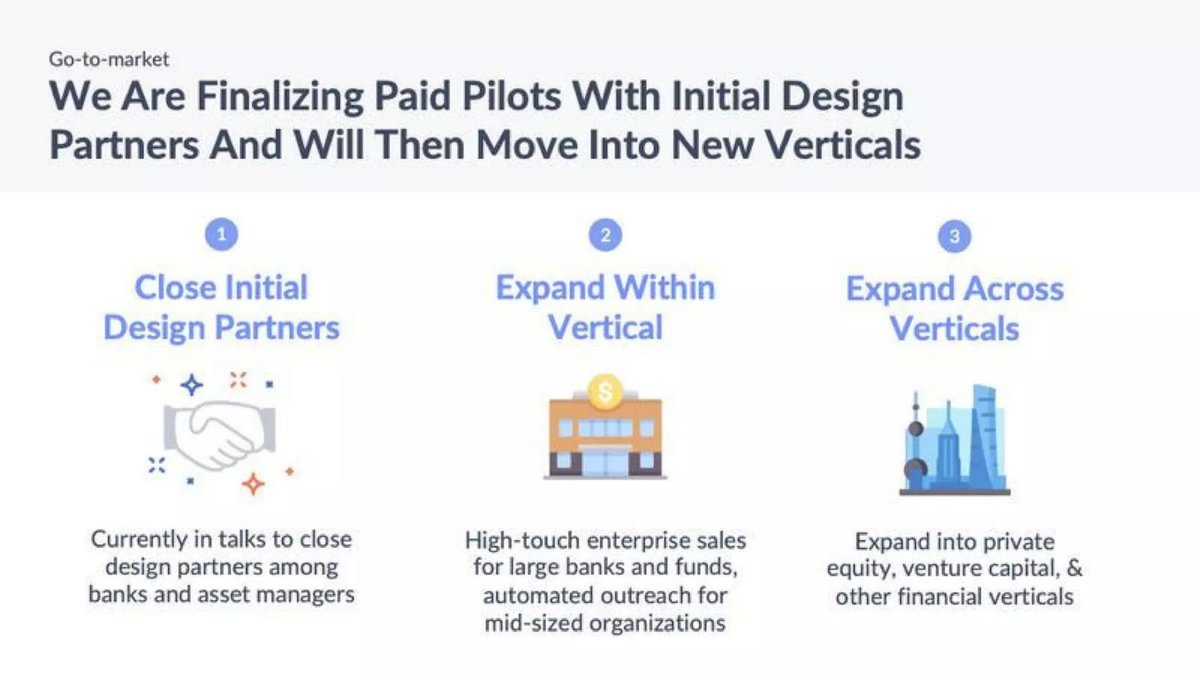
Analytics for financial firms. Three-step go-to-market slide.
Apteo deck, slide 8. Exact stored slide matched to this analysis.
Our analysis: Clear that nothing is signed; nothing to weigh.
Evidence and limitation: Stage stated honestly; no count, names or pilot terms.
What a founder can adapt: Add how many, how far along and pilot terms.
Supporting analysis
What the deck claims: "We Are Finalizing Paid Pilots With Initial Design Partners"; "Currently in talks to close design partners among banks and asset managers".
Presentation choice: Shows how to describe partners not yet signed.
When it does not fit: A segment in place of evidence.
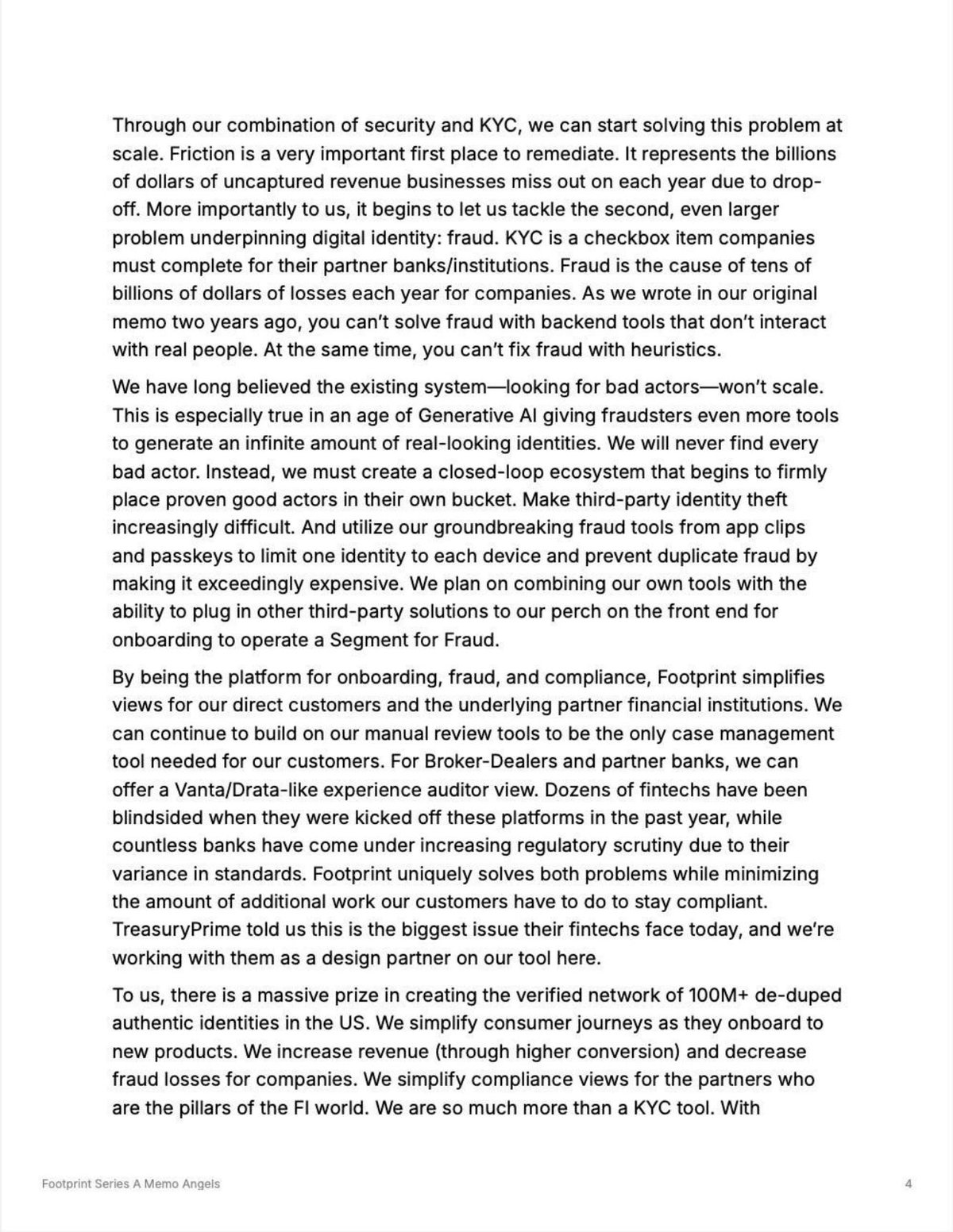
Identity verification. Written Series A memo to angels, not a slide.
Footprint deck, slide 13. Exact stored slide matched to this analysis.
Our analysis: The most specific claim; a platform partner could also be a channel.
Evidence and limitation: One named partner, one product, the partner's reason; no commitment or route to paid.
What a founder can adapt: Add what the partner commits and does at launch.
Supporting analysis
What the deck claims: "TreasuryPrime told us this is the biggest issue their fintechs face today, and we're working with them as a design partner on our tool here."
Presentation choice: Shows a design partner tied to a product and a problem.
When it does not fit: Leaving what happens after the design period unstated.
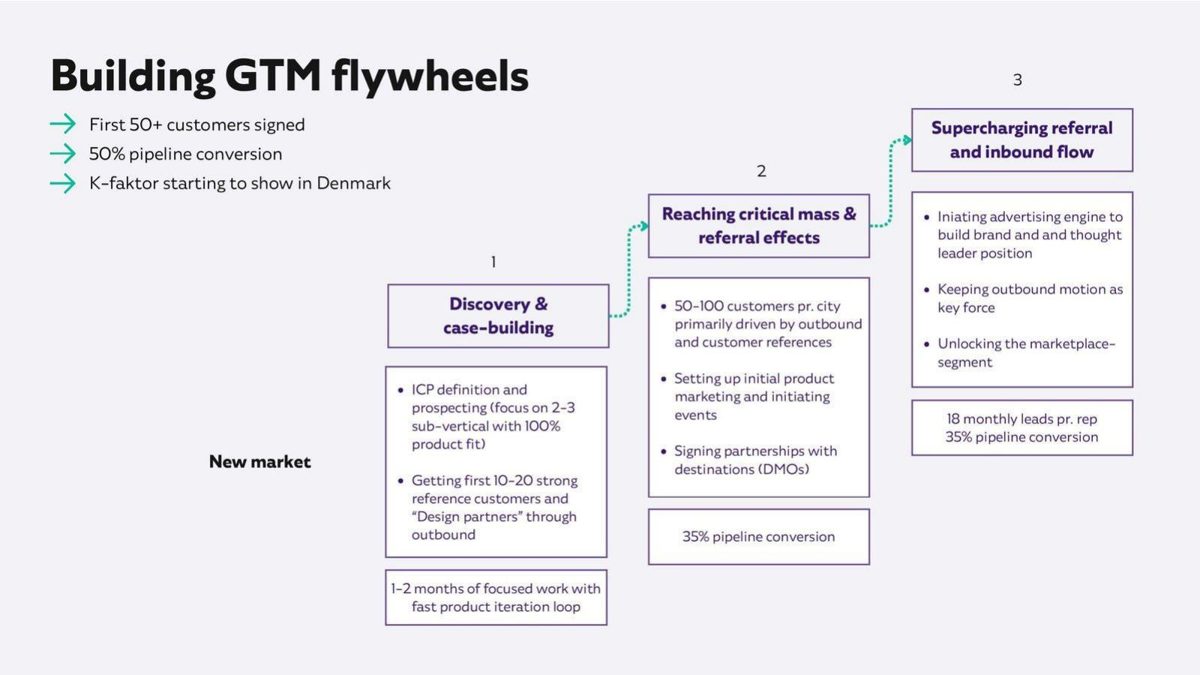
Booking software for activity operators. New-market playbook.
Holdbar deck, slide 12. Exact stored slide matched to this analysis.
Our analysis: Design partners as a repeatable, trackable step.
Evidence and limitation: Target number, method and time frame; conversion from design partner to customer not shown.
What a founder can adapt: Add the conversion rate from your first market.
Supporting analysis
What the deck claims: "Getting first 10-20 strong reference customers and \"Design partners\" through outbound"; "1-2 months of focused work with fast product iteration loop".
Presentation choice: Shows design partners as part of a plan.
When it does not fit: A planned step without evidence it worked before.
Name design partners, or give their segment and size if you can't.
Say what each partner commits: time, data, money or a signed agreement.
Say the stage: in talks, signed, live or converted.
Say what they get: discount, influence, early access.
Show the route to paid, and any conversions so far.
Keep design partners separate from paying customers in counts.
Describe your design partners
Answer these for each design partner before writing the slide.
Who. Can you name them? If not, what segment and size?
Commitment. What have they given: time, data, money or a signature?
Stage. Are they in talks, signed, live or converted?
Conversion. What happens at the end of the design period, and how many have converted?
Copyable framework: "[n] design partners ([names/segments]): [signed/paid/unpaid]; [n] converted to paid at $[x]."
Illustrative example 1 — written by us
Before: "VMware, intuit, Awake Security as design partner customers"
After: "Design partners: VMware, Intuit, Awake Security ([paid/unpaid], since [year]); [n] now paying."
What improved: Our illustrative rewrite of Macrometa's line. Bracketed details are not stated on the slide.
The question this guide answers
This guide answers one founder question: how should I present design partners on my pitch deck so that investors can tell what the relationship is worth?
Our paid-pilots draft covers trials that customers pay for, with a defined scope and a conversion decision. Our pre-revenue traction guide lists design-partner time among the kinds of evidence a company without revenue can show, alongside signed pilots and letters of intent. Our letters-of-intent draft covers written statements of intent to buy. None of these makes the design partnership itself the subject. A design partner may be unpaid and may never sign a pilot; what it gives is influence on the product, and what it promises is a first customer. The advice here is specific to that arrangement: what to disclose about who, what, how firm and how it converts.
How we chose and read the examples
We searched extracted text across the library for 'design partner' and 'design partners'. There were twelve matches. We set aside pages where the phrase refers to an architecture or product-design firm rather than an early customer, pages where it appears only in passing in a list of activities, and a deck page whose figures and product details are redacted. Four remained: a Series A deck that names design partners next to paying customers, a go-to-market slide that describes design partners still being negotiated, a written investor memo that ties one named partner to one product, and a go-to-market plan that sets a target number of design partners.
Footprint's page is from a written Series A memo to angels, not a slide; we include it because it shows a way of describing a design partner that works in a deck too. Each page was rendered from the source document and read at full size; Macrometa's light text on a blue background was enlarged before quoting. An arrow on the Macrometa slide did not render in the source file; we quote the figures on either side. We did not check any partnership, customer or figure against outside sources.
Why investors discount the phrase
It has no fixed meaning. A design partner may have signed a contract, paid a fee, given access to data and staff, or simply agreed to look at mock-ups. The phrase sounds the same in each case.
It is cheap to give. A large company can agree to be a design partner with little internal approval if nothing is paid or signed. That is why the commitment matters more than the name.
It often doesn't convert. Design partners shape a product for their own needs. Some become paying customers; some don't, because the budget holder was never involved or the product moved away from their use case. Investors want to know which pattern a company is seeing.
It can inflate customer counts. If design partners are counted as customers, the count overstates revenue-backed demand. Keeping them separate is a simple sign of a careful founder.
Named design partners beside paying wins: Macrometa
Macrometa, a data infrastructure company, has a slide in its Series A deck headed 'We knew we were ready for Series A'. Two columns follow. Under 'Founder – Market Fit': '20+ years each in data infrastructure', '7 data infra startups between the founders and current team', 'over $500M of lifetime revenue sold by founders and current team', and a line saying the team scaled the business from $0 to $1.5M ARR in 9 months. Under 'Product – Market Fit': '500+ customer & partner interviews'; 'VMware, intuit, Awake Security as design partner customers'; 'High ACV (> $250K) Enterprise Sales wins in 2020 at Verizon & Cox Communications'; and 'We had repeatability in our use cases and sales qualification'.
Naming design partners is the single most useful thing a founder can do with them, and Macrometa does it. Three recognisable companies tell an investor something about the product's target buyer and give the investor someone to call in diligence. Placing them next to named paying wins also shows the progression the company wants the reader to see: interviews, then design partners, then enterprise sales.
The phrase 'design partner customers' leaves the key question open: do VMware, Intuit and Awake Security pay? 'Customers' suggests yes; 'design partner' suggests possibly not. The slide also doesn't say what the partners contributed or whether any of them became the high-ACV wins. A short qualifier would answer this: 'design partners (two now paying)' or 'design partners, unpaid, [year]'. The '$0 to $1.5M ARR' line sits in the founder column, so it's unclear whether it refers to Macrometa or to a founder's earlier company; that needs a label too.
Design partners still being negotiated: Apteo
Apteo, an analytics company, has a go-to-market slide headed 'We Are Finalizing Paid Pilots With Initial Design Partners And Will Then Move Into New Verticals'. Three numbered steps follow. '1 Close Initial Design Partners': 'Currently in talks to close design partners among banks and asset managers'. '2 Expand Within Vertical': 'High-touch enterprise sales for large banks and funds, automated outreach for mid-sized organizations'. '3 Expand Across Verticals': 'Expand into private equity, venture capital, & other financial verticals'.
This slide is clear about stage. 'Currently in talks' and 'finalizing' tell the reader that no design partner is signed yet, and the headline says the arrangements will be paid. That honesty is worth copying: an investor who later learns that 'design partners' meant conversations feels misled; one told so upfront doesn't. The slide also puts design partners where they belong, as the first step of a sales plan, not as traction.
What's missing is anything the reader can weigh. There is no number of partners in talks, no sense of how far the talks have gone (first meeting or contract review), and no detail on what the paid pilots involve. 'Banks and asset managers' is a segment, not evidence. Even without names, 'in contract review with two of the top 20 US asset managers; pilots priced at $[x] for [n] months' would let the reader judge how close step one is.
One named partner tied to one product: Footprint
Footprint, an identity verification company, wrote its Series A pitch to angels as a memo. On page 13 it describes compliance tools for partner banks and broker-dealers, noting that many fintechs had been 'kicked off these platforms in the past year'. It then writes: 'TreasuryPrime told us this is the biggest issue their fintechs face today, and we're working with them as a design partner on our tool here.'
This is the most specific design-partner claim of the four. It names the partner, says which product the partnership is for, and gives the reason the partner cares, in the partner's own reported words. An investor can see that the design partner is an intermediary with many fintech customers, which makes it a potential distribution channel as well as a customer. That is a different and more valuable kind of design partner than a single end user, and the memo makes it visible.
It still doesn't say what TreasuryPrime commits or receives, or what happens when the tool is ready: whether TreasuryPrime will pay, resell, or recommend it. In a deck, a single line could carry all of this: 'TreasuryPrime (banking platform): design partner on compliance auditor view since [month]; plan: offer to its fintechs at launch.'
Design partners as a target with a number and a time frame: Holdbar
Holdbar, a booking software company for activity and tour operators, has a slide headed 'Building GTM flywheels'. Three results sit at the top left: 'First 50+ customers signed', '50% pipeline conversion' and 'K-faktor starting to show in Denmark'. A three-step plan for entering a new market follows. Step 1, 'Discovery & case-building': 'ICP definition and prospecting (focus on 2-3 sub-vertical with 100% product fit)' and 'Getting first 10-20 strong reference customers and "Design partners" through outbound', with a box beneath: '1-2 months of focused work with fast product iteration loop'. Step 2, 'Reaching critical mass & referral effects', targets '50-100 customers pr. city' and '35% pipeline conversion'. Step 3 adds advertising and a marketplace segment, with '18 monthly leads pr. rep' and '35% pipeline conversion'.
Holdbar treats design partners differently from the other three: not as a claim about the past, but as a repeatable step in its plan for each new market. Giving the step a target (10–20), a method (outbound) and a duration (1–2 months) turns a vague term into something an investor can track. Putting it under signed results from its home market ('First 50+ customers signed') suggests the playbook has been run once.
The quotation marks around 'Design partners' hint that the company sees them as a looser category than reference customers, but the slide doesn't say how they differ or whether they pay. It also doesn't show how many of the first 50 customers began as design partners, which is the evidence that the step works. 'In Denmark, [n] of our first 15 design partners became paying customers within [m] months' would make step 1 a proven step rather than a planned one.
What to put on the slide
Who. Name each design partner if they agree. If not, give segment and size: 'two of the top 20 US asset managers', 'a 400-store grocery chain'. If the partner is a platform or reseller, say so; it changes what the partnership is worth.
What they commit. Time from named staff, access to data or systems, a fee, a signed agreement, or a commitment to buy at launch. One or two words per partner is enough: 'signed, paid', 'unpaid, weekly sessions', 'data access'.
What they get. Discount, roadmap influence, early access, exclusivity for a period. This tells the reader what the company may have given away.
Stage. In talks, signed, live since [month], converted. Apteo's 'currently in talks' is the model for honesty here.
Route to paid. What happens when the design period ends, and what has happened so far: '[n] of [m] design partners converted to paid at $[x] ACV'. If none have converted yet, say when the first decision is due.
Counts. Keep design partners out of customer counts, or label the split: '12 customers (4 paying, 8 design partners)'.
Where design partners go in the deck
On the traction slide if they are the strongest evidence you have, with stage and commitment shown. On the go-to-market slide if they are a step in your sales plan, as Apteo and Holdbar use them. On the customer slide if you list named customers, with design partners labelled as such.
Don't put the same partners in three places with three descriptions. Pick the slide where the reader most needs them and refer back.
Templates
Traction line: '[n] design partners ([names or segments]): [signed/paid/unpaid]; [n] converted to paid at $[x].'
Single partner: '[Partner] ([type]): design partner on [product] since [month]; commits [what]; plan: [buy/resell/recommend] at launch.'
Stage, before signing: 'In [contract review / talks] with [n] [segment]; pilots priced at $[x] for [m] months.'
Plan step: '[n–m] design partners per market through [method] in [months]; [x]% converted in [first market].'
What these examples can and cannot show
These four documents show how founders have described design partners. They can't show whether the partnerships existed as described, what was signed or paid, whether any partner became a paying customer, or how investors weighed the claims. We did not check any partnership, customer or figure against outside sources.
Treat them as patterns. Macrometa names its partners next to paying wins but leaves their payment status open. Apteo is honest about stage and gives nothing to weigh. Footprint ties one named partner to one product and one problem. Holdbar turns design partners into a step with a target and a time frame but doesn't show its conversion rate.
Common mistakes
Unclear payment. 'Design partner customers' without saying whether they pay.
Segment as evidence. 'Banks and asset managers' with no count or stage.
No commitment. A named partner with nothing said about what it gives.
No route to paid. Nothing on what happens when the design period ends.
Inflated counts. Design partners counted as customers.
Diagnostic checklist
Partners named, or segment and size given.
Commitment stated per partner.
Stage stated: talks, signed, live, converted.
Conversions to paid shown, or next decision date.
Design partners kept separate from paying customers.
Frequently asked questions
Is an unpaid design partner worth putting on the deck?
Yes, if you say it's unpaid and what it does commit, such as staff time or data. Hiding the terms costs more credibility than the terms themselves.
What if a design partner won't let us use its name?
Give segment, size and stage, and offer the name in diligence under NDA.
How we chose these examples
Corpus: published pitch deck teardowns on StartupFundraising.com. Founder-uploaded private decks are excluded.
Selection (2026-10-01): we searched extracted text for 'design partner(s)', set aside design-firm uses, passing mentions and a redacted page, and kept four private-company documents each describing design partners differently.
Review: the four pages were rendered from the source documents on 2026-10-01 and read in full at full size against company, document and page number, with small text enlarged (editorial model review, with AI assistance in drafting; not human-reviewed). No partnership, customer or figure was checked against outside sources.