Fincheck's pitch deck is a study in minimalism, utilizing just 11 slides to pitch an AI-driven financial assistant. The presentation leans heavily on the pedigree of its founders, Ruth Polachek and Yehuda Granot, highlighting their backgrounds at Citibank, Seeking Alpha, and Gett. While the deck successfully identifies a massive $61 billion mid-market opportunity and visualizes the product's ability to aggregate digital information, it lacks critical investor data. There is no mention of current traction, revenue models, competitive landscape, or a specific funding ask. This suggests the deck…
Key takeaways
- The deck identifies a mid-market opportunity valued at $61 billion per year on slide 6.
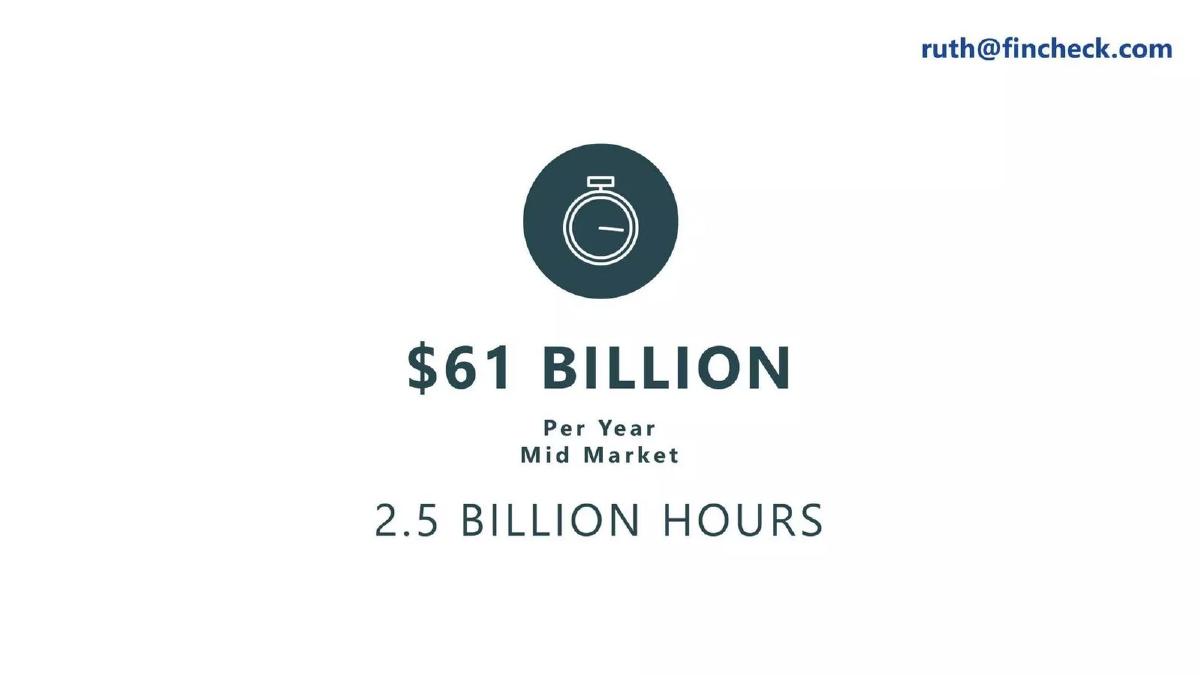
- Fincheck estimates that 2.5 billion hours are wasted on repetitive financial tasks annually, according to slide 6.
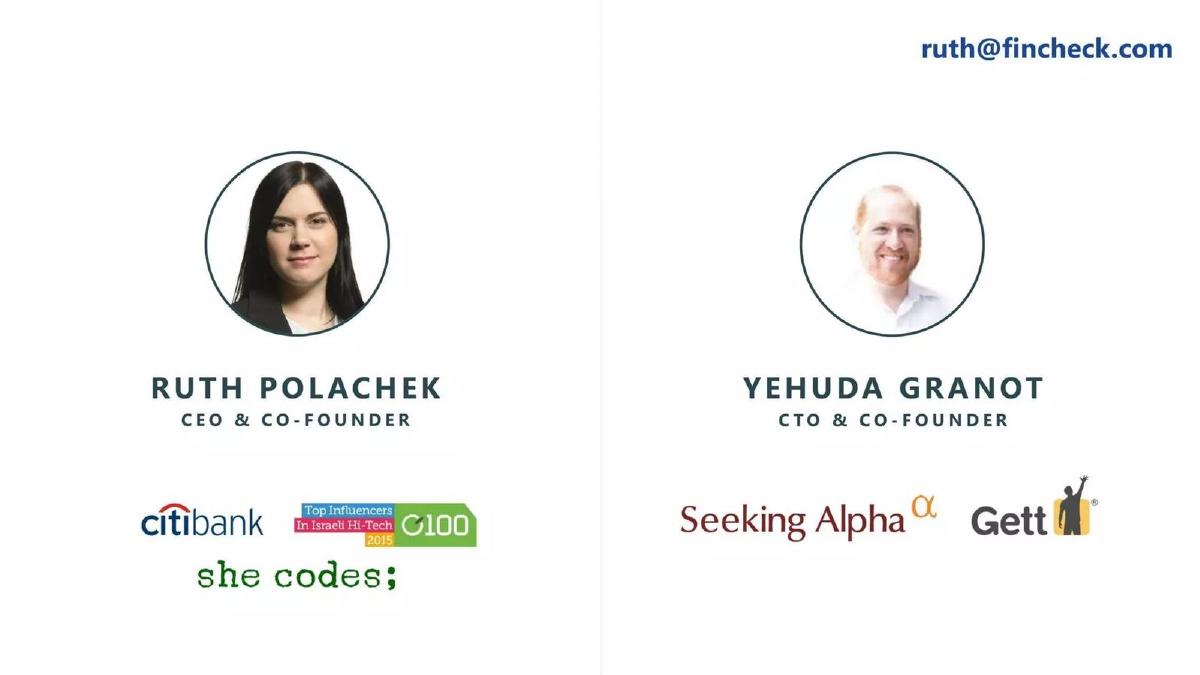
- The founding team features significant industry experience, with logos for Citibank, Seeking Alpha, and Gett displayed on slides 3 and 4.
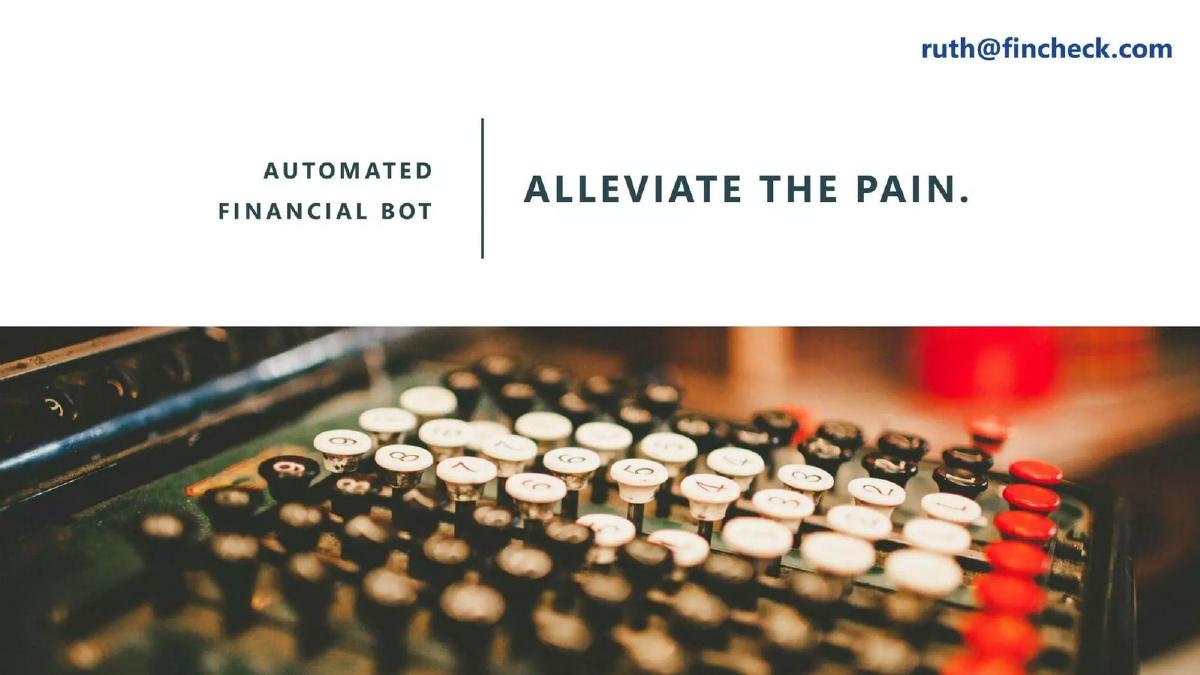
- The product is described as an 'Automated Financial Bot' designed to 'Alleviate the pain' of manual reporting on slide 5.
- Slide 7 illustrates the product's core function: connecting to users' digital information including bank statements, calendars, and emails.
- The technology relies on 'AI Machine Learning Models' to extract and generate data, as stated on slide 8.
- A mobile app interface for 'Expenses Summary' is showcased on slide 9, featuring categorized expense items.
- The deck concludes with high-level goals of 'Financial Health, Happiness, and Prosperity' on slide 10.
Introduction to the Fincheck Pitch Deck
Fincheck enters the fintech space with a highly visual, minimalist 11-slide deck. The company describes itself as a virtual assistant that uses machine learning to automate expense reporting, aiming to replace bureaucratic chores with an algorithmic solution. The deck is characterized by clean design, limited text, and a heavy reliance on the professional reputation of its founders. It functions more as a narrative of 'problem and solution' than a data-heavy business case.
Slides 1-2: The Hook and the Pain Point
Slide 1 is a simple title slide featuring the Fincheck logo and a small robot icon, establishing the brand's identity as an automated assistant. The design is sparse, using white space to focus attention on the brand name.
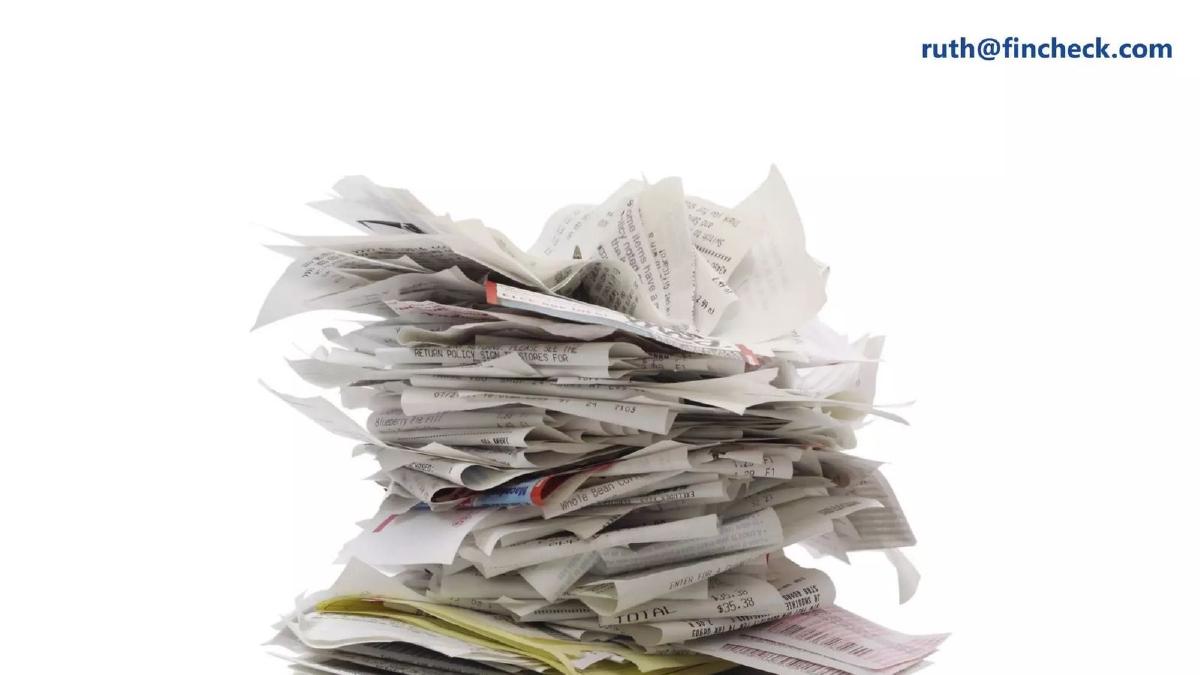
Slide 2 introduces the problem through a powerful visual metaphor: a massive, disorganized stack of paper receipts. There is no text on this slide other than the founder's email address in the corner, which appears on almost every slide. This 'show, don't tell' approach effectively communicates the chaos of manual expense management without needing a bulleted list of grievances.
Slides 3-4: The Team Pedigree
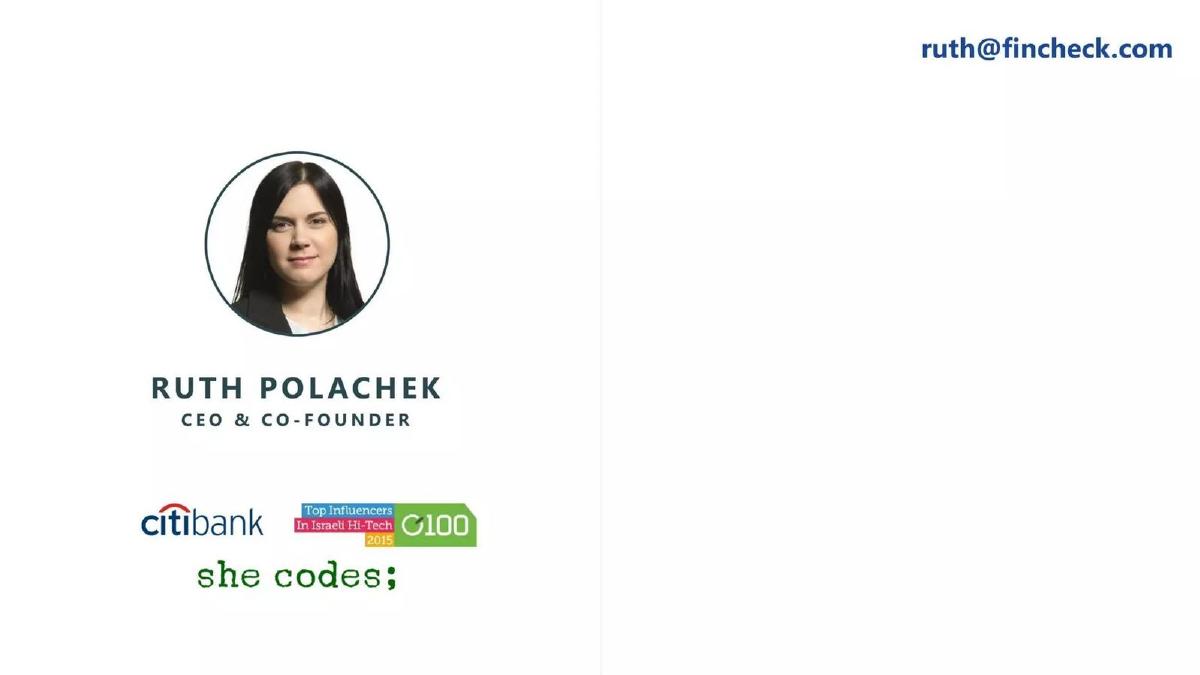
Slide 3 introduces Ruth Polachek, CEO and Co-Founder. Rather than a long bio, the slide uses logos to establish credibility. It features the Citibank logo, a badge for 'Top Influencers in Israeli Hi-Tech 2015,' and the logo for 'she codes;'. This immediately signals to investors that the leadership has both corporate financial experience and deep ties to the tech community.
Slide 4 expands the team view to include Yehuda Granot, CTO and Co-Founder. Similar to the previous slide, it relies on logos to convey experience, specifically citing Seeking Alpha and Gett. By highlighting a CTO with experience at a major financial content platform and a high-growth logistics startup, Fincheck suggests they have the technical capability to handle complex data extraction and scaling.
Slides 5-6: The Solution and Market Opportunity
Slide 5 defines the product as an 'Automated Financial Bot' with the primary directive to 'Alleviate the pain.' The background image of an antique mechanical calculator serves as a contrast to the modern AI solution they are proposing, suggesting that current methods are outdated.
Slide 6 provides the most significant data points in the deck. It claims a market size of $61 Billion per year for the 'Mid Market' and states that 2.5 Billion Hours are wasted on these tasks. This slide is critical because it moves the conversation from a personal annoyance (receipts) to a massive economic inefficiency. However, the deck does not cite the source for these figures, which is a common omission in early-stage decks.
Slides 7-9: Product Functionality and UI
Slide 7 explains the 'how.' It states that Fincheck 'Connects to Users’ Digital Information.' The slide shows screenshots of a Visa statement, a Google Calendar, and an Outlook inbox. This is a crucial technical claim: the bot isn't just scanning receipts; it is aggregating data from multiple disparate sources to build a comprehensive financial picture.
Slide 8 reinforces the technology stack, stating that 'AI Machine Learning Models Extract Data and Generate' reports. The use of gear icons is a bit generic, but the text confirms the automated nature of the backend process.
Slide 9 shows the 'Expenses Summary' on a mobile device. The UI displayed includes categorized expenses like '$1,250 Paid on May 18, 2017' and '$3,050' for another item. The interface looks clean and professional, showing 'Approved,' 'Pending,' and 'Paid' statuses. This slide proves that the product has moved beyond a concept and into a tangible user interface.
Slides 10-11: Vision and Contact
Slide 10 shifts to the high-level vision, titled 'Goals.' It lists 'Financial Health,' 'Happiness,' and 'Prosperity.' While these are aspirational, they lack the concrete business milestones usually found at the end of a pitch. The visual of three darts hitting a bullseye is a standard metaphor for precision and success.
Slide 11 is a simple closing slide with the founder's email address: ruth@fincheck.com . There is no 'Thank You' or call to action, just the contact information.
What Works in the Fincheck Deck
The primary strength of this deck is its clarity of purpose . Within the first five slides, an investor knows exactly what the problem is (receipt clutter), who is solving it (experienced founders), and how big the opportunity is ($61 billion). The minimalist design prevents the 'wall of text' syndrome that plagues many startup pitches.
The founder pedigree is also handled exceptionally well. By using recognizable logos like Citibank and Gett, the founders borrow institutional credibility. This is often more effective than a paragraph of text that an investor might skim. It positions the team as 'insiders' who understand the financial systems they are trying to automate.
Finally, the integration story on slide 7 is a strong selling point. By showing that the bot pulls from calendars and emails, Fincheck differentiates itself from simple receipt-scanning apps. It suggests a more holistic, 'invisible' automation that requires less manual input from the user.
What is Missing from the Fincheck Deck
The most glaring omission is the Business Model . There is no mention of how Fincheck intends to generate revenue. Is it a SaaS subscription for companies? A freemium model for individuals? A transaction-based fee? Without this, the $61 billion market figure feels disconnected from the company's actual potential.
There is also a total lack of Traction . The deck does not mention if they have a beta version, how many users are currently on the platform, or if they have any pilot programs with mid-market companies. For a product that relies on 'AI and Machine Learning,' investors typically want to see evidence that the algorithms actually work on real-world data.
The Competitive Landscape is ignored entirely. Expense management is a crowded field with incumbents like Concur and Expensify, as well as newer players. Fincheck does not explain why their 'bot' approach is superior to existing automated solutions or how they plan to defend their market share.
Lastly, there is no Ask . A pitch deck is a tool to raise money, yet this deck never specifies how much capital is needed or what that capital will be used to achieve. This makes the deck feel more like a general presentation than a fundraising document.
What a Founder Should Copy
Founders should emulate the visual storytelling used in the first half of the deck. The receipt stack on slide 2 is a perfect example of identifying a 'pain point' through imagery. It creates an emotional response that text rarely achieves.
The logo-based team slide is another best practice. If you have worked at reputable companies or won specific awards, let the logos do the talking. It keeps the slide clean and allows the investor to quickly validate your background.
Finally, the focus on a specific market segment (Mid Market) on slide 6 is a good move. Rather than claiming to solve expenses for 'everyone,' Fincheck narrows its focus, which makes the $61 billion figure feel slightly more attainable, even if the path to capturing it isn't fully explained in these 11 slides.
Conclusion
Fincheck's deck is an excellent example of a 'teaser' deck. It is designed to spark interest and secure a meeting rather than close a deal on its own. While it succeeds in establishing a professional tone and identifying a large problem, it leaves too many unanswered questions regarding the business's viability and competitive edge. For a full seed or Series A round, a founder would need to supplement this deck with at least five additional slides covering unit economics, competition, traction, and the specific funding request.
Frequently asked questions
- What is the primary problem Fincheck is solving?
- Fincheck targets the inefficiency of manual expense reporting and repetitive financial tasks. Slide 2 uses a visual of a large stack of paper receipts to represent the 'pain' of bureaucracy. Slide 6 quantifies this problem, stating that 2.5 billion hours are lost to these tasks annually, specifically within the mid-market segment.
- How does the Fincheck technology work?
- According to slides 7 and 8, the system connects to a user's digital ecosystem, including credit card statements (Visa), Google Calendars, and email inboxes (Outlook). It then uses AI and machine learning models to extract relevant data from these sources and automatically generate expense reports, which are then displayed in a mobile summary view.
- Who are the founders of Fincheck?
- The company was co-founded by Ruth Polachek (CEO) and Yehuda Granot (CTO). Their credentials, shown on slides 3 and 4, include Polachek's association with Citibank and the 'she codes;' community, and Granot's experience at Seeking Alpha and the ride-sharing company Gett. Polachek was also recognized as a 'Top Influencer in Israeli Hi-Tech' in 2015.
- What market size does Fincheck target?
- Fincheck focuses on the mid-market. Slide 6 explicitly cites a market value of $61 billion per year. The deck positions the solution as a way to reclaim billions of hours of lost productivity, though it does not provide a breakdown of how the $61 billion figure was calculated or which specific geographies it covers.
- What is missing from the Fincheck pitch deck?
- The deck is missing several standard venture capital requirements. There is no business model slide explaining how the company makes money, no traction slide showing current user growth or revenue, no competitive analysis, and no 'Ask' slide detailing how much capital is being raised or the intended use of funds.