The Antic Entertainment presentation, delivered by co-founder Fredrik Liliegren, is not a standard fundraising deck but rather a thematic overview of financing options for early-stage companies. Across 13 slides (7 provided), the deck moves from founder background to a pros-and-cons analysis of different capital sources. It highlights the CEO's experience in raising over $15 million and managing companies for over 20 years. The content is tailored for an Ontario-based audience, specifically mentioning local angel groups. While it lacks company-specific metrics, product details, or a financial…
Key takeaways
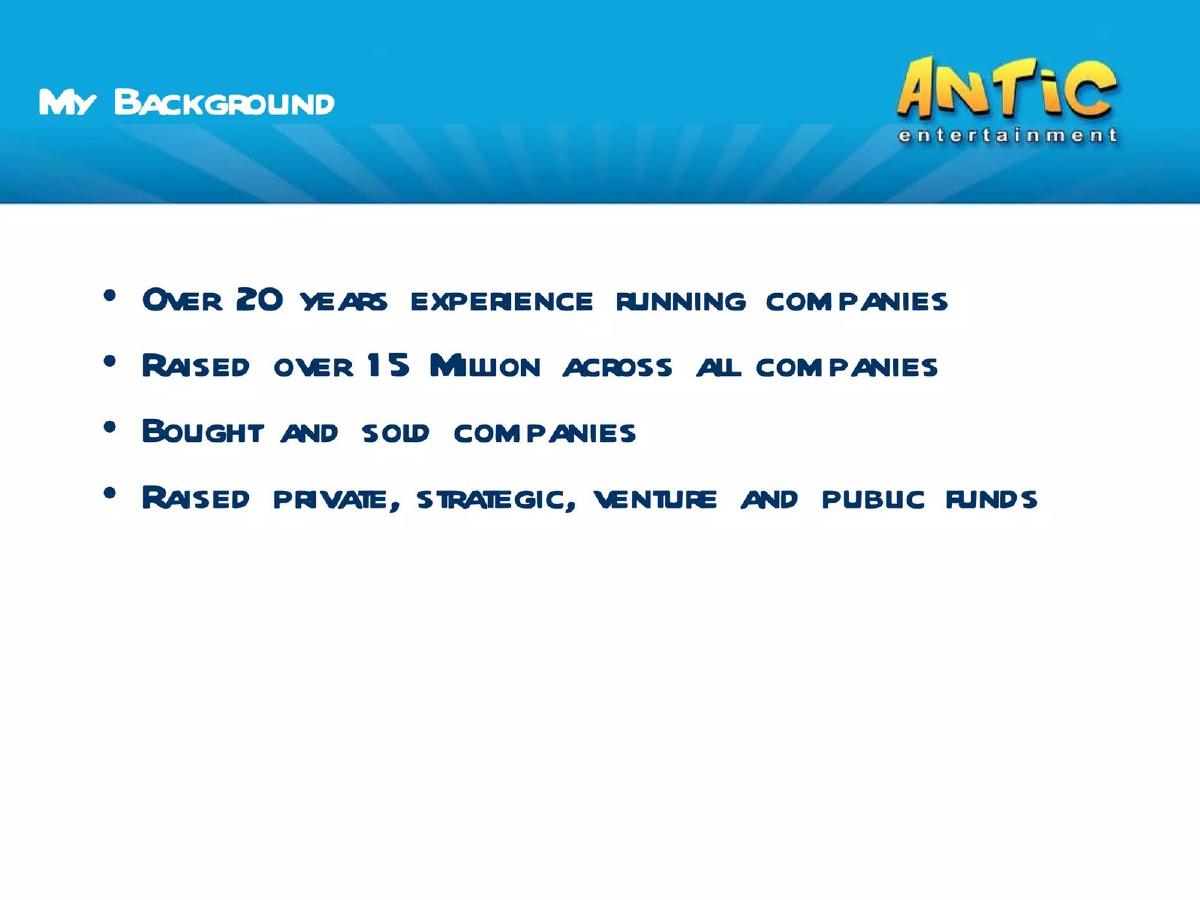
- The presenter, Fredrik Liliegren, claims over 20 years of experience running companies and has raised over $15 million in total (Slide 2).
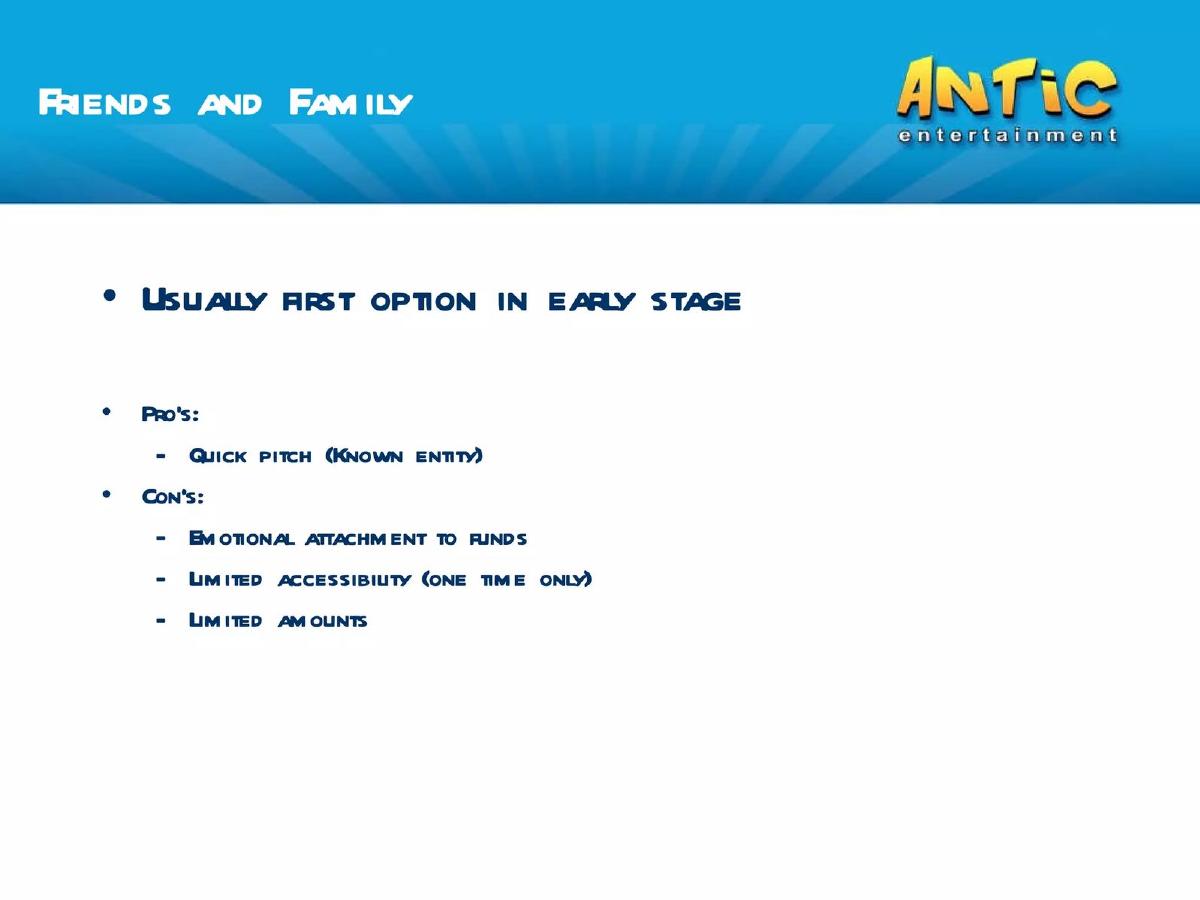
- Friends and family rounds are identified as the typical first option, but carry the risk of emotional attachment to funds (Slide 3).
- The deck specifically identifies Ontario as a viable location for angel group funding (Slide 4).
- A primary con for angel investors in the region is a lack of understanding of the gaming space (Slide 4).
- Debt financing is categorized as expensive due to interest and guarantee requirements, and is generally unavailable for early-stage startups without profit (Slide 5).
- Public funding is presented as a late-stage option that offers instant wealth acceleration but increases costs for PR and finance (Slide 6).
- The deck omits all standard startup pitch elements including product description, market size, business model, and specific funding ask.
- The presentation was likely delivered at the DIG 2011 conference, as indicated by the logo on the title slide (Slide 1).
Overview: An Educational Framework Rather Than a Pitch
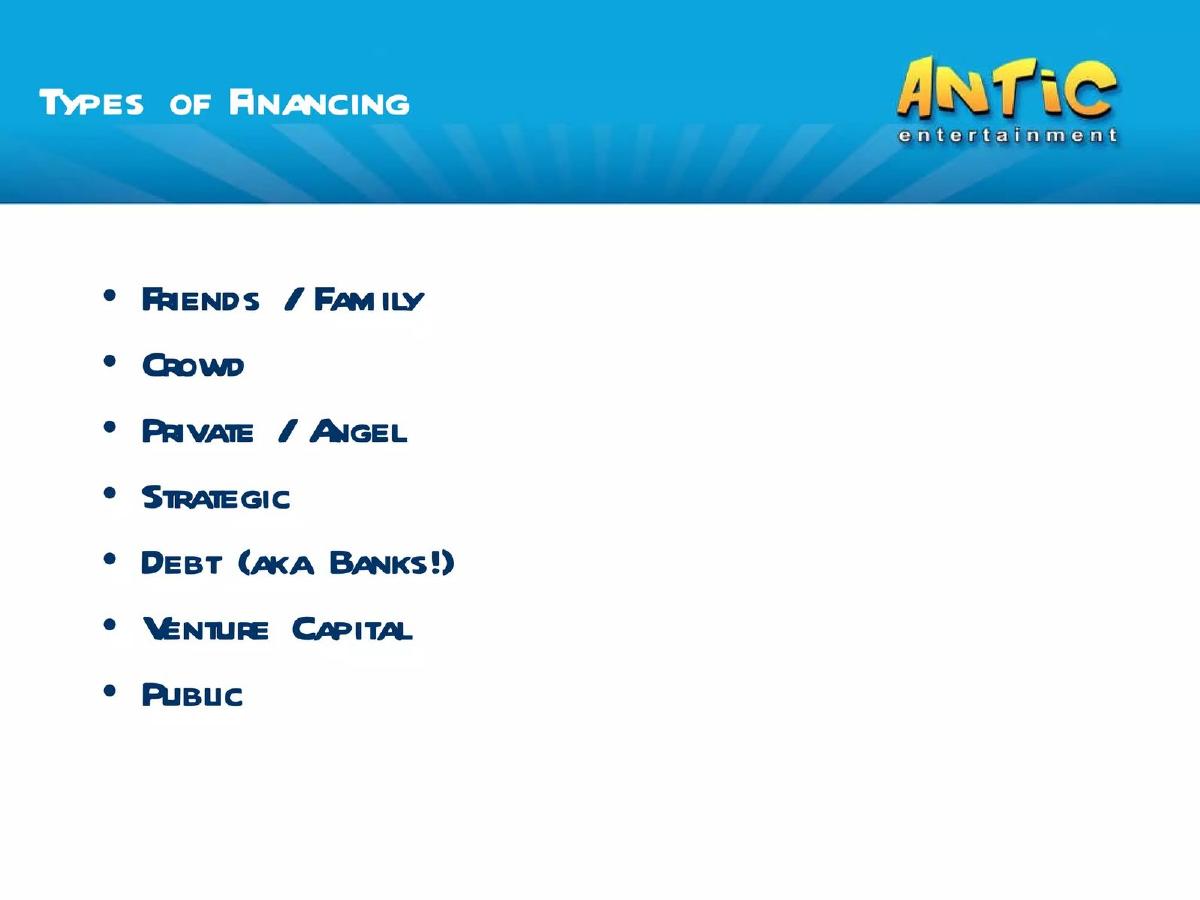
The Antic Entertainment deck is a departure from the standard venture capital pitch. While it carries the company's branding and the credentials of its CEO, the content is structured as a primer on the capital stack. It was likely delivered at a conference—specifically DIG 2011—to educate other founders on the realities of fundraising. The deck is minimalist, using bullet points to weigh the advantages and disadvantages of four primary funding sources: Friends and Family, Angels, Debt, and Public Markets.
Slide 1: Title and Branding
The title slide is simple, featuring the text Financing options in a white serif font against a blue gradient background. The Antic Entertainment logo is positioned in the bottom left, identifying Fredrik Liliegren as the Co-Founder and CEO. A 'dig 2011' logo in the bottom right suggests the venue was the Digital Interactive Gaming conference. This slide sets the stage for a thematic presentation rather than a specific company deep-dive.
Slide 2: Founder Background
This slide serves to establish the speaker's authority. Liliegren lists four key credentials: Over 20 years experience running companies , having Raised over 15 million across all companies , experience in M&A ( Bought and sold companies ), and experience with diverse funding types including private, strategic, venture, and public funds. By leading with these figures, the presenter justifies why the audience should listen to his analysis of financing options.
Slide 3: Friends and Family
The deck categorizes Friends and Family as the Usually first option in early stage . The pros are limited to a Quick pitch because the investors are a Known entity . However, the cons are more descriptive, highlighting the Emotional attachment to funds , which can complicate personal relationships. It also notes Limited accessibility , calling it a one time only resource, and mentions that the amounts available are typically small.
Slide 4: Private / Angel Investors
This slide moves into professional early-stage capital. It notes that these groups are Available in Ontario . The pros include Experienced investors with patience and the fact that they add more then funds (sic), such as support services and connections to other funding. The primary con listed is a Locally not understanding of this space (games) , suggesting that while the capital exists in Ontario, the sector expertise may be lacking.
Slide 5: Debt (AKA Banks)
The analysis of debt is pragmatic. It is described as a Very well established system but Expensive since they want interest + Guarantees . The pros include Almost unlimited access , provided the company is growing. The cons are a significant barrier for most startups: banks Makes only 'safe' bets and are Not for early stage as you need to show positive cash flow & profit . This slide serves as a reality check for founders who view bank loans as a viable alternative to equity in the pre-revenue phase.
Slide 6: Public Markets
The final financing category discussed is Late Stage Funding via public markets. The pros are focused on liquidity: A instant acceleration of your personal wealth/worth and the ability to grow via acquisition without cash (using stock as currency). The cons focus on the operational burden: the Focus on short term becomes instant , the high cost of PR, finance etc , and the constant external pressure from shareholders and regulators.
Slide 7: Questions & Contact
The final slide is a standard closing slide with a large question mark. It provides Liliegren's email at anticentertainment.com and his Twitter handle, @DancingSwede. This reinforces the nature of the deck as a speaking presentation meant to engage an audience in a Q&A session.
What Works in This Deck
Clear Categorization: The deck does an excellent job of breaking down the complex world of finance into four digestible buckets. For a founder just starting out, this taxonomy is highly useful. · Honest Trade-offs: Instead of glorifying fundraising, the slides highlight the 'cons' of every path. Mentioning the 'emotional attachment' of family money or the 'short term focus' of public markets provides a balanced view. · Credibility Building: Slide 2 effectively uses hard numbers (20 years, $15 million) to establish the speaker as an expert. This is a critical step when the goal is to educate rather than just sell. · Regional Specificity: By mentioning Ontario and the local angel scene's lack of gaming knowledge, the deck provides actionable, localized intelligence for its specific audience.
What Is Missing from This Deck
Company Metrics: There is zero information about Antic Entertainment's revenue, user base, or growth. If this were a pitch deck, it would fail immediately for lack of data. · Product Vision: The deck does not explain what Antic Entertainment actually does or what games they are developing. · Market Analysis: There is no mention of the size of the gaming market, competitors, or the specific problem the company is solving. · The Ask: The deck never specifies how much money is being raised, the valuation, or the intended use of proceeds. · Team Slide: While the CEO is featured, the rest of the leadership team and their technical capabilities are omitted.
What a Founder Should Copy
The Pros/Cons Format: When presenting options to a board or a team, using the bulleted pro/con list seen in Slides 3 through 6 is a highly effective way to drive decision-making. · The Background Slide: Slide 2 is a great template for a 'Why Me' slide. It focuses on high-level achievements (years of experience, total capital raised) rather than a long, boring resume. · Minimalist Design: The slides are not cluttered. Each slide has a single focus, making it easy for an audience to follow a verbal presentation without being distracted by walls of text. · Direct Language: The deck uses plain English to describe financial concepts. Avoiding jargon makes the content accessible to founders who may not have a finance background.
Final Analysis
The Antic Entertainment 'Financing Options' deck is a specialized tool for a specific moment: a conference presentation. It succeeds as a teaching aid because it distills complex financial structures into simple, relatable points. However, it should not be used as a template for a seed or Series A pitch deck. A real pitch requires the 'why now' and 'how much' that this deck intentionally ignores. For founders, the value here lies in the CEO's perspective on the 'hidden costs' of capital—reminding us that every dollar raised comes with a specific type of baggage, whether it is a bank's demand for profit or a family member's emotional stake.
Frequently asked questions
- Is this a pitch for investment in Antic Entertainment?
- Based on the provided slides, no. This is an educational or keynote presentation about financing options. It does not include a slide for the company's product, market opportunity, or a specific 'ask' for capital. It uses the Antic Entertainment branding but focuses on teaching the audience about the pros and cons of different funding sources.
- What is the founder's track record according to the deck?
- Fredrik Liliegren cites significant experience, stating he has over 20 years of experience running companies. He also claims to have raised more than $15 million across all his ventures and has experience in both buying and selling companies. This establishes him as a veteran in the startup ecosystem rather than a first-time founder.
- What specific regional information is included?
- The deck mentions Ontario specifically in the context of Private/Angel funding. It notes that angel groups are available in Ontario but highlights a specific challenge: a local lack of understanding regarding the gaming industry. This suggests the presentation was likely given to a Canadian audience of entrepreneurs or students.
- How does the deck view debt financing for startups?
- The deck is cautious regarding debt. It labels banks as a 'very well established system' but warns they are expensive because they require interest and personal or corporate guarantees. Crucially, it notes that debt is not for early-stage companies because banks require proof of positive cash flow and profit before lending.
- What are the stated downsides of going public?
- According to slide 6, the downsides of public funding include an 'instant' shift to short-term focus, high costs for professional services like PR and finance, and 'constant external pressure.' While it acknowledges the benefit of wealth acceleration, it frames the public market as a high-maintenance environment.