Real Estate Problem Slide: Real Pitch Deck Examples
How real estate and proptech startups present the problem in a pitch deck: name who in the property transaction feels the pain, measure it.
Real Estate Problem Slide: Real Pitch Deck Examples
Eight problem slides from real estate and proptech startups, shown in full, compare how each names the person in the property deal who feels the pain, puts a number on it, and explains why current tools or options fail them.
TL;DR
A proptech problem slide should answer three questions: which party in the property deal has the problem (owner, tenant, host, developer, agent or lawyer), how big is the cost in days, money or missed deals, and why the current option does not fix it? Northspyre opens with "More than 3/4 of real estate projects finish over-budget" and then says existing tools "focus on document and task management not critical financial drivers." Reesio names Zillow and Trulia and says their data is "2 days to 2 weeks old." Smart Host shows that hosts "can't price specific nights, while hotels set different prices for each night." The Co-Own lists three broad statements about millennials and housing with no number or source, so an investor cannot size the problem.
Proptech problem slides from real pitch decks
Each example shows the exact stored slide above its analysis and links to the full teardown. Claims are as shown on the slides; we have not verified them.
Northspyre problem slide — slide 2
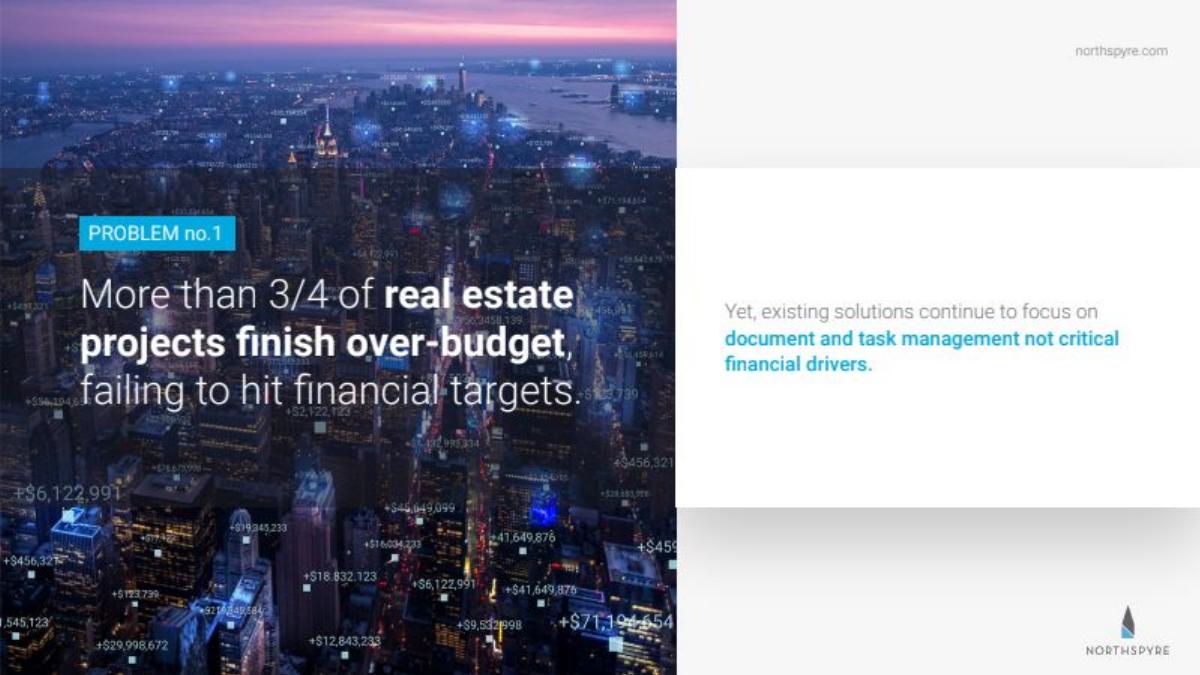
Budget and project software for real estate developers. One large claim over a city photo, with a line on current tools.
Northspyre deck, slide 2. Exact stored slide matched to this analysis.
Our analysis: The whole problem fits in one number and one sentence on why today's software misses it.
Evidence and limitation: The three-quarters figure is shown without a source on the slide.
What a founder can adapt: State the cost as a share of deals or projects, then say what current tools track instead.
Supporting analysis
What the deck claims: "PROBLEM no.1. More than 3/4 of real estate projects finish over-budget, failing to hit financial targets." "Yet, existing solutions continue to focus on document and task management not critical financial drivers."
Presentation choice: It names the party (developers running projects), the cost (overruns) and the gap in current tools in two sentences.
When it does not fit: Cite the source for the three-quarters figure, and give an overrun size (percent or dollars) so investors can size the loss.
Real estate transaction software for agents. The first of two numbered problem slides, naming the listing sites.
Reesio deck, slide 2. Exact stored slide matched to this analysis.
Our analysis: It names the incumbents buyers already use and shows exactly how their weakness costs a buyer a home.
Evidence and limitation: Data age as stated; not verified.
What a founder can adapt: Name the tool your customer uses now, give its failure a number, and show what that failure costs them.
Supporting analysis
What the deck claims: "PROBLEM #1: ZILLOW & TRULIA HAVE BAD DATA." "It's Old and Inaccurate: They pull data from MLS's and county records, both of which aren't updated frequently. Their Data ends up being 2 days to 2 weeks old." "With old data, even 2 days old: Properties go from being Not For Sale to being For Sale, Properties go into Contract… Buyers end up completely missing out on properties."
Presentation choice: Naming Zillow and Trulia makes the problem specific and shows the founders know where buyers look today.
When it does not fit: Cut the text by half; the consequence (buyers miss properties) is buried at the bottom.
Pricing software for short-term rental hosts. A headline and three short pains, each with an icon.
Smart Host deck, slide 5. Exact stored slide matched to this analysis.
Our analysis: It compares hosts with hotels, a competitor that already prices every night, which makes the gap easy to picture.
Evidence and limitation: No figures.
What a founder can adapt: Show what a better-equipped competitor does that your customer cannot.
Supporting analysis
What the deck claims: "Hosts guess at pricing. Because they don't know when competitors' properties get booked." "Can't price against competition." "Can't price specific nights. While hotels set different prices for each night." "Can't react to supply and demand changes. Even though hotels update prices over time."
Presentation choice: One party (hosts), one behaviour (guessing) and a clear reason: they lack booking data.
When it does not fit: Add one number: how much revenue a typical host loses by pricing flat.
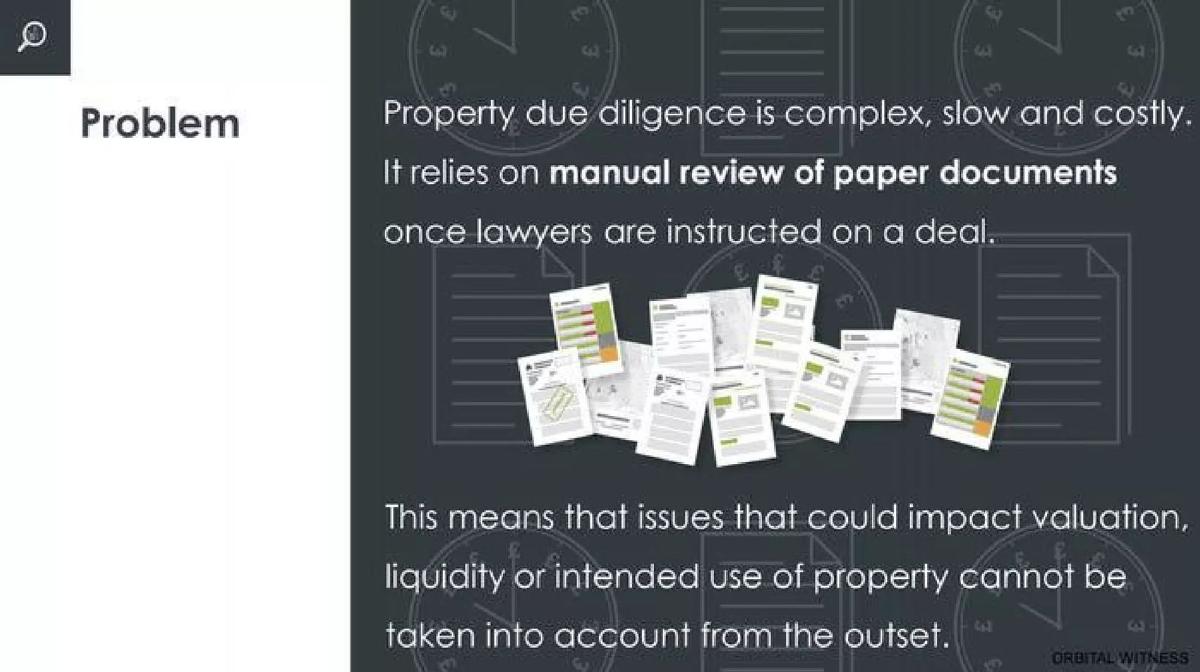
Property due diligence software for lawyers. Two sentences over a photo of paper documents.
Orbital Witness deck, slide 2. Exact stored slide matched to this analysis.
Our analysis: It explains the consequence, not just the inconvenience: problems surface after the price is agreed.
Evidence and limitation: No figures.
What a founder can adapt: Say at which step of the property deal the problem shows up and what it costs to find it late.
Supporting analysis
What the deck claims: "Property due diligence is complex, slow and costly. It relies on manual review of paper documents once lawyers are instructed on a deal." "This means that issues that could impact valuation, liquidity or intended use of property cannot be taken into account from the outset."
Presentation choice: The "once lawyers are instructed" detail tells investors exactly when in the deal the pain happens.
When it does not fit: Put a number on "slow and costly": weeks of review, legal fees per deal or deals that fall through.
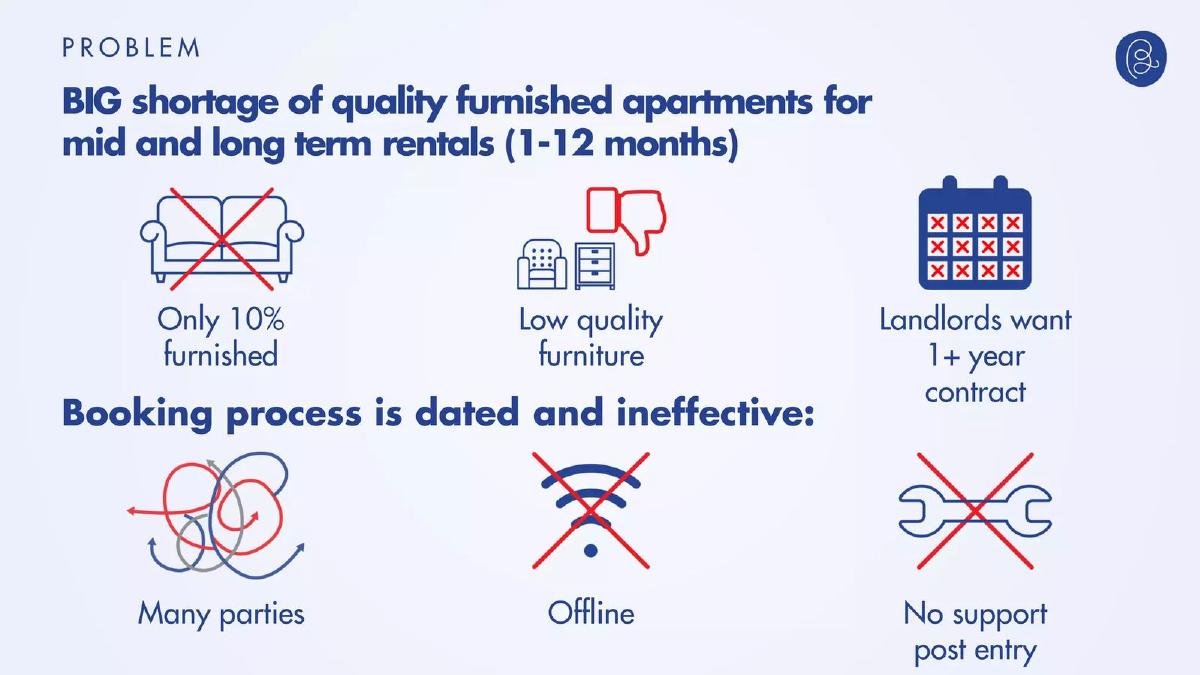
Furnished apartments for stays of one to twelve months. Two problems, supply and booking, with six icons.
Blueground deck, slide 4. Exact stored slide matched to this analysis.
Our analysis: It defines the gap precisely: stays of one to twelve months, too long for hotels and too short for landlords.
Evidence and limitation: The 10% figure is shown without a source.
What a founder can adapt: Define the exact segment left unserved, and say why the existing suppliers won't serve it.
Supporting analysis
What the deck claims: "BIG shortage of quality furnished apartments for mid and long term rentals (1-12 months)." "Only 10% furnished." "Low quality furniture." "Landlords want 1+ year contract." "Booking process is dated and ineffective: Many parties. Offline. No support post entry."
Presentation choice: "Landlords want 1+ year contract" explains why the market has not fixed itself.
When it does not fit: Name the city and source the 10% figure; supply problems are local.
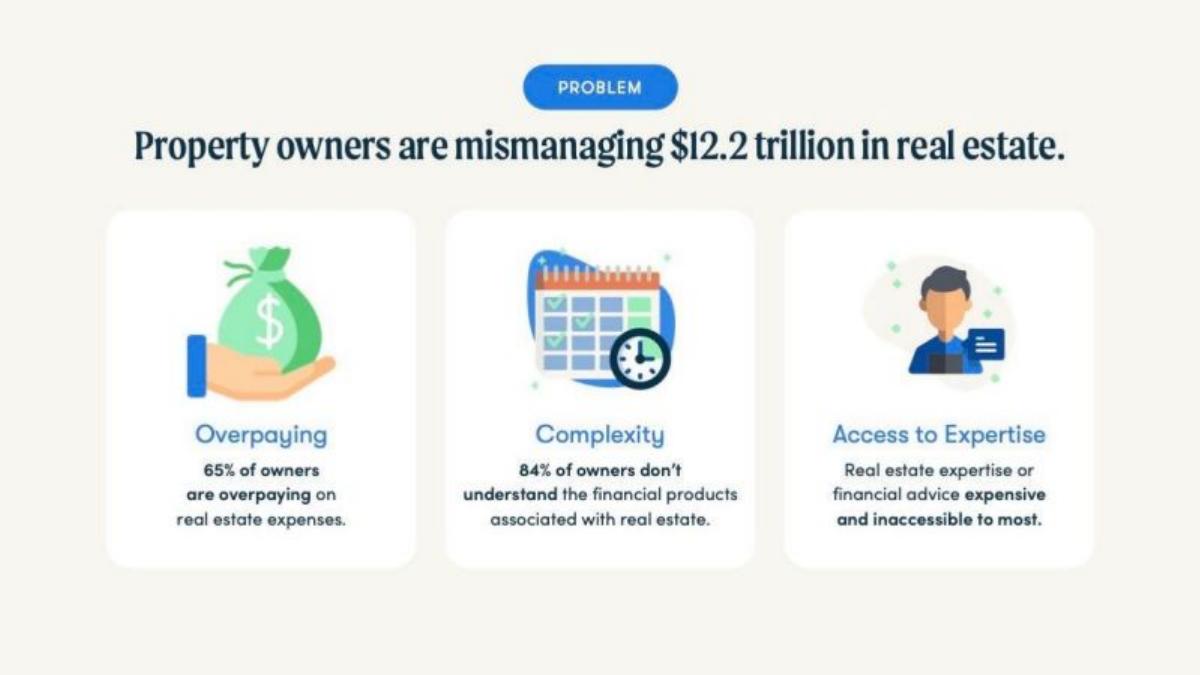
Property tax and cost help for owners. A headline figure and three cards.
Ownwell deck, slide 2. Exact stored slide matched to this analysis.
Our analysis: The 65% card is the real problem; the $12.2 trillion headline is the size of the asset, not of the pain.
Evidence and limitation: Percentages and the $12.2 trillion figure shown without sources.
What a founder can adapt: Lead with the share of customers who lose money and how much each loses.
Supporting analysis
What the deck claims: "Property owners are mismanaging $12.2 trillion in real estate." "Overpaying: 65% of owners are overpaying on real estate expenses." "Complexity: 84% of owners don't understand the financial products associated with real estate." "Access to Expertise: Real estate expertise or financial advice expensive and inaccessible to most."
Presentation choice: It shows the difference between a market figure and a problem figure on one slide.
When it does not fit: Replace the trillion-dollar headline with the average overpayment per owner, and add sources.
Serviced stays of short to medium length. A partial example: two photos, hotels versus Airbnb.
Stay Ulo deck, slide 2. Exact stored slide matched to this analysis.
Our analysis: Framing the problem as a choice between two flawed defaults is clear and visual.
Evidence and limitation: No figures.
What a founder can adapt: Show the two or three options your customer chooses between now, and what each gets wrong.
Supporting analysis
What the deck claims: "Travellers and short to medium-term stay seekers are forced to choose between two flawed options." Hotels: "Small Rooms, City Centre Locations Only, Soulless, No Kitchen, No Innovation, Uncomfortable for Long-Term." Airbnb: "Individual Hosts, Unreliable, No Service, Hit or Miss, Safety Concerns, Shady."
Presentation choice: It names the options the customer uses today, which most problem slides skip.
When it does not fit: Drop loaded words ("Shady", "Soulless") for evidence: complaint rates, length-of-stay data, or a customer quote.
Shared urban home ownership. A weaker example, included on purpose: three broad statements and a logo.
The Co-Own Company deck, slide 2. Exact stored slide matched to this analysis.
Our analysis: Each line is widely believed, which is why it does not persuade: it gives investors nothing they did not already know.
Evidence and limitation: None: no figures, city or source.
What a founder can adapt: Pick one city and give the gap: median price against median millennial income, or rent paid over five years.
Supporting analysis
What the deck claims: "THE PROBLEM. Millennials cannot afford to purchase housing in urban centers. Traditional suburban housing is boring, undesirable and lacks connection. Renting in an urban center is expensive and does not build equity."
Presentation choice: It shows the minimum a proptech problem slide needs: a place, a price and a number.
When it does not fit: Remove opinions ("boring, undesirable") and keep only claims you can back with a figure.
Whether each slide names one party in the property deal, measures the pain, and says why the current option fails.
Example
Party named
Pain measured
Why current option fails
Northspyre
Yes (developers)
Yes (3/4 over budget)
Yes (tools track documents, not money)
Reesio
Yes (buyers and agents)
Yes (2 days to 2 weeks old)
Yes (Zillow, Trulia, MLS)
Smart Host
Yes (hosts)
No
Yes (no booking data; hotels do it)
Orbital Witness
Yes (lawyers)
No
Yes (manual paper review)
Blueground
Partly (renters)
Partly (10% furnished)
Yes (landlords want 1+ year)
Ownwell
Yes (owners)
Partly (65%, 84%)
Partly (advice expensive)
Stay Ulo
Yes (travellers)
No
Yes (hotels vs Airbnb)
The Co-Own Company
Partly (millennials)
No
No
Key Takeaways
Name one party in the property deal. Real estate has many; a slide that tries to serve all of them serves none.
Measure the pain in the units that party cares about: days on market, budget overrun, fees, vacancy.
Say why the current option fails: the listing site, the spreadsheet, the hotel, the paper process.
Source market-wide figures; a large asset-class number alone is not a problem.
One problem per slide. If there are two, number them, as Northspyre and Reesio do.
Build your proptech problem slide
One party, one cost, one reason today's option fails.
Party. Which party in the property deal has this problem? Owner, tenant, host, developer, agent, lender or lawyer?
Cost. What does it cost them, in days, money, vacancy or lost deals? What is your source?
Current option. What do they use today (a listing site, spreadsheet, broker, paper), and what does it get wrong?
Place. Where is this true? Property problems are local; name the city or market.
Copyable framework: [Party] in [market] lose [cost with number, source] because [current option] [specific failure].
Illustrative example 1 — written by us
Before: Renting is broken. Tenants hate it and landlords struggle.
After: Small landlords in Chicago lose an average of 38 days of rent per turnover because listing sites send unscreened leads they must filter by phone.
What improved: Our illustrative rewrite; the figure is invented for the example. It names a party, a place, a cost and why today's option fails.
What this guide adds
The general problem slide guide covers any business. Property is different in two ways investors watch for: each transaction involves many parties with competing interests (buyer, seller, landlord, tenant, agent, lender, lawyer), and huge asset-class figures are easy to quote but say little about a specific pain. This guide compares how proptech decks pick one party and make the cost concrete.
The general guide already uses Opendoor's problem slide, so it is not repeated here.
Three things a proptech problem slide proves
Who: one named party in the deal (Smart Host's hosts, Orbital Witness's lawyers, Northspyre's developers).
How much: a cost in days, money or share of deals (Northspyre, Reesio, Ownwell, Blueground).
Why now it's unsolved: what today's option gets wrong (Reesio's listing sites, Northspyre's tools, Stay Ulo's hotels and Airbnb).
Common mistakes
Asset-class size as the problem. Trillions in real estate is a market figure, not a pain.
Every party at once. Buyers, sellers, agents and lenders have different problems; pick one.
No place. Supply, prices and rules differ by city; name yours.
Opinions instead of evidence. "Boring" and "shady" are views; give a figure or a customer quote.
Unsourced statistics. Investors in property check numbers; cite where each comes from.
Diagnostic checklist
One party in the property deal is named.
The pain has a number in days, money or share of deals.
The slide says what the party uses today and why it fails.
The market or city is named.
Every figure has a source.
Frequently asked questions
How we chose these examples
Corpus: published pitch deck teardowns on StartupFundraising.com. Founder-uploaded private decks are excluded.
Selection (2026-09-25): we searched extracted text of slides 2–6 for problem and challenge slides in decks whose recorded sector is real estate, proptech, property or construction, excluding fintech. About thirty candidates were read; climate, hospitality-development and concept slides without a property customer were set aside. Doorkee's problem slide was set aside because it is marked confidential. Opendoor's problem slide already appears in the general problem guide. The Co-Own Company is kept as a weaker contrast.
Overlap check: none of these eight slides appears in another guide.
Review: all eight stored slide images were inspected on 2026-09-25 and matched to company, deck and slide number (editorial model review). No person has yet completed an editorial review of this page.
Claims are as shown on the slides; we have not verified them. We make no claim that any slide caused a fundraising outcome.