NOQX addresses a classic enterprise pain point: the disconnect between corporate strategy and individual employee output. Their pre-seed deck relies heavily on third-party data to validate the problem, citing that 90% of organizations fail to execute their strategies. The solution is presented as a hybrid of goal-setting and collaboration tools, aiming for a 'fun' user experience in a typically dry category. While the deck is light on current revenue metrics—standard for a pre-seed round—it compensates with a clear product roadmap and a strong founding team with backgrounds at Klarna and in h…
Key takeaways
- The deck identifies a massive execution gap, noting that 70% of companies fail to achieve their goals (Slide 2).
- NOQX positions itself at the intersection of goal platforms and collaboration tools to solve 'information chaos' (Slide 9).
- The pricing model is straightforward B2B SaaS: $100/user/year for Core and $150/user/year for Professional (Slide 14).
- The startup targets medium-sized businesses with 50-500 employees, specifically in the Nordic and US markets (Slide 15).
- A detailed onboarding timeline suggests a 9-month cycle from startup meeting to contract renewal (Slide 8).
- The product roadmap outlines a transition from an OKR framework in Q4 2023 to an AI-assisted platform by Q1 2024 (Slide 11).
- The founding team brings significant experience from established tech companies like Klarna (Slide 17).
- Market validation is supported by the projected growth of the OKR software market to $2.58 billion by 2030 (Slide 13).
The Problem: The Strategy-Execution Gap
Slides 2-4: Quantifying the Chaos
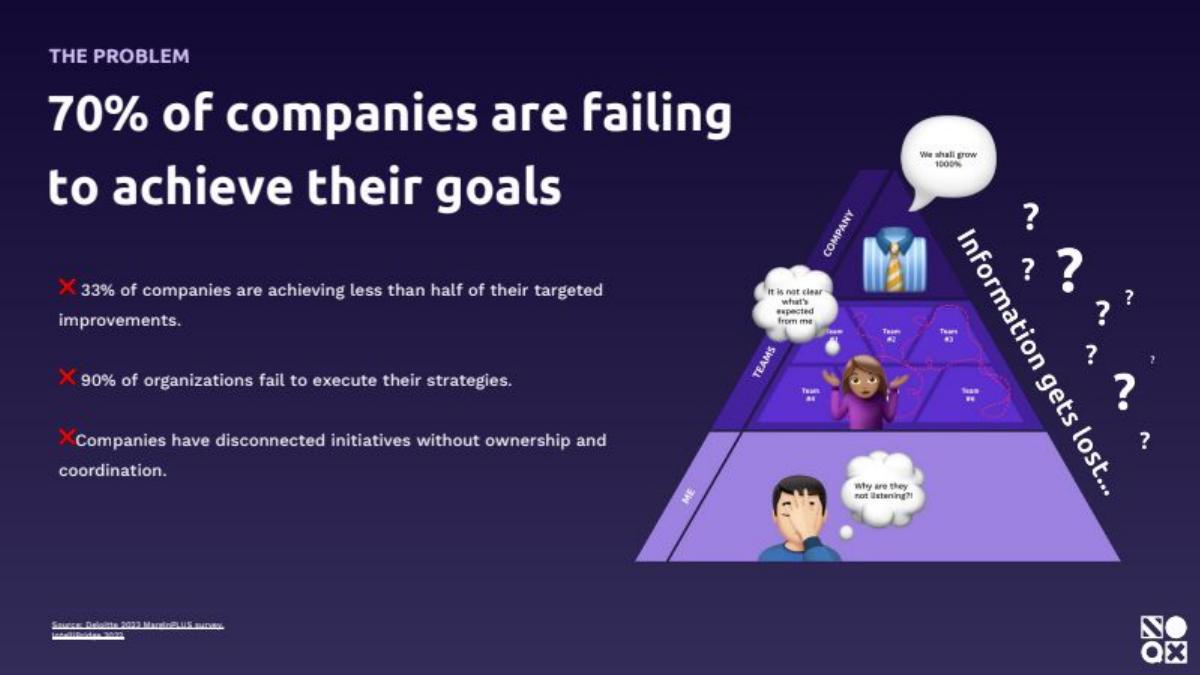
NOQX opens its pitch by leaning heavily on industry research to validate its existence. Slide 2 presents a stark headline: "70% of companies are failing to achieve their goals." It cites Deloitte and IntelliBridge to support the claim that 90% of organizations fail to execute strategies. The visual aid—a pyramid showing information getting lost as it moves from the company level down to the individual—effectively illustrates the disconnect between leadership and the workforce.
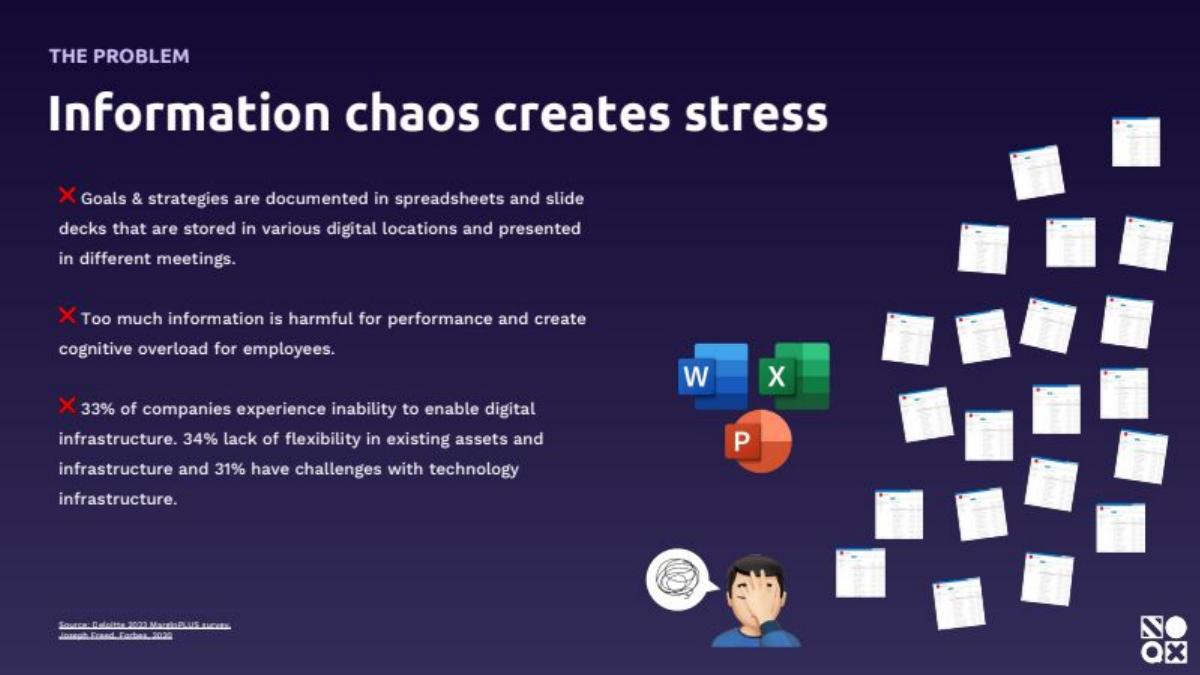
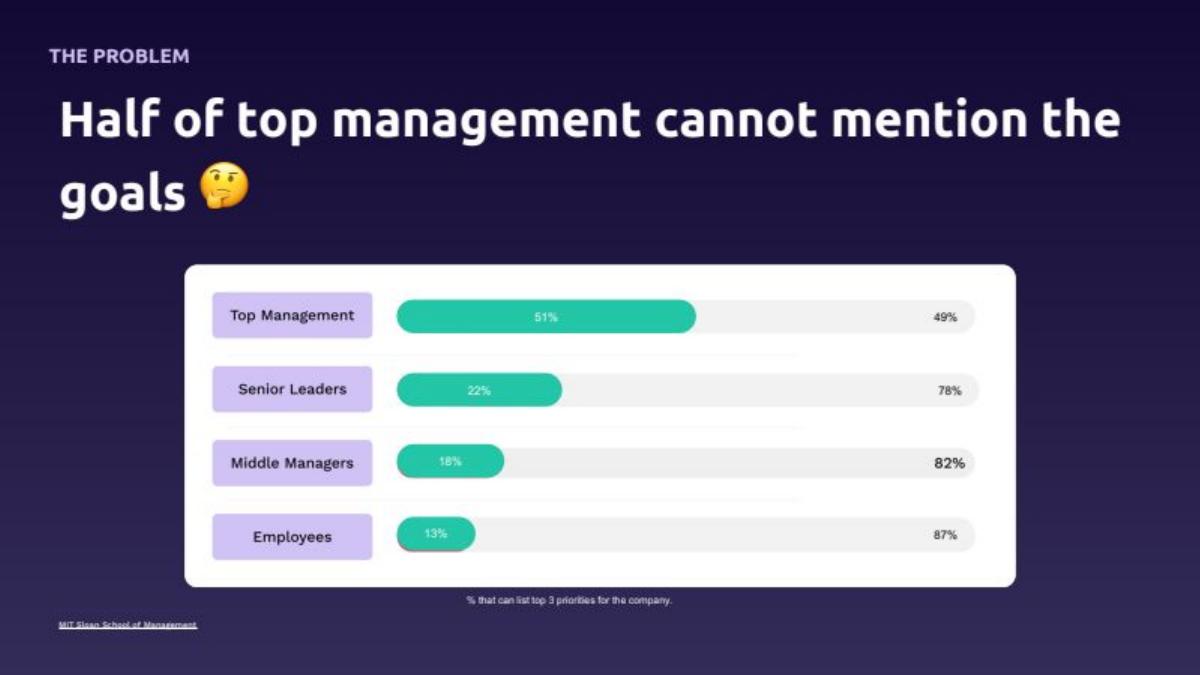
Slide 3 focuses on "Information chaos," highlighting that goals are often buried in static spreadsheets and slide decks. It notes that 33% of companies struggle with digital infrastructure. Slide 4 provides the most damning statistic: while 51% of top management can list company priorities, that number drops to just 13% for frontline employees. This establishes a clear, high-stakes problem that requires a specialized software solution rather than just better management practices.
The Solution: Merging Goals with Collaboration
Slides 5-7: The NOQX Value Proposition
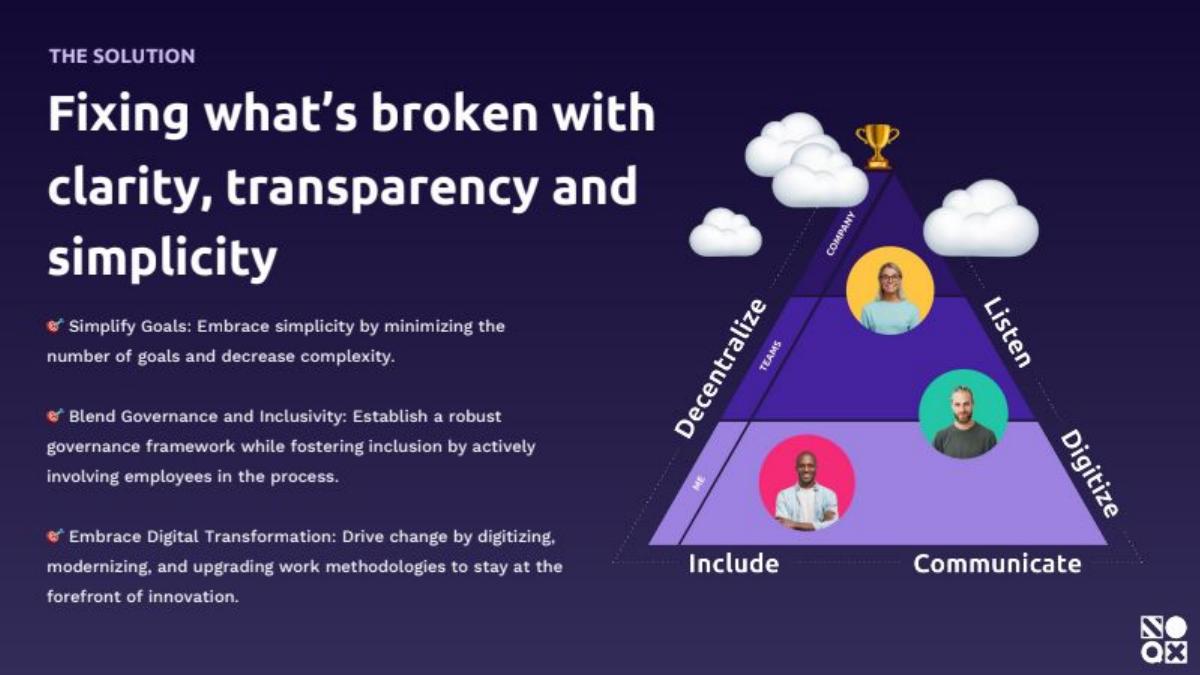
The solution is introduced in Slide 5 as a framework of clarity, transparency, and simplicity. The deck uses a similar pyramid structure to the problem slides, but this time it is populated with people, suggesting a human-centric approach to "decentralize," "include," and "digitize."
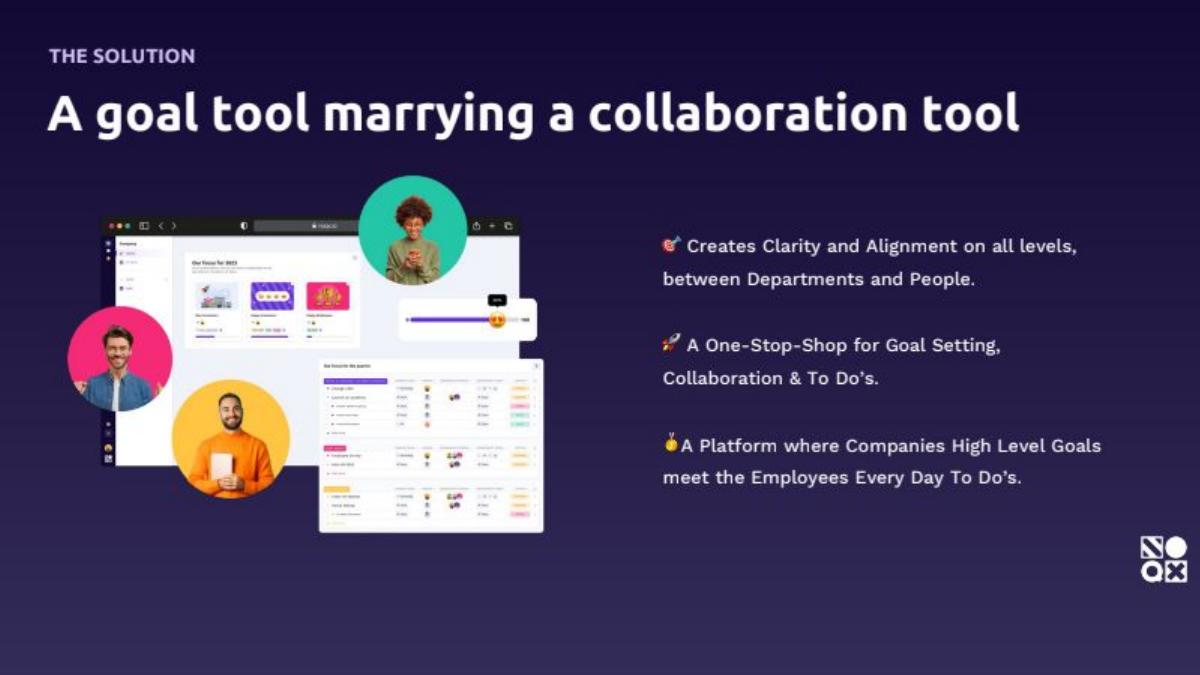
Slide 6 and Slide 7 define the product as "A goal tool marrying a collaboration tool." This is a crucial positioning move. By claiming to be a "One-Stop-Shop," NOQX is attempting to move goal-setting out of the HR department and into the daily workflow of every employee. The deck promises a UX "the world never experienced before," though it remains light on specific technical details at this stage, focusing instead on the emotional and organizational benefits of alignment.
Onboarding and Market Landscape
Slides 8-9: Implementation and Competition
Slide 8 outlines a "Timeline to success," which is essentially a 9-month customer success roadmap. It starts with a 60-minute startup meeting and ends with a renewal at Month 9. This slide is likely intended to de-risk the investment by showing that the founders have thought through the entire customer lifecycle, including training and business reviews. It also lists ambitious KPIs like "125% Lower Burnout" and "46% Higher job satisfaction," attributed to Harvard Business Review research on goal alignment.
Slide 9 features a standard 2x2 competitive landscape matrix. NOQX places itself in the bottom-right quadrant, representing high "Simplicity" and a hybrid of "Goal platforms" and "Collaboration platforms." It explicitly calls out that traditional goal tools suffer from "sporadic logins" and are often seen as a burden, whereas NOQX aims to make the process "effortless and enjoyable."
Product Differentiation and Roadmap
Slides 10-11: AI and Future Features
Slide 10 lists six unique selling points, including the integration of AI to provide executive summaries of goal progress with "just one click." This is a timely addition to a 2024 deck, addressing the current market demand for AI-driven efficiency. Slide 11 provides a quarterly roadmap for late 2023 through 2024. It shows a progression from a basic OKR framework to a more robust platform featuring multi-tenancy, billing tools, and integrations with external apps (represented by icons for Slack and other productivity tools).
Traction and Go-To-Market Strategy
Slides 12-15: The Commercial Engine
Slide 12 presents a timeline of traction. While it doesn't list current revenue, it shows that the company has completed 100 target customer interviews and is aiming for 70 paying customers by December 2024. Slide 13 sizes the market, stating the OKR software market was valued at $923.31 Million in 2022 and is projected to reach $2.58 Billion by 2030, a CAGR of 13.76%.
The "Commercial engine" on Slide 14 details a multi-channel approach involving cold calling, social selling, and email marketing. This is a very traditional B2B sales motion. Slide 14 (labeled Pricing) introduces two tiers: Core at $100 per user/year and Professional at $150 per user/year. This pricing is competitive for the enterprise SaaS space and suggests a focus on high-margin recurring revenue. Slide 15 defines the ICP as medium-sized businesses (50-500 employees) and introduces "CEO Cecile" as the primary persona.
The Team and Vision
Slides 16-18: Why This Team?
Slide 16 contrasts the "Old way" (matrix organizations, physical meetings, yearly cadence) with the "New way" (hybrid, inclusive, continuous flow). This sets the stage for the team slide. Slide 17 introduces the three founders: Sophie Hedestad (CEO), Robert Zetterqvist (CTO), and Matilda Lundsten (Head of UX). The bios are strong; Hedestad has a decade of B2B SaaS experience, Zetterqvist spent four years at Klarna, and Lundsten focuses on the user-centric design that is central to the company's differentiation. The deck concludes on Slide 18 with a simple mission statement: "To Create Clarity and Enable Execution for Employees Around the World."
What Works in the NOQX Deck
Strong Problem Validation: By using reputable sources like Deloitte and MIT Sloan, the founders make the "goal-execution gap" feel like an urgent, multi-billion dollar problem rather than a niche inconvenience. · Clear Positioning: The 2x2 matrix and the "Goal tool meets Collaboration tool" messaging clearly explain where NOQX fits in a crowded productivity market. · Team Pedigree: The founders' backgrounds at high-growth companies like Klarna provide immediate credibility, which is essential for a pre-seed round where there is little revenue to show. · Transparent Pricing: Including a pricing slide in a pre-seed deck is bold and shows that the founders have a clear hypothesis on how to monetize the product from day one.
What is Missing or Could Be Improved
Specific Product Demos: While the deck mentions a "UX the world never experienced before," the actual screenshots are small and don't fully convey how the product is fundamentally different from existing tools like Lattice or 15Five. · Current Traction Data: The traction slide is mostly a future-looking roadmap. Including even a small amount of pilot data or early LOIs (Letters of Intent) would have strengthened the case. · The 'Ask' Slide: Interestingly, the 19-slide deck provided does not include a specific "Ask" slide detailing how much they are raising and how they will spend the capital. While we know from catalogue facts they raised $200K, a standard pitch deck usually includes a slide dedicated to the funding round details. · Unit Economics: There is no mention of Customer Acquisition Cost (CAC) or Lifetime Value (LTV) projections. While these are often speculative at the pre-seed stage, some basic assumptions would show a deeper understanding of the business model's scalability.
What Other Founders Should Copy
The 'Why Now' Slide: Slide 16, which compares the "Old way" to the "New way," is a perfect example of how to frame a product as a necessary response to changing market conditions (in this case, the shift to hybrid work). · The Onboarding Timeline: Slide 8 is an excellent way to show investors that you understand the operational reality of selling to enterprises. It moves the conversation from "what is the product" to "how do we make the customer successful." · Persona-Based GTM: Slide 15 goes beyond just "Target Market" by identifying the specific buyer (CEO), the influencers (CPO, COO), and the champion (the employee). This level of detail is highly attractive to investors who want to see a sophisticated sales strategy.
Frequently asked questions
- What is the primary problem NOQX is trying to solve?
- NOQX targets the failure of strategy execution in enterprises. According to the deck, 90% of organizations fail to execute their strategies because goals are often siloed in spreadsheets and slide decks, leading to 'information chaos' and a lack of clarity among employees. Only 13% of frontline employees can list the company's top three priorities, creating a massive alignment gap that NOQX intends to bridge.
- How does NOQX differentiate itself from existing OKR tools?
- The company differentiates by focusing on the user experience and 'fun' in goal setting. They position themselves as a hybrid between traditional, often stagnant goal platforms and high-engagement collaboration tools. By linking daily 'To-Do's' directly to high-level company goals and incorporating AI for executive summaries, they aim to create a more integrated and less burdensome workflow than legacy HR-driven performance tools.
- What is the specific target market and customer profile?
- NOQX focuses on medium-sized businesses with 50 to 500 employees. Their Ideal Customer Profile (ICP) is a company undergoing significant change or digital transformation. Geographically, they are starting in the Nordic region but have stated intentions to enter the US market early in their growth phase. Their primary buyer persona is a CEO, supported by influencers like the Chief People Officer and Chief Strategy Officer.
- What does the traction and roadmap look like for NOQX?
- At the time of the deck, NOQX was in its early stages, having conducted 100 target customer interviews. The roadmap shows a launch in mid-2023, with plans to reach 70 paying customers by late 2024. The product evolution includes moving from basic OKR visualization to a more complex ecosystem featuring AI assistants, document integration, and third-party integrations with tools like Slack.
- Who are the investors in this round?
- According to the catalogue facts, NOQX raised $200K from a group of notable angel investors. These include Phillip Chambers (founder of Peakon), Maria Hedengren (former CEO of Readly), Giles Whiting, Niklas de Besche, Louise Markgren, and Aref Abedi. This high-caliber angel list suggests strong confidence in the team's ability to execute in the B2B SaaS space.