Salaaap’s 2017 investor deck presents a classic search-engine-optimization (SEO) play within the Philippine e-commerce sector. Rather than building a closed marketplace, Salaaap positions itself as a discovery layer, aiming to index over 8,000,000 products to capture organic search traffic. The deck relies heavily on a 'shotgun vs. sniper' marketing metaphor to justify a high-volume, automated approach to content acquisition via web crawlers. While the deck demonstrates early traction with 117,713 pageviews, it leaves significant gaps regarding monetization and competitive moats. The 13M PHP…
Key takeaways
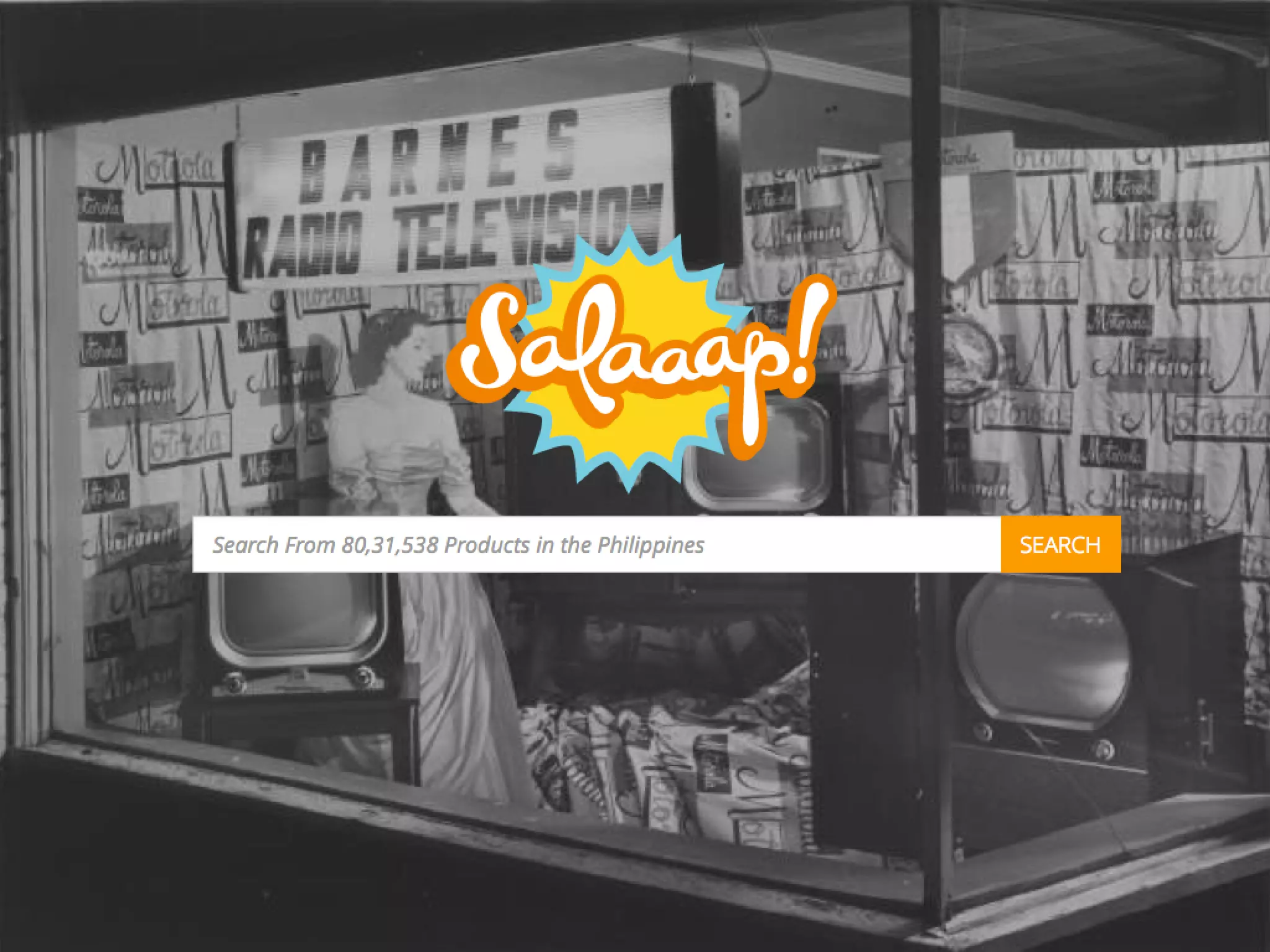
- The company claims to search from 80,31,538 products in the Philippines on the title slide (Slide 1).
- The core strategy is built on a 'Bigger Volume, Smaller Conversions' approach, described as a 'General Approach' using a shotgun metaphor (Slide 2).
- Salaaap identifies a market gap by stating that 'No-one curates their content manually' across major social platforms (Slide 3).
- The mission involves saturating organic search results with their listings and replicating the model in different countries (Slide 4).
- Technical goals include developing a web crawler to automate merchant and product acquisition (Slide 5).
- The product functions as a price comparison and lead generation tool, directing users to external merchants like 'Galleon PH' (Slide 6).
- The startup is seeking 13M (presumably PHP) for a 1-year runway to fund a team of 11 people (Slide 7).
- Early traction data shows 49,826 sessions and 44,616 users, with a bounce rate of 59.72% (Slide 8).
Slide-by-Slide Analysis
Slide 1: Title and Search Scale
The opening slide establishes the brand identity with a bright orange and yellow logo and a background image of a vintage electronics storefront. The most critical piece of information here is the search bar overlay, which claims the platform allows users to "Search From 80,31,538 Products in the Philippines." This immediately sets the scale of the project as a massive data aggregation play. The use of a specific, non-rounded number is intended to provide credibility to their database size.
Slide 2: Marketing Philosophy
Under the heading "APPROACH," the deck uses a visual metaphor comparing a shotgun ("Fig. 1") to a sniper rifle ("Fig. 2"). Salaaap explicitly aligns itself with the shotgun approach: "Bigger Volume, Smaller Conversions, General Approach." This is a transparent admission of their growth strategy. They are not looking for high-intent, high-cost niche targeting; they are playing a numbers game. By casting the widest possible net across millions of product SKUs, they aim to capture enough aggregate traffic to make the business viable despite lower individual conversion rates.
Slide 3: The Curation Gap
This slide features icons for Facebook, LinkedIn, Twitter, Google+, YouTube, and Pinterest. The text states, "No-one curates their content manually." This serves as the 'Why Now' or 'Problem' slide. It suggests that while social platforms are automated, there is a lack of human-touch curation in the product discovery space. However, it creates a slight contradiction with the previous slide's emphasis on high-volume 'shotgun' tactics, which usually require heavy automation rather than manual curation.
Slide 4: The Three-Step Mission
The mission is laid out in three clear phases: "1. Have a complete listing of all 8,000,000+ products available for online purchase in the Philippines. 2. Saturate organic search results with our listings. 3. Replicate this process across different countries." This is a pure SEO play. The goal is to own the search results page (SERP) for any product query in the region. The mention of replication across countries suggests that the founders view their crawler technology as a portable asset that can be deployed in any market with fragmented e-commerce data.
Slide 5: Operational Goals
This slide details the functional requirements of the business. Key goals include "Develop a web crawler to automate merchant and product acquisition" and "Allow anyone to create a listing manually." The fourth point, "Develop a community around policing the content," is a strategic move to offload the cost of data quality to the user base, similar to a Wikipedia or Yelp model. This addresses the inherent 'noise' and 'spam' risks associated with high-volume web crawling.
Slide 6: Product Demonstration
The "Detail Page Sample" shows a specific product: "Generic MH2001 5-in-1 Wireless Headphones." The UI includes price information ( P 1,114.00 ), merchant details (Galleon PH), and a prominent "BUY ONLINE" button. This slide confirms the business model as an aggregator. Salaaap does not hold inventory; it provides the interface for discovery and then hands the customer off to the merchant who handles "order fulfillment and customer support" (as noted on Slide 5).
Slide 7: The Ask and Headcount
The "Costs" slide is unusually specific about personnel but vague about the currency, though the context implies Philippine Pesos. They are "Raising 13M for a 1 year Runway." The budget supports an 11-person team: 3 App/Crawler Developers, 3 Encoders, 3 Community Managers, 1 SEO/Analytics Optimizer, and 1 Server Ops. The inclusion of "Encoders" suggests that despite the goal of automation, the company still requires significant manual data entry to clean or categorize the crawled product information.
Slide 8: Traction and Analytics
The final slide in this set is a screenshot of a Google Analytics dashboard. It shows 117,713 Pageviews and 44,616 Users over a one-month period (November). The 86.2% New Visitor rate reinforces the idea that traffic is coming from search engines rather than a loyal, returning user base. A 59.72% Bounce Rate is relatively standard for an aggregator where users often land on a page, check a price, and either leave or click through to the merchant.
What Works in This Deck
Clarity of Strategy: The deck does not pretend to be something it isn't. By using the shotgun metaphor, the founders are honest about their reliance on volume over precision. This helps an investor immediately understand the risk profile: this is a technical SEO and data engineering challenge, not a brand-building or community-focused play.
Specific Resource Allocation: The 'Costs' slide is excellent. Many early-stage decks ask for a lump sum for "Marketing and R&D." Salaaap breaks it down by role, showing they have thought through the exact human capital required to build a web crawler and manage a community of 8 million products.
Market-Specific Focus: By focusing on the Philippines and citing a specific number of products (8 million+), the deck demonstrates a deep understanding of the local e-commerce landscape's fragmentation. It identifies a clear pain point: finding products across many disparate, smaller online stores.
What Is Missing from This Deck
Monetization Details: While we can infer a lead-gen model, the deck never explicitly states how Salaaap makes money. Is it a flat fee per click? A percentage of the sale? A subscription for merchants? Without these details, the '13M' ask lacks a clear path to ROI.
Competitive Landscape: There is no mention of existing price comparison sites or the threat of Google Shopping. In 2017, aggregators were already facing significant pressure from search engines integrating shopping results directly into the SERP. The deck fails to explain why Salaaap’s listings will outrank established players.
Unit Economics: The deck shows traffic but not the value of that traffic. Investors need to know the Customer Acquisition Cost (CAC) versus the Lifetime Value (LTV) or at least the Revenue Per User (RPU). If the conversion rate is as small as the 'shotgun' metaphor suggests, the revenue per click must be high enough to cover the server and headcount costs.
Team Background: The attached slides do not include a team slide. For a technical play involving web crawlers and SEO at scale, the pedigree of the developers and the SEO lead is paramount. Without knowing who is building the 'App/Crawler,' the technical risk remains unaddressed.
Founder Takeaways
Own your strategy: If your business model relies on low-conversion, high-volume traffic, state it plainly as Salaaap did. It filters for investors who understand and are comfortable with that specific type of arbitrage. · Use real data to anchor claims: The specific product count (8,031,538) on the title slide is much more compelling than saying "millions of products." It suggests the work of indexing has already begun. · Bridge the gap between automation and manual work: Every 'automated' startup has a manual component. By budgeting for 'Encoders,' Salaaap acknowledges the reality that AI and crawlers aren't perfect, which builds trust with technical investors. · Show the destination: The 'Detail Page Sample' is vital. It shows exactly what the user sees and how the 'Buy' flow works. Always include a high-fidelity mockup if the product is live or in beta.
Frequently asked questions
- What is the primary business model of Salaaap?
- Based on the 'Detail Page Sample' (Slide 6) and 'Goals' (Slide 5), Salaaap acts as a meta-search engine or aggregator. It crawls external e-commerce sites to list products and compare prices. When a user clicks 'Buy Online,' they are directed to the original merchant (e.g., Galleon PH). This suggests a lead-generation or affiliate revenue model, though the deck does not explicitly detail commission rates or fee structures.
- How does Salaaap plan to acquire users?
- The strategy is almost entirely dependent on Organic Search (SEO). Slide 4 explicitly states the mission is to 'Saturate organic search results with our listings.' By indexing over 8 million products, they aim to capture 'long-tail' search queries from consumers looking for specific items, utilizing a high-volume approach to compensate for lower conversion rates (Slide 2).
- What is the significance of the 13M funding ask?
- The 13M figure (likely Philippine Pesos given the market focus) is earmarked for a 12-month runway. The 'Costs' slide (Slide 7) provides a specific hiring plan: 3 crawler developers, 3 encoders, 3 community managers, 1 SEO specialist, and 1 server ops person. This indicates the capital is primarily for human resources to build and maintain the data pipeline.
- What does the traction data reveal about the user base?
- Slide 8 shows a Google Analytics snapshot with 86.2% new visitors and 13.8% returning visitors. An average session duration of 1:26 and 2.36 pages per session suggest that users are utilizing the site for quick discovery rather than deep browsing. The high percentage of new visitors aligns with an SEO-heavy acquisition strategy where users find a specific product page via Google.
- What are the biggest risks identified in this deck?
- The deck highlights a heavy reliance on automation and external data. Slide 5 mentions the need to 'develop a web crawler,' implying the technology was not fully mature at the time of the pitch. Additionally, the 'shotgun' approach (Slide 2) admits to 'Smaller Conversions,' which puts immense pressure on the team to maintain massive traffic volumes to remain viable, especially if merchant sites block their crawlers.