Sanas secured $32M in Series A funding by presenting a highly specific, high-ROI use case for real-time AI: accent translation for the Business Process Outsourcing (BPO) sector. The deck avoids generic AI hype, instead focusing on the 'Yearly Delta' of $42,200 per agent gained by matching accents to customers. With a team boasting Stanford credentials and experience at Observe.AI and Blackstone, the founders demonstrated deep technical capability alongside market empathy. The deck highlights significant early traction, citing 26,750 seats signed and a roadmap that moves from offshore BPOs to…
Key takeaways
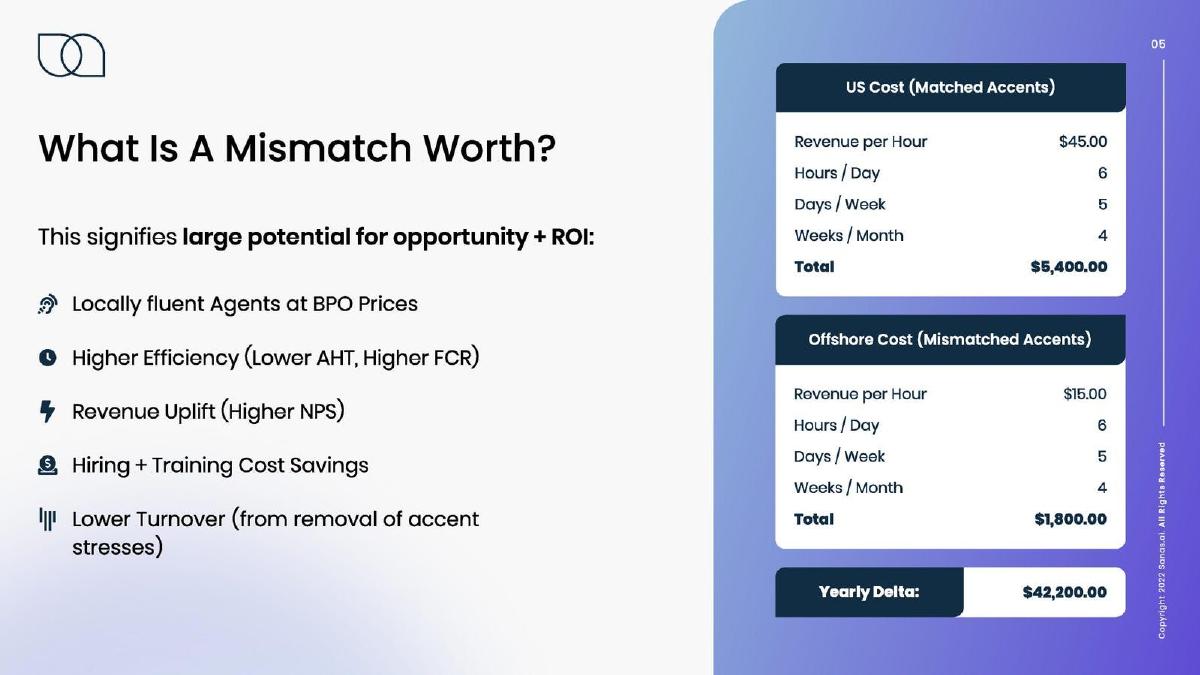
- The deck quantifies the value of 'matched accents' at a yearly delta of $42,200 per agent (Slide 5).
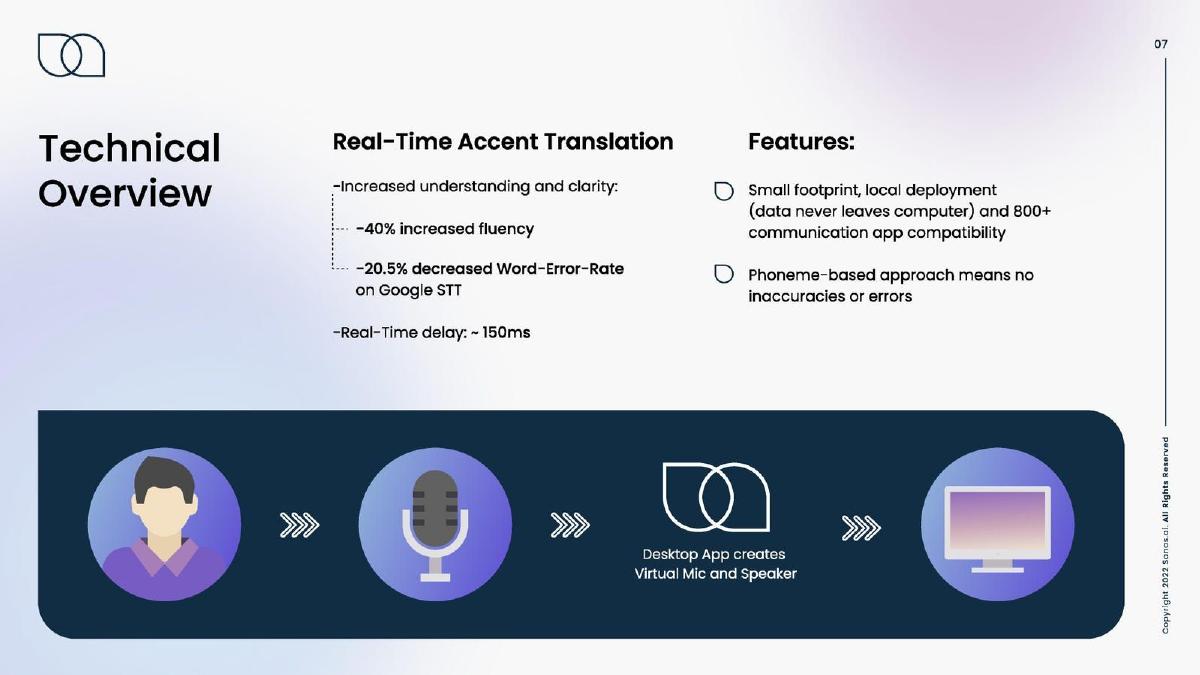
- Technical performance is validated by a 20.5% decrease in Word-Error-Rate on Google STT and a low 150ms delay (Slide 7).
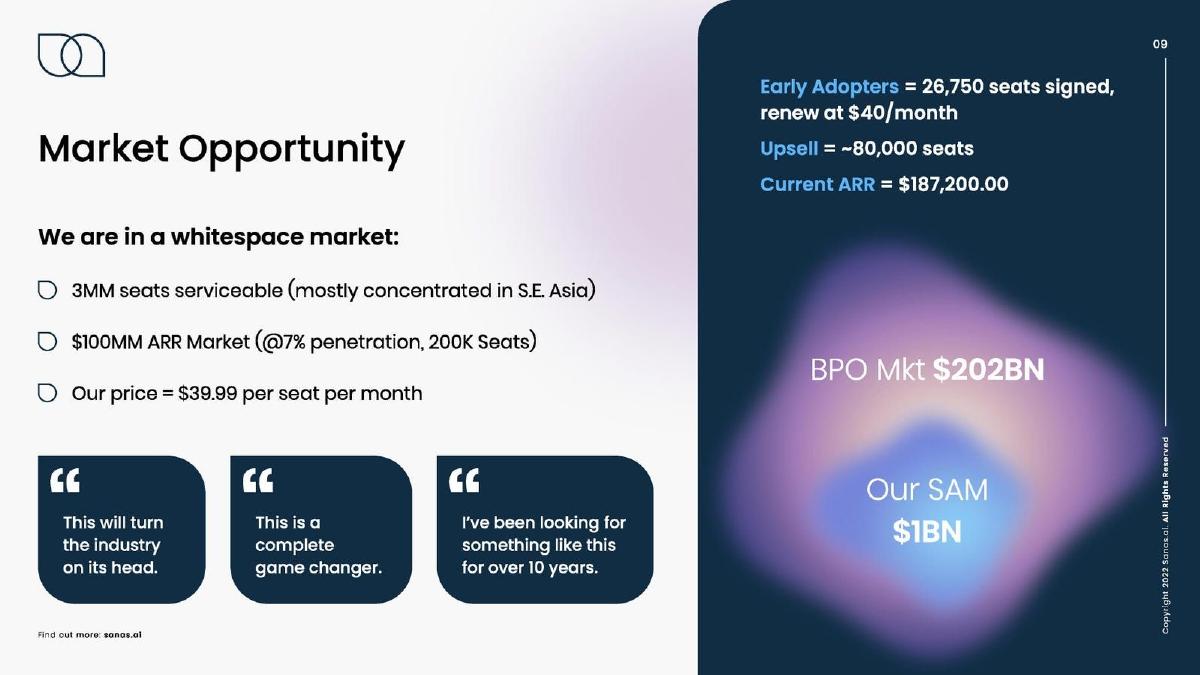
- Early traction is significant, with 26,750 seats signed at a price point of $39.99 per seat per month (Slide 9).
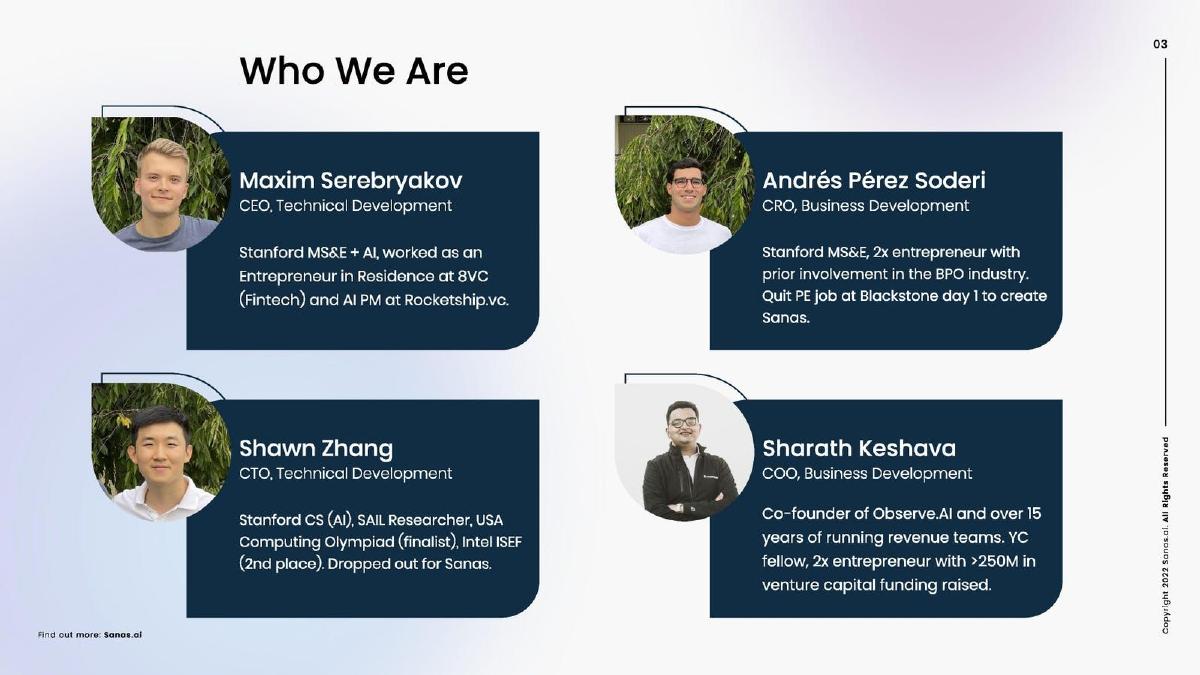
- The team slide emphasizes a mix of Stanford AI research backgrounds and deep BPO industry experience (Slide 3).
- The product is designed for privacy and speed, utilizing local deployment where data never leaves the computer (Slide 7).
- Market sizing identifies a $1BN Serviceable Addressable Market (SAM) within a broader $202BN BPO industry (Slide 9).
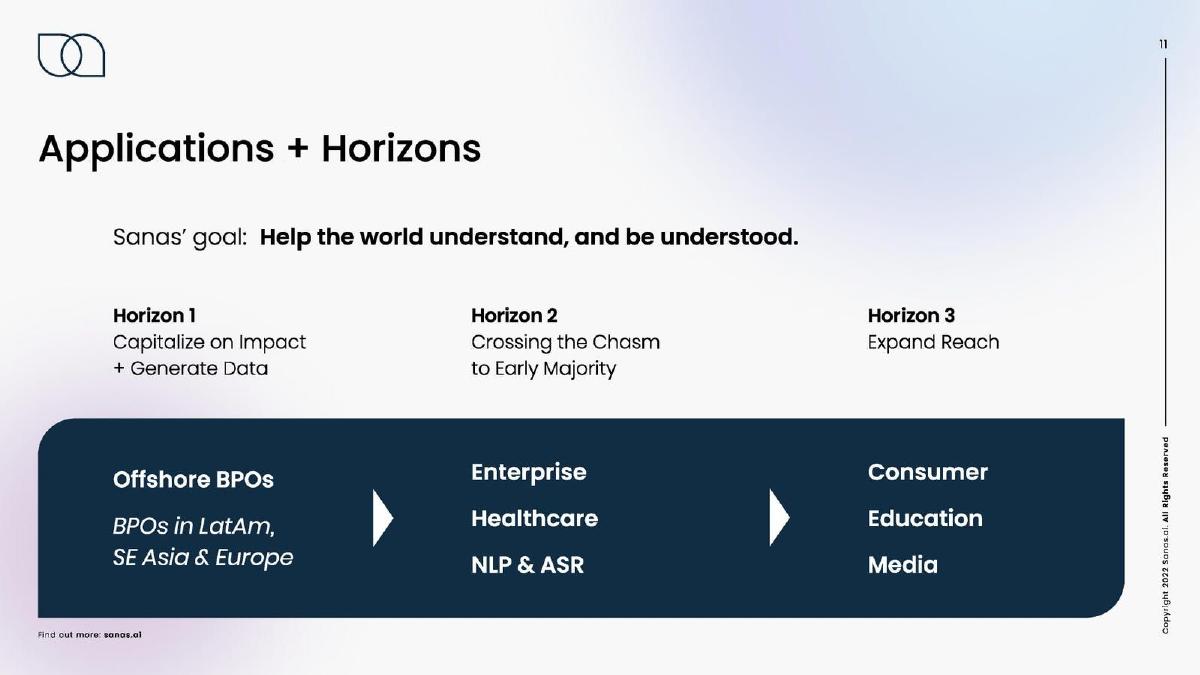
- The expansion strategy follows a three-horizon model, moving from offshore BPOs to Enterprise/Healthcare and finally Consumer/Media (Slide 11).
- The deck omits a specific 'Ask' slide detailing the use of the $32M Series A funds reported by Business Insider.
Sanas: Bridging the Global Communication Gap with AI
Sanas raised a $32M Series A to solve a friction point as old as the globalized economy: the accent barrier in international business. While many AI startups lead with vague promises of 'transformation,' Sanas used its 15-slide deck to present a cold, hard mathematical argument for why accent translation is a multi-billion dollar opportunity. By focusing on the Business Process Outsourcing (BPO) sector, they identified a market where every second of misunderstanding has a direct dollar cost. This teardown examines how they balanced technical sophistication with enterprise-grade ROI calculations.
Slide 1: Title and Vision
The deck opens with a minimalist title slide featuring the Sanas logo and the tagline: "Breaking barriers, one conversation at a time." It includes the website URL (sanas.ai) but keeps the visual focus on a soft, gradient background. This sets a professional, tech-forward tone without cluttering the initial impression.
Slide 3: The Founders and Leadership
The 'Who We Are' slide is a masterclass in establishing credibility. It splits the team into 'Technical Development' and 'Business Development' pillars. Maxim Serebryakov (CEO) and Shawn Zhang (CTO) bring the Stanford AI pedigree, with Zhang noted as a USA Computing Olympiad finalist and Intel ISEF runner-up. On the business side, Andrés Pérez Soderi (CRO) provides industry context (prior BPO involvement and Blackstone), while Sharath Keshava (COO) brings scale experience as a co-founder of Observe.AI with over $250M in capital raised. This combination suggests the company can both build the tech and navigate the complex sales cycles of global BPOs.
Slide 5: The Economic Argument (ROI)
Slide 5, titled "What Is A Mismatch Worth?" , is the most critical slide in the deck. It compares the cost of 'Matched Accents' (US-based agents) against 'Mismatched Accents' (Offshore agents). The math is explicit:
US Revenue per Hour: $45.00 · Offshore Revenue per Hour: $15.00 · Total Monthly Revenue per US Agent: $5,400.00 · Total Monthly Revenue per Offshore Agent: $1,800.00 · Yearly Delta: $42,200.00
By quantifying the 'mismatch' at over $42k per agent per year, Sanas makes their $39.99/month subscription look like a rounding error. They list additional benefits like lower Average Handle Time (AHT), higher First Call Resolution (FCR), and lower employee turnover due to reduced 'accent stresses.'
Slide 7: Technical Overview and Performance
This slide addresses the 'how' and the 'how well.' Sanas claims a 40% increased fluency and a 20.5% decreased Word-Error-Rate on Google STT . For real-time applications, latency is the deal-breaker; Sanas quotes a ~150ms delay , which is generally imperceptible in human conversation. The slide also emphasizes security: a 'small footprint, local deployment' where 'data never leaves computer.' This is a vital selling point for enterprise clients in regulated industries like healthcare or finance.
Slide 9: Market Opportunity and Traction
Sanas defines their market with specific figures. They cite a $202BN BPO Market with a $1BN SAM (Serviceable Addressable Market) . The slide reveals their pricing of $39.99 per seat per month . The traction metrics are impressive: 26,750 seats signed and an upsell pipeline of ~80,000 seats . While the 'Current ARR' is listed at $187,200.00 , the 'seats signed' figure suggests a massive impending revenue jump once those seats are fully deployed and billing.
Slide 11: Future Horizons
The 'Applications + Horizons' slide shows the long-term vision. Horizon 1 is the current focus: Offshore BPOs in LatAm, SE Asia, and Europe. Horizon 2 moves into 'Enterprise' and 'Healthcare,' where clarity is a matter of compliance and safety. Horizon 3 targets 'Consumer,' 'Education,' and 'Media,' suggesting the technology could eventually be used for language learning or content localization. This progression shows investors that Sanas isn't just a 'call center tool' but a foundational communication layer.
Slide 14 & 15: Appendix and Closing
The deck concludes with a standard Appendix divider and a 'Thank you!' slide. The final slide provides the contact information for Andrés Pérez Soderi, the CRO. Notably, there is no 'Ask' slide in this version of the deck, though publisher reports indicate the round resulted in $32M in funding.
What Sanas Does Exceptionally Well
The Sanas deck succeeds because it identifies a painful, expensive problem and offers a quantifiable solution . The 'Yearly Delta' calculation on Slide 5 is the 'aha' moment for any investor. It moves the conversation from 'cool AI voice tech' to 'bottom-line enterprise software.' Furthermore, the technical slide (Slide 7) preemptively answers the two biggest objections to real-time voice AI: latency and data privacy. By stating the 150ms delay and local deployment, they clear the path for technical due diligence.
The team slide is also a significant asset. In the AI space, talent is the primary currency. Having two Stanford researchers paired with a COO who has already scaled a successful AI company (Observe.AI) provides a level of 'de-risking' that justifies a $32M Series A. They aren't just building a product; they are building a company with people who have done it before.
What Is Missing from the Sanas Deck
While the deck is strong on ROI and team, it is light on competitive analysis . The BPO space is crowded with 'agent assistance' tools, and the broader AI voice space includes giants like Google and Amazon, as well as startups like Krisp (which focuses on noise cancellation but could pivot). Sanas does not explicitly state how their 'phoneme-based approach' is defensible against a well-funded incumbent decided to add accent translation to their stack.
Additionally, the unit economics of the sales process are absent. While they show the price ($39.99/mo), they don't show the Cost of Goods Sold (COGS) or the Customer Acquisition Cost (CAC). Given the local deployment model, COGS might be low, but selling into massive global BPOs usually involves long, expensive pilot phases. Investors would likely want to see how long it takes to convert those '26,750 seats signed' into '26,750 seats paying.'
Founder Takeaways: Copy These Moves
1. Quantify the 'Cost of Doing Nothing': Don't just say your product saves money. Show the math. Sanas's comparison of US vs. Offshore revenue per hour is a perfect example of how to frame a problem so that the solution feels like a financial necessity.
2. Address Technical Hurdles Early: If your product relies on real-time performance, put the latency numbers in the deck. If it handles sensitive data, put the privacy architecture in the deck. Don't wait for the Q&A to prove the tech is viable.
3. Use a 'Horizons' Framework: Investors want to see a massive TAM, but they also want to see a focused 'Go-To-Market' (GTM). By using the three-horizon model, Sanas shows they are focused on BPOs today but have a credible path to becoming a multi-industry platform tomorrow.
4. Lead with Signed Intent: Sanas lists '26,750 seats signed.' Even if the current ARR is low, 'signed seats' is a powerful leading indicator of demand. If you have pilots or contracts in the pipeline, highlight the volume of those commitments rather than just your current trailing revenue.
Frequently asked questions
- What is the primary value proposition of Sanas?
- Sanas provides real-time accent translation software. The deck frames this as a way to increase efficiency in BPOs by lowering Average Handle Time (AHT) and increasing First Call Resolution (FCR). By allowing offshore agents to sound locally fluent, Sanas claims to bridge the revenue gap between US-based agents ($45/hr) and offshore agents ($15/hr), creating a massive ROI for call center operators.
- How does the technology actually work according to the deck?
- Slide 7 explains that the software uses a phoneme-based approach to ensure accuracy. It functions as a desktop app that creates a 'Virtual Mic and Speaker' on the user's computer. Crucially, it features local deployment, meaning voice data is processed on the device and never leaves the computer, which addresses enterprise privacy and latency concerns (150ms delay).
- What is the current revenue and traction for Sanas?
- As of Slide 9, Sanas reported a Current ARR of $187,200.00. However, the deck highlights a much larger pipeline, noting 26,750 seats already signed that renew at $40/month, representing a potential future revenue stream significantly higher than the current ARR. They also identify an immediate upsell opportunity of approximately 80,000 seats.
- Who are the founders and what is their background?
- The team (Slide 3) consists of Maxim Serebryakov (CEO) and Shawn Zhang (CTO), both with Stanford AI backgrounds. They are joined by Andrés Pérez Soderi (CRO), who has BPO industry experience and a Blackstone pedigree, and Sharath Keshava (COO), a co-founder of Observe.AI with a track record of raising over $250M in venture capital.
- What are the long-term expansion plans for the company?
- Slide 11 outlines a three-horizon strategy. Horizon 1 focuses on offshore BPOs in LatAm, SE Asia, and Europe. Horizon 2 moves into Enterprise, Healthcare, and NLP/ASR applications. Horizon 3 targets the mass market, including Consumer, Education, and Media sectors, aiming for the goal of helping the world 'be understood'.