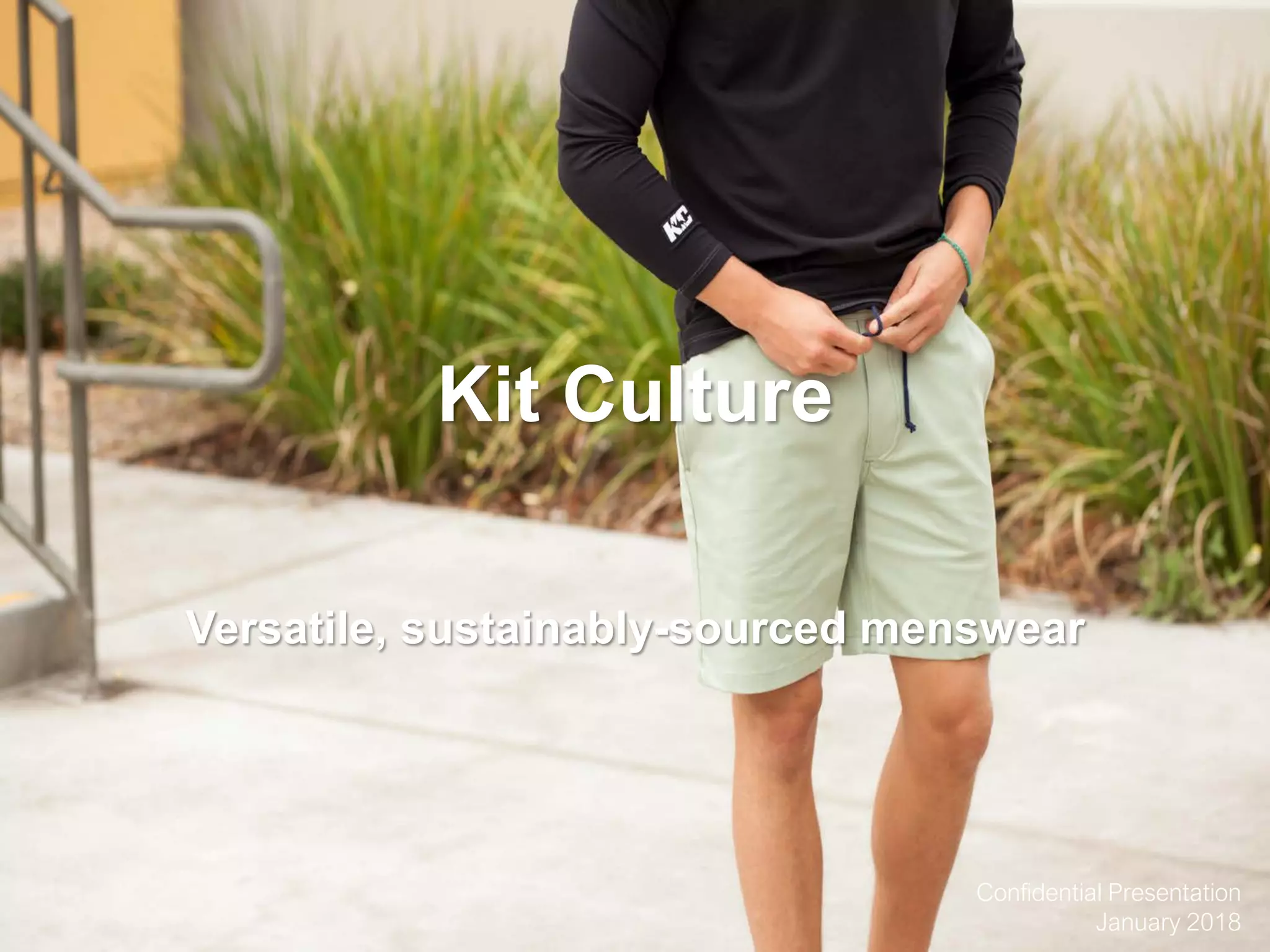
The Kit Culture pitch deck, dated January 2018, outlines a vision for a sustainable, versatile menswear brand designed for the 'young professional male.' The company, founded in 2015, reports early traction of $25k in sales with a single founder operating out of a garage (Slide 5). The deck positions Kit Culture against established D2C players like Bonobos and Mack Weldon, arguing that those competitors lack product differentiation and mission-driven sustainability (Slide 3). Interestingly, the deck sets a very low bar for its 18-month plan, seeking just $50k in seed funding to reach a goal o…
Key takeaways
- The company was founded in 2015 and achieved $25k in sales as a solo-founder operation (Slide 5).
- The brand targets young professional males who prioritize mission, design, and sustainability (Slide 2).
- Kit Culture identifies Bonobos and Mack Weldon as competitors that are 'easily copied' due to a lack of mission (Slide 3).
- The strategy relies on local manufacturing to insulate the brand from large-scale competition (Slide 4).
- The startup claims a digital footprint of 12,000 plus followers and subscribers (Slide 5).
- The 18-month roadmap includes a modest goal of achieving $100k in annual revenue (Slide 6).
- The total seed funding ask is stated as $50k (Slide 6).
- The deck lacks a dedicated team slide, detailed financial projections, or unit economics.
Slide-by-Slide Analysis
Slide 1: Title Slide
The cover slide establishes the brand identity immediately. It features a high-quality lifestyle photograph of a man wearing the product, with the text Kit Culture and the tagline Versatile, sustainably-sourced menswear . The date is clearly marked as January 2018 . The aesthetic is clean and professional, typical of a Direct-to-Consumer (D2C) fashion brand.
Slide 2: The Target Audience
This slide defines the customer persona. It states that today’s young professional male cares more about fashion and is more invested in the brands he chooses from a mission statement, design and sustainability perspective. The imagery reinforces the 'urban commuter' or 'active professional' vibe, featuring a man with a bicycle. This slide attempts to establish a market shift toward values-based purchasing.
Slide 3: Competitive Landscape
The founders categorize the market into two groups. Under Menswear Startups , they list Bonobos and Mack Weldon , noting their successful e-commerce approach but criticizing them for undifferentiated product and being easily copied. Under Proof of Concept , they list Allbirds and Reformation as examples of brands that have succeeded through sustainability and storytelling. This slide is intended to show that Kit Culture is applying the Allbirds model to the general menswear category.
Slide 4: Sustainability plus Accessibility
This slide addresses the brand's moat. It claims that local manufacturing is a core principle which insulates us from competition from large brands. The slide also makes a strategic point about pricing: by being relatively affordable , they aim to avoid being a niche 'craft' brand that only targets high-income consumers. The background image of a rural landscape with wind turbines underscores the sustainability theme, though it is less product-focused than previous slides.
Slide 5: Early Results
This is the traction slide. Key figures include: Company founded in 2015 , $25k in sales with a single founder, and 12,000 plus followers and subscribers . The slide admits the company has been operating out of a garage with a limited product selection. It also notes that customers are located all over the U.S. , which is a vital point for an e-commerce brand to prove it isn't just a local boutique.
Slide 6: 18-Month Plan
The roadmap is presented over a seascape. It lists three milestones: Test new product development model , Raise $50k in Seed , and Achieve $100k in annual revenue. The $50k ask is remarkably small for a seed round, even in 2018. The goal of $100k in annual revenue suggests the company is in the very early stages of validation.
Slide 7: Contact Information
The final slide features the KC logo with a fox silhouette and provides contact details for brian@kitculture.com . It includes a phone number, website, and Twitter handle. The branding remains consistent with the minimalist, modern look of the rest of the deck.
What Kit Culture Does Well
The deck excels at brand positioning . In the crowded D2C menswear space, simply selling 'clothes' is not enough. By aligning themselves with the 'sustainability' success stories of Allbirds and Reformation, the founders provide a clear mental model for investors to understand their potential trajectory. The use of high-quality photography (Slides 1, 2, and 5) gives the impression of a brand that is much larger than a 'garage operation,' which is essential for building trust in fashion.
The honesty regarding their current scale is also a strength. Acknowledging that the $25k in sales came from a single founder in a garage (Slide 5) sets realistic expectations. It frames the $50k ask as a logical next step to move from a hobbyist/side-project phase into a formal business entity.
What is Missing from the Deck
The most glaring omission is a Team Slide . Investors in early-stage startups are primarily betting on the people. While 'Brian' is mentioned on the contact slide, there is no information regarding his background in fashion, manufacturing, or e-commerce. Without a team slide, it is impossible to judge if the founder has the technical skills to execute the 'local manufacturing' strategy mentioned on Slide 4.
Furthermore, there is a total lack of Unit Economics . For a D2C brand, investors need to see the Cost of Goods Sold (COGS), Customer Acquisition Cost (CAC), and Lifetime Value (LTV). While the deck mentions 'relatively affordable' products, it doesn't provide price points or margins. Without these, the $100k revenue goal on Slide 6 is difficult to evaluate—is that revenue profitable, or will it cost $200k in marketing to achieve?
Finally, the Market Size (TAM) is missing. While they mention the 'young professional male,' they don't quantify how many of these individuals exist or what the total spend in this specific sub-sector of menswear looks like. This makes it hard to determine if the $50k seed is a bridge to a massive opportunity or just a small lifestyle business.
Lessons for Founders
Founders can learn two distinct lessons from this deck. First, contextualize your competition. Slide 3 is a great example of how to frame competitors not just as 'people who do what we do,' but as 'people who represent an older, less effective way of doing things.' By grouping Bonobos and Mack Weldon as 'easily copied,' Kit Culture creates a 'gap' in the market that they conveniently fill.
Second, be careful with your 'Ask' amount. A $50,000 seed round is so small that it may actually deter professional VCs who need to deploy larger amounts of capital to make their fund economics work. If you are raising such a small amount, the deck should likely be tailored for angel investors or friends and family, emphasizing personal trust and a quick path to break-even rather than massive venture scale.
Frequently asked questions
- What is the primary value proposition of Kit Culture?
- Kit Culture positions itself as a provider of 'versatile, sustainably-sourced menswear' (Slide 1). The brand emphasizes a combination of sustainability, local manufacturing, and accessibility, aiming to avoid the 'niche craft' label by keeping products relatively affordable while maintaining ethical production standards (Slide 4).
- How much capital is Kit Culture seeking in this deck?
- According to Slide 6, the company is seeking $50,000 in seed funding. This is an unusually low amount for a venture-backed startup, suggesting a 'friends and family' round or a micro-seed intended to bridge the company to its next $100k revenue milestone.
- Who are the main competitors identified by the founders?
- The deck explicitly names Bonobos and Mack Weldon as menswear startups that focus too much on business model disruption rather than product differentiation (Slide 3). It also cites Allbirds and Reformation as 'Proof of Concept' brands that have successfully scaled using a sustainability-first approach.
- What traction did the company have at the time of the pitch?
- At the time of the January 2018 presentation, the company reported $25k in total sales, a presence in a garage, a limited product selection, and a combined social/email following of over 12,000 people (Slide 5). They also noted customers were spread across the U.S., not just in Los Angeles.
- What is missing from the Kit Culture pitch deck?
- The deck is missing several standard components: a team slide (names and backgrounds), a detailed breakdown of unit economics (CAC, LTV, margins), a specific use-of-funds list, and a competitive matrix beyond the high-level pros/cons list on Slide 3.