Samosa King, also branded as Puff House Samosa Kings, presents a business model centered on centralized production and decentralized distribution through a mix of company-owned and franchised outlets. The deck, dated March 2020, outlines a strategy to scale from a single central kitchen in Telangana to six kitchens and over 100 total outlets across South and North India within one year. The company emphasizes product variety, offering 22 types of samosas including vegetarian, non-vegetarian, and dessert options. With a specific investment ask of INR 50 Lakhs for 25% equity, the deck provides…
Key takeaways
- The company offers 22 varieties of samosas categorized into Vegetarian, Non-Vegetarian, and Desserts (Slide 5).
- The business model relies on a Central Cloud Kitchen that supplies raw samosas with a shelf life of 45 days (Slide 4).
- Samosa King targets the Indian food market valued at $540 billion and the online food market at $8 billion as of 2020 (Slide 6).
- Franchise options include a standard outlet requiring 12 Lakhs investment and a Quick Service Outlet at 2 Lakhs (Slides 7 and 8).
- The expansion plan projects growing from 8 total outlets in Q1 to 112 outlets by the end of the first year (Slide 10).
- Financial projections estimate EBITDA growing from 21.93 Lacs to 46.19 Lacs per quarter within one year (Slide 11).
- The investment ask is explicitly stated as INR 50 Lakhs in exchange for 25% equity (Slide 12).
- The deck omits a team slide, providing no information on the founders' backgrounds or operational experience.
Deck Overview
The Samosa King pitch deck, dated March 2020, is a 13-slide presentation focused on scaling a traditional Indian snack through a modern cloud kitchen and franchise framework. The deck is structured to appeal to seed-stage investors or master franchisees, providing a clear breakdown of costs, product variety, and aggressive growth targets. While the visual design is functional, the content is heavily weighted toward operational mechanics and financial projections.
Slide 1: Title Slide
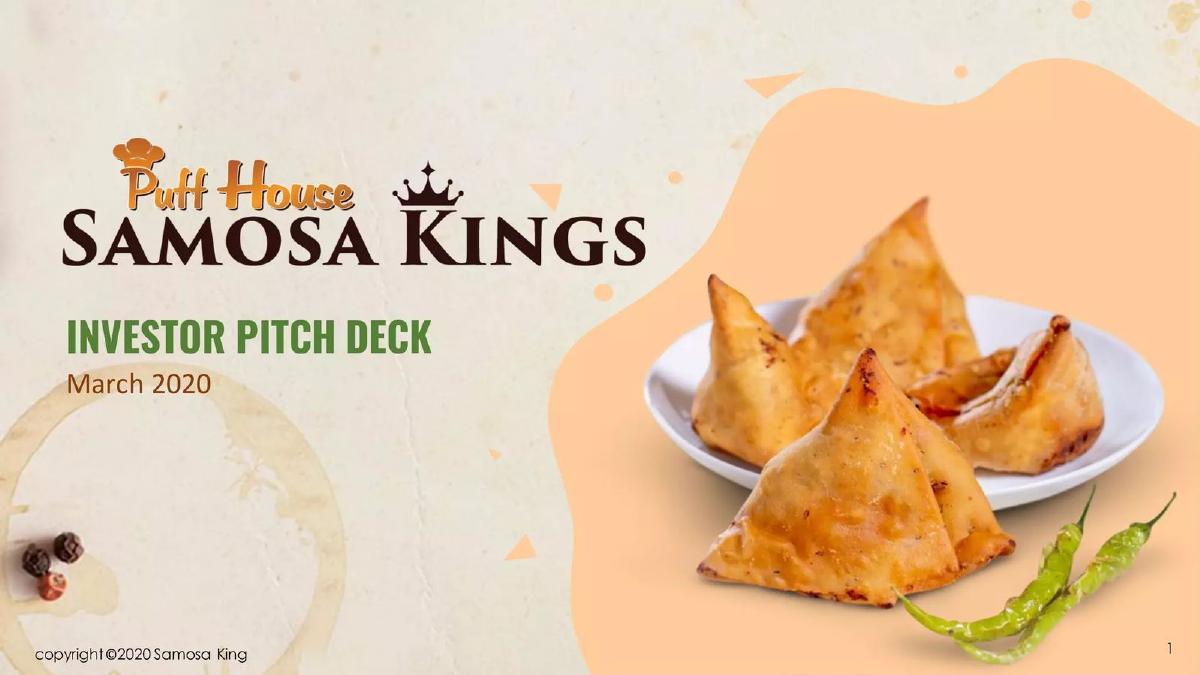
The cover slide introduces the brand as "Puff House Samosa Kings." It features a high-resolution image of samosas and green chilies, establishing the food-centric nature of the business immediately. The slide is dated March 2020 and includes a copyright notice for Samosa King.
Slide 2: About Samosa King
This slide outlines the company's value proposition. It claims "almost nil competition in Telangana" and states the company has developed 22 varieties of "tasty and Hygiene Samosas." Key strategic points include starting in Hyderabad and expanding PAN India via a franchise model. Curiously, several bullet points on this slide are exact duplicates, suggesting a lack of final editorial review.
Slide 3: The Problem
Samosa King identifies four primary pain points in the current market: Shortage of supply vis-à-vis demand , limited accessibility to the product, the expensive and tedious nature of maintaining an FMCG logistics chain, and a general lack of variety in the market.
Slide 4: The Solution
The solution is presented as a three-tier ecosystem: Central Cloud Kitchen , Franchise Outlet , and the Consumer . The Central Kitchen handles production of raw samosas with a 45-day shelf life. The Franchise Outlets are described as "low investment, low risk" with 35-40% profit margins. The slide also illustrates integration with delivery platforms like Swiggy, Zomato, Uber Eats, and Dunzo to reach the end consumer.
Slide 5: Product Diversity
This slide lists the 22 varieties mentioned earlier. Vegetarian options include Paneer Cheese and Veg Biriyani Samosas. Non-Vegetarian options feature Chicken Avakaya Pickle and Mutton Biriyani Samosas. Notably, they offer a Desserts category including Choco Coconut and 5 Star Chocolate Samosas. A photo of a "Samosa Tower" display unit is included, showing how the product is presented at retail.
Slide 6: Business Opportunity
Market sizing is addressed here, citing a 2018 Uber Eats report stating samosas are a top-ranking food in Indian metros. The slide puts the 2020 Indian Food Market Value at $540 Billion and the Indian Online Food Market at $8 Billion . These are broad macro figures rather than a specific Serviceable Obtainable Market (SOM) for samosas.
Slide 7: Franchise Business Model (Standard)
This slide details the FOFO (Franchise Owned Franchise Operated) model for a single outlet. The investment cost is 12 Lakhs (Non-Refundable) for a 150-200 square foot space. It projects Expected Monthly Sales of 3.75 Lakhs and a monthly margin of 35-40%. Support includes shop setup and a steady supply of raw samosas.
Slide 8: Franchise Business Model (Quick Service)
A smaller "Quick Service Outlet" (Takeaway) model is introduced for lower-capital partners. This requires only 2 Lakhs investment for a 50-75 square foot space. It projects Monthly Sales of 1.35 Lakhs with a 30-33% margin. This model utilizes a "Samosa Tower" and a warmer box rather than a full shop setup.
Slide 9: Competition Slide
A standard 2x2 matrix compares Samosa King against competitors like Samosa Singh, Samosa Party, and Samosa Hub. Samosa King positions itself in the top-right quadrant: Healthy and Low Price . The axis labels are "Healthy vs. Unhealthy" and "High Price vs. Low Price."
Slide 10: Business Expansion Plan
The 1-year outlook (2020-21) is highly aggressive. It projects moving from 1 central kitchen and 8 total outlets in Q1 (Apr-Jun) to 6 central kitchens and 112 total outlets by Q4 (Nov-Dec). The geographical reach expands from Telangana to a PAN-India presence within twelve months.
Slide 11: Financial Dynamics
This slide provides a bar chart of projected financials in INR Lacs. EBITDA is projected to start at 21.93 Lacs in Q1 and rise to 46.19 Lacs in Q4. The "Inflows per Quarter" include revenue from both company-owned stores and franchise fees. The fixed operational cost per quarter is listed at 15.00 Lacs.
Slide 12: Investment Ask
The ask is clear and direct: INR 50 Lakhs for 25% Equity . This implies a post-money valuation of 2 Crores. The spending plan allocates 27 Lakhs for opening 3 new company-owned outlets, 15 Lakhs for central kitchen operations, 5 Lakhs for marketing, and 3 Lakhs for other expenses.
Slide 13: Conclusion
The final slide is a simple "Thank you" featuring another product image. No contact information or website URL is provided on this slide.
What Samosa King Does Well
Clarity of Ask: Slide 12 is refreshingly blunt. Many decks hide the ask or use vague ranges; Samosa King specifies the amount, the equity, and the exact allocation of funds. · Unit Economics: By breaking down the two different franchise models (Slides 7 and 8), the company shows it has thought through the different tiers of partners it needs to scale. · Product Range: Listing all 22 varieties (Slide 5) validates the claim of "diversity" and shows a menu that caters to various regional tastes and meal times (including dessert).
What Is Missing from the Deck
The Team: This is the most significant red flag. There is no mention of the founders, their culinary background, or their experience in scaling retail chains. Investors back people, especially in the operationally intensive F&B sector. · Traction: The deck lacks historical data. It is unclear if the "1 central kitchen" in Q1 is already operational or if it is a goal. There are no photos of actual stores, only illustrations and product shots. · Logistics Detail: While a 45-day shelf life for raw samosas is mentioned, the deck doesn't explain the technology behind this (e.g., flash freezing, vacuum packaging) or how they maintain the cold chain across the projected PAN-India expansion.
What Other Founders Can Copy
Tiered Franchise Options: Offering both a full outlet and a low-cost "Quick Service" model allows a startup to saturate a market faster by lowering the barrier to entry for micro-entrepreneurs. · Visualizing the Supply Chain: Slide 4 does a good job of simplifying a complex operational flow into a digestible graphic that shows how the central kitchen supports the franchise and the end user. · Direct Financial Projections: While the numbers are ambitious, providing a quarter-by-quarter breakdown of CAPEX, OPEX, and EBITDA (Slide 11) gives investors a starting point for due diligence and shows a level of financial planning.
Frequently asked questions
- What is the core technology or innovation mentioned in the deck?
- The primary innovation is the centralized production model. Slide 4 explains that a Central Cloud Kitchen prepares and supplies 'Raw Samosas' to outlets. These raw products have a shelf life of approximately 45 days, allowing for standardized quality control, inventory tracking, and a reduction in the need for skilled cooking staff at the individual franchise level.
- How does the franchise model work for Samosa King?
- Samosa King utilizes a FOFO (Franchise Owned Franchise Operated) model. As per Slide 7, the company rents the brand for a non-refundable fee. A standard outlet requires 150-200 square feet and 4 employees, while a Quick Service Outlet (Slide 8) needs only 50-75 square feet and 1 employee. The company provides the setup, documentation, and marketing support.
- What are the projected margins for a Samosa King franchisee?
- For a standard franchise outlet, Slide 7 projects a monthly margin of 35-40% on expected sales of 3.75 Lakhs. For the smaller Quick Service Outlet, Slide 8 projects a slightly lower margin of 30-33% on expected monthly sales of 1.35 Lakhs. These figures are intended to attract small-scale investors to the brand.
- What is the geographical expansion strategy?
- The rollout begins in Telangana (Q1), expands to Andhra Pradesh (Q2), moves into other South Indian cities (Q3), and finally targets North Indian cities by the end of the first year (Q4). Slide 10 shows this rapid progression, moving from 1 central kitchen to 6 within twelve months.
- What is missing from this pitch deck that an investor would need?
- The most critical omission is the Team slide. There is no mention of who is running the company. Additionally, while Slide 11 shows 'Financial Dynamics,' these appear to be forward-looking projections rather than historical data. There is also no mention of existing revenue, current store performance, or specific customer acquisition costs.