Rove’s 17-slide deck presents a compelling case for a vertically integrated short-term rental (STR) platform. By addressing three core pain points—inaccurate income estimates, regulatory compliance, and inconsistent property management—Rove positions itself as a 'ready to rent' marketplace. The deck is particularly strong in its financial transparency, projecting a $260,000 total revenue per $2M property over five years through a 3% transaction fee and a 20-30% management take rate. While the deck lacks a formal 'Ask' slide and detailed unit economics beyond the top-line revenue, it compensat…
Key takeaways
- The company identifies a significant data gap, noting that AirDNA estimates can vary from actual performance by 50%+/- (Slide 2).
- Rove employs a hybrid revenue model combining a $60,000 transaction fee at close with a $40,000 annual management fee for a $2M property (Slide 4).
- The platform claims to outperform residential market benchmarks by up to 60% across multiple New York properties (Slide 5).
- Rove targets the 'workcation' demographic by providing 500+ mbps WiFi and 4K UHD monitors in every unit (Slide 7).
- The deck leverages B2B credibility by listing illustrative customers such as HBO, Insight Partners, and Affirm (Slide 8).
- The leadership team features deep domain expertise, specifically citing a Head of Real Estate who scaled June Homes from 2 to 2,500 units (Slide 9).
- The deck omits a specific 'Ask' slide detailing the amount being raised or the intended use of funds.
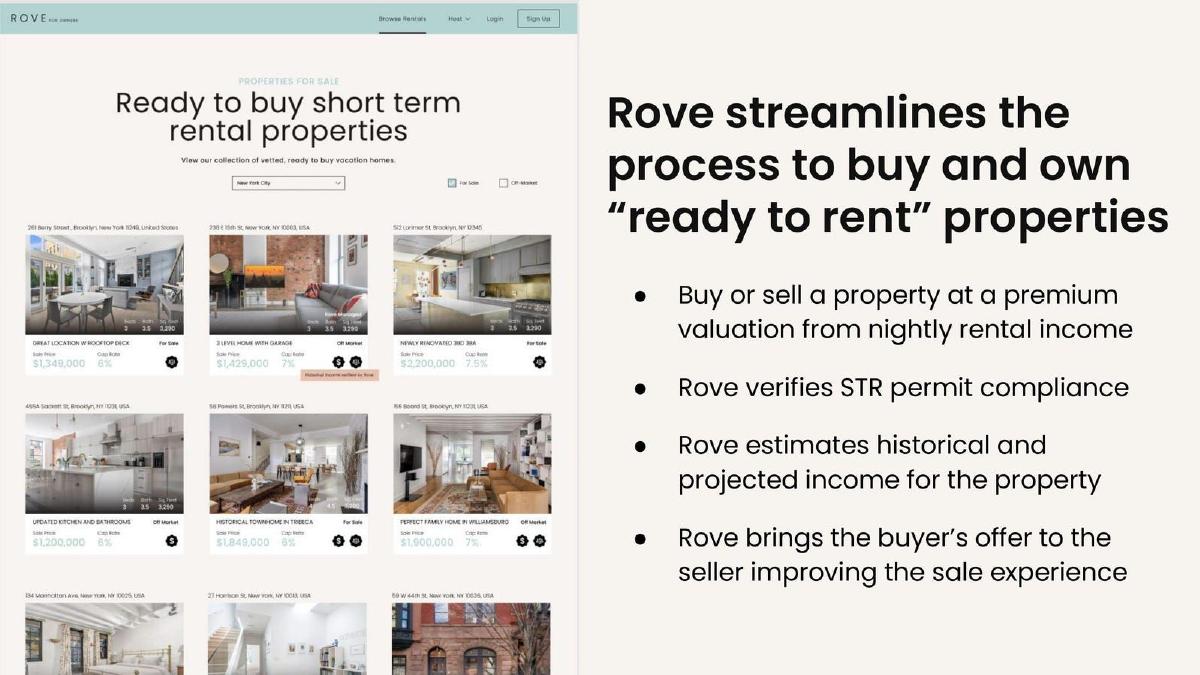
- Regulatory risk is addressed directly as a core problem, with the company offering to verify nightly rental permit compliance (Slide 3).
Introduction: The Full-Stack Real Estate Play
Rove’s pitch deck, used to raise a $4M Seed round in 2022, is a masterclass in luxury branding and clear value propositioning. As reported by Business Insider, the North American startup aims to solve the fragmentation in the short-term rental (STR) market. The deck consists of 17 slides, focusing heavily on the intersection of real estate transactions and high-yield property management.
Slide 1: Title and Positioning
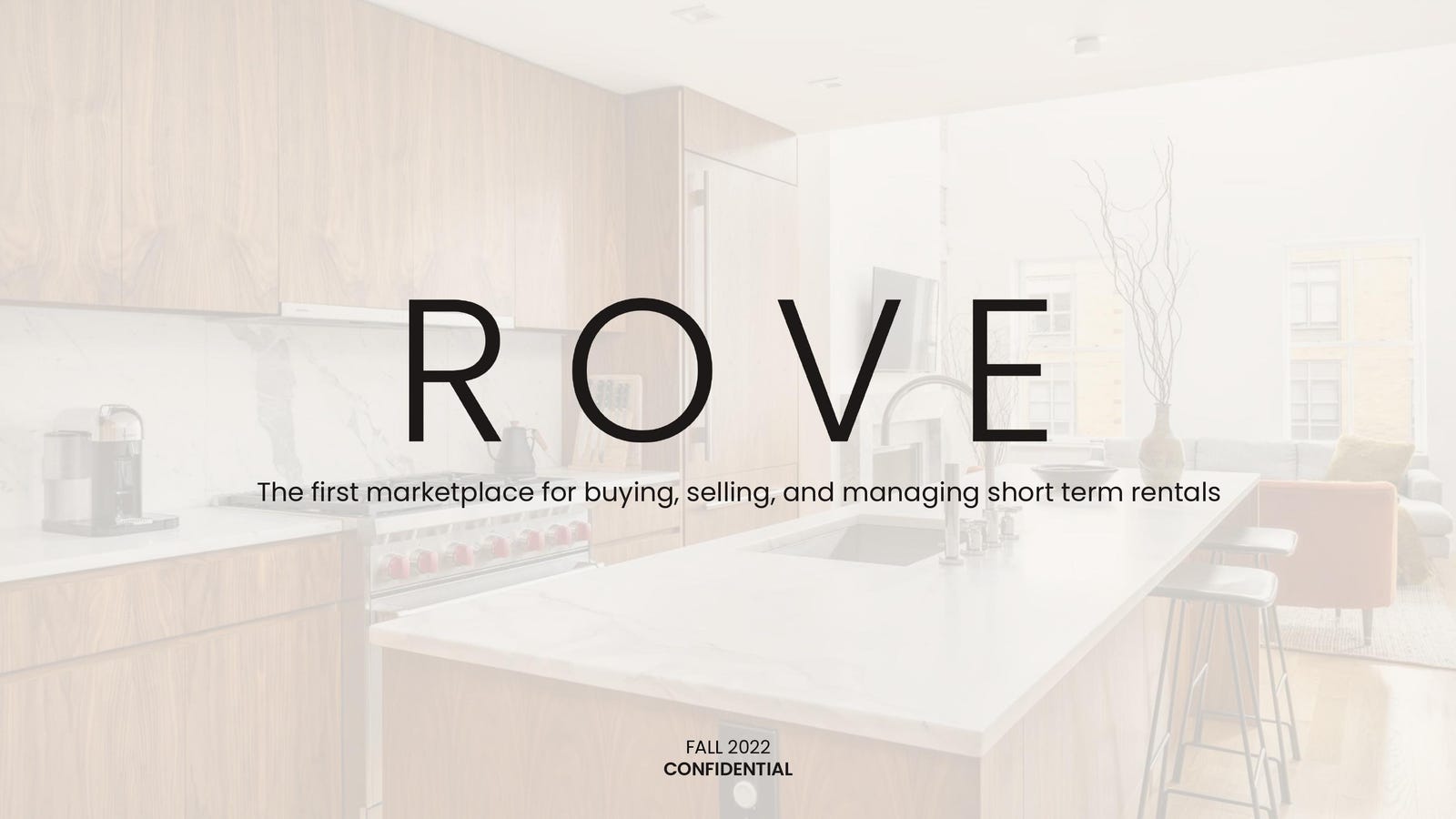
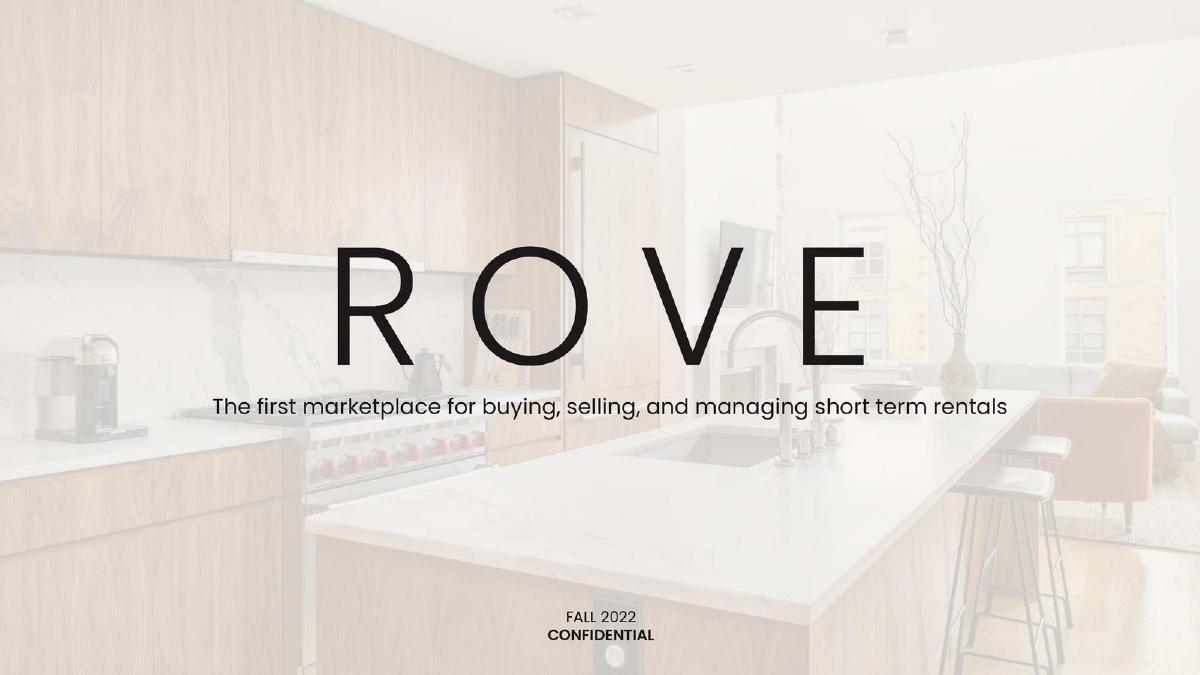
The cover slide is minimalist, featuring a high-end kitchen interior that immediately signals the 'luxury' nature of the brand. The subtitle, 'The first marketplace for buying, selling, and managing short term rentals,' establishes Rove as a vertically integrated platform rather than just a management company or a listing site.
Slide 2: The Mission and Problem Statement
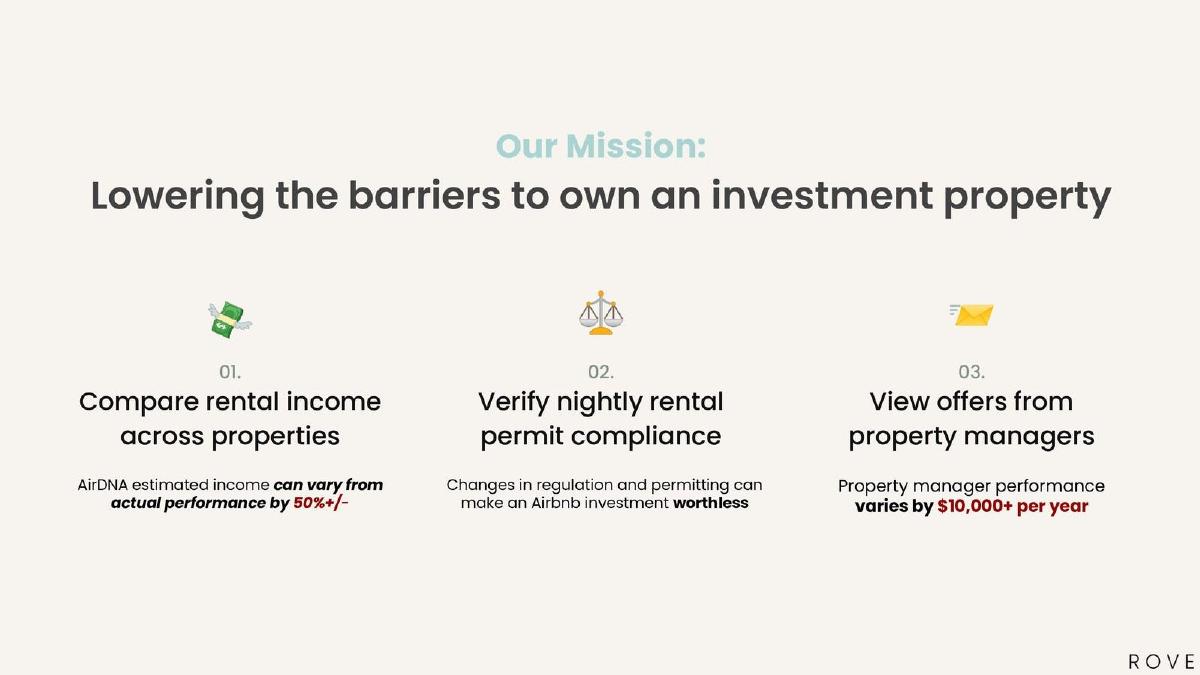
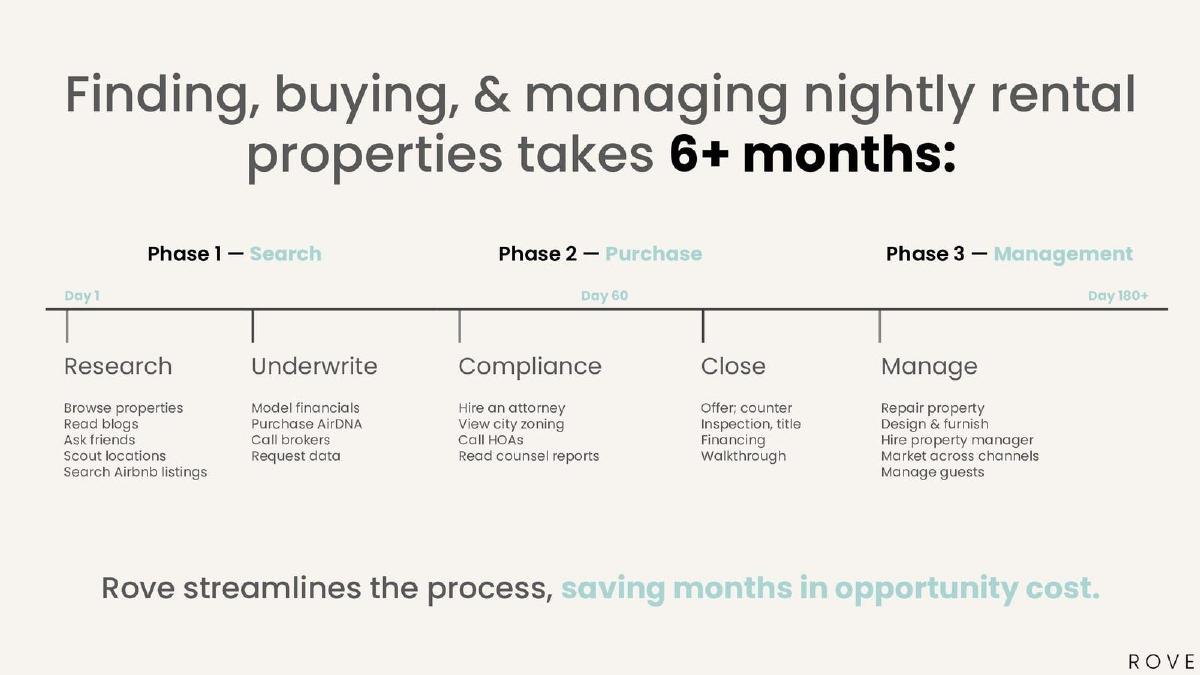
Slide 2 defines the mission: 'Lowering the barriers to own an investment property.' It identifies three specific friction points: inaccuracy in income data, regulatory compliance risks, and the high variance in property manager performance. Notably, it claims that 'AirDNA estimated income can vary from actual performance by 50%+/' and that property manager performance can vary by '$10,000+ per year.' This sets the stage for Rove as a data-driven solution.
Slide 3: The 'Ready to Rent' Solution
This slide showcases the product interface, displaying a marketplace of vetted vacation homes. Rove emphasizes four key pillars: premium valuations based on nightly income, permit compliance verification, historical/projected income estimation, and a streamlined sales experience. The slide lists properties in New York with cap rates ranging from 6% to 7.5% and sale prices between $1.2M and $2.2M .
Slide 4: The Revenue Model
Slide 4 is perhaps the most important for investors. It breaks down the 5-year revenue potential of a single $2M property. Rove combines a $60,000 transaction fee (up to 3% at close) with a $200,000 recurring revenue share (20-30% take rate over 5 years). The total projected revenue of $260,000 per property demonstrates a high LTV (Lifetime Value) compared to traditional real estate brokerages that exit the relationship after the sale.
Slide 5: Performance Benchmarks
To prove their management efficacy, Slide 5 provides a 'July Revenue by Property New York Snapshot.' It compares Rove-managed properties (like 'Astor House' and 'Parker House') against residential market benchmarks. The headline claims Rove helps homeowners 'beat income benchmarks by up to 60%.' The chart shows Rove generating over $40,000 in a single month for their top-performing property, significantly outperforming the benchmark of approximately $25,000.
Slide 6: The Dual Value Proposition
This slide splits the benefits between Homeowners and Guests. For homeowners, the focus is on 'above market returns' and 'stress-free management.' For guests, the focus is on a 'luxury quality experience' with 'no weird rules' and a 'first class remote work setup.' This dual focus is critical for marketplaces where supply (homes) and demand (guests) must both be satisfied.
Slide 7: The Guest Experience
Slide 7 leans into the 'Work from Anywhere' trend. It lists specific amenities that justify their premium pricing: 500+ mbps WiFi, 4K UHD Monitors, and Electric standing desks. By professionalizing the 'office' aspect of a rental, Rove differentiates itself from casual Airbnb hosts who may only offer a kitchen table as a workspace.
Slide 8: Social Proof and B2B Traction
Slide 8 addresses the quality of the 'demand' side. It lists 'Illustrative Customers' including major brands like HBO, Affirm, Insight Partners, and Ramp. This suggests that Rove isn't just relying on individual tourists but is capturing high-value corporate spend and 'team co-locations.'
Slide 9: The Leadership Team
The team slide highlights significant industry experience. CEO Jonah Hanig is a former YC founder (Explo). Most notably, the Head of Real Estate, Seb Oppenheim, is credited with scaling June Homes from 2 to 2,500 units. Other team members bring experience from Kasa Living, SpaceX, and PwC. This signals to investors that the team has the operational 'scar tissue' required to scale a capital-intensive real estate business.
What Rove Does Well
Vertical Integration: By capturing the transaction fee AND the management fee, Rove solves the 'leaky bucket' problem of real estate tech. They don't just find the buyer; they retain the buyer as a long-term management client.
Specific Pain Point Identification: Most STR decks talk about 'travel.' Rove talks about 'permit compliance' and '50% variance in AirDNA data.' These are the actual problems that keep real estate investors awake at night, and addressing them directly builds immediate credibility.
Asset-Light Branding: While the company deals in multi-million dollar homes, the deck emphasizes their role as a marketplace and manager. This suggests a scalable software-plus-services model rather than a heavy asset-heavy balance sheet play.
What is Missing from the Deck
The Ask: The 17-slide deck (as presented in the summary) does not include a slide detailing the $4M raise, the valuation, or the specific use of proceeds. While this may have been in a separate document or a final slide not included in the provided text, its absence in a 'pitch deck' is a notable omission for a teardown.
Unit Economics (CAC/LTV): While Slide 4 shows the revenue potential, it does not show the cost to acquire a property (CAC) or the cost to manage it. In a high-touch luxury model, operational overhead can quickly eat into a 20-30% take rate.
Competitive Landscape: There is no mention of competitors like Pacaso (fractional ownership) or AvantStay/Sonder (management). Investors would want to know how Rove defends its 'ready to rent' niche against these better-funded incumbents.
Founder's Guide: What to Copy
The 'Snapshot' Slide: Slide 5 is an excellent way to present data. Instead of showing a vague growth chart, they showed a specific month (July) and specific properties. This makes the success feel tangible and verifiable.
The Revenue Formula: Slide 4 is a perfect example of how to explain a complex business model. By using a single $2M property as the unit of measure, they make the math easy for an investor to follow and then mentally multiply by hundreds of units.
Amenity Specificity: Don't just say 'great amenities.' Rove says '4K UHD Monitors' and '500+ mbps WiFi.' In a world of remote work, these specific details are more persuasive than generic marketing speak.
Frequently asked questions
- How does Rove make money?
- Rove utilizes a dual-revenue stream. First, it charges a transaction fee of up to 3% when a property is sold through its marketplace (estimated at $60,000 for a $2M home). Second, it generates recurring revenue through a 20-30% take rate on rental income, which it estimates at $40,000 per year for a high-end property.
- What is Rove's primary competitive advantage in data?
- Rove differentiates itself from standard data providers like AirDNA by claiming their estimates can be off by 50%. Rove uses its own historical and projected income data to verify potential returns for buyers, aiming for higher accuracy in the luxury segment.
- Who is the target guest for Rove properties?
- Rove targets high-end, respectful guests, specifically focusing on corporate clients, team co-locations, and 'workcationers.' They provide specific amenities to attract this group, including electric standing desks, 4K monitors, and high-speed internet.
- Does the deck include a roadmap or future milestones?
- The provided slides do not include a forward-looking roadmap or specific expansion plans. The focus remains on the current business model, the New York snapshot of performance, and the strength of the existing leadership team.
- What is missing from the Rove pitch deck?
- The deck lacks a clear 'Ask' slide (specifying the $4M raised), a detailed breakdown of operating expenses, and a competitive landscape analysis. It also omits specific details on how they source their 'off-market' inventory.