Legal Tech Competition Slides: 6 Real Pitch Deck Examples
How legal tech startups show competition in a pitch deck: logo walls, two-axis maps, tiers of incumbents and grouped rivals.
Legal Tech Competition Slide: Show Who Lawyers and Clients Use Today
Legal tech founders face two kinds of competition at once. One is other software: contract tools, research databases, patent search, online legal forms. The other is the way legal work is already done: a law firm billing by the hour, a template in a word processor, an in-house lawyer with a spreadsheet, or a court. A legal tech competition slide has to show both, and it has to explain why a lawyer, a business or a consumer would change a habit that is often decades old. This guide compares six real competition slides from legal tech decks: two lawyer marketplaces, two contract software companies, a dispute-resolution platform and a patent software company. They use five formats: a wall of logos, two-axis maps, three tiers of rivals, groups of rivals with a difference for each, and a positioning slide that names no rivals at all.
TL;DR
Name the products and services your buyer uses today, including law firms and manual work, group them, and say what makes you different from each group. DeepIP sorts patent software into old incumbents, earlier niche tools and new AI entrants, and names companies in each. OpenLaw places itself on a map against law firms, LegalShield, LegalZoom, Rocket Lawyer and UpCounsel. CourtCorrect groups rivals into claims software, consumer legal apps and governments, and gives a difference for each group. Juro draws a map from "not optimized for legal" to "suitable for legal", but the rival names are blurred in the deck itself. LawKick shows five rival logos without saying how it differs. Contractbook lists four strengths and names no rival at all.
Legal tech competition slides from real pitch decks
Each example shows the exact stored slide above its analysis and links to the full teardown. The slides that explain the company's position come first; weaker ones follow for contrast. Claims are as shown on the slides; comments are ours.
DeepIP competition slide — slide 9
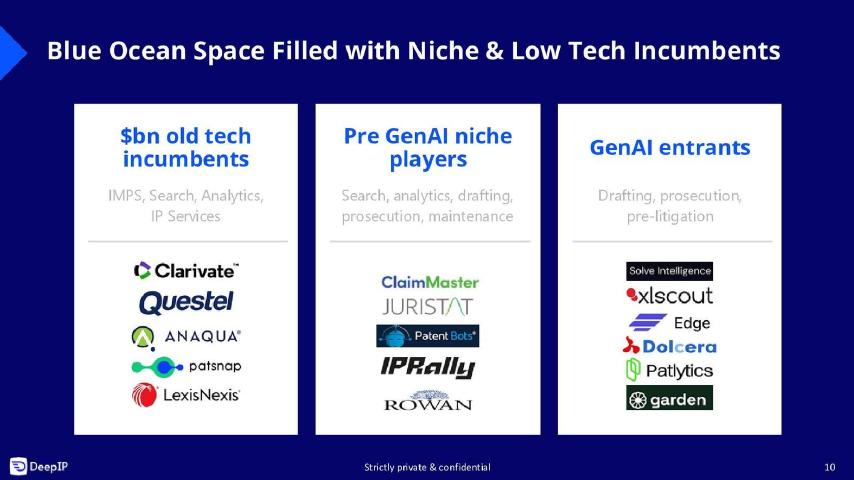
AI software for patent professionals, in a deck dated November 2024. Slide titled "Blue Ocean Space Filled with Niche & Low Tech Incumbents", with three columns.
DeepIP deck, slide 9. Exact stored slide matched to this analysis.
Our analysis: It shows a market moving in three waves and lists sixteen named rivals, more than any other slide in this guide.
Evidence and limitation: The groupings are the company's own. No figures are given for any rival. DeepIP's own site, checked on 2026-10-01, describes it as AI patent drafting and office action software.
What a founder can adapt: Add one line under each column saying what DeepIP does that the group does not, and one fact, such as time saved per patent draft.
Presentation choice: The tiers explain why now: new AI tools have opened a market that large, older companies have held for years. It is also candid that DeepIP is one of several new entrants, not alone.
When it does not fit: Calling a market a "blue ocean" while listing six direct new rivals; the columns undercut the title.
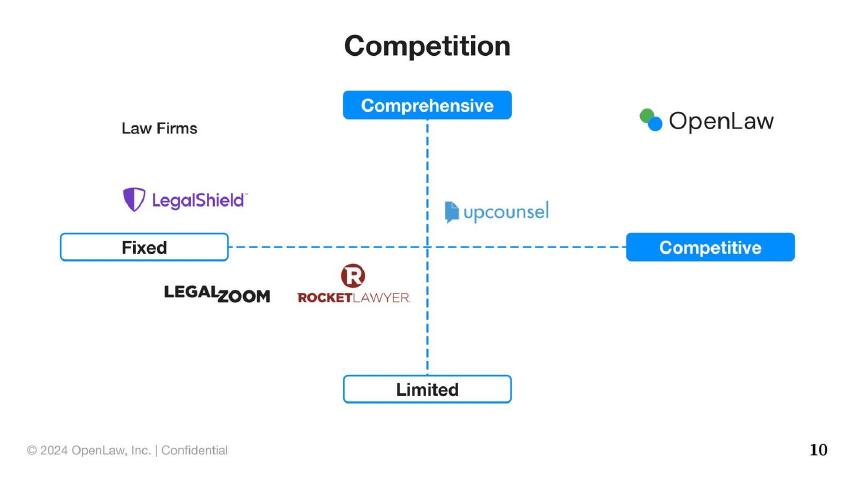
Marketplace that helps clients find lawyers. Slide titled "Competition", a two-axis map, marked 2024.
OpenLaw deck, slide 10. Exact stored slide matched to this analysis.
Our analysis: It argues that rivals either sell fixed-price packages or offer narrow services, while OpenLaw offers broad service at competitive prices.
Evidence and limitation: Positions are the company's own judgement; no basis is given.
What a founder can adapt: Give one example price for a common service from LegalZoom and from OpenLaw, and say what "competitive" means, for example lawyers bidding for a job.
Supporting analysis
What the deck claims: Axes: "Fixed" to "Competitive" and "Limited" to "Comprehensive". OpenLaw sits alone at top right (competitive, comprehensive). "Law Firms" and LegalShield sit at top left; UpCounsel near the centre; LegalZoom and Rocket Lawyer at bottom left (fixed, limited).
Presentation choice: One of only two slides here that names law firms as competition, and the axes are things a client cares about: price and range of service.
When it does not fit: Owning the best corner of your own map with no reason given; investors read it as a picture of hope.
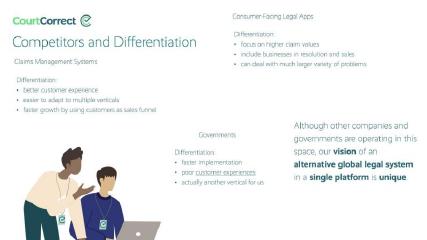
UK dispute-resolution software, in a seed round deck. Slide titled "Competitors and Differentiation", with three groups.
CourtCorrect deck, slide 8. Exact stored slide matched to this analysis.
Our analysis: It treats courts and government systems as competition, and notes that governments could also become customers.
Evidence and limitation: Claimed. No company is named in any group, and no figure supports any difference. CourtCorrect's site was reachable on 2026-10-01; we did not review its current offer.
What a founder can adapt: Name two or three companies in each group and back one difference per group with a fact, such as average time to resolve a complaint.
Supporting analysis
What the deck claims: "Claims Management Systems": "better customer experience", "easier to adapt to multiple verticals", "faster growth by using customers as sales funnel". "Consumer-Facing Legal Apps": "focus on higher claim values", "include businesses in resolution and sales", "can deal with much larger variety of problems". "Governments": "faster implementation", "poor customer experiences", "actually another vertical for us". "Although other companies and governments are operating in this space, our vision of an alternative global legal system in a single platform is unique."
Presentation choice: The format answers the right question, a difference for each kind of alternative, even though it names no companies.
When it does not fit: Ending on "our vision is unique"; a vision is not something a rival cannot copy.
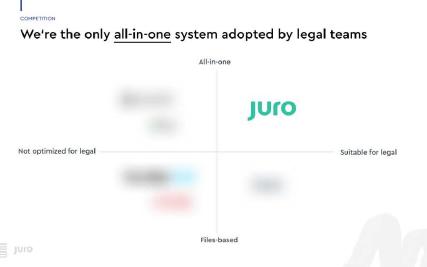
Contract automation software. Slide titled "We're the only all-in-one system adopted by legal teams", a two-axis map.
Juro deck, slide 7. Exact stored slide matched to this analysis.
Our analysis: It claims to be the only product that is both all-in-one and built for legal teams.
Evidence and limitation: The rival names cannot be read in the stored version. Juro's site, checked on 2026-10-01, now describes the company as "intelligent contracting".
What a founder can adapt: If you blur names in a shared deck, say so on the slide and describe each rival type in words, such as "e-signature tools" or "general document storage".
Supporting analysis
What the deck claims: Axes: "Files-based" to "All-in-one" and "Not optimized for legal" to "Suitable for legal". Juro sits alone at top right. Five rival logos appear in the other quadrants, but all are blurred in the stored deck.
Presentation choice: Shown as a mixed example: the axes describe a real choice legal teams make, but with names blurred a reader cannot test the claim.
When it does not fit: A headline claiming you are the only one, on a slide where readers cannot see who else is there.
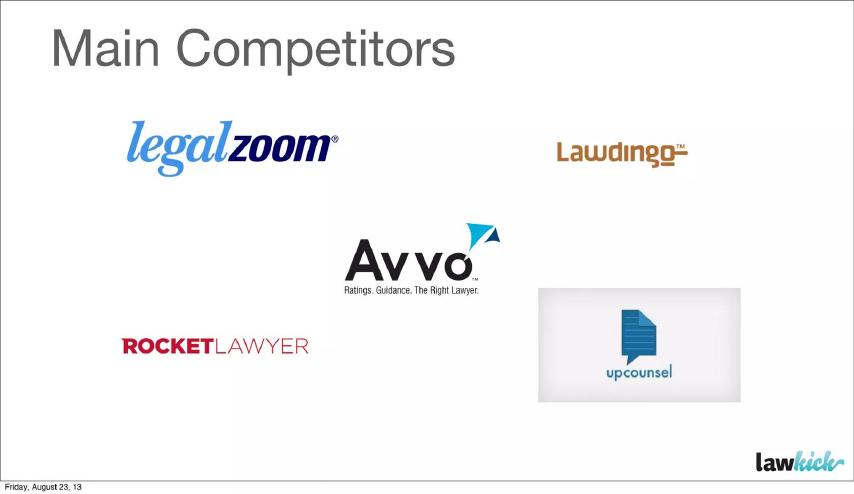
Marketplace for finding and hiring lawyers, with a slide footer dated August 2013. Slide titled "Main Competitors".
LawKick deck, slide 7. Exact stored slide matched to this analysis.
Our analysis: It shows the founders know the main online legal brands of the time.
Evidence and limitation: Avvo entered a deal to be acquired by Internet Brands in 2018, and LegalZoom listed on the stock market in 2021, both per Wikipedia. Outcome for LawKick unknown.
What a founder can adapt: Split the logos into legal forms (LegalZoom, Rocket Lawyer) and lawyer directories (Avvo, Lawdingo, UpCounsel), place LawKick, and add one line on what it does differently.
Supporting analysis
What the deck claims: Five logos: LegalZoom, Lawdingo, Avvo, Rocket Lawyer and UpCounsel. No other text.
Presentation choice: Shown for contrast: the slide lists rivals but gives no grouping, no position for LawKick and no reason a client would switch.
When it does not fit: A logo wall as your only competition slide.
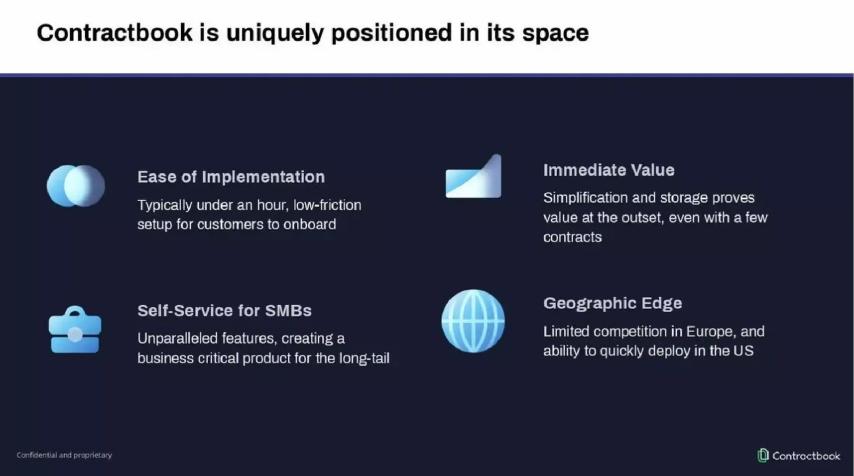
Contract management software, in a deck dated December 2020. Slide titled "Contractbook is uniquely positioned in its space".
Contractbook deck, slide 10. Exact stored slide matched to this analysis.
Our analysis: It makes the case for its position through four strengths rather than a comparison.
Evidence and limitation: Claimed. No rival is named, and no figure supports "under an hour" or "limited competition in Europe".
What a founder can adapt: Keep the four strengths, and add who you compare against for each, for example the typical setup time of the two rivals customers most often consider.
Supporting analysis
What the deck claims: "Ease of Implementation: Typically under an hour, low-friction setup for customers to onboard." "Immediate Value: Simplification and storage proves value at the outset, even with a few contracts." "Self-Service for SMBs: Unparalleled features, creating a business critical product for the long-tail." "Geographic Edge: Limited competition in Europe, and ability to quickly deploy in the US."
Presentation choice: Shown as a warning: "limited competition in Europe" is a strong claim, and without a single named rival a reader cannot judge it.
When it does not fit: Claiming a unique position or limited competition on a slide that names nobody.
Whether each slide names rivals, shows the company's own position, and gives something a reader could check.
Example
Rivals named
Own position shown
Checkable basis
DeepIP
Yes (sixteen, in three tiers)
Partly (implied as GenAI entrant)
No
OpenLaw
Yes (five, plus law firms)
Yes (map corner)
No
CourtCorrect
Groups only, no companies
Yes (difference per group)
No
Juro
Blurred in stored deck
Yes (map corner)
No
LawKick
Yes (five logos)
No
No
Contractbook
No
Partly (four strengths)
No
Key Takeaways
Include law firms and manual work as competition, not only software.
Group rivals by what the buyer uses them for, and give a difference per group.
A map only helps if a reader can see who sits where and why.
A logo wall shows awareness of the market, not a reason to switch.
Claims like "limited competition" need at least one named rival or fact.
Build your legal tech competition slide
Start from what your buyer does today when the legal task comes up.
Buyer. Is your customer a law firm, a company legal team, a small business or a consumer?
Today. Would they otherwise hire a lawyer, use a template, or buy another product?
Groups. How would you group those options so your own position is obvious?
Difference. What do you do better than each group: price, speed, accuracy, ease of setup?
Proof. Can you show a price, a time saved, an accuracy test or a customer who switched?
Copyable framework: Today [buyer] handles [task] with [law firm or manual method] at about [cost and time], or with [software group] such as [two names]. We [difference], shown by [evidence and date].
Illustrative example 1 — written by us
Before: Main Competitors: five legal brand logos.
After: Small businesses today hire a local lawyer by the hour (often several hundred dollars for a simple contract) or buy fixed-price forms from LegalZoom or Rocket Lawyer. We let three vetted lawyers quote on each job; in our pilot, the average accepted quote was 30% below the client's last lawyer bill.
What improved: Our illustrative rewrite; figures are invented for the example. It adds law firms as competition, groups the online rivals and gives one result a reader could ask about.
What this guide adds
The general competition slide guide covers any kind of business. Legal tech brings its own problems. Buyers are often lawyers, who are cautious by training and judged on mistakes rather than speed. Many products compete less with another startup than with a law firm's billable hours or with a template a client already has. Some rivals are very large: research databases owned by major publishers, or consumer brands such as LegalZoom, which listed on the stock market in 2021. And in some countries, rules about who may give legal advice limit what a software company can offer at all.
The legal tech problem, solution and market guides cover other slides from legal tech decks. Here we look only at how each deck handles rivals: who it names, how it groups them, where it places itself and what a reader could check.
How we read each slide
We quote the text on the stored slide images, read at full size. We have not checked any rival's features or prices, or any claim a company makes about its own position. "Claimed" means the company states something on the slide without a source. Where a rival named on a slide has since changed hands or listed on a stock market, we say so and cite where we found it.
The decks span roughly 2013 to 2024. LawKick's slide carries a date in August 2013; DeepIP's deck is dated November 2024; Contractbook's is dated December 2020. The legal software market changed a great deal in that time, especially after AI writing tools arrived, so we note dates where they matter.
Five formats, and what each one shows
Tiers of rivals (DeepIP) show how a market has changed over time: who the old leaders are, who came next and who is arriving now. They suit markets where a new technology has opened the door, and they let the founder place the company in the newest group without claiming to have no rivals. Two-axis maps (OpenLaw, Juro) show a gap in one glance, but the founder picks the axes, so the gap can be a result of the choice rather than of the market. Groups with a difference for each (CourtCorrect) take more words but answer the question investors ask most: why would someone pick you over each kind of alternative? A logo wall (LawKick) proves the founder knows the market and nothing more. A positioning slide with no rivals (Contractbook) can state strengths clearly, but leaves the reader to guess who the company is being compared with.
Whichever format you pick, a reader needs three things: who the rivals are, where you sit among them, and what that position is based on. Five of the six slides name or group rivals. Four place the company. Only DeepIP and CourtCorrect come close to explaining the difference, and none gives a figure that a reader could check, such as a price, a time saved or a customer who switched.
The rival most legal tech slides leave out
For many legal tech products, the strongest competitor is not software. It is a law firm, an in-house lawyer, a word-processor template or a court. Only two slides here name that kind of competition. OpenLaw places "Law Firms" on its map, and CourtCorrect lists "Governments" as a group, noting that courts are slow and have "poor customer experiences". Juro's problem slides earlier in its deck explain that contracts start in Microsoft Word, but the competition slide itself compares only software.
If your buyer would otherwise pay a lawyer by the hour or do the work by hand, put that on the slide. Say roughly what it costs today and how long it takes. It is often the easiest comparison for an investor to understand, and the one most likely to explain why a buyer would pay for something new.
Lawyer marketplaces: two decks, two approaches
LawKick and OpenLaw both help people and small businesses find lawyers, and both name the same well-known rivals: LegalZoom, Rocket Lawyer and UpCounsel. LawKick shows them as logos, adding Avvo and Lawdingo, with no comparison at all. OpenLaw puts the same names on a map, from fixed-price to competitive pricing and from limited to comprehensive service, and places itself alone in the competitive, comprehensive corner.
The map is the stronger slide because it says something a reader can test: that rivals either sell fixed-price packages or offer limited service. But it still gives no reason for each position. A line on what LegalZoom charges for a common service, and what a client pays on OpenLaw for the same thing, would turn the map from an opinion into an argument.
Questions investors ask about a legal tech competition slide
Who is the buyer? A law firm, a company's legal team, a small business and a consumer choose very differently. The slide should make clear which one the rivals are competing for.
What do buyers use today? If the answer is a law firm, a template or a spreadsheet, that belongs on the slide alongside the software rivals.
Why now? In markets with old, large incumbents, investors want to know what has changed: a new technology, a change in rules, or a shift in how legal work is bought. DeepIP's third tier, "GenAI entrants", answers this directly.
Who chose the axes? If the company sits alone in the best corner of a map, investors will ask what was left out, such as price, accuracy or how hard the product is to adopt.
Are the rivals still current? Avvo agreed to be acquired by Internet Brands in 2018, and LegalZoom listed in 2021. A slide that names rivals should be checked before each round.
Mistakes legal tech slides make most often
The most common gap across these six slides is evidence. Not one gives a price, a time saved, an accuracy figure or a customer who switched from a named rival. Legal buyers are cautious and want proof; investors know this and will ask for it. One checkable fact per group of rivals would make almost every slide here stronger.
The second gap is clarity about what is shown. Juro's rivals are blurred in the stored deck, so a reader sees a map with only Juro's name on it. Contractbook names no rival at all. CourtCorrect names groups but no companies. Each approach may have had a reason, such as keeping a public deck free of other companies' names, but in each case the reader is left to guess. If you remove names from a shared version of your deck, say so on the slide, and keep a full version ready for investors who ask.
Common mistakes
Leaving out law firms. Only OpenLaw and CourtCorrect show non-software alternatives.
Logos with no comparison. LawKick lists five rivals and never says how it differs.
Names nobody can read. Juro's rivals are blurred, so its "only" claim cannot be tested.
Unique with no rivals named. Contractbook claims limited competition without naming one company.
No evidence. None of the six gives a price, time saved or switched customer.
Diagnostic checklist
Names the software your buyer uses today.
Includes law firms, templates or manual work where they compete.
Groups rivals by what the buyer uses them for.
Puts your own company on the slide.
Gives one difference per group, backed by a fact.
Explains what has changed to let you in now.
Checks that every named rival still exists in that form.
Frequently asked questions
Who should a legal tech startup list as competitors?
The software and services your buyer uses today, including law firms and manual methods. DeepIP names sixteen patent software companies in three groups; OpenLaw adds law firms to its map alongside LegalZoom and Rocket Lawyer.
Should a legal tech competition slide include law firms?
Yes, if clients would otherwise hire a lawyer. OpenLaw places law firms on its map, and CourtCorrect lists governments and courts as a group of alternatives.
Is a logo wall a good legal tech competition slide?
Only as a start. LawKick shows five legal brands as logos but never places itself or says how it differs; grouping the logos and adding one line on the difference would fix that.
Can I blur competitor names on a shared pitch deck?
You can, but say so on the slide. Juro's stored deck shows a map with every rival blurred, so readers cannot test its claim to be the only all-in-one system for legal teams.
How we chose these examples
Corpus: published pitch deck teardowns on StartupFundraising.com. Founder-uploaded private decks are excluded.
Selection (2026-10-01): we searched extracted slide text across the full corpus for competition, competitor and landscape wording near legal, lawyer, law firm, attorney and contract, and for named legal software brands. Kept six competition slides from legal tech decks that no other guide uses. Each was viewed at full size before inclusion.
Not used: Jus Mundi p8 (a market-size slide despite the word "competition" in its text), IPRally p10 (a product plan), and slides that mention competition only in passing, such as general risk statements.
Status checks (2026-10-01): company sites for Juro, CourtCorrect, DeepIP and Contractbook opened; Wikipedia for Avvo (2018 Internet Brands deal) and LegalZoom (2021 listing). We did not review the companies' current products in depth. No public outcome was checked for LawKick or OpenLaw.
Review: stored slide text and images were checked on 2026-10-01 against company, deck and slide number (editorial model review). No person has yet completed an editorial review of this page. We make no claim that any slide caused a fundraising outcome.