Decagon’s Series A deck, used to raise $35M in 2024 as reported by Business Insider, is an ultra-lean 10-slide presentation that prioritizes momentum over methodology. The deck skips traditional sections like market size and detailed product architecture, instead leaning heavily on a steep revenue growth curve over a 7-month period (Slide 2) and a roster of high-growth technology customers (Slide 3). The core value proposition centers on the distinction between a 'chatbot' and an 'agent,' claiming a jump from 20% to 90% resolution rates (Slide 4). With a team of repeat founders and Olympiad w…
Key takeaways
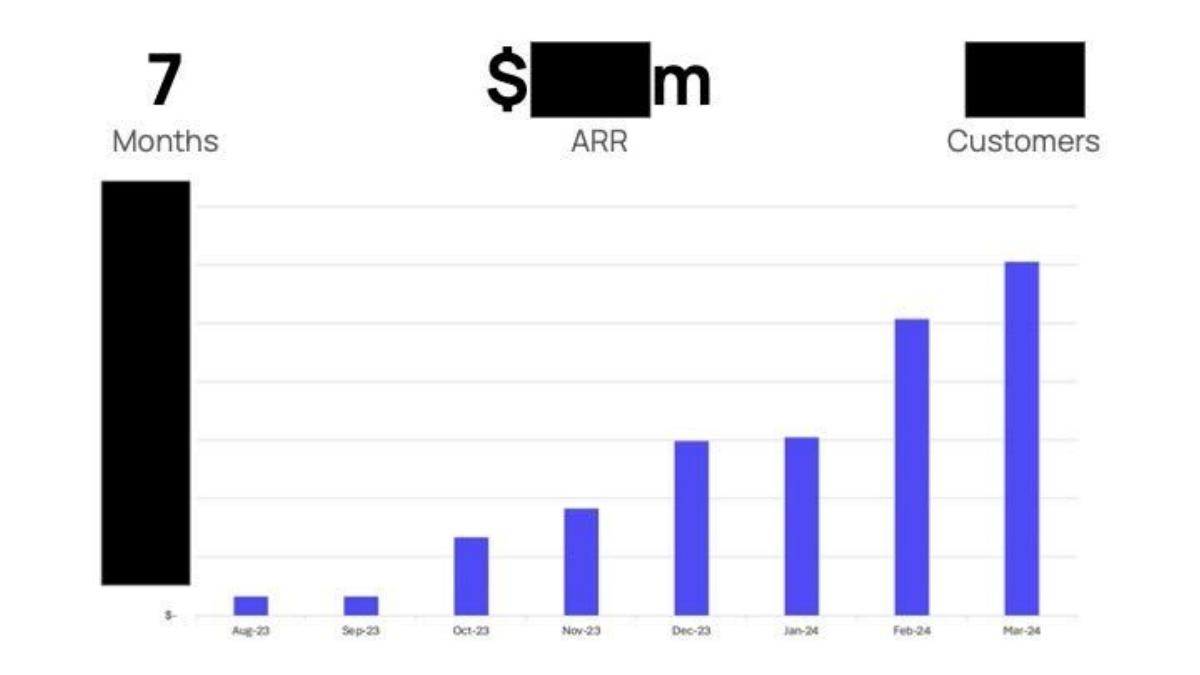
- The deck demonstrates extreme growth velocity, showing a revenue chart spanning only 7 months from August 2023 to March 2024 (Slide 2).
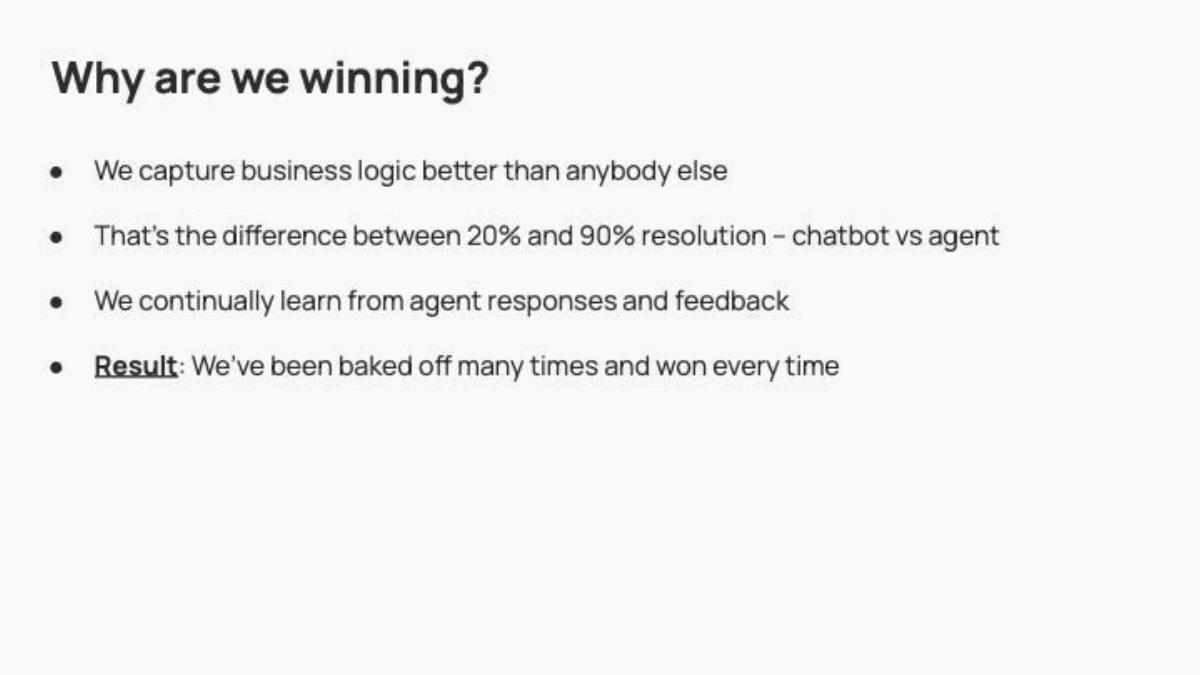
- Decagon differentiates its product by framing it as an 'agent' rather than a 'chatbot,' citing a resolution rate delta of 70% (Slide 4).
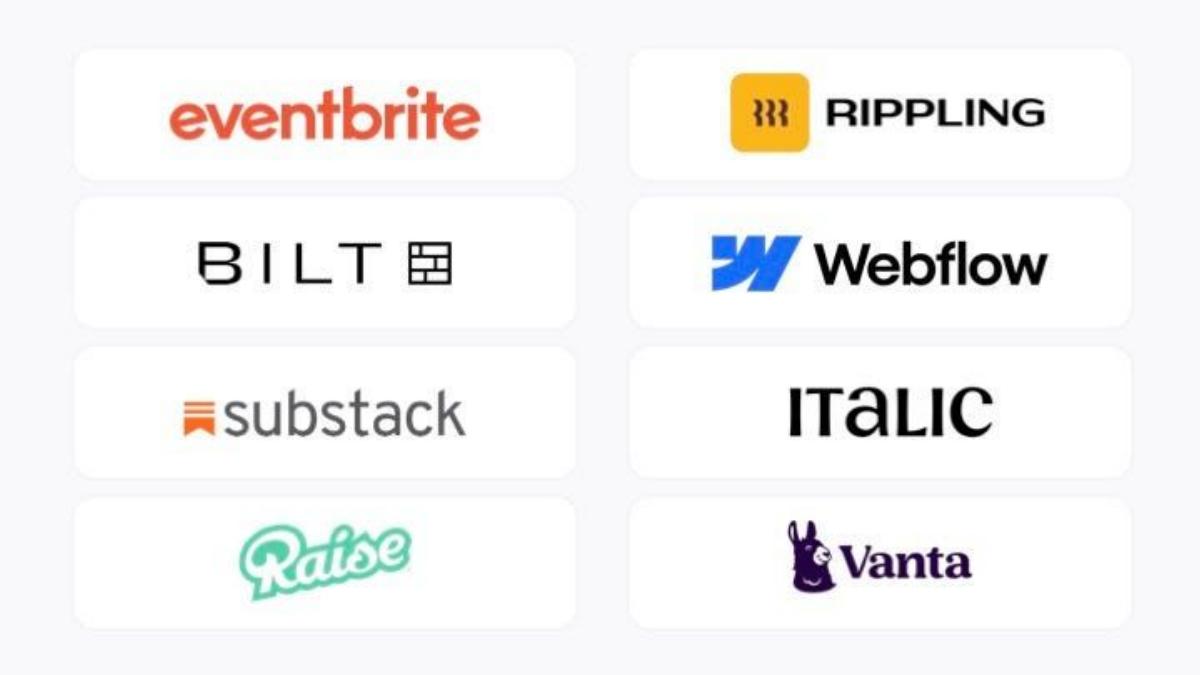
- The company leverages heavy social proof with a logo wall featuring enterprise-grade startups like Eventbrite, Rippling, and Webflow (Slide 3).
- The founders emphasize their technical pedigree, noting previous acquisitions by Niantic and Scale AI, alongside Math and Science Olympiad wins (Slide 7).
- Customer success is quantified through specific case studies for Substack and BILT, focusing on agent headcount savings and resolution rates (Slides 8 and 9).
- The deck lacks a traditional 'Ask' slide, financial projections, or a competitive landscape matrix, relying instead on the 'we won every bake-off' claim (Slide 4).
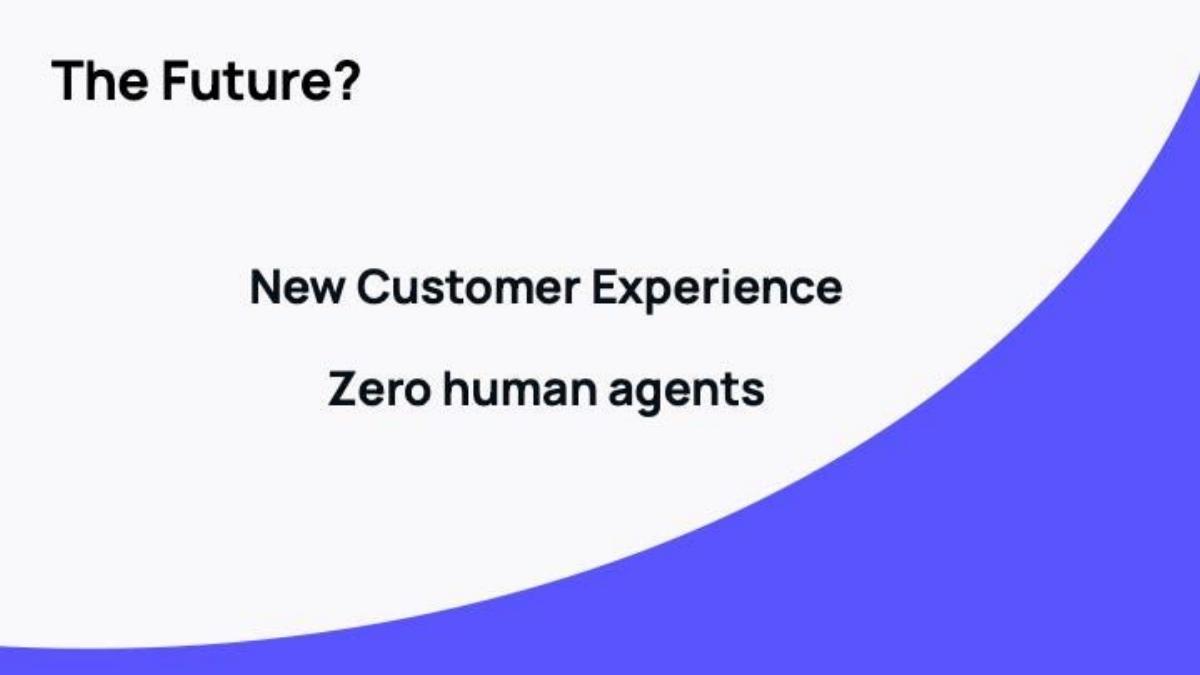
- The vision is aggressively stated as a future with 'Zero human agents' (Slide 6).
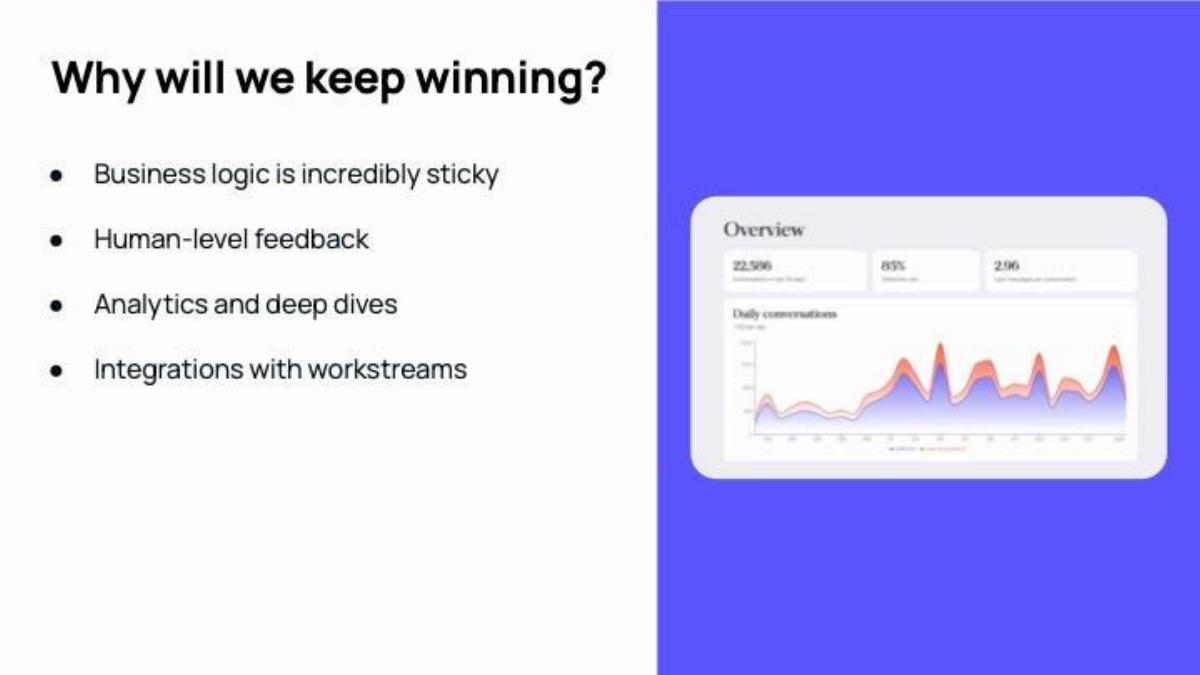
- Product stickiness is attributed to the integration of complex business logic and human-level feedback loops (Slide 5).
The Power of Momentum: Decagon's 10-Slide Series A
Decagon’s pitch deck is a clear example of 'traction-first' fundraising. In a crowded generative AI market, the company raised $35M in 2024 (as reported by Business Insider) by focusing on one thing: proof. The deck does not spend time educating the investor on why AI is important; it assumes that knowledge and instead presents a relentless sequence of growth charts, customer logos, and case studies. This is a deck designed for a hot market where execution speed is the primary differentiator.
Slide 1: The AI Customer Support Agent
The title slide is minimalist, featuring the company logo and the tagline 'The AI Customer Support Agent.' By using the word 'Agent' instead of 'Chatbot,' Decagon immediately signals a higher level of autonomy and capability. The branding is dark and professional, fitting for an enterprise-focused solution.
Slide 2: 7 Months of Hypergrowth
Slide 2 is the 'hook.' It displays a bar chart showing revenue growth from August 2023 to March 2024. Although the specific ARR and Customer counts are redacted in this version, the visual trend is unmistakable: a steep, consistent climb. The slide highlights '7 Months,' emphasizing how quickly they reached their current scale. For a Series A, this level of velocity is often more important than the absolute dollar amount, as it suggests a product that the market is pulling rather than one the founders are pushing.
Slide 3: Enterprise-Grade Social Proof
The third slide is a logo wall. It includes Eventbrite, Rippling, BILT, Webflow, Substack, Italic, Raise, and Vanta. This is a sophisticated list of customers; these are not small businesses, but high-growth, technically-literate companies. Securing Rippling and Vanta as customers early on suggests that Decagon’s security and integration capabilities meet high enterprise standards.
Slide 4: The 'Why We Are Winning' Thesis
Slide 4 addresses the competitive landscape without showing a single competitor. It claims that Decagon captures 'business logic better than anybody else.' The most compelling point on this slide is the distinction between a 20% resolution rate (chatbot) and a 90% resolution rate (agent). This 70% difference is the core of their value proposition. The slide concludes with a bold claim: 'We’ve been baked off many times and won every time,' which directly challenges any investor doubts about competition from incumbents or other startups.
Slide 5: Defensibility and Stickiness
Titled 'Why will we keep winning?', this slide focuses on the 'moat.' Decagon argues that business logic is 'incredibly sticky.' Once an AI agent is integrated into a company’s specific workflows and has learned from 'human-level feedback,' it becomes difficult to replace. The slide includes a small UI mockup showing an overview dashboard with metrics like 'Deflection rate' (85%) and 'Messages per conversation' (2.96), providing a glimpse into the product's analytical depth.
Slide 6: The North Star Vision
Slide 6 is the vision slide. It is sparse, containing only two phrases: 'New Customer Experience' and 'Zero human agents.' This is a provocative goal. While most companies talk about 'augmenting' humans, Decagon is explicitly targeting the total automation of the support function. This 'Zero human agents' vision is what justifies a high valuation and a large Series A round, as it implies a massive shift in the cost structure of enterprise support.
Slide 7: The Pedigree Slide
The team slide (Slide 7) is exceptionally strong. CEO Jesse Zhang and CTO Ashwin Sreenivas are presented not just as founders, but as proven winners. The slide notes that Zhang’s previous company, Lowkey, was acquired by Niantic, and Sreenivas’s previous company, Helia, was acquired by Scale AI. They also highlight 'USA Math Olympiad Winner' and 'International Science Olympiad Winner' credentials. This combination of entrepreneurial success and elite technical talent significantly de-risks the investment for a Series A lead.
Slide 8 & 9: Quantified Case Studies
Slides 8 and 9 provide deep dives into Substack and BILT. These slides follow a consistent format: specific metrics on the left and a quote from a high-level executive on the right. For Substack, they mention 'fully conversational cancellation/refund flows' and a quote from CEO Chris Best. For BILT, they highlight 'extremely complicated data' and 'agent headcount saved.' By showing that they can handle complex tasks like refunds and complicated data sets, they prove the 'Agent' thesis they proposed on Slide 4.
Slide 10: Conclusion
The final slide is a simple 'Thank you' with the company logo. It mirrors the title slide, maintaining a clean, professional aesthetic throughout the presentation.
What Decagon Does Exceptionally Well
Focus on Resolution: In the AI support space, the only metric that truly matters to a CFO is the resolution rate. Decagon puts the '90% resolution' figure front and center, contrasting it against the '20%' industry standard. This makes the ROI calculation for a potential customer (and investor) trivial.
Speed as a Feature: By highlighting that their growth occurred in just 7 months, they create a sense of urgency. Investors are often more afraid of missing a rocket ship than they are of a specific technical risk. The timeline on Slide 2 is designed to trigger that FOMO (Fear Of Missing Out).
Executive Endorsements: Having quotes from the CEO of Substack and the VP of Client Solutions at BILT is far more powerful than generic testimonials. It shows that Decagon is solving problems that are visible at the highest levels of their customer organizations.
What Is Missing from the Deck
The 'How': The deck is very light on technical architecture. While they mention 'capturing business logic,' they don't explain how their RAG (Retrieval-Augmented Generation) or agentic workflows differ from a standard OpenAI wrapper. For a $35M round, investors likely did deep technical due diligence that isn't reflected in these slides.
Market Sizing: There is no TAM/SAM/SOM slide. Decagon likely assumes that investors already know the customer support market is multi-billion dollar and that AI will eat a significant portion of it. However, for a less specialized investor, the lack of market context might be a hurdle.
Unit Economics and Pricing: The deck doesn't explain how they charge. Is it per resolved ticket, per seat, or a flat enterprise fee? Understanding the pricing model is key to determining if the revenue growth on Slide 2 is sustainable and high-margin.
Lessons for Founders
Traction Trumps Everything: If you have a chart that looks like Slide 2, you don't need 30 slides. You can afford to be brief because the data speaks for itself. · Sell the 'Agent,' Not the 'Bot': The market is tired of chatbots that don't work. By framing their product as an 'Agent' and backing it up with high resolution rates, Decagon distances itself from the failures of the previous generation of AI. · Leverage Your Pedigree: If you have won Olympiads or sold companies before, put it on the slide. In the early stages of a new technology cycle, investors bet on the 'smartest people in the room.' · Use Case Studies to Prove Complexity: Don't just say your AI is smart. Show it doing something hard, like 'fully conversational cancellation/refund flows.' This proves the AI can handle logic, not just text generation.
Frequently asked questions
- What is the primary metric Decagon uses to prove product-market fit?
- Decagon focuses on the 'resolution rate.' On Slide 4, they contrast a standard 20% resolution rate for traditional chatbots against their 90% resolution rate for AI agents. This 70% gap serves as their primary evidence of technical superiority and value creation for enterprise clients.
- How does the team slide contribute to the fundraise?
- Slide 7 is a high-signal team slide. It highlights that both founders are repeat entrepreneurs with successful exits (Lowkey to Niantic and Helia to Scale AI). Furthermore, it lists 'Olympiad Winner' credentials for both, signaling elite technical competency to Series A investors.
- Why is the revenue chart on Slide 2 significant?
- The chart shows a near-vertical growth trajectory over a very short window (7 months). By showing consistent month-over-month increases from August 2023 to March 2024, Decagon proves they have solved the 'cold start' problem and are in a period of rapid scaling.
- What is missing from this deck that is usually in a Series A pitch?
- This deck is notably missing a Market Size (TAM) slide, a Competitor Matrix, and a use-of-funds slide. It assumes the investor already understands the massive potential of the AI support market and focuses entirely on Decagon's specific traction and team quality.
- How does Decagon define their competitive advantage?
- According to Slide 4 and 5, their advantage is the ability to 'capture business logic better than anybody else.' They argue that this logic is 'incredibly sticky' and, when combined with human-level feedback and workstream integrations, creates a defensive moat against generic LLM wrappers.