The 2014 Dealroom deck presents a clear value proposition: automating the highly manual and inefficient process of venture capital deal sourcing. By positioning themselves as the 'most complete & granular tech company database outside USA,' Dealroom identified a specific geographic and functional gap in the market. The deck focuses heavily on the 'matching system' between companies and investors, utilizing a KPI-driven approach to reduce the 'low hit-rate' of initial contacts. While the provided slides lack specific financial projections or a detailed team breakdown, they effectively communic…
Key takeaways
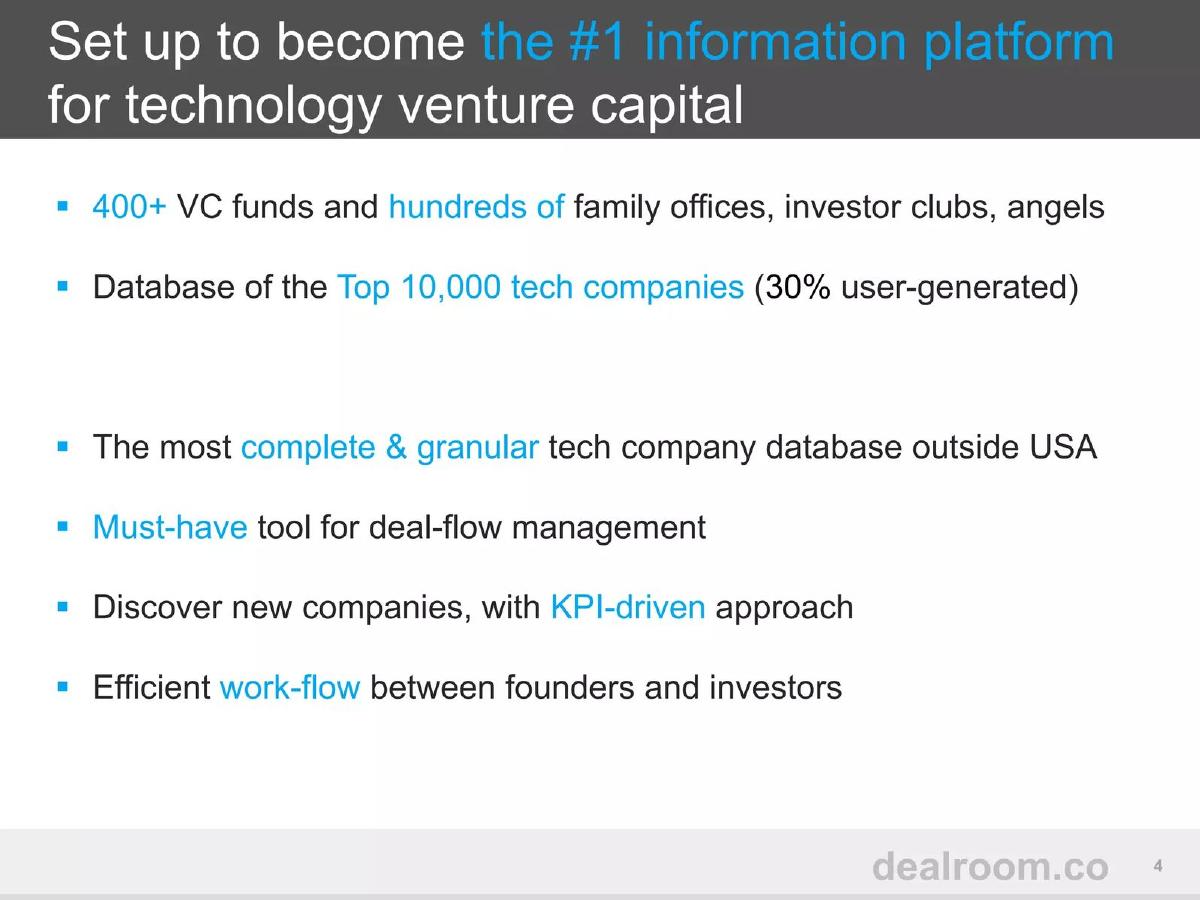
- Dealroom claimed a database of the top 10,000 tech companies, with 30% of that data being user-generated (Slide 4).
- The platform targeted 400+ VC funds and hundreds of family offices and angel investors at the time of the deck (Slide 4).
- The problem statement identifies 'fishing for information' and 'low hit-rates' as primary market inefficiencies (Slide 7).
- Automation of the intermediary role is the core solution proposed to replace manual cold-calling and conferences (Slide 10).
- The matching system uses specific data points like cheque size ($10-25M), revenue model, and employee count (Slide 13).
- The product includes a secure 'dealroom' feature for companies to share confidential PDFs, Excel models, and term sheets (Slide 16).
- The platform facilitates syndication, allowing lead investors to solicit co-investors for specific amounts, such as a €2M gap (Slide 19).
- Dealroom explicitly positioned itself as the leader for tech data 'outside USA,' acknowledging the dominance of US-centric incumbents (Slide 4).
Introduction: The Quest for Data-Driven Venture Capital
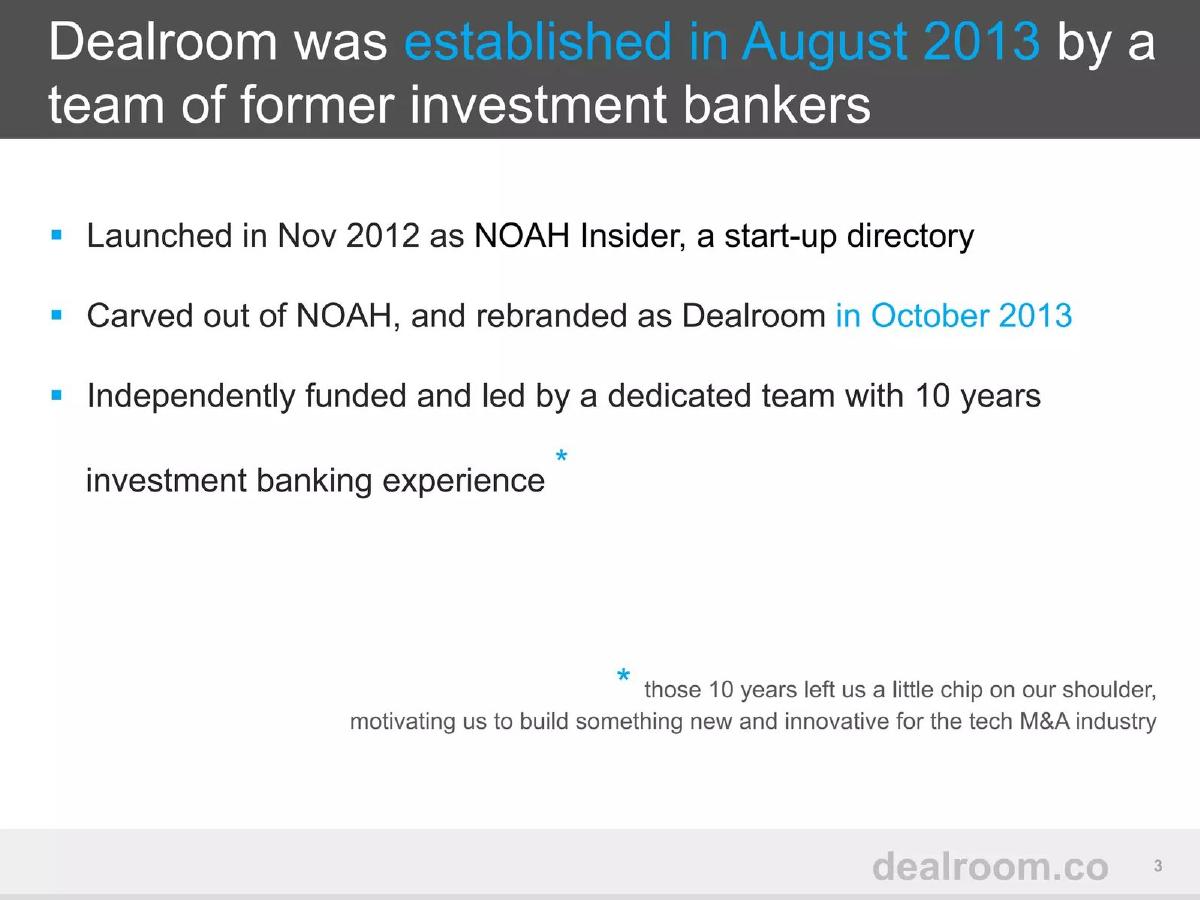
The 2014 Dealroom deck is a artifact from a time when the 'European tech scene' was beginning to institutionalize. While the US had established players like Crunchbase and AngelList, Europe lacked a unified, data-rich platform to track its fragmented markets. This deck, labeled as a 'Public Version' from March 2014, sets out to solve the information asymmetry that plagued non-US venture capital. It is a product-heavy presentation that focuses on utility, workflow, and the transition from manual 'intermediaries' to automated platforms.
Slide 1: Title and Positioning
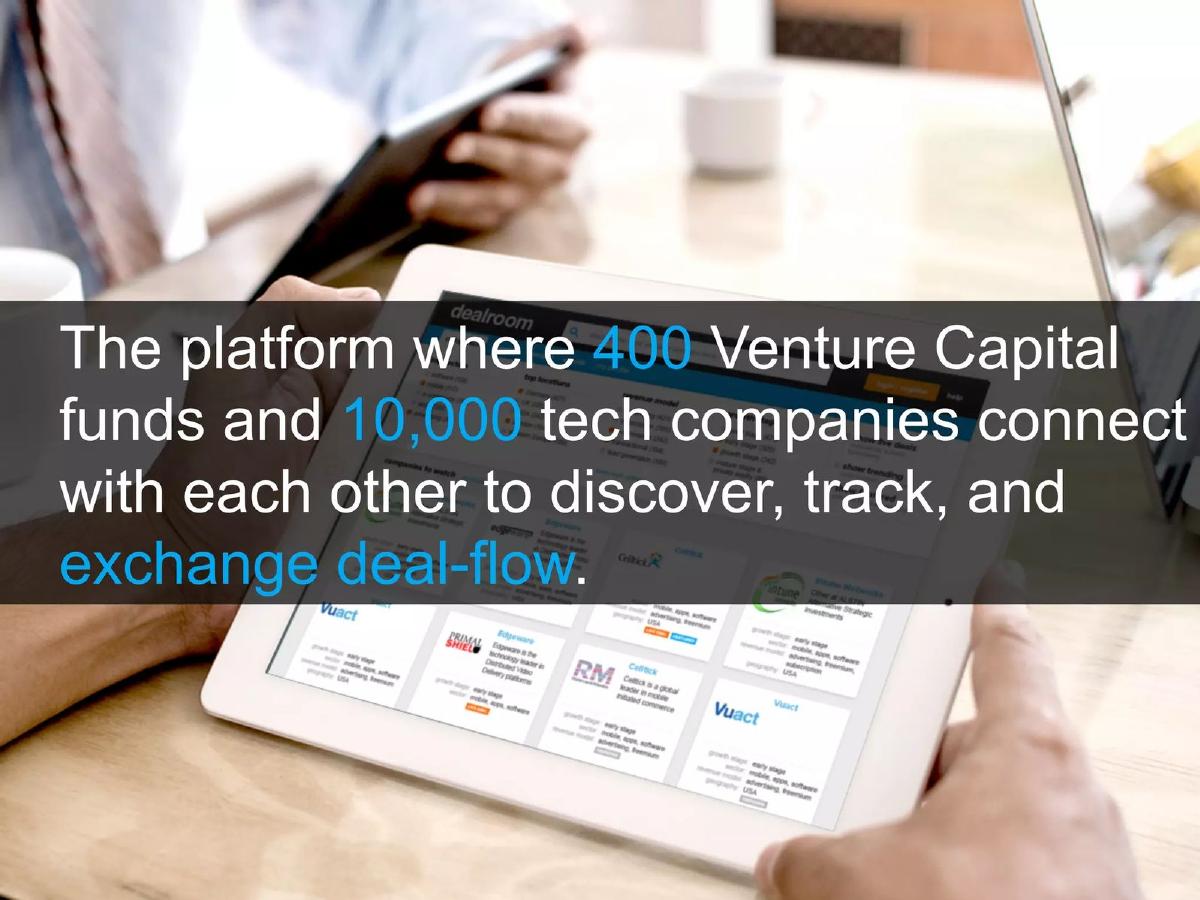
The cover slide establishes a clean, professional brand. The tagline, 'Discover, track, connect and share data,' covers the entire lifecycle of a deal, from initial sourcing to the closing of a round. By dating the deck 'March, 2014,' the company provides a snapshot of their progress at a specific moment in the growth of the European ecosystem. The background image of a tablet displaying the platform emphasizes that this is a live, functional product rather than a theoretical concept.
Slide 4: The Value Proposition
Slide 4 is the 'meat' of the early presentation. It makes several bold claims to establish credibility. First, it cites a reach of '400+ VC funds and hundreds of family offices.' This demonstrates that they already have the 'demand' side of the marketplace. Second, it quantifies the 'supply' side with a 'Database of the Top 10,000 tech companies.' A crucial detail here is that '30% [is] user-generated,' suggesting a community-driven data moat. The most important strategic statement is the claim to be the 'most complete & granular tech company database outside USA.' This is a classic 'niche down to scale up' strategy, acknowledging US competition while claiming ownership of the rest of the world.
Slide 7: Identifying Market Inefficiencies
This slide addresses the 'Why now?' and 'Why this?' questions. It lists three pain points: fishing for information (cold-calling and conferences), poor fit/timing (wasted meetings), and low hit-rates . By using the phrase 'most market participants will readily identify with,' Dealroom is signaling that they understand the daily frustrations of their target users. This slide sets the stage for the 'automation' solution that follows.
Slide 10: The Role of Automation
Slide 10 serves as a transition. It argues that the biggest opportunity for change is replacing traditional 'intermediaries' (like manual brokers or expensive consultants) with 'much needed automation.' The visual background shows the Dealroom interface on a tablet, reinforcing the idea that the software is the new intermediary. It promises a shift from high-touch, low-efficiency human processes to low-touch, high-efficiency digital ones.
Slide 13: The Matching System
This is the most technical slide in the deck, explaining the logic of the platform. It shows a two-sided marketplace. On the 'Company' side, data points include sector (online travel), stage (late growth), model (subscription), and location (Madrid). On the 'Investment Fund' side, it tracks cheque size ($10-25M), investment type (minority), and focus (European). The 'dealroom' cloud in the center represents the 'Algorithmic matching' that connects these two specific profiles. This slide is effective because it moves beyond 'we have a database' to 'we have a system that creates value through relevance.'
Slide 16: Secure Data Disclosure
Moving further down the funnel, Slide 16 introduces the 'secure dealroom.' This feature allows a company to share 'confidential info' with a 'selected sub-set of potential investors.' The slide lists specific file types: trading updates, investor decks, financial models, and term sheets. This is a critical product feature because it keeps users on the platform after the initial discovery phase. It transforms Dealroom from a search engine into a transaction tool.
Slide 19: Syndication and Co-investment
Slide 19 focuses on the investor-to-investor relationship. It illustrates how a lead investor can use the platform to 'syndicate larger deals out.' The example given is a lead investor putting in €500K and looking for co-investors to fill a €2M gap. This highlights the network effects of the platform; the more investors are on Dealroom, the easier it is for them to close rounds together. This feature targets the 'Pool of Co-Investors,' further increasing the platform's stickiness.
Slide 22: Call to Action
The final slide is a standard contact page. It repeats the background imagery of the platform to keep the product top-of-mind and provides a generic 'team@dealroom.co' email address. As a 'Public Version,' it avoids specific names, likely to protect the founders from unsolicited outreach while the deck was being circulated in wider circles.
What Works in the Dealroom Deck
Clear Geographic Focus: By explicitly stating they are the leader 'outside USA,' they avoid a direct comparison to Silicon Valley giants and focus on the underserved European market. · Product-Led Storytelling: The deck spends a lot of time showing how the product actually works (matching, data rooms, syndication) rather than just talking about how big the market is. · Quantified Traction: Citing 400+ VC funds and 10,000 companies gives the reader a sense of the platform's scale in 2014. · Logical Flow: The deck moves logically from the problem (inefficiency) to the solution (automation) to the specific features (matching and data rooms).
What is Missing from the Dealroom Deck
The Team: There is no mention of the founders or their backgrounds. In venture capital, the 'who' is often as important as the 'what.' · Business Model: The deck mentions 'revenue model' as a data point for startups, but it doesn't explain how Dealroom itself makes money (SaaS fees, transaction fees, etc.). · Financials and Ask: There are no historical growth charts, burn rate figures, or a specific request for capital. This is likely because this is the 'Public Version' of the deck. · Competitor Analysis: While they mention being the best 'outside USA,' they don't name specific competitors or explain how they will defend their data against new entrants.
Lessons for Founders
1. Own a specific geography or niche. Dealroom didn't try to be the global leader on day one. They identified that the US was covered but the rest of the world was a 'mess' of fragmented data. Founders should look for similar 'geographic gaps' in established categories.
2. Show the 'How.' Many decks stay at the 30,000-foot level. Dealroom’s Slide 13, showing the specific data points used for matching, makes the 'algorithm' feel real and tangible rather than like a buzzword.
3. Build for the whole lifecycle. Dealroom didn't just build a search engine; they built a data room and a syndication tool. By solving problems at multiple stages of the fundraising process, they increased the likelihood that users would stay on the platform.
4. Use 'Public Versions' wisely. If you are sharing your deck widely, it is smart to remove sensitive financial data and specific 'asks' as Dealroom did here. This allows the deck to act as a marketing tool without giving away the 'crown jewels' of your financial strategy.
Frequently asked questions
- What was Dealroom's primary competitive advantage in 2014?
- According to Slide 4, their advantage was geographic and data-specific. They claimed to have the 'most complete & granular tech company database outside USA.' By focusing on the European and international markets where US-centric databases were less comprehensive, they carved out a niche as a 'must-have tool' for non-US deal flow management.
- How does the platform handle data privacy for startups?
- Slide 16 details a 'secure dealroom' feature. This allows companies to disclose confidential information—such as financial models, KPIs, and term sheets—only to a 'selected sub-set of potential investors.' This indicates the platform was designed to move beyond public discovery into the actual due diligence phase of fundraising.
- What specific inefficiencies in the VC market does Dealroom aim to solve?
- Slide 7 lists three main pain points: time wasted on 'fishing for information' (manual sourcing), meetings that are a poor fit or poorly timed, and a 'low hit-rate' where very few initial contacts result in a closed deal. The deck argues that these are problems 'most market participants will readily identify with.'
- Does the deck provide information on the founding team or financials?
- No. The provided slides focus entirely on the product, the market problem, and the matching mechanism. There are no slides detailing the founders' backgrounds, current revenue, burn rate, or specific funding ask. This is common in 'public versions' of decks used for general interest or early-stage networking.
- How does the matching algorithm work according to the deck?
- Slide 13 illustrates a two-sided matching system. For companies, it tracks metrics like sector (e.g., online travel), stage, employee count, and headquarters. For investors, it tracks investment criteria like cheque size ($10-25M), geographic focus (e.g., Europe), and industry expertise. The 'dealroom' acts as the algorithmic bridge between these two data sets.