ValidMind’s 12-slide deck successfully secured an $8.1M Seed round by positioning itself at the intersection of two massive trends: the explosion of generative AI and the tightening of global AI regulations. The deck identifies a specific, high-value pain point in financial services, where manual model documentation consumes up to 70% of developer time. By quantifying the problem—projecting a 3x increase in AI risk management spend for mid-size banks by 2027—ValidMind creates a sense of urgency. The solution is presented as a developer-centric framework that automates documentation, backed by…
Key takeaways
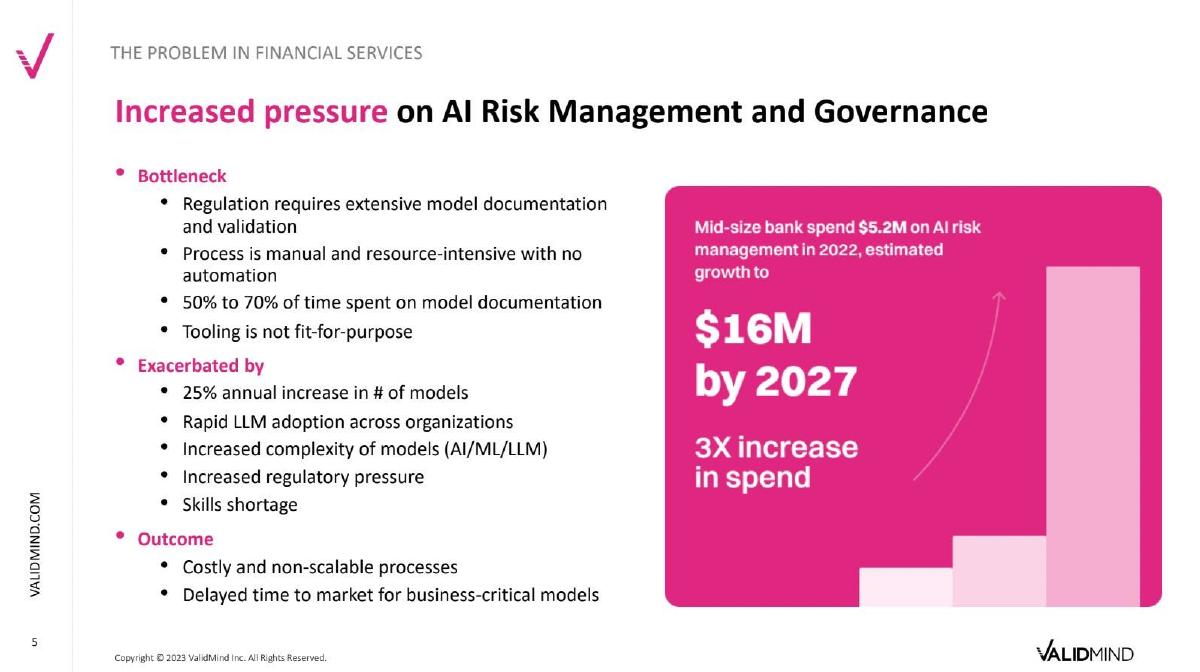
- The deck identifies a massive efficiency gap, noting that 50% to 70% of developer time is currently spent on manual model documentation (Slide 5).
- ValidMind projects that mid-size bank spend on AI risk management will grow from $5.2M in 2022 to $16M by 2027 (Slide 5).
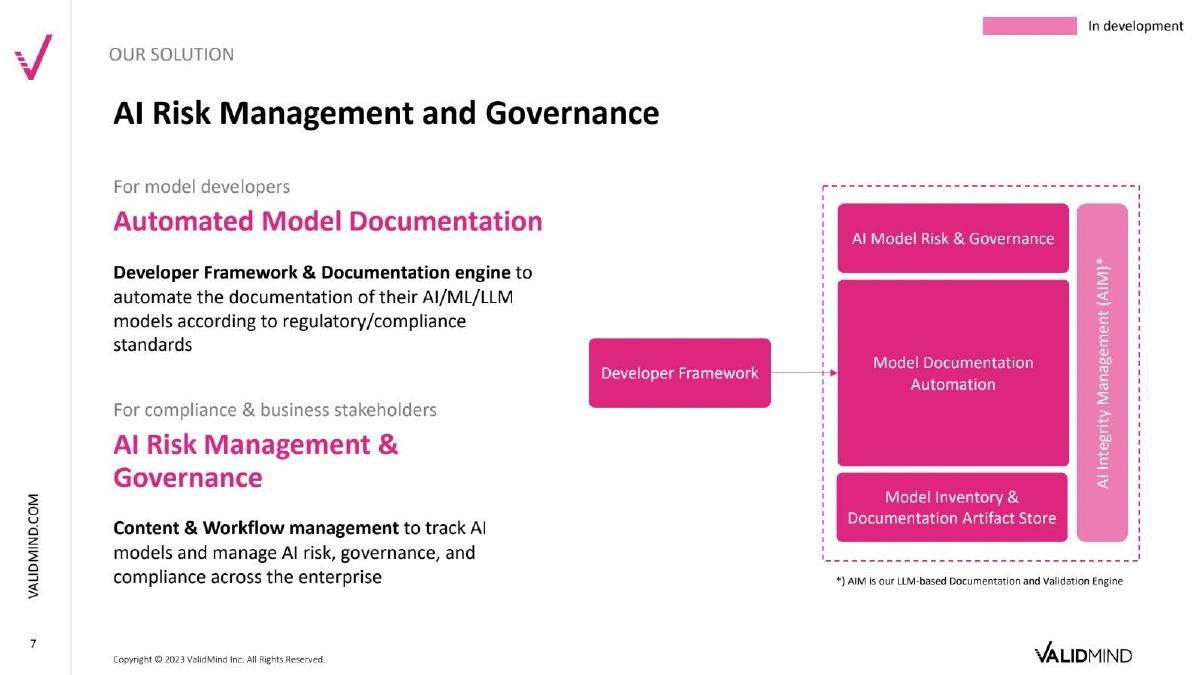
- The solution is bifurcated into a developer framework for automation and a management console for compliance stakeholders (Slide 7).
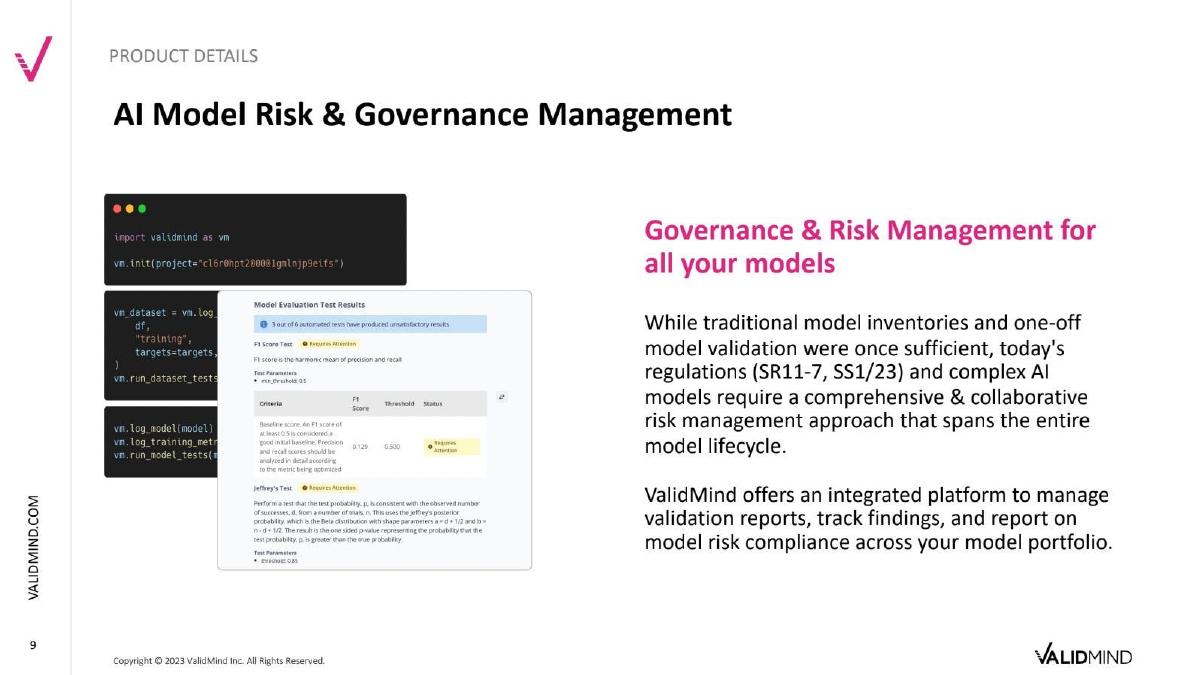
- The product integrates directly into the developer workflow, as shown by code snippets for initializing projects and running dataset tests (Slide 9).
- The company targets specific regulatory standards such as SR11-7 and SS1/23 to establish credibility within the financial sector (Slide 9).
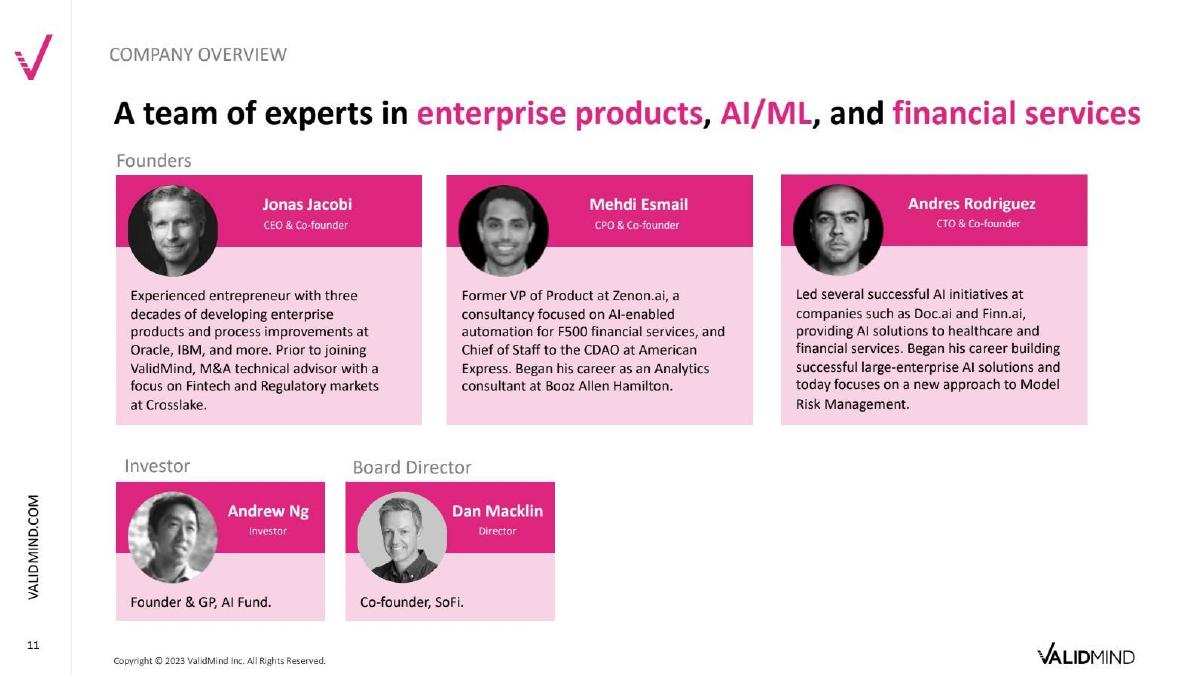
- The team slide highlights significant enterprise experience at Oracle and IBM, alongside high-profile backing from Andrew Ng (Slide 11).
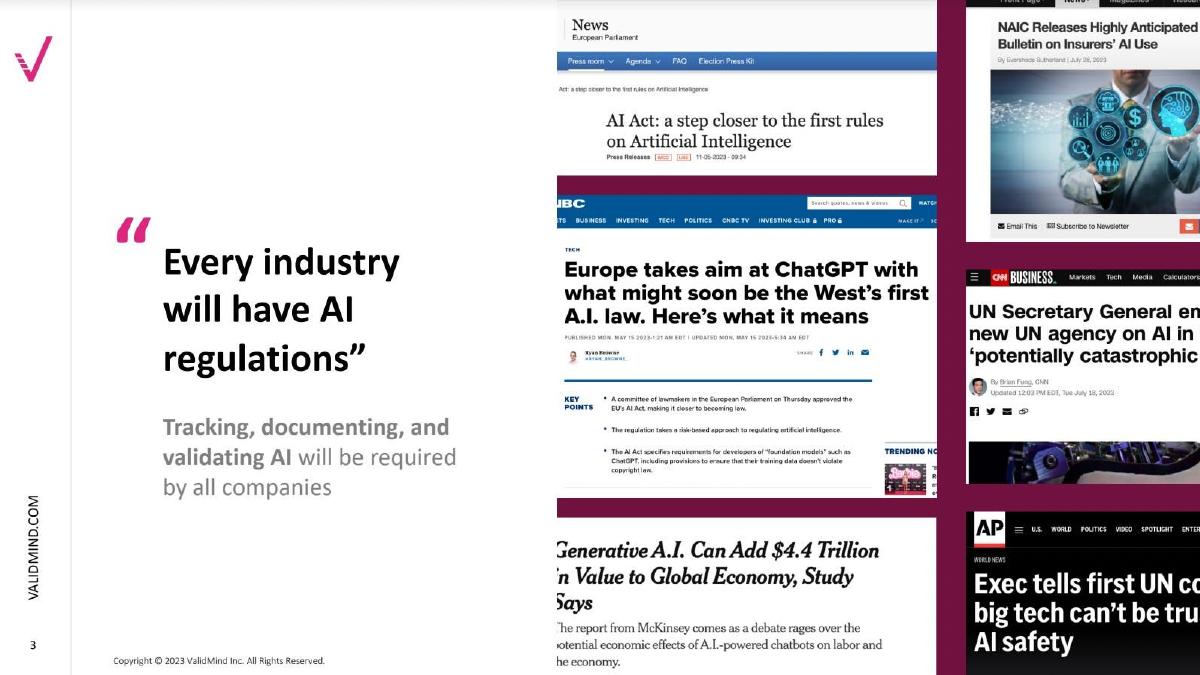
- The deck leans heavily on external validation from news sources like CNBC and the UN to justify the 'why now' of AI regulation (Slide 3).
- There is no explicit 'Ask' slide or financial projection beyond the market-level spending estimates in the provided materials.
ValidMind: Navigating the Regulatory Storm in AI
ValidMind’s Seed deck is a masterclass in 'Why Now' positioning. As reported by Business Insider, the company raised $8.1M in 2024, a period characterized by intense scrutiny of AI safety and the emergence of the EU AI Act. The deck does not just sell a tool; it sells a solution to a looming regulatory crisis that threatens to paralyze innovation in the financial sector. By focusing on the friction between developers and compliance officers, ValidMind identifies a high-friction workflow that is ripe for automation.
Slide 1-2: Branding and Simplification
The deck opens with a minimalist aesthetic, using a bold magenta color palette. The tagline 'AI Risk Management. Simplified.' immediately communicates the value proposition. In a field as complex as AI governance, promising simplicity is a strong hook for both investors and potential enterprise customers. The branding is professional and consistent with modern SaaS aesthetics.
Slide 3: The Macro Environment
Slide 3 uses a collage of headlines from CNBC, AP, and the UN to establish the inevitability of AI regulation. The central quote, 'Every industry will have AI regulations,' serves as the foundation for the entire business case. By citing the EU AI Act and McKinsey’s $4.4 trillion value projection for Generative AI, the deck frames the problem not as a niche fintech issue, but as a global economic shift. This slide effectively creates a sense of urgency, suggesting that companies who do not adopt tracking and documentation tools will be left behind or legally exposed.
Slide 5: The Financial Services Bottleneck
This is arguably the most important slide in the deck. It zooms in from the global macro view to the specific pain points in financial services. ValidMind identifies that 50% to 70% of developer time is currently wasted on manual model documentation. This is a staggering efficiency loss for high-priced talent. The slide also provides a concrete market size metric: mid-size banks are expected to see a 3x increase in AI risk management spend, reaching $16M by 2027. By quantifying the 'Outcome' as 'delayed time to market for business-critical models,' ValidMind connects compliance directly to revenue loss.
Slide 7: The Two-Sided Solution
Slide 7 breaks down the product into two distinct modules. For model developers, it offers an 'Automated Model Documentation' engine. For compliance and business stakeholders, it offers a 'Content & Workflow management' platform. This dual approach is critical in enterprise sales, where the person using the tool (the developer) is often different from the person paying for it (the Chief Risk Officer). The mention of 'AIM,' an LLM-based documentation and validation engine, shows that ValidMind is using the very technology it seeks to regulate to solve the problem.
Slide 9: Technical Integration and Credibility
Slide 9 moves from high-level concepts to product reality. It shows a code snippet, which is vital for proving to technical investors that this is a 'developer-first' tool rather than just another management dashboard. The inclusion of specific regulatory codes like SR11-7 and SS1/23 demonstrates deep domain expertise. It shows that the founders understand the specific language of bank regulators, which is a significant barrier to entry for generic AI safety startups.
Slide 11: The Pedigree Slide
The team slide is exceptionally strong for a Seed round. CEO Jonas Jacobi brings 'three decades' of experience from Oracle and IBM. CPO Mehdi Esmail adds financial services depth from American Express. CTO Andres Rodriguez provides the AI/ML technical leadership. Perhaps most importantly, the slide features Andrew Ng as an investor and Dan Macklin (SoFi co-founder) as a director. In the world of AI, an endorsement from Andrew Ng carries immense weight and serves as a proxy for technical due diligence.
What ValidMind Does Well
ValidMind excels at identifying a 'hair-on-fire' problem. In banking, model risk management (MRM) is not optional; it is a regulatory requirement. By highlighting that developers spend up to 70% of their time on documentation, they have found a way to pitch a compliance tool as a productivity tool. This is a much easier sell to a CTO. Furthermore, the deck is visually clean and avoids the 'wall of text' trap, using clear headers and bolded statistics to guide the reader through the narrative.
What is Missing from the Deck
Despite its strengths, the deck leaves several questions unanswered. There is no slide dedicated to the competitive landscape. While the problem is clear, it is not immediately obvious how ValidMind differentiates itself from legacy GRC (Governance, Risk, and Compliance) players or newer AI observability startups. Additionally, the deck lacks a 'Traction' slide. While we know they raised $8.1M, the slides provided do not disclose current revenue, pilot programs, or the number of banks currently using the platform. Finally, there is no 'Ask' slide in this version, leaving the specific use of funds to the imagination.
Founder Takeaways: How to Copy ValidMind
Quantify the Waste: If your product saves time, tell the investor exactly how much time is being wasted today. ValidMind’s '50% to 70%' stat is a compelling reason to act (Slide 5). · Bridge the Gap: If your tool has two different users (e.g., developers and managers), show how the product serves both. ValidMind’s split solution on Slide 7 is a great example of addressing the 'user vs. buyer' dynamic. · Use Regulatory Tailwinds: If your industry is facing new laws, use them as your 'Why Now.' ValidMind uses the EU AI Act to turn a 'nice-to-have' tool into a 'must-have' (Slide 3). · Show, Don't Just Tell: Including a code snippet or a screenshot of a test result (Slide 9) builds immediate technical credibility that a marketing diagram cannot match. · Leverage Your 'Names': If you have a high-profile investor or board member, give them their own space on the team slide. It acts as a powerful signal of quality (Slide 11).
Frequently asked questions
- What specific problem does ValidMind solve for banks?
- ValidMind addresses the 'bottleneck' of AI model documentation. According to Slide 5, financial institutions face a manual, resource-intensive process where 50% to 70% of a developer's time is wasted on documentation rather than building. This leads to costly, non-scalable processes and delayed time-to-market for business-critical AI models.
- How does the product actually work for developers?
- The product features a 'Developer Framework' that allows data scientists to automate documentation according to regulatory standards. Slide 9 shows a code-level integration where developers can import the 'validmind' library, initialize projects, and run automated tests on datasets and models directly within their existing coding environment.
- What is the projected market growth for AI risk management?
- ValidMind cites that a typical mid-size bank spent $5.2M on AI risk management in 2022. They estimate this will grow to $16M by 2027, representing a 3x increase in spend driven by a 25% annual increase in the number of models and rapid LLM adoption (Slide 5).
- Who are the key people behind ValidMind?
- The founding team includes CEO Jonas Jacobi (formerly Oracle and IBM), CPO Mehdi Esmail (formerly American Express and Booz Allen Hamilton), and CTO Andres Rodriguez. The deck also highlights investor Andrew Ng (Founder of AI Fund) and Board Director Dan Macklin (Co-founder of SoFi) on Slide 11.
- What regulatory standards does the platform support?
- Slide 9 specifically mentions that the platform helps manage compliance for regulations such as SR11-7 and SS1/23. These are critical standards in the financial services industry for model risk management, signaling that ValidMind is built for highly regulated enterprise environments.